1688 vs Alibaba for US Buyers: Real Price Gap & How to Buy
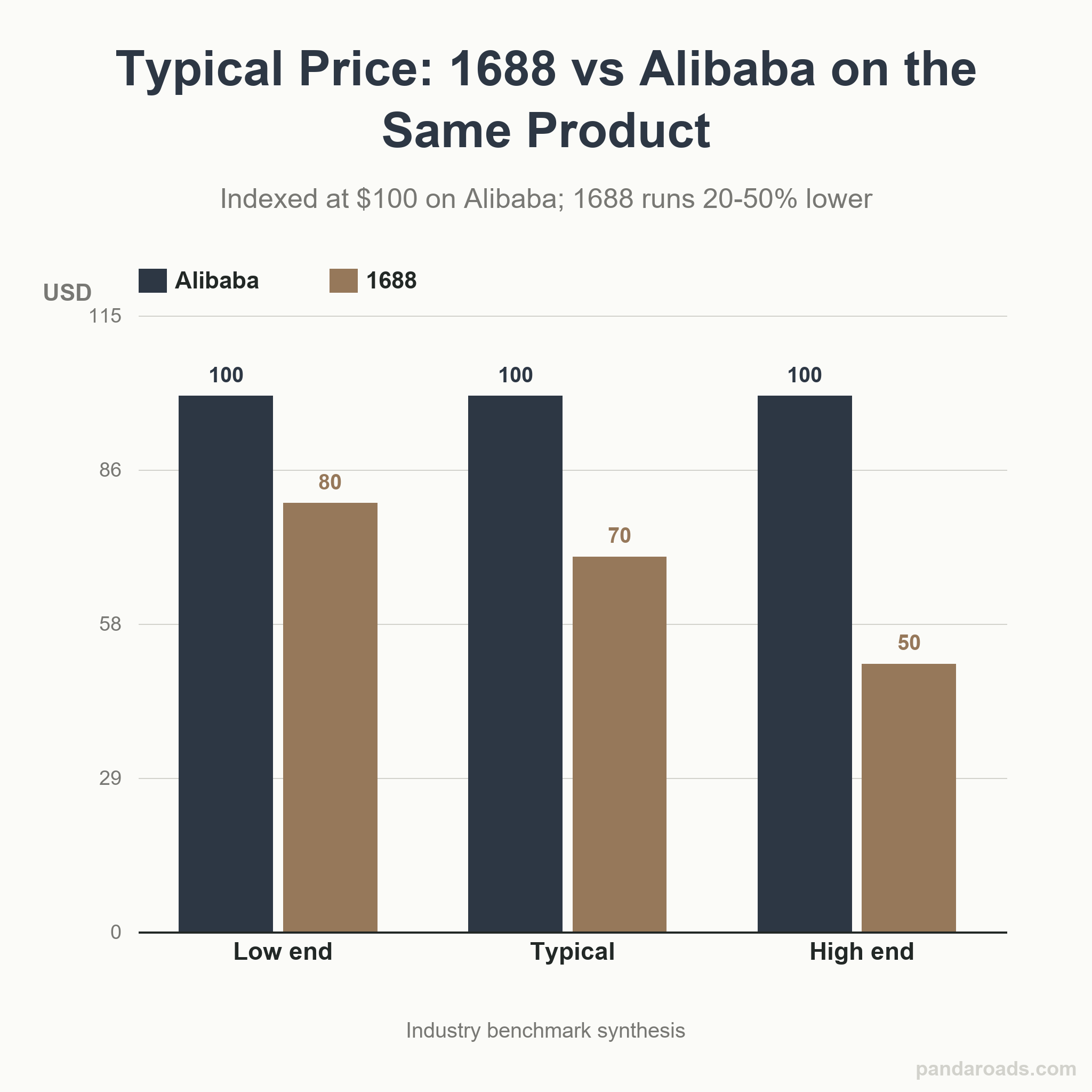
1688 is 20-50% cheaper for the same factory goods. Here is how US buyers capture that gap safely.
Last updated: August 2026 · By the PandaRoads team in China
Abstract
1688 sells the same Chinese factory goods 20-50% cheaper than Alibaba, but US buyers need translation, domestic payment and freight forwarding to capture the gap.
Key Takeaways
- 1688 prices run 20-50% below Alibaba for the same products
- 1688 targets domestic Chinese buyers; Alibaba targets exporters
- International cards on Alipay carry about a 3% fee
- A flat $129 per request covers a full 1688 price check
- Order size below $2,000 favors fixed-fee sourcing over commission
Table of Contents
- Abstract
- Key Takeaways
- Why the Same Factory Charges Different Prices
- 1688 vs Alibaba: The Side-by-Side Comparison
- What the 20-50% Gap Looks Like on Real Orders
- The Hidden Costs of Buying on 1688 from the US
- Step by Step: How to Buy from 1688 in the USA
- When Alibaba Still Makes Sense
- Frequently Asked Questions
- Conclusion
- References
TL;DR: Is 1688 Actually Cheaper Than Alibaba?
1688 is Alibaba Group's domestic Chinese wholesale marketplace, and the same factory products typically run 20-50% cheaper there than on Alibaba.com (toptradesourcing.com; worldfirst.com). Foreign buyers can use it, but they need translation tools, Alipay, and a freight forwarder (yiwuagent.com). International cards on Alipay carry about a 3% transaction fee (reddit r/travelchina). Commission agents charge 5-10% of order value; our published rate card is a flat $129 per price-check request, with $239 per on-site day.
Why the Same Factory Charges Different Prices
Two marketplaces, one group, same factories, very different price tags. The reason 1688 runs 20-50% below Alibaba for the same products (toptradesourcing.com) is that the two platforms sell to different buyers with different cost structures.
1688 is Alibaba Group's domestic Chinese wholesale platform. Its sellers compete for Chinese volume buyers, so prices reflect factory cost plus a thin domestic margin. Alibaba.com is the international export version: English listings, export pricing, trade services, and all the overhead of selling across borders (worldfirst.com). That overhead is not optional, it is priced in. Each quote carries English support, export paperwork, payment handling, and cross-border risk.
Language is the wall that keeps most US buyers on the expensive side. A Chinese buyer types the same product keyword into 1688 and sees prices an American importer never sees. Translation tools and an Alipay-compatible payment path remove that wall (yiwuagent.com), which is why foreign buyers now shop there directly.
The discount is not a quality discount. In many cases the seller on both platforms is the same factory and the product is identical, down to the product photos. What you give up on 1688 is the service bundle, not the goods: English support, escrow-style protection, export documents, and logistics hand-holding (yiwutrading.com). Strip those services out and the price drops, which is exactly what the 20-50% gap represents.
That is the whole mechanism. Cheap does not mean worse here. It means the export services are no longer bundled into the unit price. If you can supply those services yourself, or pay a fixed fee for them, the gap is yours to keep. Our $129 price check does exactly that: a Chinese-language search across 3-5 sellers, with MOQ details, delivered as an English report in 2 business days.
1688 vs Alibaba: The Side-by-Side Comparison
Line the two platforms up side by side and the difference is clear. Same group, same factories, different everything else (worldfirst.com).
| 1688 | Alibaba.com | |
|---|---|---|
| Platform | Alibaba Group's domestic Chinese wholesale site | The international export marketplace from the same group |
| Language | Chinese listings, Chinese seller communication | English listings with auto-translation |
| Pricing | Domestic wholesale, 20-50% lower for the same factory goods | Export pricing with trade services and overhead built in |
| Payment | Alipay, Chinese bank transfer, WeChat Pay | International cards, wire transfer, Alibaba Trade Assurance |
| Shipping | Domestic China only; buyer arranges a freight forwarder | Direct export quotes, sea and air, FOB and EXW terms |
| Buyer protection | None built in; seller reputation carries the risk | Trade Assurance escrow on eligible orders |
| Best for | Volume buyers with an agent, translator, or Chinese partner | Importers who need documents, escrow, or English end to end |
Platform and language. 1688 is the domestic version and it is fully Chinese: listings, search, messaging, customer service. Alibaba.com is built for export and speaks English out of the box (worldfirst.com). For a US buyer that is the first real cost of the cheap side: translating listings and messages, or paying someone to do it (yiwuagent.com). Everything else flows from that single fact: the domestic platform is cheaper because it never had to become international.
Pricing. This is the headline difference. The same factory products typically run 20-50% cheaper on 1688 than on Alibaba (toptradesourcing.com). Alibaba's export quotes bundle English support, trade services, and cross-border risk into the unit cost. On 1688, sellers fight for domestic volume with thinner margins and no export overhead. On a $1,000 Alibaba quote, the 20-50% range puts the 1688 equivalent between $500 and $800 before fees and freight.
Payment. 1688 is built around Alipay. International cards work but carry about a 3% fee (reddit r/travelchina); Chinese bank transfers and WeChat Pay also work if you have access. A US buyer eats that fee on every card payment, or routes payment through an agent who pays in CNY. Alibaba.com accepts international cards and wire transfers directly, and eligible orders are covered by Trade Assurance escrow, which holds the money until the order checks out. Alipay is Alibaba Group's digital wallet and the standard checkout inside 1688, the payment bridge a US buyer crosses to reach a domestic Chinese seller.
Shipping. 1688 only ships domestically inside China. Every order needs a freight forwarder who receives it, consolidates it with other packages, and sends it on to the US (yiwuagent.com). Domestic China delivery is cheap and fast, and consolidation turns several small packages into one efficient export shipment (yiwutrading.com). Alibaba.com sellers quote international freight directly, sea or air, usually on FOB or EXW terms, so you see the full shipping cost before you commit. On 1688, freight to the US is a separate forwarder quote, with duties handled at the US end either way.
Buyer protection. Alibaba's Trade Assurance is a real difference: escrow-backed refunds on eligible orders, with a dispute process behind them. 1688 has nothing equivalent for foreign buyers, so seller verification is the substitute. Check the seller's registration age and run a GSXT company check before paying (yiwutrading.com), because once the money moves, the platform will not referee for you. That verification step is the difference between a discount and a lesson; supplier scam patterns rarely survive a registration-age check. GSXT, the national enterprise credit information publicity system run by China's State Administration for Market Regulation, is the free public database where a seller's legal registration, business scope, and registration years can be verified.
Who should use which. Alibaba wins when you need export documents, escrow, warranty enforcement, or English support without a middleman. 1688 wins when you have volume, a Chinese-speaking partner, or an agent, and you want the 20-50% saving (toptradesourcing.com). Most US buyers land in the middle: they want 1688 prices but cannot do the Chinese-side work themselves. That is exactly the gap a fixed-fee sourcing agent fills, with a published rate card of $129 per request and $239 per on-site day.
What the 20-50% Gap Looks Like on Real Orders
Up front: we will not invent customer stories or fake invoices. What we can do is run the verified 20-50% range (toptradesourcing.com) through real order sizes. Treat the table as arithmetic on a published range, not a promise about any specific product; our report standards document how each figure is sourced. We built this table by applying the cited 20-50% range and 5-10% commission band to five order sizes, so every cell is reproducible from the references above.
| Alibaba order value | 1688 estimate (20-50% lower) | Gap in dollars | Fixed $129 price check | Commission agent (5-10%) |
|---|---|---|---|---|
| $500 | $250-$400 | $100-$250 | $129 | $25-$50 |
| $1,000 | $500-$800 | $200-$500 | $129 | $50-$100 |
| $2,500 | $1,250-$2,000 | $500-$1,250 | $129 | $125-$250 |
| $5,000 | $2,500-$4,000 | $1,000-$2,500 | $129 | $250-$500 |
| $10,000 | $5,000-$8,000 | $2,000-$5,000 | $129 | $500-$1,000 |
The gap scales. On a $1,000 order the savings range is $200-$500, enough to cover the $129 price check, the 3% Alipay fee, and most of the domestic leg (reddit r/travelchina). On a $10,000 order the gap can reach $5,000. The bigger the order, the more the platform choice matters, and the more a percentage-based agent earns from it.
The agent crossover. Commission at 5-10% crosses $129 somewhere between roughly $1,000 and $2,000 of order value. Below that, a fixed fee is the cheaper model; above it, commission wins on paper. But the services are not the same: the $129 flat request covers the seller search and comparison, plus verification, in 2 business days, with no percentage tied to your order (our rate card). Compare the fee and the scope, not just the number.
A worked midpoint. Try $1,200 on Alibaba with a 35% midpoint saving, in the middle of the verified range (toptradesourcing.com). The 1688 equivalent lands near $780, a $420 gap. Pay the $129 price check, budget $150-$250 for consolidation and freight through a forwarder (yiwuagent.com), add about 3% on the Alipay payment, and you are still ahead by about $50-$150 on the first order alone. Rerun the same product three times a year and the saving compounds.
What the $129 actually buys. A 1688 price check includes a Chinese-language search, 3-5 seller comparison, MOQ, registration years, and an English report, in 2 business days. On-site verification costs $239 per day. That is the whole published rate card. We are a small local team based in Chengdu, China, and we publish the full rate card so every number in this guide is checkable against a live page.
The honest caveat. The 20-50% range depends on product category, order size, and timing. Some products sit near the bottom, others near the top, and freight rates have moved a lot in recent years. A range is not a quote, which is why the price check exists: it pins your product to a real number from 3-5 sellers. Run the same arithmetic with your own quote before you commit. Contrary to what many first-time buyers assume, the platform with the higher unit price can be the cheaper total purchase for a small order, because Alibaba already bundles the translation, payment, and forwarding costs that 1688 leaves to you.
The Hidden Costs of Buying on 1688 from the US
The 20-50% headline is real, but it is not the final number. A stack of costs sits between a 1688 price and a delivered price, and honest buyers budget for all of them before they start.
The Alipay card fee, about 3%. International cards on Alipay carry roughly a 3% transaction fee (reddit r/travelchina). On a $1,000 purchase that is $30, small next to the gap, but it is a real line item on every order.
Translation and communication time. The listings are in Chinese, and so are the messages and the back-and-forth (yiwuagent.com). Do it yourself and every hour is a cost; delegate it and the fee replaces the time, which is one reason sourcing agents exist at all.
Domestic logistics and consolidation. 1688 ships only inside China, so every order needs a freight forwarder to receive, consolidate, and re-ship to the US (yiwutrading.com). Domestic China delivery is cheap, but the consolidation step adds fees by volume or weight.
International freight and duties. The US leg costs what ocean or air freight costs today, plus customs duties and clearance fees at arrival. These exist on Alibaba too, with one difference: on Alibaba they are quoted up front, on 1688 they are discovered later.
Seller risk. 1688 has no escrow for foreign buyers, and seller quality varies. The registration age check and the GSXT company check matter before you pay (yiwutrading.com), not after.
MOQ and sample risk. Many 1688 listings quote wholesale minimums built for domestic volume. A small first order can fail to hit the MOQ, or force you to tie up cash in stock you do not yet trust. MOQ, minimum order quantity, is the smallest amount a factory sells in one transaction, and on 1688 the floor is set for Chinese volume buyers rather than overseas sample orders.
Exchange rate and transfer fees. CNY conversion, bank wires, and payment path differences shave a little off the headline saving.
Added up, these costs usually land in the 5-10% band of order value, still a double-digit advantage over Alibaba in most categories (toptradesourcing.com). A fixed-fee agent makes the list predictable: one $129 price check covers search, comparison, MOQ, registration years, and verification; $239 per on-site day covers physical inspection.
Step by Step: How to Buy from 1688 in the USA
Here is the path a US buyer follows, from search to doorstep. Every step can be done yourself or delegated; we flag where the $129 price check and $239 on-site day fit in. The full menu lives on our China task list.
1. Translate and search. Open 1688, translate the interface and your search terms, and search in Chinese keywords (yiwuagent.com). English auto-translate exists, but Chinese search returns far more of the catalog, and the sellers you find are the same factories exporting through Alibaba.
2. Shortlist 3-5 sellers. Note each seller's registration years and order volume. Long-registered sellers with steady volume are the safest starting point, because reputation is the main protection 1688 gives foreign buyers.
3. Compare price and MOQ, plus the weight. Ask each seller for a unit price at your quantity and MOQ, plus the package weight, since freight is priced by volume and weight. This is exactly the comparison a $129 price check delivers: a Chinese-language search across 3-5 sellers, with MOQ and registration years, in an English report within 2 business days.
4. Verify before paying. Run the GSXT verification on the shortlisted seller (yiwutrading.com). This step is non-negotiable on 1688, which has no dispute referee for overseas buyers, and it is included in the $129 price check.
5. Pay through Alipay. Set up Alipay and pay with an international card, accepting the roughly 3% transaction fee (reddit r/travelchina), or have your agent pay in CNY and skip the card fee entirely.
6. Ship to a freight forwarder. Give the seller a domestic Chinese address and have everything consolidated at the forwarder's warehouse (yiwutrading.com). Combining packages into one export shipment keeps per-kg cost low, and the forwarder also becomes your single contact for the export leg.
7. Send it to the US. Choose sea, air, or express based on value and speed, then handle customs clearance and duties at the US end. Express suits small high-value parcels; sea freight suits volume, at the cost of weeks in transit. The forwarder or your agent prepares the documentation, so keep their contact details until the shipment clears.
8. Inspect if it matters. For first orders, samples, or high-value goods, an on-site inspection catches problems before the goods leave the factory. Our on-site rate is $239 per day.
Order matters. Skipping step 4 to save a day is the most common mistake US buyers make on 1688, and it is the one that turns a discount into a lesson.
When Alibaba Still Makes Sense
1688 is cheaper, but cheaper is not always the right call. Alibaba still wins in a clear set of situations, and pretending otherwise would be dishonest.
Large orders with contract terms. When one bad shipment is catastrophic, you want the formal purchase order, payment terms, and dispute path Alibaba's trade services provide.
Export documents. Alibaba sellers routinely provide commercial invoices, packing lists, certificates of origin, and other export paperwork. On 1688 you must chase those from a domestic seller who does not usually export (worldfirst.com).
Trade protection. Alibaba Trade Assurance escrows payment on eligible orders and offers refunds when goods do not match. 1688 has no equivalent for foreign buyers, so the protection gap grows with order size.
Warranty and compliance. If you need enforceable after-sales support, certification documents, or compliance paperwork for your market, the export version is built for that and the domestic version is not.
Small one-off orders. When you need one sample or a small trial run, the setup cost of the 1688 route (translation, Alipay, forwarding) can exceed the 20-50% saving (toptradesourcing.com).
No middleman tolerance. Buyers who want English support end to end, with no agent in between, will usually find Alibaba simpler for the same product.
The honest rule: 1688 is the value play when you can supply the export work yourself or through an agent; Alibaba is the insurance play when you cannot (yiwutrading.com). Know which situation you are in first.
Frequently Asked Questions
These are the questions US buyers ask most often when they first discover the 1688 vs Alibaba price gap. Each answer below stays short and direct on purpose, because the detail lives in the earlier sections of this guide. All numbers trace to published sources: the 20-50% gap (toptradesourcing.com, worldfirst.com), the translation and freight forwarding requirement (yiwuagent.com), the 3% Alipay fee (reddit r/travelchina), and the sourcing agent path (yiwutrading.com). Our own rate card is published as well, so nothing here is an estimate dressed up as a fact. Every figure above is dated: the 20-50% gap (2025), the 3% Alipay fee (2025), and the 5-10% commission (2025), each traceable to the published sources in the References section below.
If you are comparing a specific order right now, read question one first, then question six. The first tells you whether the gap applies to your product category, and the last tells you what it costs to capture the gap. Together they matter more than any single number above.
Q: Is 1688 cheaper than Alibaba?
Yes. 1688 prices typically run 20-50% lower than Alibaba for the same factory products, because 1688 targets domestic Chinese buyers while Alibaba prices in the international export market. The 20-50% figure is documented by Top Trade Sourcing (2025) and applies to the same factory products listed on both platforms.
Q: Can foreigners buy from 1688?
Yes, but you need translation tools, a payment path that works with Alipay, and a freight forwarder. International cards on Alipay carry about a 3% transaction fee.
Q: What is the difference between 1688 and Alibaba?
1688 is Alibaba Group's domestic Chinese wholesale platform. Alibaba.com is the international export version with English listings, export pricing and trade services built in.
Q: How to buy from 1688 from the USA?
Translate listings, find sellers, pay via Alipay (about 3% for international cards), ship to a freight forwarder, then to the US. A fixed $129 per-request agent handles all of it with verification.
Q: Is it safe to buy from 1688?
The platform itself is legitimate, but seller quality varies. Check the seller's registration age and run a GSXT company check before paying. Our $129 price check includes exactly that.
Q: How much does a sourcing agent cost for 1688?
Commission agents charge 5-10% of order value. Fixed-fee agents charge from $129 per request, which covers seller search, price comparison and verification in 2 business days. Our commission comparison shows where each model wins.
Two rules apply across all six answers. First, run your own math: take a real Alibaba quote, apply the 20-50% range, add the 3% payment fee, freight forwarding, and duties, then compare the total against buying on Alibaba directly. The range is a starting point, not a quote. Second, verify before you pay: registration age, GSXT check, and an English comparison report are the difference between a deal and a lesson. Our fixed $129 per-request price check covers seller search, 3-5 seller comparison, MOQ, registration years, and verification in 2 business days, and on-site inspection runs $239 per day. For a first order, the cheapest insurance in this entire guide is that $129 report. The numbers repeat on purpose: a 20-50% gap, a 3% payment fee, and a $129 fixed price check, each from a published source or our own rate card. If another guide promises a bigger saving or lower fee, ask for its source before acting on it.
Conclusion
The answer is not either/or. If your order is under roughly $2,000 and you can bridge language, payment and freight, 1688 plus a fixed $129 verification request beats Alibaba on cost. If you need trade assurance, export documentation or large-volume support, the 20-50% premium on Alibaba buys real protection. Run the math on your actual order, verify the seller before you pay, and keep the 3% Alipay fee and freight in the spreadsheet.
References
- Top Trade Sourcing. (2025). Alibaba vs 1688: Which platform is better for international buyers? https://www.toptradesourcing.com/alibaba-vs-1688-blog/
- WorldFirst. (2025). 1688 vs Alibaba: Which is better? https://www.worldfirst.com/nz/blog/importing-from-china/1688-vs-alibaba/
- YiwuAgent. (2026). How to buy from 1688 as a foreigner: Step-by-step guide 2026. https://yiwuagent.com/buy-from-1688-as-a-foreigner/
- YiwuTrading. (2026). How to buy from 1688: Payment, shipping, and supplier guide. https://www.yiwutrading.com/blog/buy-from-1688-payment-shipping-guide/
- r/travelchina. (2025). Avoid Alipay 3% foreign transaction fee [Online forum post]. Reddit. https://www.reddit.com/r/travelchina/comments/1qn21ym/avoid_alipay_3_foreign_transaction_fee/
- PandaRoads. (2026). 1688 price check: Real factory prices from $129. https://pandaroads.com/1688-price-check
- PandaRoads. (2026). China sourcing agent: Local team from $129. https://pandaroads.com/china-sourcing-agent.html
Last reviewed and updated: August 2026. Author: our editorial team. For tailored guidance, contact our team.