China Sourcing Agent Cost 2026: Fees, Commissions, Real Prices
What sourcing agents really charge, and what a flat $129 per request covers.
Last updated: August 2026 · By the PandaRoads team in China
Abstract
China sourcing agent pricing is a 5-10% commission or $300-$2,000 fixed-fee market, and most small US importers overpay because nobody publishes a transparent rate card.
Key Takeaways
- Commission agents typically charge 5-10% of order value
- Fixed project fees commonly run $300-$2,000 per engagement
- Orders under $2,000 usually fit flat fees better than commission
- A $129 per-request rate covers supplier research with real verification
- Hidden markups on inspection and samples inflate real cost
Table of Contents
- Abstract
- Key Takeaways
- Why the Fee Question Costs Importers More Than Any Other
- The Two Pricing Models: Commission vs Fixed Fee
- What 5% Commission Actually Costs on Real Orders
- What a Flat $129 Request Covers
- Hidden Costs Agents Never Quote
- How to Compare Sourcing Agent Quotes
- When Paying Commission Still Makes Sense
- Frequently Asked Questions
- Conclusion
- References
TL;DR: What a China Sourcing Agent Really Costs
The short answer: 5-10% of your order value, or $300-$2,000 per project (youna-global; dragonsourcing). On a $10,000 order, commission runs $500-$1,000. A flat $129 request covers the same supplier research with no percentage attached. Fixed fees beat commission on orders under $2,000 (youna-global). PandaRoads publishes its own rate card: $129 per remote request, $239 per on-site day. If you only remember one number, remember the crossover: below $2,000 in order value, fixed fees win; above it, commission earns consideration.
Why the Fee Question Costs Importers More Than Any Other
Ask a new importer what they researched first, and it's almost never the fee. They compare factories, check MOQs, argue about shipping. The fee question gets pushed to the end, which is backwards. The fee structure decides how your agent works, and your agent decides how much you pay for everything else.
Most published pricing is a range, not an answer. Commission agents quote 5-10% of order value (youna-global; terraceltd). Fixed-fee agencies quote $300-$2,000 per project and $300-$1,000 a month for retainers (dragonsourcing). A range confirms the market exists. It tells you nothing about what you should pay.
Here's why this question costs money. A commission agent earns a percentage of your order. Higher order value means higher pay, so the agent has a financial reason to steer you toward pricier suppliers. That's not an accusation, it's arithmetic. The fee model creates the incentive, and the incentive shows up in the quotes you receive.
The same logic runs in reverse. A fixed-fee agent gets paid the same whether your order is $800 or $80,000. Their incentive is to finish the job and keep you as a client, not to inflate the number. That alignment is worth more than the fee itself, and it's the reason our what we won't do list is public.
The stakes are concrete. On a $20,000 order, the difference between 5% commission and a flat fee is roughly $1,000 or more per sourcing round. Miss the fee question once and you overpay on every order after it.
So ask about fees first, not last. Ask what the agent earns when your order goes up. Ask for a rate card. If there isn't one, that's an answer too.
The Two Pricing Models: Commission vs Fixed Fee
Every sourcing agent in China prices one of two ways: a commission on your order, or a fixed fee. Retainers, service charges, inspection add-ons, they're all variations on one of the two. Pick the right model and your sourcing cost is predictable. Pick the wrong one and you pay for it on every order.
Commission: a percentage of whatever you buy.
Commission agents charge a share of your order value. In a commission model, the fee scales with the order value; in a fixed-fee model, it is a flat amount agreed before work starts. The published standard is 5-10% (2026), dropping to 3-5% on orders above $50,000 (youna-global; terraceltd; marketunion). The agent usually collects after you place the order.
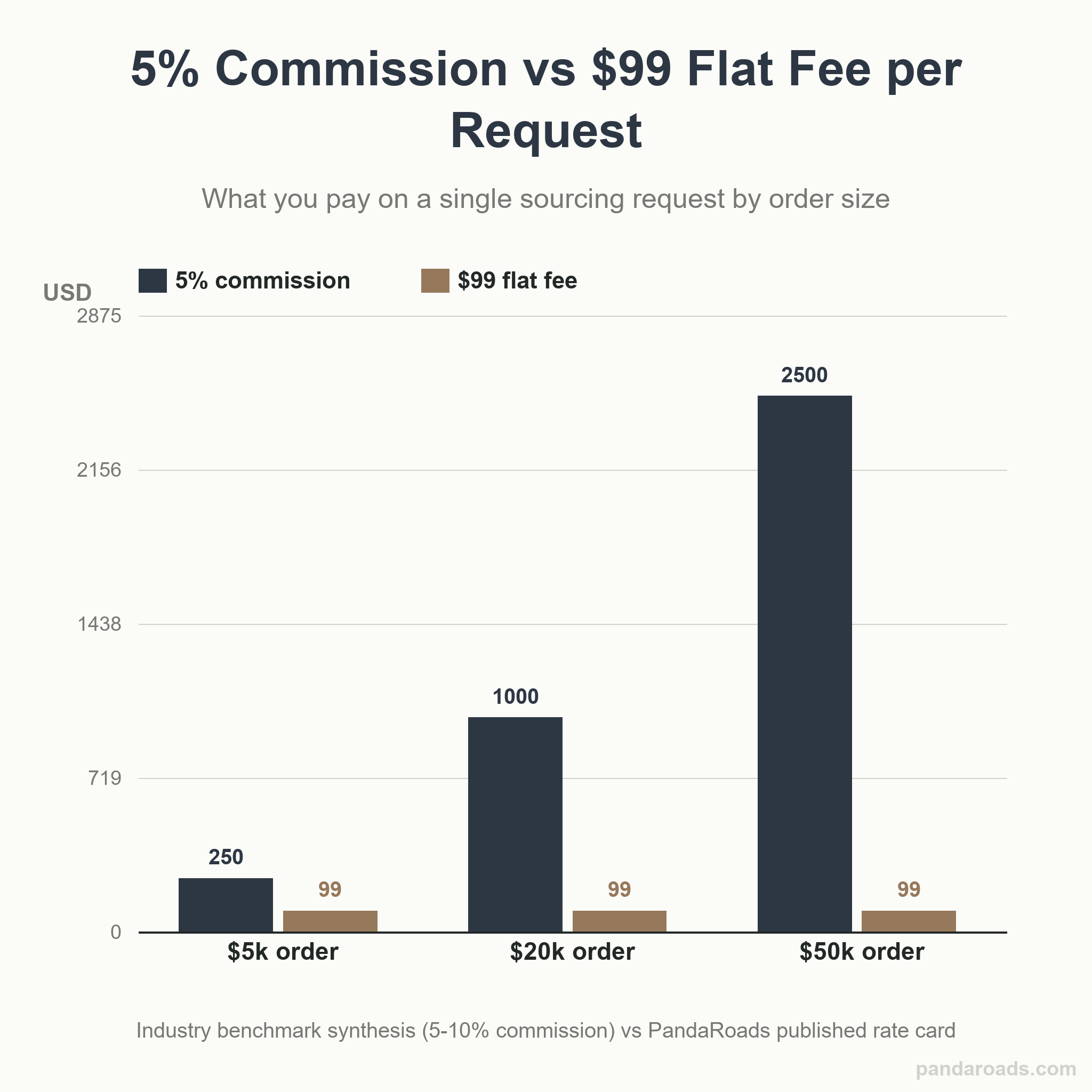
The appeal is the zero-upfront entry. No invoice for research, no risk if you don't buy. The cost hides in plain sight: on a $5,000 order at 5%, the fee is $250. At 10%, it's $500. Scale that to a $20,000 order and you're at $1,000 to $2,000 before a single carton ships.
"Free" is the other word you'll hear, as in "the service is free, we earn from the factory." Free is the wrong word. Nothing is free. The percentage is built into your order, and it compounds across every reorder, so the real cost grows while the agent's pitch stays the same.
The deeper issue is incentive. A commission agent earns more when your order costs more. A factory quotes $4.80 per unit, another quotes $5.20, and the agent's pay grows with the higher number. Nobody has to be dishonest for this to matter. It just quietly shapes which supplier gets recommended (marketunion).
Fixed fee: the same price, no matter the order.
Fixed-fee agents quote a flat amount for a defined job. Project fees commonly run $300-$2,000, and monthly retainers run $300-$1,000 (dragonsourcing). Per-task rates are the lean version: one price for one deliverable, like our $129 request.
Fixed pricing has its own trade-offs. A $300 project fee feels expensive when you only need a quick price check, and complex multi-month projects push flat quotes upward because the agent has to price in their own risk. The payoff: the agent's pay never moves with your order size, so there's no incentive to steer you toward expensive suppliers.
Some agencies blend both: a base retainer plus a reduced commission. That's still commission at the core, so run the same incentive test.
The two models, side by side.
| Commission | Fixed fee | |
|---|---|---|
| How you pay | Percentage of order value | Flat amount per project, task, or month |
| Typical range | 5-10% of order value; 3-5% above $50,000 | $300-$2,000 per project; $300-$1,000 monthly retainer |
| Incentive | Earns more when your order costs more | Earns the same regardless of order size |
| Best fit | Large, repeat orders with ongoing support | Small orders, single tasks, price checks |
| Fee on a $5,000 order | $250-$500 | $129-$300 |
| Fee on a $20,000 order | $1,000-$2,000 | $129-$2,000 |
| Upfront cost | Usually none | Set by the quote |
The fee-on-order rows are where the decision lives: the fixed column stays flat while commission scales with your money.
Where the crossover sits.
Published guides put the tipping point around $2,000 in order value (youna-global). Below that, a 5-10% commission works out to a small number for the agent and a percentage you can't predict for you. Above it, commission starts to earn its keep when the agent carries real ongoing work: negotiation across suppliers, quality checks, logistics coordination across multiple shipments. For a one-off sourcing task at any order size, a flat request wins on both price and predictability.
The transparent option.
PandaRoads sits on the fixed side of the line. A remote sourcing task costs $129 per request, delivered within 2 business days with supplier comparison and verification, and on-site work costs $239 per day, quoted before we go (pandaroads.com/1688-price-check). Both prices are published. That's the point: you should never have to email a sales rep to learn what a service costs. The team behind the rate card is a small local team based in China, so the on-site day rate is a published price for work the team can actually perform on the ground, not a subcontracted promise. Our own model keeps the same flat structure: one published price per deliverable, with no percentage of your order on the line.
Choose the model that matches your order size and your tolerance for hidden incentives. Under $2,000, commission is hard to justify. Above it, ask what the percentage actually covers, and get the answer in writing. Contrary to what many small buyers assume, the percentage fee is not the fairer option for them; below the $2,000 crossover, a flat fee is cheaper and more predictable.
What 5% Commission Actually Costs on Real Orders
Five percent sounds painless. It isn't. On a $50,000 order, that "small" percentage is $2,500, more than most first-time importers spend on the entire sourcing process. The math below is plain arithmetic, but most buyers never run it before they sign.
| Order value | 5% commission | $129 flat request | You keep |
|---|---|---|---|
| $5,000 | $250 | $129 | $151 |
| $20,000 | $1,000 | $129 | $901 |
| $50,000 | $2,500 | $129 | $2,401 |
The "You keep" column is the part that matters. It's the money you hand an agent on top of the research itself. The $129 request doesn't get cheaper because your order is small; one carton or one container costs the same. The $129 flat request covers the same research work on every row: 1688 search in Chinese, comparison across 3-5 sellers, MOQ and packaging notes, seller registration age, and an English report with links, delivered within 2 business days (pandaroads.com/1688-price-check). Commission buys the same category of work, then adds a percentage on top of it.
And 5% is the friendly number. Published fee guides put the standard range at 5-10% of order value, with rates dropping to 3-5% only on orders above $50,000 (youna-global; terraceltd). Run 7.5%, the middle of the range, on a $20,000 order and you get $1,500 for one sourcing round, before samples, inspection, or logistics fees. For comparison, fixed project fees from sourcing agencies commonly run $300-$2,000 per engagement (youna-global). Even the bottom of that range is three times a single flat request.
The real problem with commission is not the dollars, it's the incentive. A commission agent earns more when your order costs more. That's not a mystery, it's how the model works. If one factory quotes $4.80 per unit and another quotes $5.20, the agent's take grows with the higher number. Some agents inflate the factory price and pocket the difference, which is why fixed-fee models are the standard recommendation for smaller orders (marketunion). The bigger your order, the more expensive that "free" advice becomes.
Here's where our own boundary sits: $129 per request is research and verification, not order management. We don't hold your money, sign your contracts, or forward payments, and that's deliberate. Our what-we-dont-do page spells out why (pandaroads.com/what-we-dont-do). If you need someone standing inside a factory taking photos, the on-site rate is $239 per day, quoted and approved before we go. Run that number against the table above: a full day of on-site verification costs less than the 5% commission on a $5,000 order.
Now run the same table with your own order value. If the first column sits under roughly $2,000, commission is almost never worth it, which matches the threshold the fixed-fee guides recommend (youna-global). Above that, the question is whether the agent's percentage buys something you actually can't get from a flat request. For most first orders, the answer is no.
What a Flat $129 Request Covers
A flat $129 request is a complete deliverable, not a consultation fee or a retainer deposit. You approve the quote first, pay through PayPal, and get a written English report within 2 business days (pandaroads.com/1688-price-check). Here is exactly what the request includes:
- 1688 search in Chinese. Every 1688 price check starts with a search of the domestic Chinese wholesale market using Chinese keywords, which surfaces factory-level prices that English searches can't reach. 1688.com is Alibaba's domestic wholesale marketplace for the Chinese market, and its prices are typically below what English-language export sites quote.
- Price comparison across 3-5 sellers. You get a range, not one cherry-picked number, so you know the market spread before you negotiate.
- MOQ and packaging notes. Minimum order quantities and packaging details pulled straight from the listings, so you can tell whether a supplier fits your order size.
- Seller registration age. How long each seller has been registered, a basic but useful signal when you're choosing between similar factories. You can also verify a business license yourself with our free GSXT check guide. GSXT (国家企业信用信息公示系统, the national enterprise credit information publicity system run by China's State Administration for Market Regulation) is the public register where every business license is searchable, and the unified social credit code it assigns to each registered company is the Chinese equivalent of a US EIN.
Every price in the English report links back to the seller so you can open it yourself, and you can forward it without translating a word. Delivery is a fixed two business days, not "as soon as we get to it." The report standards we follow are published so you know what every deliverable contains before you order.
The point of a published rate card like this is that nothing is hidden. There is no minimum order, no monthly retainer, no setup fee, and no percentage of your order on the line (pandaroads.com/1688-price-check).
The boundary is just as public. A $129 request covers research and verification, and we don't pretend otherwise. We don't hold your money, we don't sign contracts on your behalf, we don't fabricate screenshots or invent factory quotes, and we don't promise you the lowest price anywhere on earth. If a factory raises its price the day after we quote you, the report says so. Those limits are written in plain language on our what-we-dont-do page (pandaroads.com/what-we-dont-do), because hiding them would make the whole report suspect.
When do you need more than $129? When the task physically requires someone to be present, our on-site factory verification covers it: a factory visit, a sample pickup, or a check on whether the address on the business license matches the building in the photos. That runs $239 per day with same-day photos and notes, quoted before we go. Two days of that, $478, is still less than the 5% commission on a $10,000 order, and it comes with evidence attached.
The rule of thumb is simple. If the job can be done from a desk in China, it's $129. If it needs boots on the ground, it's $239 a day. Both prices are published, both are fixed, and both are what you pay, not what you pay "plus fees."
Hidden Costs Agents Never Quote
The commission rate on the quote is rarely the full price. After working through how sourcing agents actually bill, a few patterns keep showing up, and none of them appear on the first page of a proposal.
Markups on samples and inspection. A commission agent's income is tied to the size of your order, so the agent has an incentive to see that order grow. One common way is to add a margin to services that should pass through at cost: samples, factory inspection fees, freight quotes. The markup gets folded into the invoice as "handling," and you never see the underlying price. We're not naming companies here, but any buyer who has itemized a sourcing invoice has seen the pattern. Our China supplier scams guide lists the variations to look for.
Minimum spends and bundled retainers. Some agents pair a low-looking commission with a required minimum order value, or wrap the real fee into a monthly retainer that keeps billing whether or not you have active orders. Retainers commonly run $300-$1,000 per month (dragonsourcing), which is a different cost conversation than a 5% commission suggests.
Fee-on-fee structure. Commission, then a separate line for "sourcing management," then a third line for follow-up. Each line looks small on its own. The total no longer resembles the 5% you agreed to.
Our answer is to publish the boundaries instead of the fine print. Every request is quoted and approved before work starts, and the $129 rate card has no "plus fees" anywhere on it. We don't hold your money or forward payments, we don't sign documents for you, and we don't produce reports that flatter a sale. Those rules are public on our what-we-dont-do page (pandaroads.com/what-we-dont-do).
Ask any agent you're evaluating for an itemized quote with pass-through costs visible. If the answer is "we'll sort it out later," that's a hidden cost trying to stay hidden.
Warning: If the answer is "we'll sort it out later," that's a hidden cost trying to stay hidden.
How to Compare Sourcing Agent Quotes
Agent quotes vary widely, so treat the first number you receive as an opening bid, not a final price. Two agents can quote the same factory and come back with very different numbers. Work through this checklist before you sign anything.
Require a written quote. A verbal estimate is not a quote. Ask for a document that itemizes the commission rate, fixed fee, or retainer structure so you can compare agents on the same terms. If an agent hesitates to put numbers on paper, that is a signal.
Warning: A verbal estimate is not a quote. If an agent hesitates to put numbers on paper, that is a signal.
Ask who pays for samples and inspection. Sample costs and third-party inspection fees can add up fast. Some agents fold them into their fee; others bill them separately. Get the answer in writing, not in a reply that says "we will figure it out later."
Confirm there is no minimum spend. Some commission agents quietly expect a minimum order volume even when the published rate looks small. Ask directly whether a small first order is acceptable, and get that answer in the written quote.
Request verifiable reports. If an agent quotes factory prices, ask for the source: a supplier quote, a factory price list, or an inspection report. Any agent can forward a number. A good one can show where the number came from.
Match the fee model to the order size. Per youna-global.com data, small orders are better served by fixed fees. When your order value is low, a 5% commission can cost more than a flat rate while giving the agent less incentive to negotiate hard.
Get the guarantee in writing. Confirm what happens if the factory ships late or the goods arrive defective. Who covers the replacement cost? If the agent will not put this in writing, keep looking.
By the Numbers
- 5-10% commission is the published standard (youna-global; terraceltd)
- $129 per request for a published flat rate (pandaroads.com/1688-price-check)
- $239 per on-site day, quoted and approved before we go (pandaroads.com/1688-price-check)
- $2,000 is the crossover where fixed fees win (youna-global)
- 3-5% on orders above $50,000 (youna-global; terraceltd; marketunion)
When Paying Commission Still Makes Sense
Not every order fits a flat fee. Commission agents can be the right call when the numbers line up, and there are real scenarios where a percentage makes more sense than any fixed price.
Steady, repeated orders above $2,000. If you buy regularly and each order clears roughly $2,000, a 5-10% commission is a fair price. The agent has an ongoing incentive to keep your supply chain running, and the percentage stays predictable as your orders grow.
Orders that need a long-term supplier relationship. Commission agents live on repeat business. When you need a supplier who holds pricing, manages quality, and prioritizes your orders, an agent whose income depends on your continued orders has a real reason to protect that relationship.
Extended on-site presence. If the job requires someone standing in a factory for days or weeks, you cannot do that remotely. For hands-on factory time, an on-site rate of $239 per day, or a monthly retainer in the $300-$1,000 range, is common in the industry. For hands-on time like this, a factory verification visit documents what actually happens on site.
You have no time to manage the process. Commission agents handle the back-and-forth: samples, revisions, follow-ups, and chase-up calls. If your own time is worth more than the percentage, the fee pays for itself.
The honest trade-off: commission creates an incentive to see your order grow. As long as you know that going in and verify quotes independently, commission is not a bad deal. It is a different deal, and in the scenarios above it is often the better one.
Glossary
- Commission: a percentage of your order value; the fee scales as the order grows.
- Fixed fee: a flat amount for a defined job, agreed before work starts.
- Retainer: a monthly retainer that keeps billing whether or not you have active orders.
- MOQ: minimum order quantities pulled straight from the listings.
- 1688: Alibaba's domestic wholesale marketplace for the Chinese market.
- GSXT: the national enterprise credit information publicity system run by China's State Administration for Market Regulation.
Frequently Asked Questions
These are the questions buyers actually ask before hiring a China sourcing agent, along with the most honest answers we can give. Fee structures vary from agent to agent, so treat every number here as a realistic range rather than a fixed price list. Commission rates, project fees, and monthly retainers all exist in the market, and each one fits a different kind of order. If your situation does not fit neatly into one of the answers below, the same rule applies in every case: run the math on both fee models for your actual order size before you choose. One caveat applies to every range in this guide: the figures come from published fee guides and from PandaRoads' own rate card, so they describe the market as it is documented rather than a promise about any individual agent's quote.
Quick reference: commission runs 5-10% (2026) and drops to 3-5% on orders above $50,000 (2026), project fees run $300-$2,000, monthly retainers run $300-$1,000, and per-task work starts around $129 per request. Those four numbers, current as of August 2026, cover the range you will actually encounter when you start comparing agents.
Q: How much does a China sourcing agent charge?
Commission agents charge 5-10% of order value; fixed-fee agents typically charge $300-$2,000 per project. Flat per-task rates like $129 per request exist but are rarely advertised, which is why our 1688 price check service publishes the price up front.
Q: What is the typical commission rate for a China sourcing agent?
5-10% of order value is the published standard, dropping to 3-5% on orders above $50,000. Commission creates an incentive to inflate factory prices.
Q: How much does it cost to hire a sourcing agent in China?
Expect $300-$2,000 per project or $300-$1,000 per month for retainers. For a single task, a fixed $129 per request covers supplier research with verification.
Q: Are China sourcing agents worth it?
Yes for verification and negotiation you cannot do remotely. The math changes once your order value exceeds roughly $2,000 and commission starts exceeding flat fees.
Q: How do sourcing agent fees work?
Commission is a percentage of order value; fixed fees are per project or task; retainers are monthly. Fixed per-task fees remove the incentive to inflate prices.
Q: What is the difference between commission and fixed fee sourcing agents?
Commission agents earn more when you pay more, which can inflate quotes. Fixed-fee agents earn the same regardless of order size, aligning their interest with yours.
Two takeaways apply to every answer above. First, get the fee model in writing before any work starts, and make sure it matches the order you actually plan to place. Second, verify independently: ask for supplier quotes, inspection reports, or order confirmations instead of trusting a single number. The right agent will have no problem showing their work.
If you are still deciding, start with the smallest possible order and a fixed per-task fee. That keeps your exposure low while you test how an agent communicates, how quickly they respond, and whether their supplier research holds up in practice. Once you have proof of that, moving to a larger order with commission or a monthly retainer becomes a much easier decision. A sourcing agent should be a tool that saves you money and time, not a second supplier you have to manage. For a single task, request a quote and get the fixed price in writing before any work starts.
Conclusion
The core of the decision is simple. A commission agent earns a percentage of your order, a fixed-fee agent earns a flat amount, and the model you pick shapes how your agent behaves on every order after it. Below roughly $2,000 in order value, a flat per-task rate like PandaRoads' $129 request beats commission on both price and predictability. Above that, commission can be a fair deal when the percentage covers real ongoing work, but only if the rate and the pass-through costs are itemized in writing. Before you sign anything, run the math for your own order size, ask for a written quote, and verify every number independently.
References
- Youna Global. (2026). How much does a China sourcing agent cost? Honest fee breakdown (2026). https://www.youna-global.com/blog/blog-sourcing-agent-cost-guide-2026.html
- Dragon Sourcing. (2026). Top 10 cost insights for hiring a China sourcing agent. https://www.dragonsourcing.com/top-10-cost-insights-for-hiring-a-china-sourcing-agent/
- MarketUnion. (n.d.). Sourcing agent fees: Commission-based vs. fixed rate. https://www.marketunion.com/blog/sourcing-agent-fees--commission-based-vs--fixed-rate
- Terrace International. (2026). China sourcing agent fees: Commission models explained. https://terraceltd.com/en/blog/china-sourcing-agents-fees
- PandaRoads. (2026). 1688 price check: Real factory prices from $129. https://pandaroads.com/1688-price-check
- PandaRoads. (2026). What a China agent won't do: Honest boundaries. https://pandaroads.com/what-we-dont-do
- PandaRoads. (2026). China sourcing agent: Local team from $129. https://pandaroads.com/china-sourcing-agent.html
Last reviewed and updated: August 2026. Author: our editorial team. For tailored guidance, contact our team.