China Errand Service Without WeChat Pay: A Buyer's Guide
You can get a scoped task done inside mainland China and pay for it in US dollars without ever setting up WeChat Pay. Here is how to compare the three no-wallet paths, the real foreign-card limits, and the danger signal to refuse.
Last updated: October 2026 · By the PandaRoads team in China
TL;DR
You do not need WeChat Pay to get a task finished in China, and for a buyer overseas the wallet is often the worst option anyway. The decision is not 'how do I bind a card', it is 'who finishes the job and how do I pay them in dollars with proof.' Three paths exist: (1) a done-for-you errand service that bills you as a US-dollar merchant and hands back an itemized receipt and delivery photos, (2) asking a personal contact to front the money, which leaves you with no receipt and no recourse, and (3) a freelance or gig marketplace where the job is real but the counterparty usually asks you to add them on WeChat and pay person-to-person, which reintroduces the wallet and the risk. The reason so many people stall on WeChat Pay is concrete: the foreign card is capped and merchant-only and cannot send red envelopes or person-to-person transfers at all. The single most important buyer check: when a local says 'just WeChat-transfer it to me,' treat it as a danger signal, not a payment method. And one honest boundary: if the other party only communicates on WeChat, the wallet is still how you reach them, even when the money never moves through it.
Abstract
A buyer's guide for the decision to get something done inside mainland China without ever setting up WeChat Pay: it names the real foreign-card ceilings and the person-to-person prohibition that make the wallet a poor fit for a remote client, compares the three no-wallet paths (a dollar-settled done-for-you service, a personal contact, and a gig marketplace that still wants the other party on WeChat), teaches the direct-transfer danger signal, walks the order-to-payment flow that touches no Chinese wallet, and states honestly the one case where you still need WeChat.
Key Takeaways
- You can get a China task done without WeChat Pay; for a remote buyer the wallet is usually the wrong tool, not the missing one.
- A foreign card on WeChat Pay is capped per transaction and per month, is merchant-only, and cannot send red envelopes or person-to-person transfers.
- Three no-wallet paths: a dollar-settled done-for-you service, a personal contact with no paper trail, or a gig marketplace that pulls you back toward WeChat.
- Only the done-for-you path bills you as a US-dollar merchant and returns an itemized receipt plus delivery proof.
- When a local tells you to 'just WeChat-transfer it to me,' that is a danger signal and a loss of recourse, not a way to pay.
- Order to payment without any Chinese wallet: scope and quote, dollar card charge, milestone or delivery proof, itemized receipt.
- You still need WeChat when the other side only communicates there, even if the money is settled in dollars.
Table of Contents
- Abstract
- Key Takeaways
- You do not need WeChat Pay to get something done in China
- Why so many people stall on the WeChat wallet
- The three ways to finish a China task with no WeChat Pay
- Path A: a done-for-you service that settles in US dollars
- Path B: a personal contact who pays on your behalf
- Path C: a gig marketplace that still wants you on WeChat
- When a local says "just WeChat-transfer it to me": the danger signal
- From order to payment: a flow that never touches a Chinese wallet
- What proof to demand before you pay
- The honest boundary: when you still need WeChat
- Frequently asked questions
- The bottom line
- References
You do not need WeChat Pay to get something done in China
Here is the decision you are actually making. Something has to happen inside mainland China: a purchase collected and sent, a document queued at a window, a package taken in, a site checked and photographed. You are abroad, and you do not have, and largely do not want, WeChat Pay. The question is not how to force the wallet to work for you. It is whether the job can get done and paid for in US dollars without you ever opening a Chinese payment app. It can.
For a buyer overseas, refusing WeChat Pay is not a deficiency to apologize for. It is a reasonable posture. The wallet is built for someone standing in a Chinese city with a local phone plan and a passport to scan, not for someone in Ohio who wants a receipt and a chargeback option. Setting it up means handing a super-app your identity and a foreign card that is capped and merchant-only anyway. You are allowed to skip all of that and still get the errand finished.
This page is deliberately narrow. It is a buyer's guide to one objection: can I hire a China errand service with no WeChat Pay needed, and how do I pay for it safely. The general framework for getting anything done in China from abroad, the full step-by-step method with its own survey of every payment route, lives in our companion guide on how to get something done in China from abroad; read that first if you want the whole map. For the catalog of which tasks people commission, start at our hub for errands in China from overseas.
The friction is real and well documented, and it starts with a phone number that cannot receive the code.
"How can I contact China Mobile from abroad to setup international roaming? I need to send and get a verification code via SMS for wechat." (reddit r/chinalife, 2024)
That post is the search behind this article, phrased by someone stuck at the gate. We are going to walk the three routes that let you finish the job without going through that gate, what each one costs you in proof, and the one case where you genuinely still need the app.
A buyer overseas can commission a scoped errand inside mainland China and pay for it as a US dollar merchant transaction, without opening a Chinese payment app. A 2024 post from a stuck user captures the friction: they could not receive the WeChat SMS verification code. The wallet is one payment route, not the only way to finish a job.
Why so many people stall on the WeChat wallet
The short answer to "what is the WeChat Pay limit for foreign cards": roughly RMB 6,000 per transaction and RMB 50,000 per month on WeChat Pay, and roughly RMB 3,000 per transaction on Alipay, all of it restricted to merchant payments, with a fee under RMB 200 waived and about 3 percent charged above it (source: china-briefing.com). Nowhere in those rules is a person allowed to send money to another person with a foreign card. That is the wall, and it is why a growing number of overseas buyers decide not to fight it at all.
Three concrete barriers push people toward a no-wallet path, and each one is a fact, not a preference.
First, identity and a live phone. Turning on WeChat Pay is not signing up for an account. It is real-name verification, which means submitting identity documents and passing a mobile number that can receive China SMS codes (source: china-briefing.com). The number itself can be overseas, but the loop is fragile, and it is exactly the loop the r/chinalife buyer above could not complete. If you cannot reliably receive that code, the wallet is not available to you no matter what card you hold.
Second, the ceilings are small and the fees are not zero. A linked foreign Visa or Mastercard is cleared for merchant purchases only, up to roughly RMB 3,000 per Alipay transaction and RMB 6,000 per WeChat Pay transaction, with a WeChat monthly cumulative ceiling near RMB 50,000; a fee under RMB 200 is waived and about a 3 percent fee applies above it (source: china-briefing.com). For a tourist buying lunch those numbers are fine. For funding a job on the ground they are the wrong shape entirely.
Third, and most decisive for an errand, the merchant-only rule blocks the exact move you would want to make. A foreign card cannot send red envelopes and cannot make person-to-person transfers at all (source: china-briefing.com). Sending money directly to an individual runner, the thing most buyers picture, is the one transaction your card is not allowed to perform.
What a linked foreign card can and cannot do
| Wallet action | Foreign card, per china-briefing.com |
|---|---|
| Pay a registered merchant | Allowed, up to the per-transaction and monthly ceilings |
| Send a red envelope | Blocked |
| Person-to-person transfer to an individual | Blocked |
| Fee below RMB 200 | Waived |
| Fee above RMB 200 | About 3 percent |
Put those three walls together and the buyer's conclusion writes itself. If getting your errand done means scanning a passport, chasing a China SMS code, and then being told you still cannot pay the person doing the work, the rational move is to route the job through someone who never asks you to touch the wallet. That is the whole premise of the three paths in the next section.
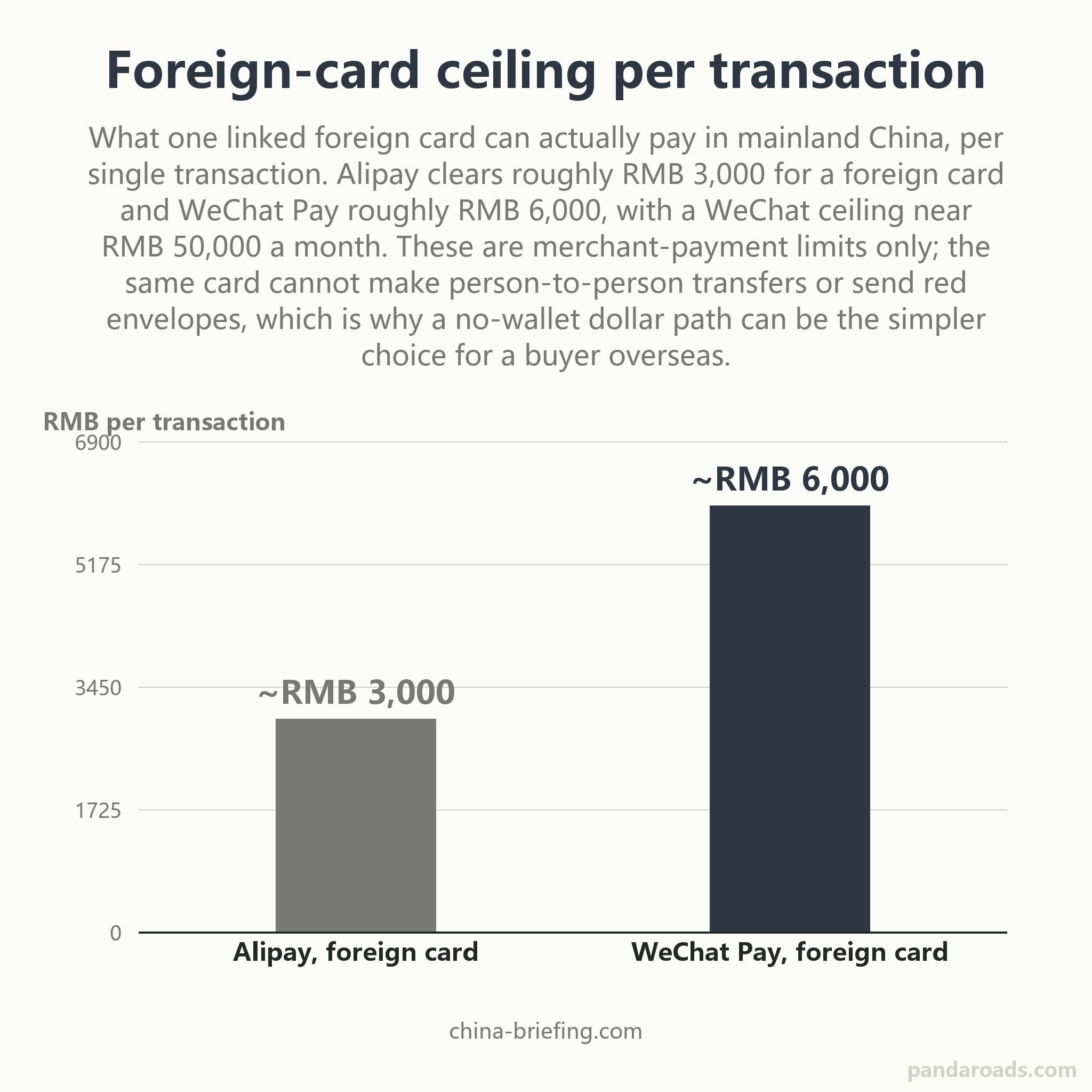
The WeChat Pay limit for foreign cards is roughly RMB 6,000 per transaction and RMB 50,000 per month, with Alipay capped near RMB 3,000 per transaction, all merchant-only, a fee under RMB 200 waived and about 3 percent above it. A linked foreign card cannot send red envelopes or make person-to-person transfers (china-briefing.com).
The three ways to finish a China task with no WeChat Pay
Is there an alternative to WeChat Pay for a foreigner who wants a job done? Yes, and there are exactly three of them. They differ not in whether the errand gets done but in what you hand the other party, how the money actually moves, and what proof and recourse you keep afterward. A US buyer should pick the channel on those terms, the same way you would pick any vendor.
Path one is a done-for-you service that settles in US dollars. You commission a scoped task, the company is the merchant of record and runs your card in dollars, and its runner on the ground handles every local payment with rails you never see or touch. This is the only path where you are a customer with an invoice rather than a party to a private money transfer.
Path two is a personal contact who pays on your behalf. A relative, a friend, or someone you already know fronts the local cost and you settle up afterward, off-platform. It can work for a small informal favor between you and that person, but it is not a purchase channel: there is no receipt, no dispute path, and no one accountable if the job stalls. We keep that case deliberately short, because as a buying decision it does not really compete with path one.
Path three is a freelance or gig marketplace. You match with an individual through a platform, and the task is real, but in practice the counterparty moves the conversation and the payment onto WeChat, which re-imports every wall from the last section: the wallet, the identity check, the foreign-card cap, and a person-to-person transfer your card is not permitted to make. It only works if that person also accepts a platform-escrowed, off-WeChat payment, and many will not.
Three channels a US buyer can actually compare
| No-wallet path | How you pay | Proof and recourse you keep |
|---|---|---|
| Done-for-you service | US-dollar card to the platform as merchant of record | Dollar invoice, delivery photos, chargeback path |
| Personal contact | They front it, you settle privately later | No receipt, no dispute path |
| Gig-marketplace counterparty | Often pushed to a direct WeChat transfer | Foreign card blocked; little recourse |
Read across the bottom two columns and the ranking is obvious. The contact path is cheap but blind: you cannot prove the work happened and you have no one to escalate to. The gig path pretends to be a purchase but collapses into a private transfer the moment the counterparty says "add me on WeChat." The done-for-you path is the only one where the thing you receive is documentation, not just a text message saying it is done.
That is not a small distinction for someone twelve time zones away. A dollar invoice is a record you can dispute with your card network. Delivery photos are evidence the errand actually happened. A written scope is what an escrow or milestone payout can be measured against. None of those exist in the other two columns.
The rest of this guide takes each path in turn, then shows the payment flow that never touches a Chinese wallet, and finishes with the one honest case where you still need the app anyway.
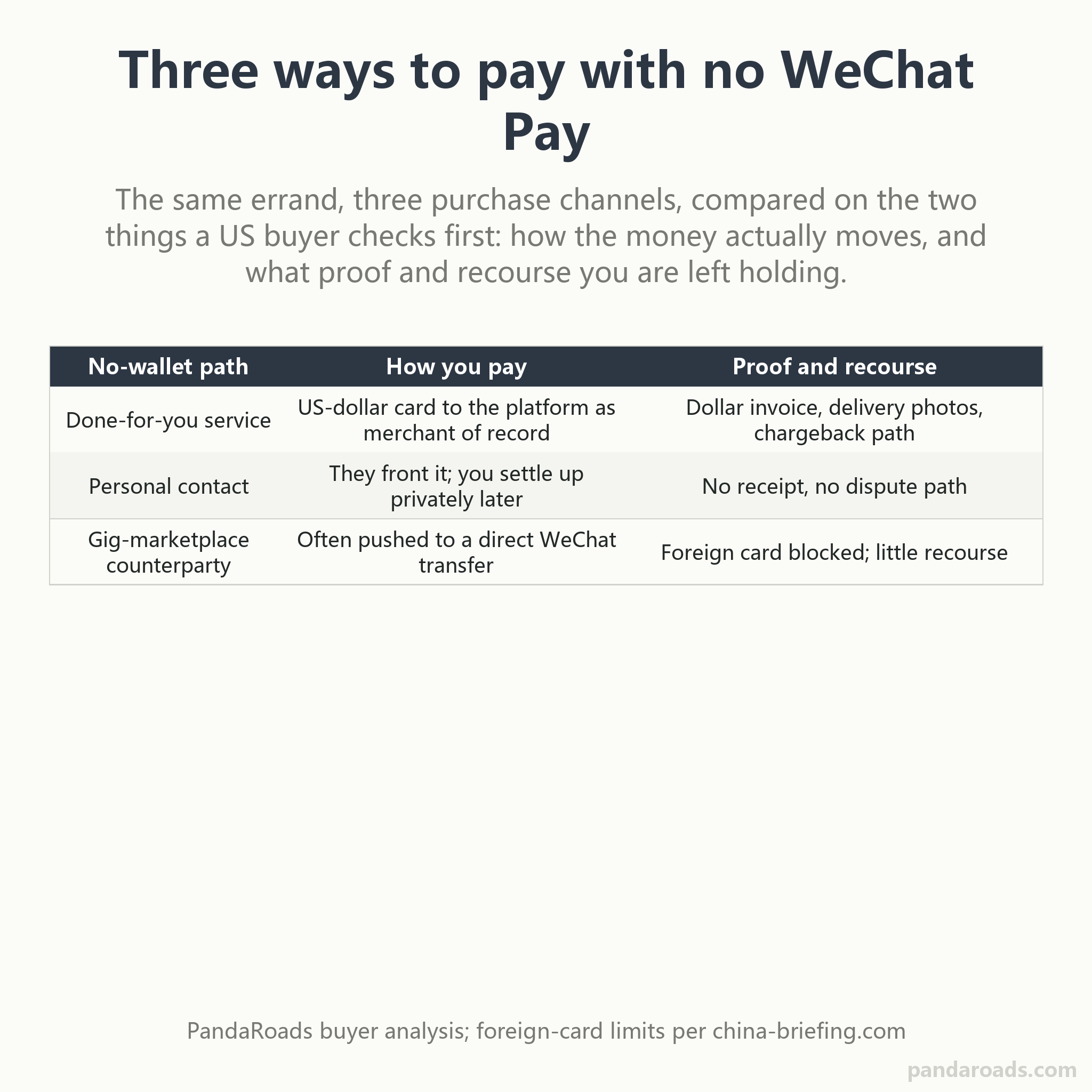
Is there an alternative to WeChat Pay for foreigners? There are 3 routes: a done-for-you service that bills you in US dollars, a personal contact who fronts the money with no receipt, and a gig marketplace that usually pushes payment onto WeChat. Only the first returns a dollar invoice, delivery photos and a chargeback path.
Path A: a done-for-you service that settles in US dollars
This is the path most buyers who refuse WeChat Pay should actually choose, because it is the only one that treats you like a customer instead of a counterparty in a money transfer. A done-for-you errand service takes the job, does the work on the ground, and bills you as an ordinary merchant transaction in US dollars. You never hold renminbi, never link a card to a Chinese app, and never send money to an individual.
The mechanism is worth spelling out, because the word "errand service" makes people assume the money still has to reach China somehow. It does, but not from you. When you place an order with a managed provider, that company is the merchant of record. Your card is charged in dollars through a normal checkout, the same kind of transaction any overseas purchase clears. Inside China, the provider's own operation funds the local cost, the courier fee, the purchase, the notarization window charge, through payment rails it already runs. You settle up with a company in your currency; the company settles locally in renminbi. The two legs never require you to touch a wallet.
Priced honestly, the dollar-settlement model is also cheaper than the DIY alternative most people consider next. A managed errand runs on a fixed schedule rather than a negotiation with a stranger: single errands start from $239, a remote task handled for you is $129 per request, and a Local Errand within 30 kilometers over two working days is $239 with photos and receipts included. By comparison, the DIY fly-out route, catching a flight to clear one window in person, runs a round-trip to China in the low thousands of dollars, and that is before the time cost of the trip itself. For a bounded task, sending a scoped request to a dollar-billed service is a straightforward return-on-time trade, which is exactly how you would judge any other remote vendor.
Three properties make Path A the buyer-grade option, and you should check for all three before ordering:
- Merchant settlement in your currency, so the charge reads as a purchase and keeps your card-network protections.
- A written scope and an itemized receipt, so there is an artifact that says what you paid for and what was delivered.
- Documented proof on completion, delivery or collection photos, a receipt chain, something that exists outside a private chat thread.
If a provider hands you all three, you are buying a service. If they hand you none of them and instead ask you to send money to a person, you are not on Path A at all, you have quietly been moved to the danger signal we cover two sections down. Start from a scoped request so the quote and the paper trail are set before any money moves, through the task quote form, and keep the broader errands-from-overseas hub open for what actually counts as a commissionable task.
A done-for-you service is the merchant of record. You pay an ordinary US dollar card charge, and its runner funds the renminbi leg inside China on rails you never touch. Prices are fixed, a single errand from $239 and a Local Errand within 30 kilometers at $239 with photos and receipts, against a round trip in the low thousands.
Path B: a personal contact who pays on your behalf
The honest treatment of this path is short, because as a purchase decision it barely qualifies. A personal contact, a relative, a friend, or someone you already know, can front the local cost in renminbi and you settle up with them afterward, off-platform, in whatever way you arrange privately. For a small informal favor between you and that specific person, that can be perfectly reasonable.
What it is not, is a buying channel. A personal contact leaves you with no receipt, no itemized invoice, and no dispute path. There is no merchant of record to charge back, no scope document to point at when the job is half-done, and no third party accountable if the errand stalls or the money and the work never line up. When something goes wrong, your only remedy is the personal understanding between you, which is exactly the kind of remedy a buyer trying to manage a transaction from overseas does not want to rely on.
This is where a common question quietly answers itself: "how do I pay someone in China without WeChat Pay" is not the same question as "how do I buy a finished job with proof." Path B can move money between two people who trust each other; it cannot produce the paper trail a commercial task needs. If what you are handling matters enough to want a receipt, a contact is the wrong instrument, full stop. If it is genuinely a one-off favor and you accept no proof and no recourse, it is fine, and it is also the reason Path A exists. We will not spend more words here, because there is not much more a buyer needs to weigh.
A personal contact can front the local cost, but it is not a purchase channel. There is no receipt, no itemized invoice, no merchant of record to charge back, and no dispute path. It suits a one-off favor between 2 people who already trust each other, not a commercial task where you want the paper trail.
Path C: a gig marketplace that still wants you on WeChat
The third path looks like the safest one on paper and is often the trap. A freelance or errand marketplace, the TaskRabbit-style model you already know, matches you with an individual who will do the job. There is a profile, a rating, a chat thread. It feels like procurement. Then the transaction starts and the floor drops out.
Here is what usually happens. The counterparty agrees to the task, and then says, reasonably enough, "let's talk and settle it on WeChat, it is faster." Instantly you are back at every wall from the first section. To complete the payment they want, you need the wallet, the real-name verification, and the China SMS code. And even with all of that, the person-to-person transfer they are asking you to make is the exact thing a foreign card is blocked from doing (source: china-briefing.com). The platform you trusted to keep the transaction off WeChat did not, and you are now negotiating a private money transfer with someone whose only hold on you is that you already agreed to the job.
The mismatch is not that marketplace workers are dishonest. It is that a gig platform built for domestic use assumes both sides already live inside the local payment system. It solves matching, not cross-border settlement. So the buyer who cannot, or will not, run a Chinese wallet is structurally the worst customer on that platform, and the friction lands on you.
This is the anxiety a lot of these searches are really voicing, stated plainly by someone trying to hire on the ground:
"I'm buying from alibaba and as my volume increases I'd like to hire a QA inspector, how do you find a trustworthy one?" (reddit r/ecommerce, 2024)
Read that the way a US buyer would: it is a vetting and payment-security question, not a cultural one. The person is not asking who to befriend, they are asking how to verify a vendor and pay them safely across a border. A marketplace can help with the first half and then quietly hands the second half back to you as "just send a WeChat transfer." Path C only works when the individual will accept a platform-escrowed, off-WeChat payment and give you a receipt. If they will not, the marketplace has bought you nothing over the contact path, and Path A still wins on every dimension that matters.
A gig marketplace can match you with an individual, but the counterparty often moves payment onto WeChat, re-importing the identity check and the foreign-card cap. A 2024 buyer post asking how to find a trustworthy local inspector is really a payment-security question, not a cultural one. It works only if the person takes a platform-escrowed, off-WeChat payment.
When a local says "just WeChat-transfer it to me": the danger signal
Is it safe to send money directly to someone in China you just met? For a buyer, the useful answer is not a warning about feelings, it is a check on mechanics. A request to pay an individual by direct WeChat transfer is a danger signal, because it strips out every protection that makes a cross-border purchase recoverable, and on a foreign card it may not even be executable.
Consider what a "just send it to me on WeChat" instruction removes. There is no merchant of record, so there is nothing to dispute with your card network if the job never happens. There is no itemized invoice, so there is no agreed scope to point to when the result is half-done. There is no review trail held by a platform, only a private chat you would have to reconstruct. And there is no escrow or milestone, so the money is gone before any proof of delivery exists. Every one of those is a control a US buyer relies on without thinking when paying any vendor at home.
There is also the hard technical fact. A foreign card linked into WeChat Pay is restricted to merchant payments and cannot make person-to-person transfers or send red envelopes at all (source: china-briefing.com). So even if you wanted to comply with the request, the card you have is not permitted to perform the transaction the other party is asking for. A seller who insists on that route is either not familiar with the rules or is steering you away from rails that would leave a record. Either way it is the wrong channel for a buyer.
Here is the buyer's checklist. Before you pay anyone to handle a China errand, a legitimate payee offers all of these; a direct-transfer request offers none of them.
- A written scope or quote, so both sides agree what "done" means and for how much.
- A dollar merchant charge, so the payment is a purchase with card-network protections.
- An itemized receipt after the work, so you have an artifact that documents the spend.
- Milestone or completion proof, timestamped photos, a collection code, a delivery confirmation.
- A real dispute path, a platform or company that can be escalated to, not a private thread.
If a "local person" cannot give you those five things and instead pushes you toward a direct wallet transfer, you are not looking at a convenience. You are looking at the absence of a vendor. The correct move is to walk back to Path A, where the company invoices you and its runner never needs you to move money to a stranger. If you are deciding between providers, the full methodology for getting something done in China from abroad walks the same checklist against every delegation route, so you can see why a scoped dollar invoice beats an informal transfer no matter which task you are commissioning.
Is it safe to send money directly to someone in China you just met? Treat it as a danger signal. A direct transfer strips 5 controls a US buyer relies on, no merchant of record, no itemized invoice, no chargeback, no review trail, no escrow, and a foreign card cannot make a person-to-person transfer at all (china-briefing.com).
From order to payment: a flow that never touches a Chinese wallet
Once you pick Path A, the rest is ordinary e-commerce, and it is worth watching the money leg step by step so you can see exactly where WeChat Pay would have been and why it never appears. This is the same order-to-payment sequence for almost any commissionable task, whether you are collecting and shipping a purchase, receiving a parcel, or queuing a document at a window. For the receiving-and-forwarding case in particular, that scenario runs on the identical dollar-settlement model, and we cover it end to end in our guide to China package forwarding.
Step one, define scope and get a dollar quote. You describe the task, the address, the constraint, and you receive a fixed price in US dollars before anything is spent. A written quote is what turns an errand into a contract you can hold someone to, and it is the artifact the parent get-it-done-from-abroad method treats as step one for a reason.
Step two, place the order and pay the merchant. You pay through the provider's normal checkout by card, billed in US dollars to the platform as merchant of record. This is the load-bearing move. Your card clears it because it is a merchant transaction, the same kind any overseas online purchase is. There is no wallet to open, no passport to scan, no China SMS code to wait on, no renminbi balance to hold. The foreign-card ceilings and the person-to-person block from the first section simply never come into play, because you are not paying a person, you are paying a company for a service.
Step three, the on-the-ground leg happens inside China, funded by the provider. The runner pays the local courier, the vendor, or the window fee using payment rails the company operates domestically. You are not the source of that renminbi movement and you are not on the hook for it. Whatever the local cost is, it is settled by the service, not by a transfer you make.
Step four, checkpoints and proof. A managed job returns evidence as it goes: a collection or delivery photo, a tracking scan, a timestamped confirmation. This is the difference between a service and a text message.
Step five, itemized receipt and dispute path. You get an itemized dollar receipt for your records, and if the job goes wrong your recourse is the company and your card network, not a stranger who has already been paid.
Read back through those five steps and count how many require you to touch a Chinese payment app. The answer is none. Every wallet-dependent action sits on the provider's side of the line, and every action on your side, quote, dollar charge, receipt, is one you already know how to do from any US purchase.
The order-to-payment flow runs in 5 steps and touches no Chinese wallet: a dollar quote fixes scope, you pay the merchant of record by card in US dollars, the provider funds the renminbi leg on the ground, checkpoints return delivery photos, and you finish with an itemized receipt. Your card clears it as a normal merchant purchase.
What proof to demand before you pay
A US buyer does not decide whether a job was done by how the other party sounds at 11 p.m., they decide it from artifacts. Before money moves, know exactly which documents a legitimate no-wallet errand produces and what each one proves. This is the standard that separates a real service from a stranger holding a phone, and it costs you nothing to require because a service generates the paperwork as a byproduct of doing the work. The cleanest way to force that paperwork to exist is to start from a written, scoped China task quote, so the price and the deliverable are on paper before you pay.
The core artifacts are few and concrete. A written scope or quote defines what "done" means and at what price, so there is a baseline to measure against. A dollar merchant invoice shows you paid a company, not a person, and gives your card network something to stand behind. Timestamped completion or delivery photos show the physical act actually happened at a real place and time. A collection or tracking record ties the result to a verifiable chain. And an itemized receipt closes the loop on what you were charged for.
Here is the same list read as a demand sheet, with what each artifact proves and what a direct-transfer arrangement cannot give you.
| Proof artifact | What it establishes | A private transfer gives you |
|---|---|---|
| Written scope or quote | What "done" means, and the price | Nothing written down |
| Dollar merchant invoice | You bought a service, chargeback exists | No merchant of record |
| Timestamped delivery photo | The act physically happened | A text claiming it did |
| Tracking or collection record | An independent chain of custody | Whatever they choose to share |
| Itemized receipt | What the money was actually for | No line items, no audit |
Two cautions keep this honest. First, proof of delivery is not proof of a legal outcome. A runner can photograph a collected parcel or a submitted form, but the runner is not a licensed money transmitter, a customs broker, or your agent of record, and cannot make a legal declaration on your behalf. Second, a provider who resists giving you any of the artifacts above is telling you something. A real service hands back an invoice and photos without being asked; a person angling for a WeChat transfer is structurally unable to, because there is no service layer producing the record. If you have to beg for a receipt, you already know which column of that table you are standing in.
A legitimate no-wallet errand leaves 5 concrete artifacts: a written scope or quote, a dollar merchant invoice, timestamped delivery photos, a tracking or collection record, and an itemized receipt. A private WeChat transfer produces none, and a foreign card is barred from person-to-person transfers regardless (china-briefing.com).
The honest boundary: when you still need WeChat
A buyer's guide that told you the wallet is always optional would be selling something. It is not. There is one boundary where WeChat stays in the picture even on a no-wallet purchase, and being straight about it is part of the point.
The boundary is communication, not payment. WeChat in China is not only a wallet; it is how a large share of people message, and many counterparties, a factory contact, a building manager, an older relative, a small shop that only answers on WeChat, do not keep email or a phone line. If the person or office you need to reach runs only on WeChat, you may still need the app to get in touch with them, even when no money ever moves through it. That is a real dependency, and it is about a chat channel, not a bank. The distinction matters because it changes what you are solving: reaching someone who only uses WeChat is an availability problem; paying them with a capped foreign card is a settlement problem, and only the second one has a clean no-wallet answer. A dollar-settled service largely removes the need to solve the first yourself, because its runner already has the local channel and the language to use it.
A second, harder boundary sits on the compliance side, and it is the same line every honest provider draws. A runner can stand in line, courier a parcel, take delivery photos, translate a form, and witness that a document was submitted. What a runner cannot do is act as a licensed money transmitter, clear a customs declaration on a cross-border shipment, or serve as your legal agent of record. Those are regulated roles that belong to licensed institutions, not to whoever is holding your package. If a service claims it can be your money transmitter or file declarations as you, that is a warning sign, not a feature.
So the correct conclusion is not "WeChat is never needed." It is narrower and more useful. You do not need WeChat Pay to buy a finished task, because a dollar merchant settlement replaces the wallet entirely on the money side. You might still need WeChat to reach a specific person, which is a different problem with a different tool. Keep those two in separate boxes and the decision stops being confusing.
A no-wallet purchase still hits 1 real limit, communication. WeChat is how many Chinese counterparties message, so if the person or office you need runs only on WeChat you may still need the app to reach them even when no money moves through it. Reaching someone is an availability problem; paying them is a settlement problem with a clean no-wallet answer.
Frequently asked questions
Do I need WeChat Pay to get something done in China? No. You can commission a scoped errand and pay for it as a US-dollar merchant transaction, without ever opening a Chinese payment app. The wallet is one way to pay locally; it is not the only way to finish a job from abroad.
Can I use WeChat Pay without a Chinese bank account? A foreign card can be linked for merchant payments, but activation still requires real-name verification and a mobile number that can receive China SMS codes. The card is capped and merchant-only, and it cannot make person-to-person transfers or send red envelopes (source: china-briefing.com).
What is the WeChat Pay limit for foreign cards? Roughly RMB 6,000 per transaction with a monthly cumulative ceiling near RMB 50,000 on WeChat Pay, and about RMB 3,000 per transaction on Alipay. A fee under RMB 200 is waived and about 3 percent applies above it, for merchant purchases only (source: china-briefing.com).
How can I pay for a service in China from the US? Pay a company that acts as merchant of record and bills you in US dollars through a normal card checkout. The provider funds the local renminbi leg on the ground. You never hold renminbi or send money to an individual.
Can I hire someone in China without setting up WeChat? Yes, through a done-for-you service that invoices you in dollars, or a marketplace individual who accepts a platform-escrowed, off-WeChat payment. What does not work is being told to add a stranger on WeChat and transfer them money, which your foreign card is blocked from doing anyway.
Is there an alternative to WeChat Pay for foreigners? Yes, three of them, ranked above: a dollar-settled done-for-you service, a personal contact, and a gig marketplace. Only the done-for-you service gives you a US-dollar invoice, delivery proof, and a chargeback path.
Why does WeChat Pay require identity verification? Because it is a regulated payment wallet, activation involves real-name identity checks and a phone that can receive China SMS codes. That identity step is exactly the friction that pushes many overseas buyers toward a no-wallet path.
Is it safe to send money directly to someone in China you just met? Treat it as a danger signal. A direct transfer has no merchant of record, no itemized invoice, no chargeback, and no review trail, and a foreign card cannot legally complete a person-to-person transfer regardless (source: china-briefing.com).
Does a China errand service accept US dollars? A managed provider that is the merchant of record does, and that is the model to prefer: single errands start from $239 and a Local Errand within 30 kilometers is $239 with photos and receipts. You pay in dollars; the company settles locally.
Can I pay in US dollars instead of using a Chinese wallet? Yes. Paying a dollar-invoicing service keeps you entirely off the wallet. You make an ordinary US-dollar card purchase and receive an itemized receipt and delivery proof, while the renminbi leg stays on the provider's side of the transaction.
The bottom line
Here is the decision rule, stated once so you can carry it into any quote. You do not need WeChat Pay to get a task finished inside mainland China, and for a buyer sitting in the United States the wallet is usually the wrong tool rather than the missing one. It is capped per transaction and per month on a foreign card, it is bound to a real-name identity check and a number that must receive China SMS, and it is merchant-only, which means it cannot even send the person-to-person transfer a stranger is asking you to send (source: china-briefing.com).
The path that clears every one of those walls is a done-for-you service that acts as merchant of record: you pay a US-dollar card charge, receive an itemized receipt and timestamped delivery proof, and keep your chargeback. A personal contact leaves you with no paper and no recourse. A gig marketplace often drags you back onto WeChat anyway. So treat "just WeChat-transfer it to me" as a danger signal, not a payment method.
You still need the app only to reach a person who will not talk anywhere else, which is a messaging problem, not a money problem. For the full step-by-step method, read our guide on how to get something done in China from abroad, browse the errands hub for what people actually commission, and see how a received parcel gets forwarded under the same dollar settlement when the job is a package rather than an errand.
References
- China Briefing. (2023, July 24). WeChat enables foreigners to pay with overseas cards in China. China Briefing. https://www.china-briefing.com/news/wechat-enables-foreigners-to-pay-with-overseas-cards-in-china/
- PandaRoads. (2026). China errands from overseas: done-for-you local tasks [Service hub]. PandaRoads. https://pandaroads.com/errands-in-china-from-overseas.html
- PandaRoads. (2026). Request a China task quote [Order surface]. PandaRoads. https://pandaroads.com/task-quote.html
- PandaRoads. (2026). China package receiving & forwarding [Service page]. PandaRoads. https://pandaroads.com/china-package-forwarding.html
Last reviewed and updated: October 2026. Author: our editorial team. For tailored guidance, contact our team.