How to Get Something Done in China From Abroad (2026)
Get something done in China from abroad with a five-step method: choose the right hire path, pay without a Chinese card, make authority provable, and verify the result.
Last updated: October 2026 · By the PandaRoads team in China
TL;DR
Getting something done in mainland China while you live abroad is a procurement decision, not a favor. Run it in five steps, in order. (1) Choose who acts, weighed like any other hire: a managed done-for-you service, a freelance marketplace gig, a licensed professional such as a law firm or corporate services firm, or DIY fly-out where you go yourself. (2) Fund it, remembering that a foreign card tops out around RMB 3,000 per Alipay transaction and RMB 6,000 per WeChat Pay transaction with a RMB 50,000 monthly ceiling and cannot make person-to-person transfers. (3) Make your authority provable with a power of attorney, a notarization plus the November 2023 apostille, or an online video verification. (4) Verify the work against a deliverable standard: timestamped photos, itemized receipts, and a written report. (5) Accept the honest line where remote stops and your presence is mandatory. Compare the four hire paths on written scope, invoice, payment protection, proof, liability, and time cost, not on goodwill. This page is the HOW. For the WHAT, the catalog of scenes, it links out to the hub and each task guide.
Abstract
A transferable, five-step method for getting one specific on-the-ground task done in mainland China when you are not there. First treat who acts as a procurement decision with four hireable paths: a managed done-for-you service, a freelance marketplace gig, a licensed professional such as a law firm, or flying out yourself. Then fund the job within the real limits of a foreign card, make your authority legally provable, verify the result against an evidence standard, and name the jobs the system reserves for your physical presence.
Key Takeaways
- Treat who acts as a hire, not a favor: managed service, freelance gig, licensed professional, or DIY fly-out, compared on contract, invoice, proof, liability, and time cost.
- A foreign card funds merchant payments only, roughly RMB 3,000 on Alipay and RMB 6,000 on WeChat per transaction, and it blocks person-to-person transfers.
- Make authority provable: a notarized power of attorney, an apostille, or online video verification.
- China added the apostille on November 7, 2023, ending consular legalization for most documents.
- Verify against a deliverable standard: timestamped photos, itemized receipts, and a written report, not a text saying it is done.
- Some things cannot be delegated: opening a bank account and biometric steps need you in the room.
- DIY fly-out is the fourth option: price the ticket, the days off work, and the ground time against a flat service fee before you book a flight.
Table of Contents
- Abstract
- Key Takeaways
- Why getting something done from abroad is a method, not a favor
- Step one: choose who actually acts for you
- Step two: pay for the job without a Chinese bank card
- Step three: make your authority provable
- Step four: verify the thing was actually done
- Step five: know what cannot be done remotely
- A fast way to judge: can this specific task be delegated?
- Common tasks, and where each one is actually handled
- The honest boundary: what a runner can and cannot stand in for
- Frequently asked questions
- The bottom line
- References
Why getting something done from abroad is a method, not a favor
Getting one specific thing done in mainland China from another country is a five-step procedure, not a favor you hope someone grants. The steps run in a fixed order: choose who acts and hold them to a written scope, fund the job without a Chinese card, make your authority provable, verify the result against an evidence standard, and name the acts that need you in the room.
You are somewhere else. A specific thing needs doing in a mainland Chinese city, a certificate collected from a bureau, a payment made to an office, a document handed to a counter, a package received and forwarded, and the whole process on the ground assumes you are standing inside it. You are twelve to fifteen time zones away, usually with no Chinese phone number, no Chinese bank card, and no readable Chinese. The reflex is to ask someone for a kindness. That is the wrong frame. This is a transaction: someone acts, you pay, they hand back proof, and you should pick and protect that transaction the way you would vet any other vendor.
Say first what this page is not. It is not a catalog of the tasks a person abroad might want done. That catalog is the hub, Getting things done in China from overseas, and it lists the scenes. This page is the other half. It answers how, for any one of those scenes, the thing actually gets finished when you cannot be there: who acts and on what contract, how you pay without a Chinese card, how you make your authority provable, how you verify the result, and where the honest line falls between a task you can hand off and a task the system reserves for your own body in the room.
The people asking are not asking for a list. A poster on r/chinalife, arranging a police clearance for someone who had already left the country, named the real problem, and the only asset they listed was personal contacts:
"The problem is that he's no longer in China, and we're unsure how to get this certificate from abroad. But he has friends in china." r/chinalife, 2025-06 (source: reddit r/chinalife, 2025-06)
Personal contacts are not a contract, an invoice, or an evidence file. The decision in front of you is a hiring decision with four defensible answers, and the rest of this page is the procedure around them: choose who acts, fund the job, make your authority provable, verify the result, and know what cannot be done remotely.
Step one: choose who actually acts for you
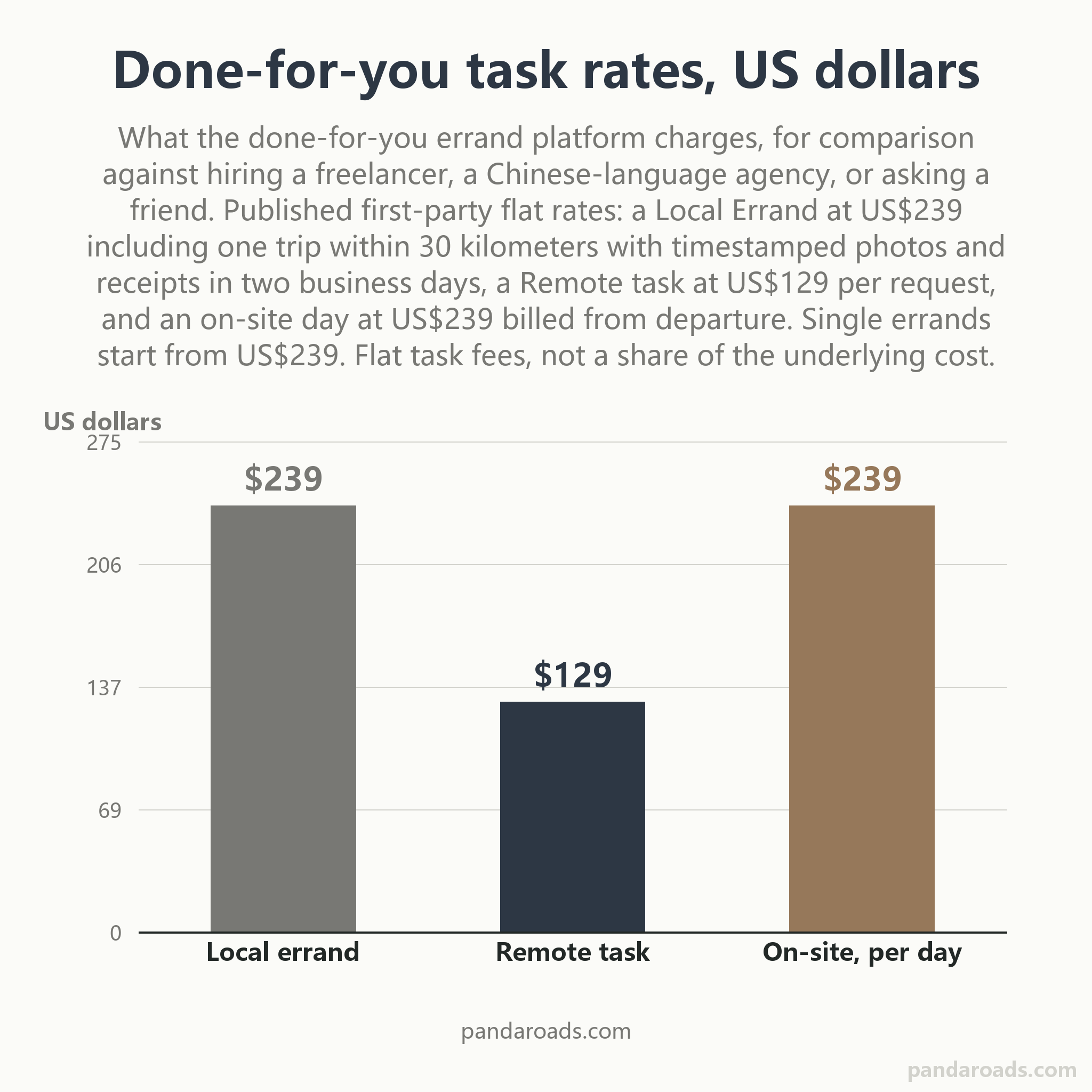
There are four defensible ways to get a physical thing done in China while you are abroad, and you pick between them the way you would pick any vendor. A managed done-for-you service charges a fixed task fee and returns evidence files. A freelance marketplace hire is an individual from an Upwork, Fiverr, or TaskRabbit-style board. A licensed professional, a law firm, a notary-backed corporate services firm, or a China-facing advisory of the kind that publishes under the China Briefing name, handles anything that turns on an authorization chain or a formal filing. Or DIY fly-out: you get on a plane and do it yourself. The deciding question is transactional. Does the job need a licensed actor and provable written authority, or does it need only a person who can stand in a queue and send back a photo?
The managed service is the closest thing here to a standard contract, and PandaRoads is one. Scope, price, and the report you get back are fixed before anything is charged, the fee is flat per task rather than a cut of what you spend, and the deliverable is an evidence file: timestamped photos, itemized receipts, and a short written report (source: pandaroads.com). A freelance hire found on a task board or a city expat group is usually cheaper for one simple pickup or drop, and it is sold exactly that way, as a gig, not as a service with a scope of work. There is no standard deliverable and no insurance behind the person, and if something goes wrong your recourse is the marketplace's dispute process and whatever review trail that seller has built. A law firm or corporate services firm quotes in English, papers everything, and can act where a licensed hand is required, an authorization chain, a court filing, or a registry appearance; you are buying a signed engagement letter and a professional liability backstop, billed by the hour or by the matter, typically well above a task fee. And you can always go yourself, a round-trip airfare, several days of leave, hotel, ground time, and the language barrier on the day, which is a straight return-on-investment question against the other three rather than a fallback.
The four hire paths, compared on what a buyer checks
| Hire path | Written scope and invoice | Payment protection | Proof returned | Liability and review trail | Time cost |
|---|---|---|---|---|---|
| Managed done-for-you service | Fixed scope quoted up front, itemized receipt | Flat task fee, approved before charge | Timestamped photos, itemized receipts, written report | Named account and order history; not a licensed actor | Low, days |
| Freelance marketplace hire | Gig listing, often no formal scope | Marketplace escrow or pay on completion | Whatever the freelancer chooses to send | Marketplace dispute and star ratings; no insurance | Low to medium |
| Licensed professional (firm) | Signed engagement letter, itemized bill | Retainer plus milestone billing | Formal filings and legal instruments | Professional liability and bar discipline | High, weeks |
| DIY fly-out (go yourself) | None, you are the vendor | Your own card and cash | You see it done firsthand | You carry all the risk | Highest, a whole trip |
Read that table on the columns a buyer actually checks: what is written down before money moves, how you pay, what proof comes back, and who is on the hook if it does not get done. The gig hire wins on price and loses on scope, proof, and recourse. The licensed firm wins on the authorization chain and costs several multiples more and runs in weeks. The managed service is the only one of the three whose default output is an evidence file you can act on from another country at a flat, itemized price (source: pandaroads.com). DIY fly-out returns the most certainty and the least leverage, because you are both the buyer and the worker. Choose on the deliverable and the paper trail first, then on price.
For the specific ask where you are booking a table or a small gathering for others to attend, the delegation and the +86 presence problem are laid out in hiring someone in China by the day.
Step two: pay for the job without a Chinese bank card
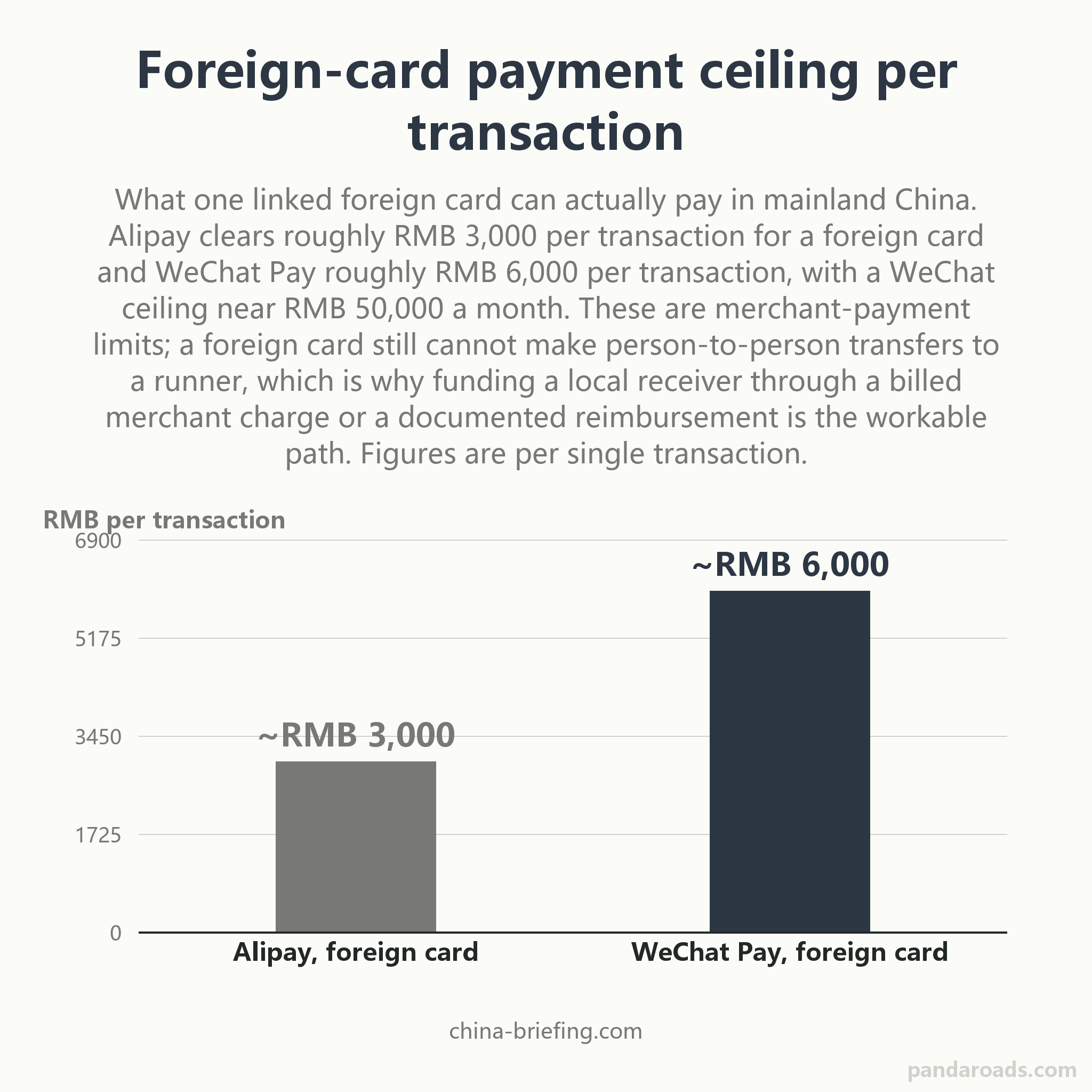
Alipay caps a linked foreign card at roughly RMB 3,000 per single transaction and WeChat Pay at about RMB 6,000 per transaction with a monthly ceiling near RMB 50,000, so funding an errand from abroad runs through a merchant checkout plus a locally fronted spend, never a direct transfer to the runner (source: china-briefing.com).
The wall that stops most buyers is not language, it is money movement. A foreign principal in another country usually holds no Chinese bank account, and the fastest-seeming fix, sending money straight to the local person through Alipay or WeChat, is the one move the system forbids. Foreign cards linked into those wallets are cleared for merchant payments only and explicitly do not support red packets or direct person-to-person transfers (source: china-briefing.com). You cannot simply Venmo your runner.
The ceilings are real and small. Alipay allows a maximum of roughly RMB 3,000 per single foreign-card transaction, while WeChat Pay allows up to roughly RMB 6,000 per transaction with a monthly cumulative limit near RMB 50,000; a fee under RMB 200 is waived and about a 3 percent fee applies above that threshold (source: china-briefing.com). Those numbers are per transaction, and they are for paying a store or a service, not for funding a stranger's cash flow on your errand.
Funding paths that actually work from abroad
| Path | What it can fund | Ceiling from a foreign card | Works to pay a runner? |
|---|---|---|---|
| Foreign card linked in Alipay / WeChat | Merchant and store payments | ~RMB 3,000 (Alipay), ~RMB 6,000 (WeChat) per transaction | No, it blocks P2P transfers |
| Merchant checkout on a platform | The platform's own fixed task fee | Set by the platform's USD checkout | Yes, you pay the fee, not the errand cash |
| Runner fronts the local cost | The on-the-ground RMB spend, repaid later | Not a card path at all | Yes, with itemized receipts and one flat fee |
| Overseas bank transfer to a local person | A large sum, days later | Wire limits, not wallet limits | Slow, and needs a domestic account |
The path most absent principals land on is the middle two. You pay a flat task fee through a platform's normal card checkout, in USD, which a foreign card clears without trouble because it is a merchant charge (source: pandaroads.com). The on-the-ground RMB spend, the certificate fee, the courier, the meal, is fronted by the person standing there and reimbursed inside that same flat fee with the itemized receipts returned to you, so no foreign card ever has to reach a domestic wallet directly. For a bigger or riskier sum, the honest answer is that a slow wire to a trusted domestic account beats a fast transfer you are not allowed to make.
Step three: make your authority provable
Making a foreign-signed power of attorney provable changed on November 7, 2023, when China joined the Hague Apostille Convention, so most documents now need one apostille from a provincial Foreign Affairs Office instead of the old notarize-then-consular-authenticate chain (source: lawandborder.com).
A runner standing at a government counter needs one thing the photo of your passport does not give them: proof that you authorized this specific person to act. In Chinese practice that proof is a power of attorney, a 委托书, and how you make it valid from abroad changed recently and in a way most older guides miss.
Until late 2023, a power of attorney signed overseas had to be notarized in the country where you signed it and then authenticated by a Chinese embassy or consulate, a slow consular chain. China acceded to the Hague Apostille Convention on November 7, 2023, and for most documents an apostille issued by a provincial Foreign Affairs Office now replaces that consular authentication (source: lawandborder.com). One link in the chain disappeared; the practical detail that survived is filing, which is still usually an in-person appointment, processed at a published RMB tier and mailed within China but not internationally (source: lawandborder.com).
There is a second route that never existed in the older guides. For court-appointed authority specifically, the Supreme People's Court provisions effective February 2021 let a verified overseas party sign the power of attorney in an online video session witnessed by a judge, so the person abroad is authenticated live instead of through the paper chain (source: chinajusticeobserver.com). Outside litigation, some provinces have pushed remote notarization itself online, using identity verification, video, and e-signature so that overseas citizens can apply for notary services under the One Visit at Most program (source: en.moj.gov.cn).
The practical read is short. For an ordinary errand, a signed and apostilled power of attorney naming your person and the task is the workhorse, and the November 2023 change made it meaningfully faster to produce (source: lawandborder.com). For a court matter, ask whether the online video-verification path applies before you mail anything. For a notarial act, check whether the specific province supports the remote flow. The thing you never skip is naming the exact authority: which office, which document, which dates, and the identity number of the person who will stand at the counter.
Step four: verify the thing was actually done
Verification means a paid runner returns timestamped photos, the original itemized receipts, and a written English report naming which office, which document, and which date, plus the +86 number they used so an agency callback reaches a real line. A text message saying the task is done is not a deliverable (source: pandaroads.com).
Verification is the part a casual arrangement never gives you and a contracted service must. The standard is not a message that says it is done; it is an evidence file you can read from another country and act on. A legitimate runner hands back timestamped photos of the document or the delivery, the itemized receipts, and a short written report to a fixed standard, in English, naming what was submitted, to which office, on what date, and what comes next (source: pandaroads.com). That returned artifact, not a text bubble, is the deliverable, and it is where the four hire paths diverge most. A managed service returns it by default, a gig returns it only if you demanded it in the work order, a firm returns formal filings, and DIY returns only your own memory of standing there.
The verification habit is a checklist, and it belongs in the agreement before money moves, not after a problem:
- Agree the deliverable in advance: the exact photos, the itemized receipt, and the report you expect back, written into the scope or work order before anything is charged.
- Pay in stages or on evidence, never a full sum to an unproven party before anything is collected; use escrow or milestone billing when the marketplace or the firm offers it.
- Ask for the office stamp or the tracking number, the durable identifiers a bureau or courier produces anyway.
- Confirm the +86 number the person used, so an agency calling back reaches a line that exists.
- Keep the written report as the record you re-use; a task done once should leave paper for the next time.
The recurring buyer question across expat forums is how to hold a standing obligation at distance with someone who is not on your payroll. One poster on r/expats put that plainly:
"How do you manage aging/disabled parents while living abroad?" r/expats, 2025-11 (source: reddit r/expats, 2025-11)
Managing a parent's affairs from abroad is the same procedure applied to a recurring engagement: a named party under a written scope, funding controls that do not put you at risk, authority the office accepts, and a written trail you can audit without flying back. The published bar for what a runner returns, and what a proper task report contains, is set out in China task report standards.
Step five: know what cannot be done remotely
Some acts in China are not a delegation problem but a presence problem, and they fall into 2 kinds: steps that capture your biometrics or identity, and filings a registry or notary requires you to attend in person. A foreign national opening a bank account will very probably have to visit a branch in person (source: wise.com).
A method is only credible if it says where it stops. Some things in China are not a delegation problem at all, because the system reserves the act for your physical body, and no managed service, freelance hire, licensed firm, or power of attorney can substitute for you in the room.
The clearest one is money at the source. A foreign national opening a Chinese bank account will very probably have to walk into a branch in person, present the passport and residence paperwork, and complete on-site identity steps; it is not a form you file from another country (source: wise.com). The same logic runs wherever identity is captured rather than checked. Any step that records your biometrics, or that a registry or notary requires you to appear for, is a presence task, not an errand. Certain document filings keep an in-person appointment even after the apostille change (source: lawandborder.com). And a handful of applications, licenses, and collection of specific original certificates turn on a counter that wants to see the applicant.
The distinction to hold in your head is between authority and presence. A power of attorney transfers authority: it lets someone else act on your behalf where acting is the point. It does not transfer presence, and it cannot where the law wants the person, the face, or the fingerprint. Every delegable errand lives on the authority side of that line; the items above live on the presence side and no amount of cleverness moves them. Recognizing which side your task sits on is worth more effort than finding a runner, because it stops you paying to attempt something that structurally requires a flight.
A fast way to judge: can this specific task be delegated?
A fresh request can be sorted with 3 quick questions in order: does the act capture your identity rather than just check it, does it belong to a licensed actor such as a notary office, Foreign Affairs Office, court, or registry, and does success depend on someone holding a reachable +86 presence. Two yes answers on the first two mean you are comparing a licensed professional against a flight, not picking a runner.
When a fresh ask lands, run it through three questions in order, and the answer usually arrives before the third. Each question maps to one of the parts of the method above, and together they separate a delegable errand from a presence-only filing.
First, does the act require your identity to be captured, not just checked? A biometric, a facial capture, or a counter that wants the applicant in person is a presence task, and the answer is no, book the flight or find the one remote channel the authority actually publishes. Second, does the act belong to a licensed actor? Notarization, consular or apostille issuance, court filings, and property title transfer belong to notary offices, Foreign Affairs Offices, courts, and registries; a runner can prepare, queue, deliver, and witness a document chain, but cannot perform the licensed act itself, so on this branch you weigh a licensed firm against going yourself, not against a gig. Third, does success depend on a reachable local number or a person answering a callback? If so, it is delegable to someone who genuinely holds that presence, which is exactly what a paid local runner supplies.
If the task clears all three, it is an errand, and Step one picks the hire and Step two funds it. If it fails the first or second, it is a presence or licensed task, and your real choice is a licensed professional or a flight, weighed on cost and time. If it fails only the third, it is delegable to a person on the ground, which is the ordinary case this method is built for. Hold the three questions; they are the whole judgment in miniature.
Common tasks, and where each one is actually handled
This is a routing index, not a catalog. The method above is general; the scenes below are specific, and each already has its own how-to. The point of this table is to tell you, in one line, whether the thing you have in mind is remote-delegable and where the step-by-step lives, so you leave this page to the right place. For the full list of scenes, the hub is Getting things done in China from overseas.
Six common task families split between delegable and presence-only, and each links to its own how-to here. Sending a hot meal or groceries to family is a merchant-order errand, while collecting a certificate or document is mostly delegable with a power of attorney. The 2 families that fail the routing test, a bank account and a biometric filing, need you in person, not a runner.
Task families, the delegation call, and the guide
| Task family | Delegable from abroad? | Where the how-to lives |
|---|---|---|
| Send a hot meal or groceries to family | Yes, a merchant-order errand | Send food delivery to family in China |
| Book a table or small gathering for others | Yes, but needs a +86 presence | Order a birthday banquet for parents |
| Pick up or collect a certificate or document | Mostly, with a power of attorney | Report and evidence standards |
| Meet someone at an airport or escort a parent to a hospital | Yes, a by-the-day presence | Airport pickup and hospital escort in China |
| Operate a local app you cannot log into | Yes, with setup help | China apps download and install guide |
| Read a booking or map screen in Chinese | Yes, with translation help | How to use AMap in China |
The two rows that fail the routing test, a bank account and a biometric filing, are named honestly in Step five rather than here, because the honest answer to those is not a link but a date on a plane. Where the licensed line sits for any errand is stated in what a China agent will not do.
The honest boundary: what a runner can and cannot stand in for
A China errand service has a hard ceiling, and the honest version names it: a runner can accompany, queue, collect, photograph, courier, translate, and witness a document chain, but 4 acts stay with licensed authorities. Notarization belongs to a notary office, an apostille to a provincial Foreign Affairs Office, a court filing to a judge, and a title transfer to the registry (source: pandaroads.com).
A good errand service is candid about its ceiling, and the candor is the point of this page rather than a disclaimer. A runner on the ground does the physical and administrative legwork: accompanying a parent, standing in the queue, collecting the document, photographing the result, couriering the package, translating the counter, and witnessing a document chain from your door to the office. What a runner does not do is perform acts reserved to a licensed authority.
Notarization is done by a notary office, 公证处. An apostille is issued by a provincial Foreign Affairs Office. A court filing is filed before a court, and title transfer is recorded by the registry. A power of attorney authorizes a runner to carry those documents and stand in line with them; it does not make the runner the notary, the judge, or the registrar, and any service that implies it can is telling you something false (source: pandaroads.com). The published limits of the service are stated plainly on what a China agent will not do, and they should be read before you brief any errand, this one or anyone else's.
This is the line that keeps a method from becoming a sales pitch. Steps one through four widen what you can genuinely arrange from another country. Step five and this section mark where the widening stops, so that the four parts you do hire for are hired with clear eyes.
Frequently asked questions
How can I get something done in China if I am not there? Pick who acts as a hire, not a favor: a managed service, a freelance gig, a licensed professional, or flying out yourself, then fund the job within a foreign card's merchant limits, make your authority provable with a power of attorney or apostille, verify with timestamped photos and a report, and accept that some acts need your presence (source: pandaroads.com).
Can someone act on my behalf in China with a power of attorney? Yes for tasks where acting is the point. A signed 委托书 naming the person, the office, and the authority is the workhorse, and since November 7, 2023 it usually needs an apostille from a provincial Foreign Affairs Office instead of the old consular authentication (source: lawandborder.com).
How do I pay for a task in China from overseas without a Chinese bank card? Do not try to send the runner money wallet to wallet, since foreign cards are merchant-only and block person-to-person transfers (source: china-briefing.com). Pay the platform's flat task fee through its card checkout, and let the local RMB spend be fronted and reimbursed with itemized receipts.
Which things in China require me to be there in person? Anything that captures your identity rather than checks it, such as opening a bank account, which a foreigner usually must do at a branch, plus biometric steps and certain in-person registry or notary filings (source: wise.com).
Can I get a Chinese document notarized or apostilled from abroad? You prepare it from abroad, but the act has a physical end. An apostille is issued by a provincial Foreign Affairs Office and filing is usually an in-person appointment (source: lawandborder.com). Some provinces now offer remote, video-based notarization for eligible applicants (source: en.moj.gov.cn).
Is it safe to hire a stranger in China to handle money for me? Only within limits. Pay a fixed task fee through a merchant checkout, not a large cash sum to an individual, and prefer a service that puts the scope and the receipt in writing, since foreign cards cannot make the direct transfers a scam needs anyway (source: china-briefing.com).
How do I verify that a task in China was actually done? Demand proof before payment, not after: timestamped photos, the original itemized receipt or invoice, a tracking or filing number, and a short written report naming what was submitted, to which office, and on what date (source: pandaroads.com).
What is remote video notarization in China? It is an online notarization path that uses identity verification, video, and e-signature so an overseas applicant can apply for notary services without traveling, rolled out under the One Visit at Most program in provinces such as Zhejiang (source: en.moj.gov.cn).
Who can I trust to run an errand in China: an agency, a freelancer, or a friend? Judge the hire on the paper, not the person. Ask for a written scope, an itemized invoice, payment in stages or escrow, and a proof standard. A licensed firm brings a contract but costs the most, a gig is cheapest with the thinnest trail, and a managed service returns an evidence file you can act on from abroad (source: pandaroads.com).
How do I give a local person in China my address and details safely? Share the minimum the task needs, in writing, through the platform's order rather than a personal chat, and put authority in a named power of attorney instead of handing over passport scans and account access to an individual you have not verified (source: pandaroads.com).
The bottom line
Getting something done in China from abroad is a procedure with a hard edge, not a favor you hope someone grants. Pick the hire on the deliverable and the paper trail, contract, itemized invoice, payment protection, proof standard, liability, and time cost, before you pick it on price, and treat flying yourself as the fourth option worth a straight return-on-investment check against the other three. Fund it the way the system allows, a flat merchant charge plus a locally fronted spend, since a foreign card cannot send a runner money directly (source: china-briefing.com). Make authority provable, now mostly through a November 2023 apostille rather than the old consular chain (source: lawandborder.com). Verify with timestamped photos, itemized receipts, and a written report. And respect the line: a bank account and any biometric step are presence tasks, not delegation puzzles.
For the scenes themselves, start at the hub of things you can do in China from overseas, pick your task, and when the job is real and needs a person on the ground, send the city, the task, and the deadline for a fixed itemized quote you approve before anything is charged.
References
- China Briefing. (2023, July 24). WeChat enables foreigners to pay with overseas cards in China. China Briefing. https://www.china-briefing.com/news/wechat-enables-foreigners-to-pay-with-overseas-cards-in-china/
- Chodorow Law Offices. (2023, October 8). China joins Hague Apostille Convention. Law and Border. https://lawandborder.com/china-joins-hague-apostille-convention/
- Du, G., & Yu, M. (2021). Online verification streamlines overseas power of attorney in China. China Justice Observer. https://www.chinajusticeobserver.com/a/online-verification-streamlines-overseas-power-of-attorney-in-china
- Ministry of Justice of the People's Republic of China. (2023, January 10). Zhejiang advances online notary services. EN.MOJ.Gov.CN. https://en.moj.gov.cn/2023-01/10/c_846818.htm
- Wise. (n.d.). How to open a bank account in China as a foreigner. Wise Blog. https://wise.com/en-cn/blog/how-to-open-a-bank-account-in-china-as-a-foreigner
- PandaRoads. (2026). China sourcing & local task service [Service page]. PandaRoads. https://pandaroads.com/china-tasks.html
Last reviewed and updated: October 2026. Author: our editorial team. For tailored guidance, contact our team.