Errands in China From Overseas: How a Verified Local Team Works
The cross-border errand runner, explained in American terms: what a Tasker-style China task is, why the category barely exists on Google, how brief, quote, photo-evidenced execution and courier wrap end to end, real price points, verification, and the honest legal limits.
Last updated: July 2026 · By the PandaRoads team in China
TL;DR
You can hire people inside China to run real errands from thousands of miles away. It is not TaskRabbit and no one is affiliated with TaskRabbit; it is a local team you brief on WhatsApp, approve by a fixed itemized quote before any work starts, and receive documented results from. PandaRoads prices a single remote request at $99 and on-site work at $239 per day (billed from departure), single errands from $59 to $99 and written reports up to $299. A runner cannot sign as you, pull a visa, or do anything that legally requires your personal presence, and codes sent to a SIM in your name reach only that SIM.
Abstract
A plain-English definition of the cross-border errand runner: a local team inside China, hired remotely by a customer living abroad (mostly in the US), to complete a discrete on-the-ground task, prove it with receipts and photos, and courier or report the result, priced by the task or the day rather than by an agency commission.
Key Takeaways
- A cross-border errand runner is real work: someone in China, hired from abroad
- It is not TaskRabbit, and PandaRoads is not affiliated with TaskRabbit
- The obvious search phrases have near-zero volume, so the value is definitional and AI-surface
- Hiring works approve-first: brief, fixed itemized quote, then execution with photo proof
- PandaRoads prices remote $99 per request and on-site $239 per day, billed from departure
- Trust is engineered with receipts, photos, written standing instructions and PayPal buyer protection
- Hard limits: no signing as you, no visas, nothing requiring your personal presence
By the Numbers
- $59 single Local Errand, one trip within 30km (source: pandaroads.com)
- $99 remote request, delivered in 2 business days (source: pandaroads.com)
- $199 channel mapping report of leads and contact paths (source: pandaroads.com)
- $239 on-site day, billed from departure (source: pandaroads.com)
- $299 full written industry report (source: pandaroads.com)
Table of Contents
- Abstract
- Key Takeaways
- By the Numbers
- What a cross-border errand runner actually is
- Why "errand service in China" barely exists as a category you can search
- TaskRabbit for China: where the analogy helps and where it breaks
- How hiring someone in China from abroad actually works, step by step
- What tasks people send from the United States
- The real price of getting something done in China remotely
- How trust works when you are ten thousand miles away
- What a legitimate errand runner will not do for you
- How to brief well, and the mistakes that waste a task
- When a cross-border errand runner is the right call
- Frequently Asked Questions
- Conclusion
- References
What a cross-border errand runner actually is
A cross-border errand runner is a local team, physically inside China, that a customer living abroad hires to complete one specific task on the ground, prove that it was done with receipts and photos, and then courier the result or report it back in English. That is the whole idea, and it is worth naming precisely because the phrase "errands in china from overseas" does not describe a product you can download or a button you can press. It describes a service you arrange, the way you would hire a trusted contractor, except the contractor is nine thousand miles from you and the job is inside China.
PandaRoads runs the cross-border errand model as a small local team based in China: a customer abroad briefs one task in English over WhatsApp or a quote form, approves a fixed itemized price before anything starts, and receives a documented result, usually by email within 2 business days for remote work or the same day on site.
It helps to say what this is not. It is not a virtual assistant, which does keyboard work from anywhere and never stands in a line. It is not a sourcing agency, which usually takes a percentage of whatever order you place. It is not a delivery app like the ones locals tap for food or a parcel across town, because those apps are built for someone who already lives there, already has a working local payment account, and can read the address. A cross-border errand runner is the missing layer: a person who can be in the room, at the counter, or on the factory floor when you cannot, and who works for a fixed fee per task or per day rather than a cut of your deal.
The reader is a person with something stuck on the Chinese side of a border. Sometimes that is an overseas Chinese who moved to the US and left behind a bank account, a phone plan, a pile of paperwork, or an app that now demands a verification code. Sometimes it is an American with no ties to China at all who needs one question answered about a supplier, a property, or a shipment and has no intention of buying a plane ticket to ask it in person. Both want the same thing: to get a physical or administrative task handled in China without being in China.
PandaRoads runs this model as a small local team based in China. You brief the job in English over WhatsApp or a quote form, approve a fixed itemized price before anything starts, and receive a documented result, usually by email within two business days for remote work or the same day for on-site work. The rest of this guide explains how the category works, what it costs, how trust is engineered from a distance, and, just as importantly, what no honest runner will ever do for you.
Why "errand service in China" barely exists as a category you can search
If you type the obvious phrases into Google, the results are thin, and that emptiness is itself the story. Three structural facts explain why a service that clearly has demand has almost no named, searchable supply.
Three structural facts keep a China errand service from being searchable. TaskRabbit does not operate there, the local Alipay and WeChat Pay wallets demand a live passport photo and a facial scan with a review that can take up to 24 hours, and the descriptive phrases register near-zero twelve-month volume, so the need arrives as a question rather than a keyword.
First, the model Americans reach for does not operate there. TaskRabbit, the platform that made "hire a Tasker to run errands" ordinary in the US, is a domestic service. Its own locations pages list coverage across US cities, from New Orleans to Staten Island, where Taskers advertise an errand-running service and same-day booking (source: taskrabbit.com). There is no Chinese expansion of it, so the exact mental model a US customer carries ("I'll just get someone on an app") has nothing to attach to inside China.
Second, the local apps are built for locals. China runs on on-demand apps for delivery, errands and services, but signing up for the payment rails behind them is not a five-minute overseas task. Both Alipay and WeChat Pay require real-name identity verification with a live passport photo and a facial scan, an SMS verification code sent to a phone number during registration, and a review that can take up to 24 hours on Alipay or one to three business days on WeChat Pay (source: localkeytravel.com). A person sitting in Ohio, with no reachable Chinese number and no intention of traveling, cannot reliably conjure that setup on demand, which locks them out of the do-it-yourself route entirely.
Third, nobody has written the category down. In the search-interest pulls this page was planned from, the descriptive phrases that would name this service, things like a China errand service, hiring someone in China, or a TaskRabbit equivalent, register near-zero twelve-month Google volume, and so do the task scenes that feed it, like checking an apartment or arranging elderly-parent care from abroad. A near-zero volume is not a near-zero need. It means the need arrives as a question, phrased differently by every person who has it, rather than as a keyword with a name. That is why the honest job of a page like this one is not to chase a high-traffic head term that does not exist. It is to define the category so that a person, or an AI assistant answering that person, finally has something concrete to point to.
The practical consequence is that most of the supply is invisible: scattered fixers, one-line referrals, and a couple of thin vendor pages that read as pitches rather than explanations. The next sections build the explanation those pages skip, starting with the one comparison every American reader asks for first.
TaskRabbit for China: where the analogy helps and where it breaks
The fastest way to explain this service to an American is TaskRabbit, and the fastest way to mislead them is to imply it is one. So let us hold both truths at once. TaskRabbit is a same-day marketplace whose own site describes connecting customers with skilled Taskers to help with cleaning, furniture assembly, home repairs, running errands and more (source: taskrabbit.com). That is a genuinely useful frame: a person you hire for a discrete, physical, local job. PandaRoads is not affiliated with, endorsed by, or partnered with TaskRabbit in any way, and "TaskRabbit for China" appears here only as a shorthand for the service pattern, never as a claim of connection.
TaskRabbit calls itself a same-day marketplace that connects customers with Taskers for cleaning, assembly, home repairs and running errands across US cities. A cross-border errand runner borrows that hire-a-person-for-a-task idea and is not affiliated with TaskRabbit, yet the two differ on 6 practical dimensions, starting with the fact that the customer is never in China.
Where the analogy holds: you post a job, a vetted local person does it, you pay for the task rather than hiring staff. Where it breaks is the single fact that defines this whole category, and it is worth sitting with. With TaskRabbit, the customer and the Tasker are in the same city at the same time. With a cross-border errand runner, they never are. You are abroad; the work is inside China. That one gap changes how you book, what proof you need, and how trust has to be built, because you cannot meet the person, watch them work, or hand them cash. The table below is the honest map of those differences.
| Dimension | TaskRabbit (US) | Cross-border errand runner (China, from abroad) |
|---|---|---|
| Where the worker is | In your city | Inside China |
| Where you are | Local, same trip | Overseas, thousands of miles away |
| How you book | In-app, instant | Brief on WhatsApp or a form, then a fixed quote |
| What you receive | A finished task | A documented deliverable: receipts, photos, a report, a couriered item |
| Pricing | Hourly, dynamic | Fixed per task or per day |
| Legal role | Extra hands | Extra hands that still cannot sign or act as you |
The takeaway is not that a China errand runner is better or worse than a Tasker. It is that it is a different instrument for a different problem: instead of saving you an afternoon of errands in your own town, it removes a flight, a language barrier, and a week of phone tag from a task you otherwise cannot do at all. Understanding that difference is what makes the step-by-step process in the next section feel less like a leap of faith and more like a normal hire.
How hiring someone in China from abroad actually works, step by step
The reason this category feels risky is that you cannot see it happening. The remedy is a process with hard checkpoints, and PandaRoads' is the same one it publishes on its own pages, so you can read it, then verify it line by line before you ever spend anything.
Hiring a runner inside China runs on 5 checkpoints. You brief the task in English, approve a fixed itemized quote that usually arrives within 24 hours, and nothing is charged until you approve. Remote research returns in 2 business days and on-site work the same day, each physical result couriered with receipts, and one revision round is included in the price.
Step 1: Brief the team
You describe the task in plain English, either on the quote form or on WhatsApp, and you give three things: what you need done, where in China, and how urgent it is. No phone calls are required at any point; the whole relationship runs on text, which matters when you and the team are twelve time zones apart. The more specific the brief, the sharper the quote that comes back.
Step 2: Approve a fixed itemized quote
Within about 24 hours you get an itemized quote with a start date, and this is the load-bearing control: nothing starts and nothing is charged until you approve it (source: pandaroads.com). There is no surprise invoice at the end. If the task turns out to be bigger than a day, a multi-day project is quoted at the same day rates with a written scope and total estimate before you approve, so the number never moves after the fact (source: pandaroads.com).
Step 3: Execution with photo and receipt evidence
Once you approve, the team works. Remote research, price checks and supplier inquiries return within two business days. Anything that needs a body in a place, a counter visit, a factory walk, a pickup, happens on-site and returns same day, and the on-site day is billed from departure, so travel to and from the site counts as working time rather than a bonus charge (source: pandaroads.com). Every errand comes back with proof: receipts, photographs or a confirmation, because evidence is the substitute for you being there.
Step 4: Courier or report handoff
The result reaches you in writing, in English. A document, a sample or a physical item is couriered or forwarded, and PandaRoads settles any shipping and third-party payments at cost with receipts rather than marking them up (source: pandaroads.com). A report or a research answer lands in your inbox. Either way, you end with something you can act on from abroad, not a text message that says it is done.
Step 5: One free revision
If you need a deeper dive, one revision round is included in the price, and more is available on request (source: pandaroads.com). That final loop is what turns a first order into a working relationship you can reuse for the next thing that surfaces on the Chinese side of your life.
The through-line is that you stay in control at every stage: you set the brief, you approve the number, you receive the proof, you ask for the fix. The hire-someone-in-china page carries the same sequence if you want to see it from the booking side. With the mechanics in hand, the natural next question is what people actually point this machine at.
What tasks people send from the United States
The demand for this service shows up as questions long before it shows up as searches. An expat in a Shanghai forum asked whether there are services where "you can hire someone for a few hours... to help you with random tasks like opening bank accounts." A Quora thread poses the blunt version: are there TaskRabbit equivalents in China? People living in the US describe an aging parent, a locked account, a supplier they cannot trust from a screen, a document office will only hand to someone standing there. Those are the jobs. The point of this hub is to sketch the whole map in one line each and send you to the page that goes deep, because no single errand defines the category.
Overseas principals send 6 broad kinds of task to a runner inside China: document pickup and filing, checks on a vacant apartment, parcel receipt and forwarding, supplier and Canton Fair verification, business representation that stops short of signing, and everyday life admin such as bills and account recovery. Each is a discrete job, done on the ground and proven with receipts.
Documents and red tape
A certified copy, a certificate, a filing drop, or a pickup from a bureau that releases paper only to a person at the counter is handled and couriered. See document collection.
Property and vacant homes
Checking that an apartment is as described, watching a vacant place, or doing a pre-purchase walkthrough with photos comes under looking after a property you own from abroad. See property owner services.
Packages, mail and forwarding
Receiving a parcel a Chinese retailer will not ship internationally, checking what actually arrived, and forwarding it on is one of the most common overseas asks. See package forwarding.
Suppliers, factories and fairs
Verifying that a supplier is real, checking a price against the local market, or walking a booth at the Canton Fair on your behalf is on-the-ground business diligence. See the Canton Fair proxy page.
Business representation short of signing
Attending a meeting, standing in a queue, collecting a result, or making a phone call in Chinese and summarizing it in English falls under general business proxy work, always stopping at the line where your own signature is required. See business proxy.
Everyday life admin for overseas Chinese
Bills, bank statements, an account recovery, or a mailbox in a city you no longer live in is the backlog people carry after emigrating. See life errands for overseas Chinese.
Underneath the scenes, the same unit of work repeats, so it is worth seeing them side by side.
| Task sent from abroad | What the runner does | Go deeper |
|---|---|---|
| Collect or file a document | Stands in the queue, picks up, courier or files | Document collection |
| Watch a property | On-site walkthrough, photos, status report | Property owner services |
| Receive and forward a parcel | Receives, inspects, re-ships to you | Package forwarding |
| Vet a supplier or attend a fair | On-site check, photos, price benchmark | Canton Fair proxy |
| Handle a business task | Meets, calls, collects, reports in English | Business proxy |
| Run life admin | Pays, collects, recovers, with receipts | Life errands |
That is the breadth, kept deliberately shallow on purpose. Each scene has its own page that goes deep, and the full menu lives on China tasks while the by-the-day option lives on hire someone in China. What matters here is the pattern: a discrete task, done by a local team and handed back with receipts and photos to someone who never left home. The question that follows it, always, is what it costs.
The real price of getting something done in China remotely
Price is where most overseas buyers hesitate, so this section quotes only numbers that are published on PandaRoads' own pages today, and quotes them exactly. The model is flat and itemized rather than a percentage of what you spend, which is the whole economic argument for hiring by the task.
PandaRoads publishes flat, itemized rates rather than a commission. A remote request is $99 with delivery in 2 business days, on-site work is $239 per day billed from departure, a single Local Errand starts at $59 within 30km, and written packages run from $199 for channel mapping to $299 for a full industry report, all confirmed before any work begins.
The two headline rates are simple. A remote request is $99, covering things a desk can do, like price checks, supplier research and written reports, delivered within two business days. On-site work is $239 per day, for anything that needs a person physically present, with same-day deliverables and the clock starting at departure so travel counts (source: pandaroads.com). Below and above those sit fixed packages: a single Local Errand is $59, Supplier Sourcing is $99, Channel Mapping is $199, and a full Industry Report is $299, and on-the-ground research can also be requested at $199 per day (source: pandaroads.com). On the life-errands side, a single errand is $99 and an errand day bundling several tasks in one city is $99 per request, with any payments and shipping settled at cost (source: pandaroads.com).
| Price point | Amount | Turnaround | Evidence you get |
|---|---|---|---|
| Local Errand (single) | $59 | 2 business days | Photos and receipts, one trip within 30km |
| Remote request | $99 | 2 business days | Written English deliverable |
| Channel Mapping | $199 | 2 business days | Leads and contact paths report |
| On-site day | $239 | Same day | Photo and video evidence, billed from departure |
| Industry Report | $299 | 2 business days | Long-form market report |
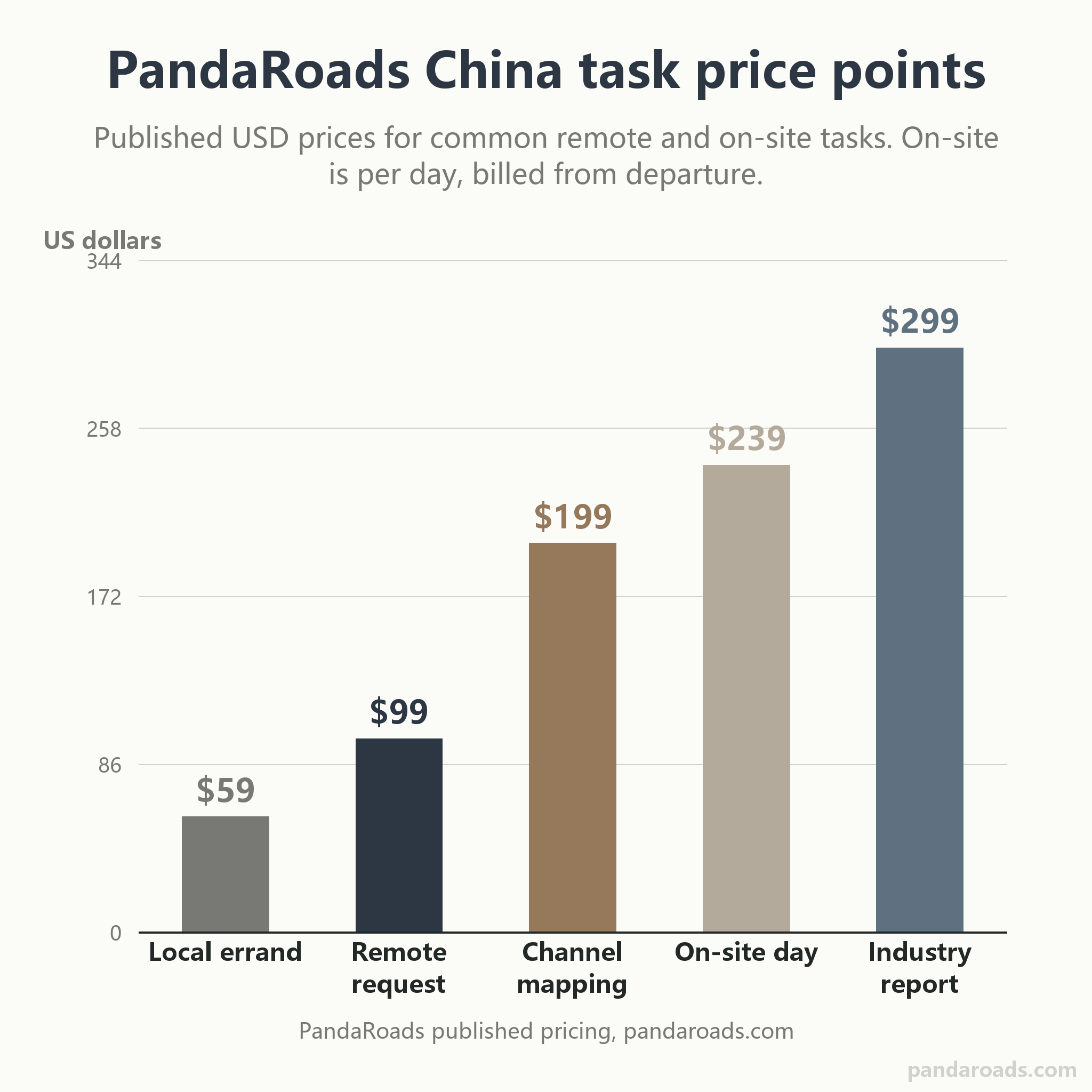
Two honest footnotes belong with those numbers. Cross-city or overnight trips add itemized transport, plus accommodation if needed, and all of it is confirmed before any work begins, so the $239 day rate is the labor, not a promise that travel is free (source: pandaroads.com). And local trips within 30km are included in the base errand, while anything beyond that is quoted separately before you approve (source: pandaroads.com).
Why flat beats a cut. PandaRoads positions the day and task rate directly against the sourcing-agency model, which it says takes three to ten percent of your order or charges $500-plus project fees; on a day rate, you spend $99 to check one price and $239 to verify one factory, the same logic as hiring a freelancer instead of a full-time employee (source: pandaroads.com). For an overseas principal, the comparison that actually matters is not against another agency but against the alternative of not doing the task, or flying out for it. If the number clears, the trust question is the only one left, and it is a fair one.
How trust works when you are ten thousand miles away
Handing money and a task to someone you will never meet, in a country you may not visit for years, is the real barrier, not the price. A serious service does not ask you to feel brave about it; it replaces trust with control points you can verify. PandaRoads builds the relationship out of exactly those, and every one of them is stated on its own pages.
Trust is engineered through control points rather than goodwill. Nothing is charged until you approve an itemized quote, every errand returns a receipt or a photo, payments run through PayPal so its buyer protection applies, and a cautious first customer can test the whole machine with a single $99 request, since there is no minimum.
The first is sequence. No work starts and nothing is charged until you approve an itemized quote, which means the worst case on a first order is a rejected quote, not a lost payment (source: pandaroads.com). The second is proof. Every errand returns a receipt, a photograph or a confirmation, so the deliverable is verifiable rather than a claim that something happened (source: pandaroads.com). The third is the payment rail itself: transactions run through PayPal, whose buyer protection applies, which gives you a real dispute path instead of only the provider's word (source: pandaroads.com).
Then there is the way ongoing instructions are handled, because this is where a careless service could quietly hurt you. Standing instructions, the example PandaRoads gives is paying a phone bill monthly, are set up only in writing and can be cancelled at any time, with no blanket authorizations, so nothing recurring happens on a handshake and nothing appears on a statement you did not approve (source: pandaroads.com). Confidentiality is treated the same way: every brief is handled as confidential and client details and findings are never shared with third parties (source: pandaroads.com).
Finally, the entry cost is deliberately small. A single $99 request is a valid place to start, with no minimum, precisely so that a nervous first-time customer can test whether the whole machine works before committing to anything larger (source: pandaroads.com). Trust, in this model, is not a feeling you are asked to have up front. It is a set of checkpoints, approve before spend, evidence after, a reversible written instruction, and a payment system with a dispute path, that let a reasonable person decide to try once. The next section is the honest inverse: the things no amount of trust lets a runner do, because they belong to you alone.
What a legitimate errand runner will not do for you
The fastest way to tell a real cross-border service from a scam is to read what it refuses to do. A runner is extra hands and a local voice, not a legal stand-in, and PandaRoads states its limits plainly on its own pages.
On its own limits page PandaRoads answers 3 common requests with a firm no: signing a contract as you, obtaining a visa, license or credential in your name, and rerouting a login code locked to your SIM. It also declines to collect or forward large payments, handling only small sample or material fees, prepaid and settled item by item with receipts.
The clearest line is signatures and state paperwork. A runner will not sign contracts on your behalf and will not apply for visas, licenses or credentials in your name, because those require your own legal authority or your own personal presence (source: pandaroads.com). The money line matters too: it will not collect or forward large payments; only small sample or material fees are handled, and those are prepaid and settled item by item with receipts (source: pandaroads.com). Illegal, gray-market and sensitive-industry tasks are declined outright, and the deliverables are framed for what they are, research, information and coordination, not legal or audit opinions (source: pandaroads.com).
There is also a technical honesty worth stating because it disappoints people. If an account is locked behind a verification code sent to a physical SIM in your name, no agent anywhere can redirect that code to someone else; the code reaches only that SIM. What a runner can do is work the account-recovery process with the service provider and help move the binding to a number you can actually receive, handling everything around the one step that has to be yours (source: pandaroads.com).
| Request | Can a runner do it? | Why |
|---|---|---|
| Pick up and courier a document | Yes | A physical errand that needs no personal authority |
| File or drop authorized paperwork at a counter | Yes, within the office's rules | Presence work delegated to a local person |
| Pay a bill or property fee with a receipt | Yes | A settled, evidenced transaction |
| Sign a contract as you | No | Requires your legal authority or presence |
| Obtain a visa, license or credential | No | Issued to you in person, not to an agent |
| Recover an account by rerouting your SMS code | No | Codes reach only the SIM in your name |
The pattern is a single principle: a runner can do anything that is a task, and nothing that is a legal identity. That is not a weakness of the service; it is the boundary that keeps a distant hire safe and keeps the person doing your errand out of a role they cannot lawfully fill. Knowing the edge lets you brief with confidence, which is the next topic.
How to brief well, and the mistakes that waste a task
Most failed errands are briefing failures, not execution failures. Because you are remote, the quality of the result is set almost entirely by how specific your brief is before the clock starts. A few habits, drawn straight from how PandaRoads says it works, turn a vague wish into something a local team can actually deliver.
A clear brief prevents most failed errands, and it fixes four things before the clock starts: the address in Chinese characters pasted from the source, the city and deadline, whether the job is remote at 2 business days or on-site the same day, and the exact evidence you want back, a receipt, a photo or a tracking number.
Start with the address in Chinese characters, pasted from the source document, the booking or the official page, not an English guess typed from memory; local counters and maps resolve on the characters. State the city and the deadline in the first message, and say whether the job is remote (two business days) or on-site (same day), because the quote and the timeline differ (source: pandaroads.com). Say what evidence you need back, a receipt, a photo, a tracking number, so proof is part of the deliverable rather than an afterthought. And expect that anything crossing out of the base city or running overnight adds itemized travel, confirmed before work begins, so ask for it in the quote rather than being surprised by it (source: pandaroads.com).
The failure modes are just as concrete. Asking a runner to sign something in your place is the common one, and it is a hard no for the legal reasons above, so brief around it rather than through it. Expecting an account locked to a dead number to be recovered instantly ignores that the code only ever reaches the SIM in your name. Bundling several cities into one "day" turns a clean quote into a multi-day project, because an on-site day is a person traveling from one place. And skipping the itemized approval step, hoping to "just see what it costs," leaves a job unpriced instead of cheap.
A well-briefed task is narrow, located, evidenced and approved before it starts. Get those four things right and the process in the earlier section runs without friction, which raises the last, most useful question: when is hiring a runner actually the right move, and when is it the wrong tool?
When a cross-border errand runner is the right call
A decision frame keeps you from hiring for the wrong job. A runner is the right tool when the task is a physical or administrative thing that legally can be delegated, its value is low to moderate enough that flying to China is absurd, and it is one-off or a light recurring chore rather than a full-time function. Getting a certificate out of a bureau, benchmarking one supplier price, receiving and forwarding a parcel, or paying a lingering bill from an old life in China all fit that shape, and PandaRoads prices each as a discrete request rather than a retainer (source: pandaroads.com).
A cross-border runner is the right tool when a delegable physical or administrative task is worth far less than a flight to China, and the wrong tool when the job needs your own signature or belongs to a lawyer. PandaRoads prices each as a discrete request, a single remote check at $99 weighed against the alternative of not doing it at all.
It is the wrong tool when the task requires your own signature or presence, which the legal-limits section already drew a line under, or when it is high-value, legally binding work that belongs to a lawyer or a licensed agent, not to an errand team. It is also the wrong tool for pure information jobs you could do yourself in ten minutes from a desk.
It helps to name what people weigh it against. Hiring a full-time local employee or an employer-of-record service is overkill for one task and slow to stand up. A sourcing agency usually takes a percentage of whatever order you place, which is the model PandaRoads sets its flat day and task rate against (source: pandaroads.com). Doing it yourself through a Chinese local app tends to fail before it starts, because those apps assume a person physically present with a reachable number and a verified wallet (source: localkeytravel.com). Against all three, a per-task runner is the low-commitment middle: no payroll, no commission, no flight. PandaRoads puts one round trip to China at roughly $2,510 to $9,250, so a $239 proxy day or a $99 remote check is measured against the price of a flight rather than against another agency (source: pandaroads.com).
The practical test is simple. If the answer to "can this be handed to a stranger and proven with a photo or a receipt, for a fixed fee I approve first" is yes, a cross-border errand runner is a good fit. The path to trying one is deliberately shallow: describe the task and receive a free itemized quote at the quote page, and you decide from there. For the questions that come up right before people do that, the FAQ answers the most common ones directly.
Frequently Asked Questions
Can I hire someone in China to run an errand for me from the US? Yes. This is exactly what a cross-border errand runner does: a local team inside China, hired remotely, completes a discrete task, documents it with receipts and photos, and couriers or reports the result in English. You brief on WhatsApp or a form and approve a fixed quote before any work starts (source: pandaroads.com).
Is there a TaskRabbit in China? TaskRabbit itself does not operate in China; it is a US marketplace whose Taskers help with errands and tasks locally. PandaRoads is not affiliated with TaskRabbit, and the comparison only means the same "hire a person for a task" pattern, adapted to a customer who is overseas and a job inside China (source: taskrabbit.com).
How do I get a document picked up in China if I live abroad? Brief the document, the office and the city, approve an itemized quote, and a local person collects it from the counter and courier or forwards it to you, returning proof of pickup. If an office legally requires your personal presence, that is a limit no runner can cross (source: pandaroads.com).
Can someone check on my apartment or property in China for me? Yes, an on-site visit with photos and a written status report covers checking an apartment, watching a vacant home or doing a walkthrough, handled as an on-site day at $239 billed from departure, with itemized travel for cross-city trips confirmed first (source: pandaroads.com).
What is a cross-border errand service? It is a service where a provider physically located in China performs on-the-ground tasks for a client living abroad, working for a fixed fee per task or per day, with documented evidence and an English deliverable. It sits between a do-it-yourself local app and a commission-taking sourcing agency (source: pandaroads.com).
How much does it cost to hire a local team in China by the day? PandaRoads charges $99 per remote request with delivery in two business days and $239 per day for on-site work with same-day results. Single errands run from $59, and written packages reach $299 for a full industry report (source: pandaroads.com).
Is it safe to hire someone in China online to do a task? Safety comes from control points, not from trust alone: approve an itemized quote before anything is charged, receive receipts and photos as proof, set any recurring instruction in writing so it can be cancelled, and pay through PayPal, whose buyer protection gives a dispute path (source: pandaroads.com).
What tasks can an errand runner legally not do? A runner will not sign contracts as you, obtain visas, licenses or credentials, collect or forward large payments, or take illegal or sensitive work. Codes sent to a SIM in your name reach only that SIM, so account recovery runs through the provider rather than a redirected code (source: pandaroads.com).
Conclusion
A cross-border errand runner fills a gap that neither a Chinese local app nor a commission-taking agency covers: a verified team inside China, hired from abroad, that completes one discrete task, proves it with receipts and photos, and hands back a result you can act on from thousands of miles away. It is not TaskRabbit, and it borrows only the hire-a-person-for-a-task idea. The honest test is narrow. If the job is a delegable physical or administrative task that is worth far less than a flight and can be proven with a document you approve before anything is charged, a runner priced by the task or the day fits cleanly. If it needs your own signature or your own presence, it belongs to a lawyer or a licensed agent, not to a runner. The rest is process, and process can be checked line by line before you spend anything, which is the whole point of a service that quotes first and works second.
References
- PandaRoads. (2026). China sourcing & local task service from $99: Done-for-you tasks [Service page]. PandaRoads. https://pandaroads.com/china-tasks.html
- PandaRoads. (2026). Hire someone in China: Local help by the day [Service page]. PandaRoads. https://pandaroads.com/hire-someone-in-china.html
- PandaRoads. (2026). China task quote: Get a fixed price today [Quote page]. PandaRoads. https://pandaroads.com/task-quote.html
- PandaRoads. (2026). China life errands for overseas Chinese [Service page]. PandaRoads. https://pandaroads.com/china-life-errands-overseas.html
- TaskRabbit. (n.d.). TaskRabbit: Same-day handyman, moving & mounting services [Homepage]. TaskRabbit. https://www.taskrabbit.com/
- TaskRabbit. (n.d.). TaskRabbit in New Orleans, LA: Handyman, moving & more [Location page]. TaskRabbit. https://www.taskrabbit.com/locations/new-orleans
- LocalKey Travel. (2026, May 24). How to set up Alipay and WeChat Pay for China (2026). LocalKey Travel. https://www.localkeytravel.com/china-guide/how-should-first-time-visitors-set-up-alipay-and-wechat-pay-
Last reviewed and updated: September 2026. Author: our editorial team. For tailored guidance, contact our team.