How to Import from China: 2026 Costs, Tariffs & Steps
Real landed-cost math for 2026: the new 12.5% Section 301 layer, suspended de minimis, current shipping rates, and the 7-step path US importers actually use.
Last updated: September 2026 · By the PandaRoads team in China
Abstract
Importing from China in 2026 means a new 12.5% Section 301 layer, a suspended $800 de minimis exemption, and sea rates that swing month to month. The winning path: classify your HS code, calculate true landed cost before ordering, verify the supplier before paying, and control quality before shipment.
Key Takeaways
- Most goods need no federal importer license, but FDA/FCC items do
- A 12.5% Section 301 layer applies since July 24, 2026
- The $800 de minimis exemption is suspended for China shipments
- Landed cost = product + freight + insurance + duties + clearance
- Pre-shipment inspection costs far less than one bad container
Table of Contents
- TL;DR: How to Import from China in 2026
- What Changed for Importers in 2026
- Step 1: Register and Check You Can Legally Import
- Step 2: Find and Verify Suppliers Before Paying
- Step 3: Calculate Your True Landed Cost
- Step 4: Choose Shipping That Matches Your Margin
- Step 5: Inspect Before Shipment, Not After
- Step 6: Clear Customs Without Surprises
- Step 7: When to Use a China-Based Agent Instead
- Frequently Asked Questions
- References
TL;DR: How to Import from China in 2026
Importing from China in 2026 means no federal importer license for most goods, a new 12.5% Section 301 tariff layer on most China lines that took effect July 24, 2026 (Annex A products exempt), and a suspended $800 de minimis exemption [source: dimerco.com]. The playbook: register as importer of record, classify your HS code, calculate landed cost (product + freight + insurance + duties), verify the supplier, then clear customs with a broker [source: ship4wd.com].
Our CIF-based model puts a $5,000 FOB order at $7,430 to $8,370 landed, after freight, duty, and broker fees. Run that number before you wire anyone.
By the Numbers
- 12.5% Section 301 additional tariff on most China lines, effective Jul 24, 2026 [source: dimerco.com]
- $800 duty-free de minimis exemption, suspended for Chinese shipments [source: whitehouse.gov]
- $7,430 to $8,370 our CIF-based worked example for a $5,000 FOB order, using the Ship4wd method [source: ship4wd.com]
- $6,726 to $8,221 20GP container, China to US, Sep 2026 [source: sino-shipping.com]
- 20-50% gap between 1688 domestic prices and Alibaba export listings [source: toptradesourcing.com; worldfirst.com]
- ~24% month over month drop in ocean rates out of China, Sep 2026 [source: sino-shipping.com]
What Changed for Importers in 2026
Three things changed for China importers in 2026: a new Section 301 layer of 12.5% on most China lines took effect July 24, 2026, it stacks on pre-existing 301 rates, and the $800 de minimis exemption is suspended [source: dimerco.com].
Three tariff-and-fee changes matter most for anyone importing from China in 2026 (the table below adds the freight swing): a new Section 301 additional tariff of 12.5% on most China lines took effect July 24, 2026 on top of pre-existing rates (the 10% tier announced in the same action applies to other countries, not China), and the $800 duty-free de minimis exemption is suspended for Chinese shipments [source: dimerco.com]. That stack is why the old import math no longer holds.
If you ordered in 2024, the numbers you memorized are stale. The 12.5% layer sits on top of whatever Section 301 rate your line already carried, so a category that once added a few points now adds more [source: dimerco.com]. And because the $800 de minimis treatment is suspended for China, the small-parcel channel that let you drop-ship test orders duty-free is closed; those packages now clear through the normal entry process [source: whitehouse.gov]. If you still move small parcels, see how China package forwarding works now before assuming the old drop-ship math applies.
The single biggest trap is assuming one rate fits all. The new 301 layer is country-specific (China sits at 12.5%, with only Annex A products exempt), and on top of it your exact HTS line sets the base MFN duty, which varies widely between products [source: dimerco.com]. Two importers moving visually similar products can face different totals because the goods classify differently. Classify first, then quote; skipping that order is how budgets blow up.
| Change | Figure / effective date | What it means for you | Source |
|---|---|---|---|
| New Section 301 layer | 12.5% on most China lines, effective Jul 24, 2026 | Stacks on pre-existing 301 rates; Annex A exempt | dimerco.com |
| Section 301 country tiers | 12.5% (China) vs 10% (other countries) | Annex A products exempt; base MFN varies by HTS | dimerco.com |
| De minimis suspension | $800 exemption suspended for all countries incl. China (Feb 2026) | Small parcels now owe duty and fees | whitehouse.gov |
| Sea freight swing | Down about 24% month over month (Sep 2026) | Re-quote; do not trust a stale rate | sino-shipping.com |
Here is the practical takeaway. Freight is the one variable moving in your favor. Ocean rates out of China dropped roughly 24% month over month in September 2026, which buys room to absorb the tariff layer if you lock the right sailing [source: sino-shipping.com]. The importers who come out whole re-ran landed cost against the 2026 stack instead of reusing last year's spreadsheet, before committing to a supplier or a payment term.
Step 1: Register and Check You Can Legally Import
To import from China legally in 2026, register as importer of record with CBP; for most commercial goods there is no federal importer license required, though regulated categories like food, electronics, and cosmetics need FDA or FCC clearance first [source: cbp.gov]. Infrequent importers usually cover each entry with a Single Transaction Bond costing roughly $50 to $500 or more [source: gingercontrol.com].
That surprises everyone. You expect a license process, and CBP says for most products there simply is not one [source: cbp.gov]. What you do need is an importer of record identity, usually tied to your tax ID, plus a bond that guarantees duty payment. If you import a few times a year, a Single Transaction Bond is fine, and it runs about $50 to $500+ per entry depending on the shipment value [source: gingercontrol.com]. Ship monthly and a continuous bond starts to make sense, but do not overbuild early.
The real work is checking your product, not your paperwork. CBP not requiring a license does not mean you are clear. FDA-regulated goods, FCC-rated electronics, and similar categories carry agency permits on top of customs [source: cbp.gov]. Confirm your exact item is even legal to bring in before you spend a dollar on samples.
Two habits save you here. First, nail the HS code now, because that code sets your duty rate downstream and you cannot compute landed cost without it. Second, decide early whether you will act as importer of record yourself or have a broker carry filings. Most first-timers underestimate how much of this is a classification problem dressed up as a registration problem. Solve the classification step and the rest of the register-and-permit chain gets a lot shorter.
Step 2: Find and Verify Suppliers Before Paying
Verify before paying: a $5,000 order can turn into a total loss if the seller is fake, while a Single Transaction Bond to import legally runs only about $50 to $500 [source: gingercontrol.com]. In 2026, check the seller's GSXT business license, confirm it can actually export, and hold payment until that verification clears.
Finding suppliers is easy; filtering them is the job. Alibaba still anchors most Western sourcing, but plenty of prices you see there route through trading companies reselling someone else's factory floor. If you are comparing sourcing channels, start with how 1688 and Alibaba differ for US buyers before you decide where to source. The platform is not the guarantee; the entity behind the listing is.
Here is the check that separates real factories from resellers and ghosts. Every registered Chinese company has a GSXT record, the national business registry. Pull the seller's license number and match the registered name, address, business scope, and status against what they told you verify a China factory through GSXT. A trading company with a five-person staff suddenly quoting you custom tooling is a flag. A registered manufacturer whose scope includes your product category is not.
Then assume good faith is not enough. The classic first-order disasters repeat: the too-cheap quote that vanishes after you pay an upfront deposit, the "sample approved, mass production changed" swap, the agent who is really the seller in a second account. Walk through the supplier scams that burn new importers so you recognize the patterns before you are inside one.
Payment terms are your only real protection, so use them. Do not wire a full balance up front. A deposit-plus-balance structure tied to inspection, or a channel with some recourse, keeps you in control. Verify the legal entity, confirm export capability, and get the agreed terms in writing before any money moves. Skip any of those and you are not sourcing; you are rolling the dice with your own cash.
Step 3: Calculate Your True Landed Cost
Landed cost equals product plus freight plus insurance plus duties and import fees plus clearance. CBP legally assesses duty on the transaction (FOB) value, but most forwarder landed-cost models, including the Ship4wd method we follow here, tax the CIF value (cost, insurance, and freight) as a conservative proxy [source: ship4wd.com]. On a $5,000 FOB order in 2026, our CIF-based model puts total landed cost at about $7,430 to $8,370 once duty, freight, insurance, and broker-and-bond fees are added.
Here is the mistake that quietly kills margins: pricing off the FOB quote. Your supplier's $5,000 invoice is not what the goods cost you. Freight, insurance, duty, and clearance stack on top, and duty is charged on CIF, a value that already includes freight and insurance, so that fee compounds [source: ship4wd.com]. The rate itself comes from your HS code. Get the classification wrong and every number downstream is wrong.
Let us work it on a real order. Take $5,000 FOB and assume a combined duty of 20% on the CIF value in this worked example, a blend of the base MFN rate (most-favored-nation) and the Section 301 layer that has added 12.5% on most lines since July 24, 2026 [source: dimerco.com]. The one lever you actually control is freight, so I ran the same order through a low-freight and a high-freight tier.
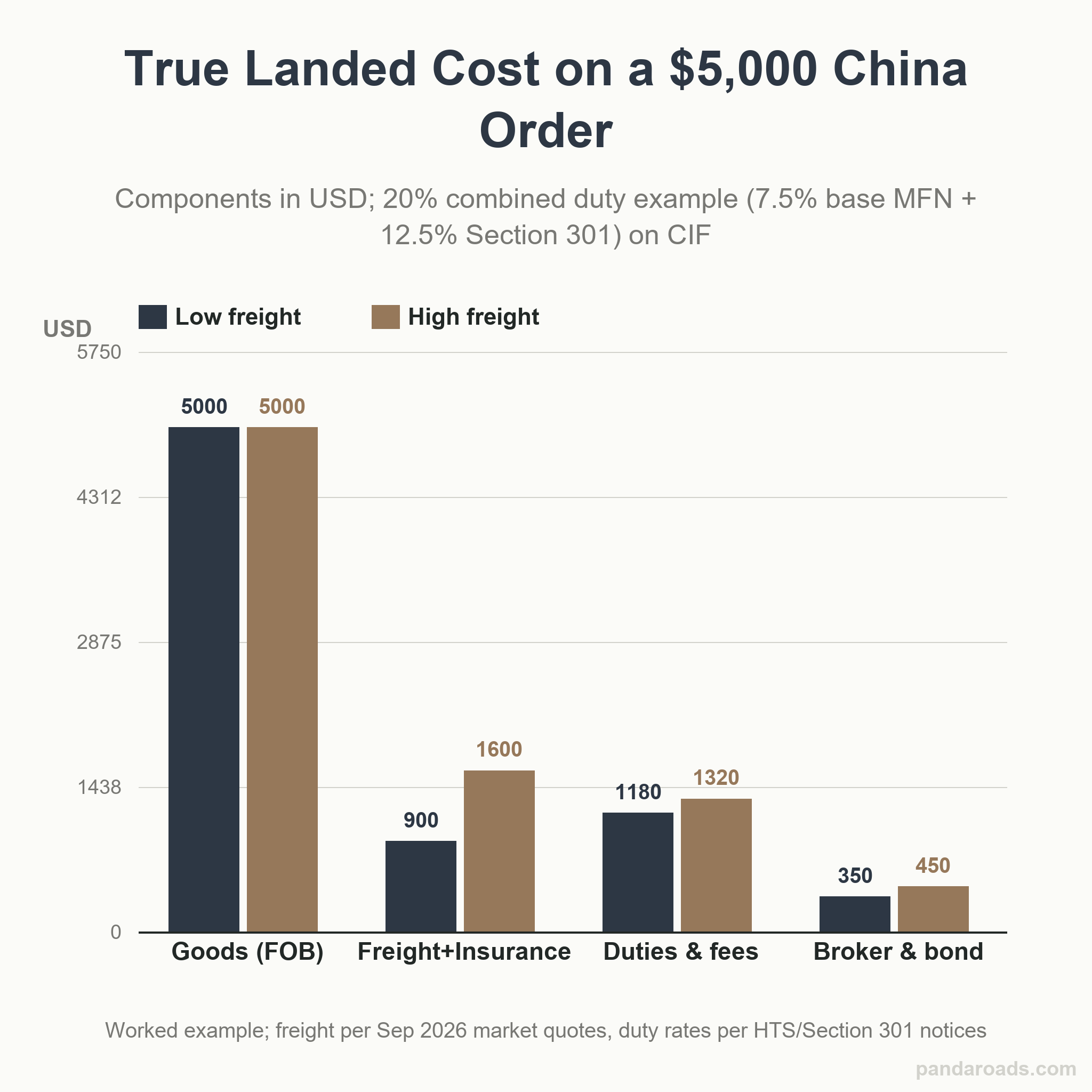
| Line item | Low-freight tier | High-freight tier |
|---|---|---|
| Product (FOB) | $5,000 | $5,000 |
| Freight + insurance | $900 | $1,600 |
| CIF value | $5,900 | $6,600 |
| Duty @ 20% on CIF (example rate) | $1,180 | $1,320 |
| Broker + bond | $350 | $450 |
| True landed cost | $7,430 | $8,370 |
Two mechanics matter once the numbers are on the page. In this model duty rides on CIF rather than the raw FOB invoice, so freight and insurance sit inside the base you tax (CBP itself assesses on transaction value; ask your broker which base they enter). A higher freight line quietly raises the duty dollars too, which is why the high-freight tier costs $140 more in duty alone than the low one. Nothing about the product changed; only the shipping choice did.
And that 20% is a stand-in. Pull the real MFN rate for your HTS line, then add the Section 301 layer, which is 12.5% on most China lines since July 24, 2026, while the 10% tier covers other countries [source: dimerco.com]. Swapping the assumption for your actual classification is the difference between a rough guess and a landed cost you can price against. The example totals also leave out the merchandise processing fee (0.3464% of entered value, minimum about $33.58, capped near $651.50 per entry) and any harbor maintenance fee; add both as separate lines in your own sheet [source: gingercontrol.com].
Read what the table says. The gap between the two tiers is $940, and all but $100 of it traces to freight, which then drags duty higher because this model taxes the CIF base. That is why a cheap product with lazy shipping can cost more than a pricier product on a well-booked sailing. Divide the landed figure by your unit count and you get the only number that matters: your real per-unit cost before you set a price. If that number leaves no margin after the 2026 tariff stack, no supplier discount will save the deal. Build the full landed cost first, then decide whether the order pencils out. If you want the classification and the fee math handled alongside sourcing, see get landed-cost and customs checks run for you.
Step 4: Choose Shipping That Matches Your Margin
Shipping from China in 2026 splits by weight. Standard air freight runs about $3/kg for 150 to 500 kg shipments, with air express cheaper below that, while a 20GP ocean container quotes roughly $6,726 to $8,221 China to US as of September 2026, down about 24% month over month [source: sino-shipping.com]. Match the mode to your margin, not your urgency.
Pick the mode by the clock and the cube, not by habit. Under about 150 kg, air express usually beats everything on door-to-door cost because you skip the minimums that punish small standard-air shipments. Once you sit in the 150 to 500 kg band, standard air freight near $3/kg is the number to beat [source: freightos.com]. Above that, ocean almost always wins on unit economics even though it is slower.
For ocean you have two doors. LCL, less than container load, bills you by volume and shares space with other shippers, which suits a partial order. FCL books the whole box. In September 2026 a 20GP container ran roughly $6,726 to $8,221 China to US and a 40GP about $6,770 to $8,275, both down around 24% from the month before [source: sino-shipping.com]. Notice how close the 20GP and 40GP figures sit: when the spread is that thin, the bigger box is nearly free space, so consolidate rather than ship twice.
Do not anchor on a single quote. Smaller LCL shipments and secondary lanes price far below those full-container numbers, anywhere from $1,500 to $4,000 depending on route and terms in 2026 forwarder guides, and spot rates move month to month. Re-quote in the week you book, not the week you plan, and treat any rate older than a few weeks as stale.
The margin test is blunt. Freight that pushes your per-unit landed cost past what the market will pay is the wrong freight, no matter how fast it lands. Speed you cannot sell is just a faster way to lose money.
Step 5: Inspect Before Shipment, Not After
Inspect before shipment, not after. On a $5,000 order that lands between $7,430 and $8,370 once duty and freight are paid, a pre-shipment inspection costs a fraction of that and catches defects while the goods are still in China and still the supplier's problem [source: ship4wd.com]. Fixing issues after a container reaches a US port is far more expensive.
The economics are lopsided in your favor, so use them. An inspection is priced per man-day and runs a rounding error next to the container value you now have to defend. Catch a defect at the factory and the supplier reworks it on their dime. Catch it at your warehouse and you are paying to return, repair, or liquidate goods you already duty-paid on.
Time it right. The inspection happens when production is finished and packed, before the container loads. That window is the whole point: goods still at the factory are fixable, goods on the water are not. Build the inspection into your payment terms so the balance clears only after a pass.
A basic check covers quantity, workmanship, packing marks, and a random sample pulled against your approved golden sample. For most consumer goods that is enough to surface a bad run before it ships. If you want the full protocol and what a usable report looks like, see how pre-shipment inspection protects your order.
Skip it and you are gambling the entire landed cost on trust alone. For a supplier you have not tested, that is the one bet worth not placing. The inspection fee is the cheapest insurance on this whole journey, and the only kind that stops a problem before it crosses an ocean.
Step 6: Clear Customs Without Surprises
Clearing US customs in 2026 needs five core documents, and the table adds the filing-side items your broker turns them into: a commercial invoice, packing list, bill of lading or airway bill, your HS code, and an ISF filing for ocean cargo due at least 24 hours before loading [source: cbp.gov]. Your licensed broker files the entry, and you cover duty plus a Single Transaction Bond of roughly $50 to $500 [source: gingercontrol.com].
The paperwork is where a lazy import turns into held cargo. Get any of it wrong and CBP or the broker stops your shipment while storage fees run against you. The list itself is short and fixed.
| Document / filing | Who provides it | Watch-out |
|---|---|---|
| Commercial invoice | Supplier | Must show the real value; undervaluing invites penalties |
| Packing list | Supplier | Match counts exactly to the invoice |
| Bill of lading / airway bill | Carrier or forwarder | Required to claim the cargo |
| HS code classification | You or broker | Sets the duty rate; get it right |
| ISF "10+2" filing | You or broker (ocean) | Due at least 24 hrs before loading |
| Entry filing + bond | Licensed broker | Single Transaction Bond about $50 to $500 [source: gingercontrol.com] |
Two items trip first-timers most. The ISF, called 10+2, combines your data with the carrier's, and on ocean shipments it is due at least 24 hours before the cargo loads [source: cbp.gov]. Miss that window and you face a penalty even when nothing else is wrong. The second is invoice value. Duty rides on the declared value at your HS rate, so an understated invoice is not a discount, it is a penalty waiting to surface [source: ship4wd.com]. Hand the clean set to a licensed broker, cover the bond, and let them file the entry so the only surprise is the arrival date.
Warning: The ISF 10+2 filing is due at least 24 hours before ocean cargo loads, and missing that window draws a penalty even when every other document is correct [source: cbp.gov].
Step 7: When to Use a China-Based Agent Instead
A China-based sourcing agent pays for itself once your order clears the point where one mistake exceeds their fee. For a $5,000 order landing near $7,430 to $8,370 after duty and freight, an agent who handles factory verification, inspection, and payment staging often saves more than they cost, especially on your first supplier [source: ship4wd.com]. For a realistic budget, see what a China sourcing agent costs in 2026.
Be honest about the boundary. You do not need an agent to buy one box of a commodity you can inspect yourself. You earn one when the order gets complex: multiple SKUs, custom tooling, a seller you cannot verify from across an ocean, or a payment you would rather stage through someone physically near the factory floor.
An agent's real value is presence. They stand in the warehouse when the container loads, walk the line when a sample fails, and hold the balance until goods pass. That is the same protection as Steps 2 and 5, executed by someone in the local timezone. If that trade feels right, how a China sourcing agent works and what to expect breaks down where the fit is.
For smaller, one-off jobs you would rather not learn cold, task-based help beats a full retainer: a single factory audit, one inspection, a payment released strictly on your terms. See book a specific China-side task. The rule stays simple. Hire help where distance genuinely hurts you, and keep doing yourself whatever you can already control from home.
Frequently Asked Questions
Short answers, each with the dated figure behind it: a 12.5% Section 301 layer (2026), ocean rates down about 24% (2026), 1688 factory prices 20-50% below Alibaba export listings (2025), and no $800 de minimis lane for China parcels (2026).
Is it cheap to import from China?
Yes for most categories. 1688 domestic Chinese prices typically run 20-50% below Alibaba export listings for the same factory goods [source: toptradesourcing.com; worldfirst.com], which absorbs much of the 2026 tariff stack, including the 12.5% Section 301 layer on most China lines, with Annex A products exempt [source: dimerco.com]. The savings survive only if you do two things: calculate landed cost before you order rather than after, and keep freight a small share of goods value. A cheap product on lazy shipping erases the gap fast, because the landed total, not the FOB sticker, is what decides your margin. Before you negotiate, run a real 1688 price check against the same factory goods.
Do I need a license to import from China to USA?
For most commercial goods, no. CBP does not require a federal importer license; you register as importer of record and cover entries with a bond [source: cbp.gov]. The catch is other agencies. Regulated categories like food, electronics, and cosmetics need FDA or FCC clearance first, and some need permits regardless of what CBP requires [source: cbp.gov]. Check your specific product before assuming you are clear. The license question is really a permits-and-classification question.
How much is shipping from China to USA?
As of September 2026, standard air freight runs about $3/kg for shipments in the 150 to 500 kg range, with air express cheaper below that [source: freightos.com]. Ocean is where the spread lives: a 20GP container quotes roughly $6,726 to $8,221 on major China to US lanes, and rates fell about 24% month over month [source: sino-shipping.com]. Because ocean swings hard, re-quote in the week you book instead of trusting last month's number.
What documents are needed to import goods from China?
You need a commercial invoice, a packing list, the bill of lading or airway bill, your HS code classification, and an ISF filing for ocean shipments. The ISF, known as 10+2, is due at least 24 hours before the cargo loads. Your licensed broker then files the entry for you [source: cbp.gov]. Get the invoice value and the HS code right, because those two drive the duty you pay on the CIF value.
How much tax do I pay when importing from China?
You pay the base MFN duty for your HS code plus a Section 301 additional rate, which is 12.5% on most China lines since July 24, 2026, with Annex A products exempt (the 10% tier in the same action applies to other countries) [source: dimerco.com]. All of it is assessed on your CIF value, and a merchandise processing fee sits on top. Note too that the $800 de minimis exemption is suspended (a February 2026 measure covering all countries, China included), so there is no duty-free lane for small parcels anymore [source: whitehouse.gov].
References
Sources for the 2026 tariff figures, freight benchmarks, and landed-cost method used throughout this guide:
Dimerco. (2026). US tariff update 2026. https://dimerco.com/us-tariff-update-2026/
The White House. (2026). Continuing the suspension of duty-free de minimis treatment for all countries. https://www.whitehouse.gov/presidential-actions/2026/02/continuing-the-suspension-of-duty-free-de-minimis-treatment-for-all-countries/
U.S. Customs and Border Protection. (2026). Tips for new importers and exporters. https://www.cbp.gov/trade/basic-import-export/importer-exporter-tips
U.S. Customs and Border Protection. (2026). Importer Security Filing '10+2'. https://www.cbp.gov/border-security/ports-entry/cargo-security/importer-security-filing-102
Freightos. (2026). Shipping from China to US [Updated September 2026]. https://www.freightos.com/shipping-routes/shipping-from-china-to-the-united-states/
Sino Shipping. (2026). Shipping from China to USA [Updated September 2026]. https://www.sino-shipping.com/country-guides/shipping-from-china-to-usa/
Ship4wd. (2026). How to calculate landed cost when importing from China. https://ship4wd.com/logistics-shipping/how-to-calculate-landed-cost
Ginger Control. (2026). Customs fees explained. https://gingercontrol.com/blog/customs-fees-explained
Top Trade Sourcing. (2025). Alibaba vs 1688: Which platform is better for international buyers? https://www.toptradesourcing.com/alibaba-vs-1688-blog/
WorldFirst. (2025). 1688 vs Alibaba: Which is better? https://www.worldfirst.com/nz/blog/importing-from-china/1688-vs-alibaba/