China Product Inspection Cost: When It Pays For Itself
Real per-man-day rates ($149-$550, most all-inclusive near $300), the one-division break-even test, and the ISO 2859-1 AQL numbers that decide it - the inspection call as arithmetic, not branding.
Last updated: September 2026 · By the PandaRoads team in China
Abstract
A China product inspection is a math decision, not a brand decision: at roughly $149 to $550 per man-day (most all-inclusive rates land near $300), a single inspector-day pays for itself the moment the defect risk it catches is worth more than the fee on your order. Decide with the ISO 2859-1 AQL (acceptable quality level) sampling math and a break-even test, not with a vendor logo.
Key Takeaways
- Inspection costs about $149-$550 per man-day, most all-inclusive near $300
- Decide by break-even: a $300 check can protect a $20,000 order
- Standard consumer-goods AQL is 0 critical, 2.5 major, 4.0 minor (ISO 2859-1)
- Book pre-shipment only when 80% packed, about 2 days before shipping
- Ignore brand logos; verify the report shows sample size and accept/reject numbers
Table of Contents
- Abstract
- Key Takeaways
- Why Inspection Is a Math Decision, Not a Brand Decision
- What a 'Man-Day' Actually Buys You (and What It Costs)
- How to Read AQL: ISO 2859-1 Sampling in Plain English
- The Break-Even Test: When a $300 Inspection Saves a $20,000 Order
- How Many Man-Days Does Your Order Actually Need?
- Which Inspection: Pre-Shipment, During Production, or Container Load
- Inspection Providers Compared by Man-Day Rate (Neutral, Not Ranked)
- How to Verify a Provider Really Runs AQL (and Red Flags)
- What to Ignore: Marketing Claims That Shouldn't Move Your Decision
- Frequently Asked Questions
- Conclusion
- References
TL;DR: What a China Product Inspection Costs and When It Pays
A China product inspection runs about $149 to $550 per man-day, billed per inspector-day, and most all-inclusive quotes land near $300 [source: testcoo.com; aqiservice.com]. The spec behind it is normally 0 critical, 2.5 major and 4.0 minor under ISO 2859-1 [source: testcoo.com].
The fee is one half of a two-number test. On a $20,000 order, $300 is 1.5% of goods value ($300 / $20,000), so the check pays whenever the loss it can catch clears that line. Below it you are insuring risk you do not carry.
Timing decides the rest. Book only when about 80% of the goods are packed, so the inspector samples real export cartons [source: testcoo.com], at least two days before the planned shipment [source: guidedimports.com]. Miss it and you have bought a report you cannot act on, as our inspection walkthrough explains.
By the Numbers
- $149-$550 published man-day rate band, low-cost floor to the widest guide ceiling [source: testcoo.com; newbuyingagent.com]
- 1.5% break-even loss on a $20,000 order at the roughly $300 all-inclusive day rate ($300 / $20,000) [source: aqiservice.com]
- 0/2.5/4.0 AQL ceiling per defect class under ISO 2859-1, General Inspection Level II [source: testcoo.com]
- 26-30% of global manufacturing output accounted for by China, UNIDO's 2024 series near 26% and industry reviews rounding to 30% [source: stat.unido.org; v-trust.com]
- $50.92B China Testing, Inspection and Certification market in 2025 [source: mordorintelligence.com]
- ~5,000 units covered by one inspector-day at one factory, two days above that [source: newbuyingagent.com]
Why Inspection Is a Math Decision, Not a Brand Decision
China accounts for roughly 26 to 30% of global manufacturing output (UNIDO's series puts 2024 near 26% and V-Trust's China market review rounds it to 30%) [source: stat.unido.org; v-trust.com], and its Testing, Inspection and Certification market reached about USD 50.92 billion in 2025 [source: mordorintelligence.com]. That scale is why a bad lot from a Chinese factory is an arithmetic problem rather than a trust problem.
Every provider sells trust. What you buy is one inspector-day of sampling, and the price is public. Sellers routinely contrast cheap in-factory visual labor against the third-party per-man-day rate. Those are not quotes for the same job: one is labor inside the factory, the other an outsider whose paycheck does not depend on your container shipping.
Brand changes nothing in that calculation. If the defect rate on a $20,000 order runs 6%, then $1,200 of goods value is exposed ($20,000 x 0.06), whether the report arrives on famous letterhead or from a two-person shop. You control the fee, the sample the inspector is allowed to pull, and whether you can act before the carton tape hits the pallet.
Growth makes the noise louder. Between 2025 and 2030 China's TIC market is forecast to grow at 5.71% a year, from USD 50.92 billion to USD 67.21 billion [source: mordorintelligence.com], and much of that spend goes into positioning, not sampling: platforms, dashboards, certificate walls. None of it moves your break-even number.
Two figures decide a China product inspection, the man-day fee and the loss rate at which it pays, both computable from your own purchase order before you email a vendor. If the real question is whether the factory deserves your deposit at all, that is a different job and it starts with verifying the factory before you pay.
What a 'Man-Day' Actually Buys You (and What It Costs)
Published China product inspection man-day rates cluster tight: $149 to $320 at low-cost firms, $198 at nbnqc, $240 at Tetra, $268 or $298 at V-Trust, about $300 all-inclusive per aqiservice, from $309 for QIMA in Zone A [source: testcoo.com; nbnqc.com; tetrainspection.com; v-trust.com; aqiservice.com; tradeaiders.com].
Unpack the label before comparing prices, because a man-day is not eight hours of checking. The rate absorbs the trip to the factory, setting up an area on someone else's floor, pulling the random sample from stacked export cartons, writing the report on-site and getting back out [source: testcoo.com]. Effective examination time is therefore shorter than buyers assume, which is why a $198 day and a $309 day can end up inspecting a broadly similar number of units.
What separates the tiers is evidence and speed, not hours on the stool. V-Trust publishes reports within 24 hours and no weekend surcharge at $268 [source: v-trust.com]. TradeAider's 2026 comparison credits QIMA with about 48-hour deployment at a Zone A day rate starting from $309 on request [source: tradeaiders.com], and Tetra says most inspections finish inside a single day at $240 [source: tetrainspection.com].
Whole-market guides put China inspection at $250 to $550 per inspector-day [source: newbuyingagent.com], while SGS, Bureau Veritas and Intertek sit nearer $250 to $400 and often answer a pricing request with a custom quote instead of a posted rate [source: zmcexpress.com]. That spread is brand and overhead, not extra hours in your cartons.
Calendar timing is the line item nobody raises on the call. On Chinese holidays a 50 to 100% premium over the day rate is common, roughly $450 to $600 on a $300 base [source: tradeaiders.com]. The multiplier is not universal: testcoo and V-Trust both state they add no weekend surcharge [source: testcoo.com; v-trust.com]. If your container has a fixed October sailing, that multiplier belongs in your cost sheet before you call the check expensive.
| Published rate | Who states it | What it covers |
|---|---|---|
| $149 to $320 | testcoo.com | Low-cost band |
| $240 | tetrainspection.com | All-inclusive, one day |
| $268 or $298 | v-trust.com | Major regions / elsewhere |
| $299 to $300 | aqiservice.com | All-inclusive day |
| from $309 | tradeaiders.com (QIMA Zone A) | Zone A, 48h deploy |
| $250 to $400 | zmcexpress.com (SGS, BV, Intertek) | Often custom quote |
| $250 to $550 | newbuyingagent.com | Buyer-guide band |
| $450 to $600 | tradeaiders.com | Holiday premium (50-100%) |
Read that spread as a decision, not a leaderboard. The distance from the cheapest advertised day to the widest guide ceiling is about 3.7x ($550 / $149), and none of it changes your sample size, because lot size and AQL set that. The extra dollars buy response speed, an inspector employment model and reporting polish, and whether they are worth triple depends on your order value, not on a vendor's marketing budget.
How to Read AQL: ISO 2859-1 Sampling in Plain English
The standard consumer-goods spec for a China product inspection is 0% critical, 2.5% major and 4.0% minor defects under ISO 2859-1, single-stage, normal severity, General Inspection Level II [source: testcoo.com], and the AQL defaults cited for 2026 pre-shipment checks are the same three numbers [source: testcoo.com].
None of that mentions a vendor, which is the point: the sampling math is identical in every quote you receive this month.
Three defect classes do the work, and they are contractual buckets rather than severity adjectives. A critical defect makes goods unsafe or illegal to sell: a missing ground pin, a banned substance, no required warning label. A major defect stops the product doing what the buyer paid for and generates a return. A minor defect is cosmetic, the loose thread most customers would open, shrug at, and keep.
Your AQL is the ceiling on each bucket, written as a share of the sample rather than of the lot. Zero on critical means one unit fails the shipment. The 2.5 on major means a 2.5% defective share is the tolerated ceiling, about one unit in forty (1 / 0.025 = 40) at the sampling-plan rate; the 4.0 on minor is about one in twenty-five (1 / 0.04 = 25). Your actual accept and reject counts come from the level-II table for your lot size, not this inverse.
| Class | AQL ceiling | Plain-English test | Effect on the lot |
|---|---|---|---|
| Critical | 0 | Unsafe or illegal to sell | One unit fails the lot |
| Major | 2.5% | Product fails its purpose | About 1 in 40 tolerated |
| Minor | 4.0% | Cosmetic, buyer keeps it | About 1 in 25 tolerated |
That structure comes from a published standard, not a policy page. BS EN ISO 2859-1, "Sampling procedures for inspection by attributes", is the primary document behind these tables [source: bsigroup.com], and it is why a competent report names the sampling level and the sample size instead of printing a verdict with a photograph. Ask which sampling level they ran and what sample size your lot produced.
Sampling is imperfect by design, whatever a sales page implies. Operations-research work models inspection error and quality inside two-level supply chains precisely because a sample can pass a lot that is genuinely bad [source: torontomu.ca]. AQL is a priced risk limit rather than a promise of zero defects, and the same research explains why buyers contract third-party inspectors instead of trusting supplier self-declaration [source: scientific.net].
One habit saves an argument later. Write your defect definitions into the purchase order before production starts, because the same loose thread is minor on a hem and major on a load-bearing seam, and those calls sit 1.5 tolerance points apart (4.0 minus 2.5). Inspectors decide fast on a factory floor with your supplier behind them.
The Break-Even Test: When a $300 Inspection Saves a $20,000 Order
A pre-shipment inspection pays whenever the loss it can catch exceeds the fee, and at the all-inclusive China rate of about $299 to $300 per man-day that threshold is a 1.5% loss on a $20,000 order ($300 / $20,000) [source: aqiservice.com].
One division, done on your own invoice, settles an argument vendor pages spend four thousand words avoiding. The fee is fixed and public. Your exposure is the goods value you have paid a deposit on, multiplied by the share of it that could arrive unusable. Compare those two and the decision stays yours rather than the sales team's.
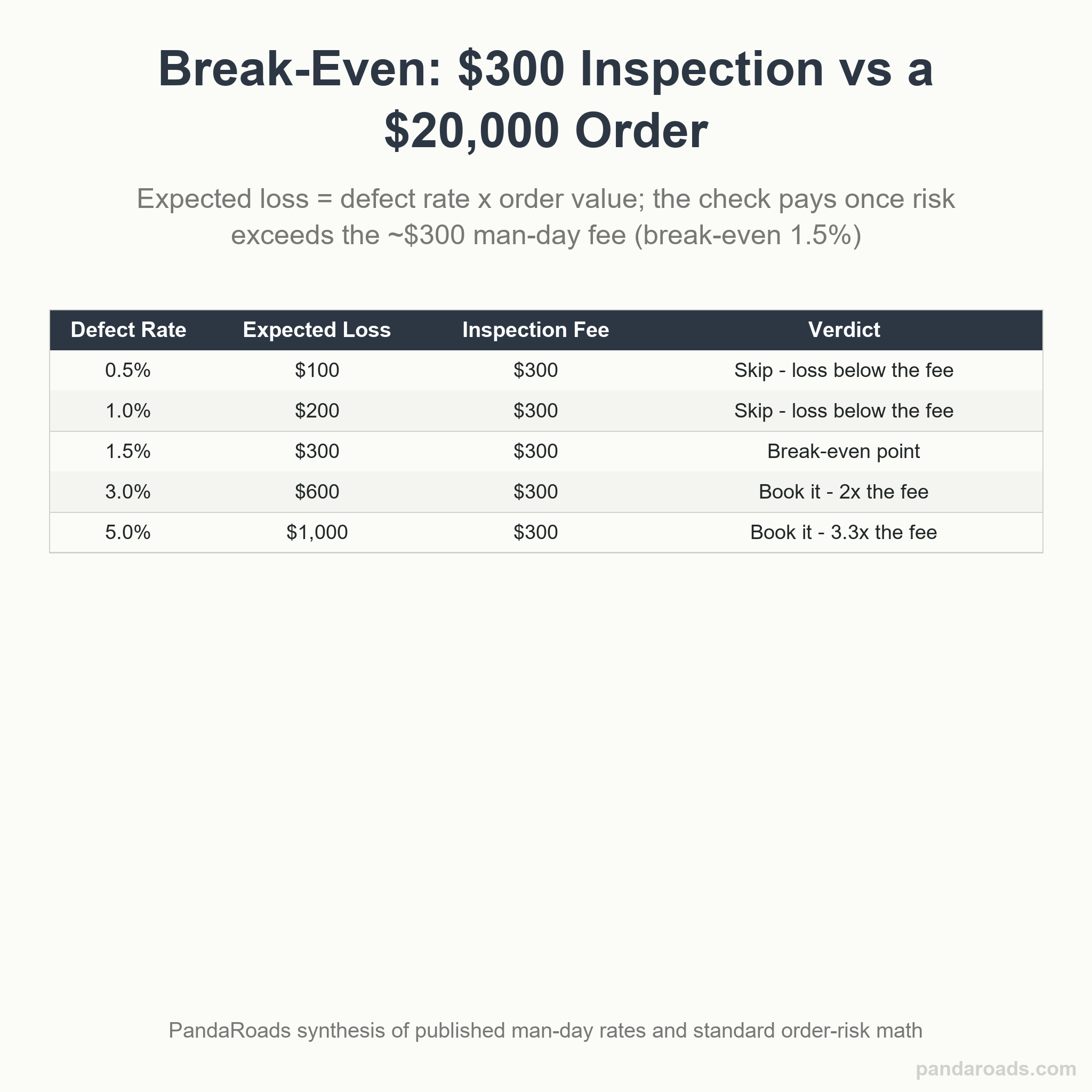
Work the chart line by line. A 0.5% loss on that order is $100 of goods ($20,000 x 0.005), less than the $300 day, so the check is a net loss before it finds anything. At 1% you are protecting $200, still under the fee. At 1.5% the two meet, and that is the break-even point. At 3% exposure doubles the fee at $600, and at 5% it is $1,000 against a $300 inspection, 3.3x over.
Notice what the test never mentions: the provider's name. The same 1.5% threshold applies to a $198 day on a $13,200 order ($198 / 0.015) and to a $400 enterprise quote on a $26,667 order. Change the fee and the line moves proportionally, so a cheap day and an expensive day can both be the right purchase at different order sizes. Comparing rate cards without comparing order values is how buyers overpay for a China product inspection and still feel they got a discount.
Scale it against your own numbers and the answer changes shape. On a $5,000 trial order the $300 day sits at 6% of goods value ($300 / $5,000), so you need real defect exposure before it pencils. On a $50,000 reorder it sits at 0.6%, a bar almost any supplier history clears. Two man-days doubles the fee to about $600 and lifts the threshold on a $20,000 order to 3% ($600 / $20,000), which is where a second day stops being routine.
Bring AQL into the same frame, because that is where the two halves of this guide meet. A lot running at the 2.5% major ceiling on a $20,000 order carries $500 of defective goods ($20,000 x 0.025), which is 1.7x the $300 fee ($500 / $300 = 1.67). A shipment sitting exactly at the acceptable limit is already worth more than the inspection that measures it, and that is the honest case for booking: not that your supplier is bad, but that acceptable means a loss you agreed to absorb.
Two inputs keep the arithmetic honest. Estimate your defect rate from something real, a prior order, a failed first article, new tooling, or a category with a known return rate, and use the fee a provider actually publishes instead of a quote you hope for. A first order from an untested supplier is where the estimate is weakest and the payoff usually largest, and that is the case a flat-fee remote sourcing task is built for.
How Many Man-Days Does Your Order Actually Need?
One inspector-day covers an order up to about 5,000 units, two days covers larger ones, inside a published band of $250 to $550 per inspector-day [source: newbuyingagent.com]. Order size drives how many man-days a China product inspection needs, so quantity and fee move together before you compare providers.
The unit threshold is the only widely published rule of thumb here, and it reads as a floor. One inspector works one factory in one day. Split that quantity across two sites and you have two travel legs, two sampling setups and two write-ups, which is two man-days however few units sit in each box [source: testcoo.com].
Two gates decide whether those days buy anything. The inspection happens only when about 80% of the order is packed, so the sample comes from actual export cartons rather than whatever was assembled first [source: testcoo.com]. It also has to land at least two days before the planned shipment, because a failed lot helps only if there is time to rework before the container is committed [source: guidedimports.com].
| Order size | Man-days | Fee at $300/day | Break-even on $20,000 |
|---|---|---|---|
| Up to ~5,000 units | 1 | $300 | 1.5% |
| Above ~5,000 units | 2 | $600 | 3.0% |
| Either, holiday slot | 1 to 2 | $450 to $1,200 | 2.3% to 6.0% |
Multiply across the rate band and the spread gets silly. Two days at $149 is $298, less than one day at QIMA's starting $309 [source: testcoo.com; tradeaiders.com], while two days at the $550 ceiling is $1,100 [source: newbuyingagent.com]. Same lot, same logic, three invoices.
That last column is worth printing, because fee divided by order value turns a rate card into a threshold you can test against your own history: $450 against $20,000 is 2.3%, $1,200 against the same order is 6.0%. Two days of checking must catch twice the loss one day must, a fair ask on a $50,000 order and a hard one on a $5,000 trial.
Sequence it to waste the least money. Confirm the packed percentage in writing, book the day, hold the balance until the report lands. A pass costs one man-day; a fail two days before sailing costs the fee plus a freight window, which still beats losing the order.
Which Inspection: Pre-Shipment, During Production, or Container Load
Buyers choose between five checks (initial production check, during-production inspection, pre-shipment inspection or final random inspection, container loading verification, and a factory audit or lab test), and the pre-shipment one is what most first-order importers buy [source: testcoo.com]. That stage is valid only once about 80% of the goods are packed [source: testcoo.com].
Each stage answers a different question, and the inspector's hands move differently. An initial production check confirms that raw materials, components and the first pieces off the line match what you approved, before a full run locks in a mistake. A during-production inspection, DUPRO, samples units that already exist while time remains to fix a machine setup or a wrong part.
Pre-shipment is the strict one. It waits until roughly 80% of the order is finished and packed so the sample comes from your real export cartons rather than a bench of cooperative prototypes [source: testcoo.com]. The inspector pulls to the AQL sample size, runs visual and functional checks, sorts findings into critical, major and minor, photographs the evidence and writes the report on site [source: testcoo.com].
Container loading verification is the fourth check and a factory audit or lab test the fifth, closing the enumerated five. A container loading verification counts cartons against the packing list and confirms the seal, so what you paid for is the box on the water. A post-shipment inspection sits outside those five: by then the goods have crossed an ocean and duty is paid, so it verifies the delivered lot after the fact instead of stopping a defective one before it ships [source: the-inspection-company.com].
Cost logic picks the stage. A DUPRO at the same $240 or $300 a day catches a setup error while most of the order is unbuilt, so the fix costs your supplier an afternoon [source: tetrainspection.com]. The identical error found at pre-shipment costs a re-pack and a missed sailing; found after arrival it costs freight both ways. Earlier days are cheaper to act on, which is why a long run with an unmeasured supplier justifies two visits.
For a repeat order from a supplier with clean history, pre-shipment alone is proportionate. For a first order on new tooling, an initial check plus pre-shipment is the pairing worth pricing, and our sourcing team can run both against one purchase order instead of selling you a bundle.
Inspection Providers Compared by Man-Day Rate (Neutral, Not Ranked)
Public 2026 China product inspection rates span $149 to $320 at low-cost firms, $198 at nbnqc, $240 at Tetra, $268 and $298 at V-Trust, from $309 at QIMA for Zone A, and $250 to $400 at the global firms [source: nbnqc.com; tetrainspection.com; v-trust.com; tradeaiders.com; zmcexpress.com].
No ranking follows, deliberately. Every top list in this niche puts its own publisher first, testcoo's Top 30 roundup included [source: testcoo.com], so a placement there is an advertisement. What is publishable is the arithmetic: the rate a firm states, what it claims the rate covers, and what evidence arrives that day.
The rate column hides a second question: who absorbs an unclear result. A $149 day that produces a report you have to chase is not a $149 decision, and a $309 day whose deployment window misses your sailing date is worth nothing [source: testcoo.com; tradeaiders.com]. Price the failure mode, not the sticker.
| Provider | Published rate | Evidence model | Turnaround |
|---|---|---|---|
| testcoo | $149 to $320 | AQL sampling, photo report | not stated |
| Tetra Inspection | $240 all-inclusive | pre-shipment check | usually one day |
| V-Trust | $268, or $298 elsewhere | full-time inspectors | reports in 24 hours |
| aqiservice | about $299 to $300 | all-inclusive day | not stated |
| QIMA, Zone A | from $309 | AQL, own inspector network | about 48h |
| SGS, Bureau Veritas, Intertek | $250 to $400 | global TIC, custom quote | not stated |
Map that table to your situation, not to a league table. A small first order needs a published flat rate and a labeled photo report, and any entry between $198 and $300 that will show a sample report qualifies, the difference being scheduling; QIMA publishes no posted rate, so its Zone A figure reaches the buyer on a call. A repeat FBA seller with a known supplier is buying speed, so firms publishing a window, about 48 hours at QIMA and 24-hour reporting at V-Trust, form the shortlist [source: tradeaiders.com; v-trust.com].
Two structural differences outweigh price. V-Trust states it uses only full-time local inspectors rather than freelancers, presented as a control on bribery risk [source: v-trust.com]. That matters before you book the cheapest day: the freelancer-versus-employee question separates providers more cleanly than any badge. Custom quoting is not a secret either; it is how firms in the $250 to $400 bracket price scope, so your rate is set inside a conversation [source: zmcexpress.com].
For transparency on our side of the table: the on-site day we sell is a flat $239 with photo evidence and a same-day English report, inside the mid-band above and neither the cheapest nor the dearest option here. We publish it because a rate handed out on a call is what this guide exists to make unnecessary.
If you want a wider survey, the two least self-promotional datasets are TradeAider's per-zone rate table and the $250 to $550 whole-market band [source: tradeaiders.com; newbuyingagent.com]. Read them for the numbers and skip the adjectives.
How to Verify a Provider Really Runs AQL (and Red Flags)
A genuinely AQL-compliant report names the sampling level, lot size, sample size and the accept and reject numbers for each defect class, and a provider who cannot show a sample report is unverified [source: tradeaiders.com]. Billing extra for the report, for a larger sample or for photographs is a documented red flag [source: testcoo.com].
Those four fields are checkable in ten minutes before you book a China product inspection. Ask for a redacted sample report and look for all four. A PDF with a verdict, twelve photographs and a signature tells you an inspector was somewhere. A PDF stating lot size, sample size and the accept number per class tells you a method was followed, and that is the document you can defend to your supplier.
The pricing flags are just as concrete. Several firms advertise an all-inclusive day in the $240 to $309 range [source: tetrainspection.com; aqiservice.com; tradeaiders.com]. One sentence gets a clean answer: what does the man-day price include, in writing?
Warning: A provider adding a line for photographs, for the report, or for a bigger sample than the AQL requires is charging twice for the same work [source: testcoo.com].
Then look at who shows up. One mid-market firm markets a no-freelancer policy as a bribery-risk control [source: v-trust.com], and buyers weigh that distinction alongside photo evidence rather than brand names. Freelance sourcing is not automatically dishonest, but a contractor paid per visit has a relationship with your factory you will never have.
Live evidence is the capability most legacy firms do not offer. Real-time photo and video monitoring during an inspection is cited as the least-shared differentiator among top China providers, most of whom deliver only after the visit [source: tradeaiders.com]. Ignore it if you never open dashboards. Demand it if you suspect a pass was written before the inspector boarded the train.
Three questions, in that order, sort the market faster than any badge. Can you send a sample report showing sampling level, lot size, sample size and accept and reject numbers? Is the quoted rate all-inclusive, covering travel, photographs and the report? Are the inspectors employed by you or contracted per visit? Firms running real AQL answer all three without hesitating, and hesitation is an answer.
What to Ignore: Marketing Claims That Shouldn't Move Your Decision
Self-listed rankings carry no information here: testcoo places itself first in its own "Top 30 third-party inspection companies" roundup, and TradeAider does the same in its "Top 10" list [source: testcoo.com; tradeaiders.com]. A placement on either is an advertisement, not evidence.
Every one of those pages is a sales page, which is not a scandal, just a reason to read the rate, not the adjectives. A logo wall says nothing about who walked your production line that day. A bare "ISO certified" claim without a sample report is untestable, since what governs your inspection is the sampling method and the four fields it must report [source: tradeaiders.com]. Enterprise platform positioning does the same job differently: the myQIMA and QIMAone framing on QIMA's China page shows no visible USD man-day rate, so you get a custom quote instead of a comparable number [source: qima.com; zmcexpress.com].
Also ignore the upsell that a bigger sample is safer. Sample size follows from your lot size and the AQL you agreed, so a provider selling extra units to inspect charges twice for arithmetic the standard already fixes [source: testcoo.com]. Same for the live dashboard nobody opens: continuous photo and video monitoring is rare among legacy firms and worthless if you will not watch it during the visit [source: tradeaiders.com].
What survives the purge is small and arithmetical. A China product inspection decision reduces to two numbers you can compute yourself, the man-day fee you can screenshot and the break-even rate found by dividing that fee by your order value (1.5% at $300 against $20,000), plus four report fields that prove AQL was actually run. Two numbers, a verification checklist, no brand names.
Frequently Asked Questions
Six questions importers ask before booking a China product inspection, answered with the same numbers used throughout this guide. China supplies roughly 26 to 30% of global manufacturing output (UNIDO series), the standard consumer-goods AQL spec is 0% critical, 2.5% major and 4.0% minor defects under ISO 2859-1 (2026), and a single inspector-day pays for itself from about a 1.5% loss on a $20,000 order (2026). A common mistake is reading a provider's rate card without setting it against your own order value, and that comparison is what the arithmetic in the named section settles.
How much does an inspection cost in China?
About $149 to $550 per man-day, billed per inspector per day. Low-cost firms advertise $149 to $320 [source: testcoo.com], mid-market all-inclusive rates cluster around $240 to $300 [source: tetrainspection.com; aqiservice.com], and global firms such as SGS, Bureau Veritas and Intertek run roughly $250 to $400, often on a custom quote [source: zmcexpress.com].
Is pre-shipment inspection worth it?
Yes when the fee is small against the landed cost of a defective container. At about $300 all-inclusive per man-day, one inspector-day pays for itself the moment the risk it can catch on a $20,000 order exceeds 1.5% of that order's value [source: aqiservice.com]. A tiny reorder from a supplier with clean history may not clear that bar.
What does an inspector do during a pre-shipment inspection?
They confirm about 80% of the goods are finished and packed, pull a random sample from actual export cartons to the AQL sample size, run visual and functional checks, classify critical, major and minor defects, photograph the evidence and write the report on-site [source: testcoo.com].
How do I verify that an inspection company uses ISO 2859-1 AQL methodology?
Ask for a sample report. A compliant one states the sampling level, lot size, sample size and the accept and reject numbers for each defect class [source: tradeaiders.com]. A provider who cannot produce it, or who bills extra for the report, a larger sample or photographs, is unverified [source: testcoo.com].
Is a cheaper inspection company less reliable than SGS or Intertek?
Not automatically. Price tracks brand and overhead more than rigor, so judge the evidence: the same ISO 2859-1 AQL spec of 0, 2.5 and 4.0, full-time rather than freelance inspectors, and a labeled photo report [source: testcoo.com; v-trust.com]. A published $268 all-inclusive rate can be more transparent than a custom $400 quote [source: v-trust.com; zmcexpress.com].
What are the 5 types of quality inspection?
Commonly an initial production check, during-production inspection (DUPRO), pre-shipment inspection or final random inspection, container loading verification, and a separate lab test or factory audit [source: testcoo.com]. For most first orders the pre-shipment check is the one worth buying, booked when 80% is packed [source: testcoo.com]. If you want a quoted task instead of a retainer, that is the same scope.
Conclusion
A China product inspection is arithmetic, not branding. Weigh a man-day fee of roughly $149 to $550, most all-inclusive quotes near $300, against the loss it can catch: on a $20,000 order that line sits at a 1.5% break-even. Hold the provider to the ISO 2859-1 spec of 0 critical, 2.5 major and 4.0 minor, and to a report naming the sampling level, lot size, sample size and the accept and reject numbers. Those two numbers and four fields decide it; the rest of the page is marketing.
References
- BSI British Standards. (n.d.). Sampling procedures for inspection by attributes (BS EN ISO 2859-1). https://doi.org/10.3403/02345715
- Khan, M. (2021). Inventory control in a two-level supply chain with learning, quality and inspection errors [Doctoral dissertation, Ryerson University]. Ryerson University Library and Archives. https://doi.org/10.32920/ryerson.14643891
- Huang, B., Li, Y. Y., & Dan, B. (2011). Mechanism design for quality control in ATO supply chain with mixed inspection. Advanced Materials Research, 204-210, 427-432. https://doi.org/10.4028/www.scientific.net/amr.204-210.427
- TESTCOO. (2026). Quality control inspection company in China. https://www.testcoo.com/en/blog/quality-control-inspection-company-in-china
- TradeAider. (2026). China inspection service cost in 2026: Complete pricing guide. https://www.tradeaiders.com/china-inspection-service-cost-in-2026-complete-pricing-guide.html
- V-Trust. (2026). Quality control and inspection services in China: man-day pricing and terms. https://www.v-trust.com/en/our-network/quality-control-inspection-services-in-china
- New Buying Agent. (2026). Pre-shipment inspection in China: What to verify before releasing payment. https://www.newbuyingagent.com/resources/pre-shipment-inspection-in-china-what-to-verify-before-releasing-payment
- AQIService. (2026). Comprehensive guide to quality inspection costs. https://aqiservice.com/comprehensive-guide-to-quality-inspection-costs/
- Tetra Inspection. (2026). Product inspection cost: transparent quality control pricing. https://tetrainspection.com/pricing/
- ZMC Express. (2026). Pre-shipment quality inspection in China: 2026 man-day rates. https://zmcexpress.com/pre-shipment-quality-inspection-in-china/
Last reviewed and updated: September 2026. Author: our editorial team. For tailored guidance, contact our team.