Get Divorced in China While Living Abroad: 4 Real Routes
A procedure map for a Chinese citizen or resident now living in the United States whose marriage still has to be dissolved on the Chinese side: the four lawful routes (a mainland civil affairs registration, a consular registration, a Chinese court case, and recognition of a foreign judgment), who has to be physically present in each one, the 30-day cooling-off clock that turns one planned trip into two, and the four ways to make a signature made in America count before a Chinese registry or court.
Last updated: September 2026 · By the PandaRoads team in China
TL;DR
Getting divorced in China from the United States is a choice between four routes with completely different attendance rules, and the two cheapest routes are the two that need the most flying. A mainland civil affairs divorce needs BOTH spouses at the counter twice, 30 days apart, because either one can cancel the file alone inside the cooling-off window (source: xinhuanet.com) (source: xzfg.moj.gov.cn). A contested divorce can instead be run as a Chinese court case that you never attend in person, but only after your letter of authorization has been notarized at a Chinese consulate for a published 22 US dollars, or apostilled at a US notary and Foreign Affairs office, or signed on video before a judge under the Supreme People's Court cross-border online route that waives notarization and authentication entirely (source: newyork.china-consulate.gov.cn) (source: court.gov.cn) (source: beijing.gov.cn). A divorce already granted by a US court dissolves the marriage on the Chinese side only after a Chinese intermediate court recognizes it, and that recognition route does not cover property division, maintenance or child support (source: sh148.org).
Abstract
A procedure map for a Chinese citizen or resident who is now living in the United States while the marriage itself has to be dissolved on the Chinese side: the four lawful routes (a mainland civil affairs registration, a consular marriage-registration office, a Chinese court case, and recognition of a foreign judgment), who has to be physically present in each one, how a signature made in America is validated so a Chinese registry or court accepts it, and what the 30-day cooling-off clock really costs an overseas spouse.
Key Takeaways
- A mainland registry divorce needs both spouses twice, 30 days apart
- Either spouse can cancel a registry filing alone inside 30 days
- A contested divorce can go to court without you boarding a plane
- Your US signature needs consular notarization or an apostille first
- Consular notarization of the litigation authorization costs 22 US dollars
- Online court video witnessing can skip notarization altogether
- A US divorce judgment needs a Chinese court recognition order
Table of Contents
- Abstract
- Key Takeaways
- What this job actually is: four doors, one clock
- The four routes side by side
- Doors 1 and 2: a registry divorce, in China or at a consulate
- Door 3: a Chinese court case you may not have to stand in
- Making a signature made in America count in China
- Do you have to appear in person?
- A divorce granted abroad, and the Chinese side of it
- What the paperwork costs, and what flying back costs
- Frequently asked questions
- The bottom line
- References
What this job actually is: four doors, one clock
You have a job in New Jersey, a lease, a work visa or a green card, and a marriage that ended somewhere in the last two years. Your spouse is still in Chengdu, and so is the marriage certificate, so is the household register, so is everything a Chinese office asks to see. Somebody has told you to fly back and sign. The first thing you learn when you start reading Chinese procedure instead of English summaries is that a Chinese divorce is not one signature on one paper. It is a route, and you either qualify for the route or you do not.
The question people actually post is the wrong-shaped one. A writer on r/chinalife put it this way: "can I get divorce papers signed remotely?... the Chinese courts now offer online hearings and also online signatures. Go and find a lawyer in China and talk..." (source: reddit r/chinalife, 2022-06, search snippet). That is the right direction and the wrong specificity. There is no single thing called signing divorce papers remotely in China. There are four separate doors, each with its own attendance rule, its own paper trail, and its own clock.
Quick answer: you can get divorced in China while living abroad, but not on one procedure, and for a couple split between the two countries only two of the four doors are usually reachable without both people standing in a Chinese office.
Door one is a consent divorce registered at a mainland civil affairs bureau, which needs both spouses at the same counter twice, 30 days apart. Door two is a divorce registered at a Chinese embassy or consulate, which sounds like the answer built for people overseas and usually is not (source: cs.mfa.gov.cn).
Door three is a contested divorce in a Chinese court, and that is the door an overseas spouse can often work through without boarding a plane, once the paperwork is validated and the court accepts a written opinion instead of a body. Door four is what happens when you already finished the divorce in a US court and China still has to be told about it.
Two facts decide which door you can use. Whether your spouse will sign the same agreement twice. And whether you can be physically present in a Chinese office thirty days apart, because a consent divorce in mainland China now runs on a cooling-off clock that turns one planned trip into two (source: xinhuanet.com).
Note: This article is about ending a marriage that a Chinese office has to recognize. The general business of getting foreign documents notarized or apostilled, police certificates included, is a different scene and it has its own guide on retrieving documents in China from abroad; notarization comes up below only where a divorce document depends on it. Property transfer and inheritance chains are out of scope too. Everything here is procedure information current as of September 2026, not legal advice on whether to divorce, what to concede, or how a court would rule on your marriage.
By the Numbers
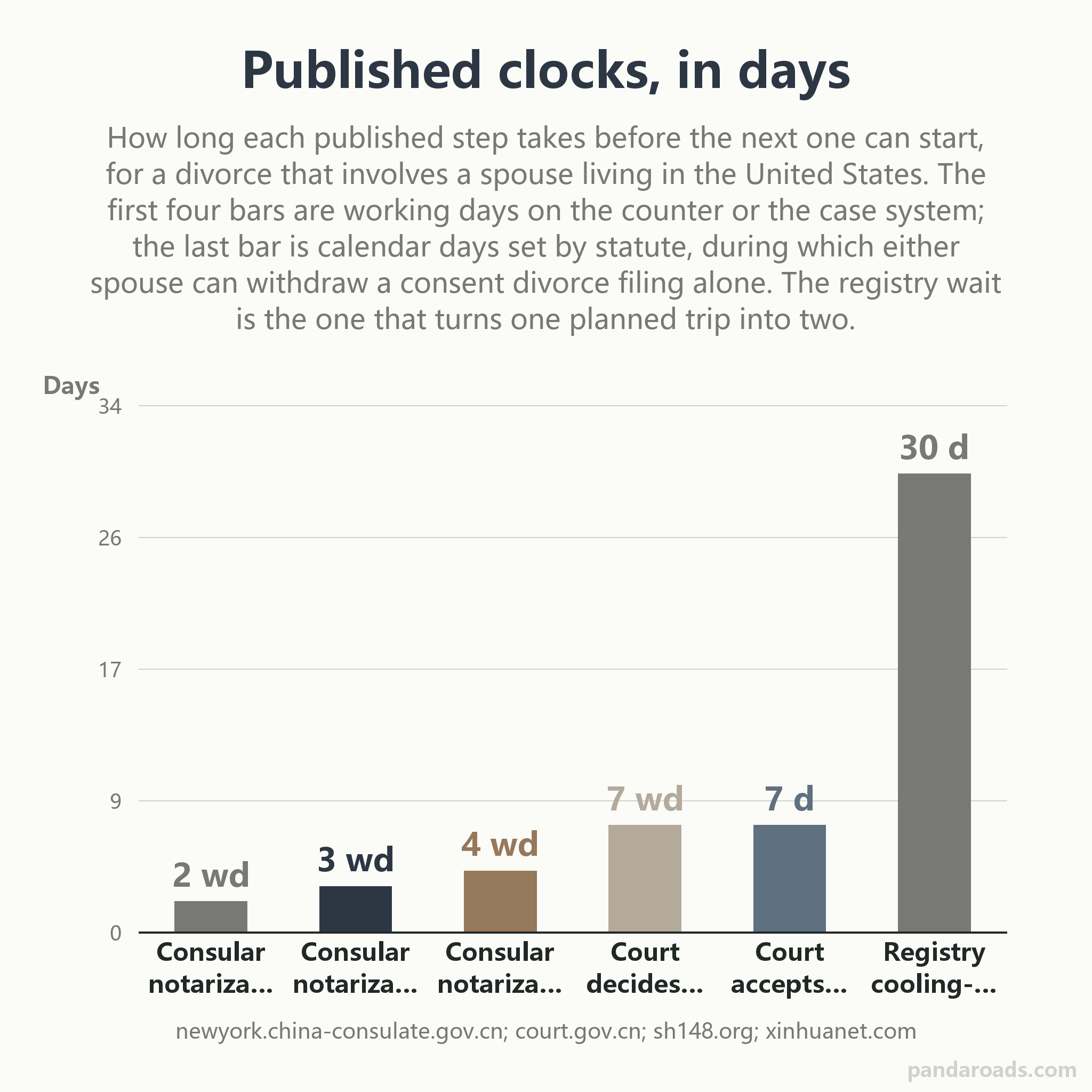
- 30 days The cooling-off wait after a mainland civil affairs bureau accepts a divorce application, during which either spouse can withdraw it alone (source: xinhuanet.com)
- 30 more days The window after that in which both spouses must personally go back and ask for the certificate, or the file is treated as withdrawn (source: xinhuanet.com)
- 2 visits The number of in-person counter appearances a consent divorce registration requires, and the reason one business trip is not enough (source: xzfg.moj.gov.cn)
- $22 What a Chinese consulate in the United States publishes as the fee for the original notarial certificate on a civil document, which is what a litigation authorization becomes (source: newyork.china-consulate.gov.cn)
- 50 to 300 RMB, the published acceptance fee for a divorce case filed in a Chinese court, before any property division is counted (source: hnlsxfy.hncourt.gov.cn)
- 4 doors The lawful routes covered below, two of which are usually closed to a couple split between the United States and China
Six numbers, and the one Americans cannot believe is the first. Every US state lets a divorce be finished on papers plus a hearing that is often remote, so the idea that a signed, notarized, mutually agreed divorce file can be cancelled by one spouse walking into an office alone, with no reason required, reads like a mistake. It is not a mistake, it is Article 1077 of the Civil Code, and it is the reason the registration door costs two trips rather than one (source: xinhuanet.com). The fourth and fifth numbers are the quiet argument for the court door: a validated authorization priced in tens of dollars, and a case acceptance fee priced in hundreds of yuan, against an airfare counted in thousands.
The four routes side by side
You can get divorced in China while living abroad, but not on one procedure: a consent divorce needs both spouses at the counter twice, 30 days apart, a contested divorce runs through a court that can accept a validated overseas authorization, and a US judgment needs recognition by a Chinese intermediate court before it ends the marriage on the Chinese record (source: sh148.org).
| Route | Who must appear in person | What has to be validated first | Realistic clock |
|---|---|---|---|
| Consent divorce at a mainland civil affairs bureau | Both spouses, at filing and again at collection | Nothing overseas, but the marriage must have been registered in mainland China (source: xzfg.moj.gov.cn) | 30 days plus a 30 day return window (source: xinhuanet.com) |
| Divorce registered at a Chinese embassy or consulate | Both spouses, before the consular officer | Only if the certificate will be used in mainland China, then its own chain (source: cs.mfa.gov.cn) | Same 30 plus 30 shape, by appointment |
| Contested divorce in a Chinese court | In principle both, unless the court excuses attendance and accepts a written opinion | Your letter of authorization, by consulate, apostille, or video before a judge (source: policy.mofcom.gov.cn) (source: court.gov.cn) | Months, set by the case |
| Recognition of a foreign divorce judgment | The applicant side files; the court rules on documents | The foreign judgment plus a certified Chinese translation, notarized and authenticated abroad (source: sh148.org) | Filed within 7 days of a complete application, then review |
Two of those doors are usually shut for a couple split between the United States and China. The consular registration door needs both spouses to be Chinese citizens residing in that consulate's country, which is exactly the condition a China-staying spouse breaks (source: cs.mfa.gov.cn). And the mainland registration door has a threshold that surprises people who married in a US county office: the marriage registration authority will not accept a divorce registration application where the marriage was not registered in mainland China (source: xzfg.moj.gov.cn). That leaves the court door and the recognition door for most of the readers of this guide, which is why the next five sections spend their time there.
Read the table as a decision, not a menu. The route is chosen by three facts about your marriage, whether your spouse will sign, where the marriage was registered, and whether a court outside China has already spoken.
Doors 1 and 2: a registry divorce, in China or at a consulate
The 30 and 30 clock, spelled out
If both of you want the divorce and nothing is contested, the mainland registry is the cheapest door in the whole system, and it is the door that punishes an overseas spouse most. Article 1076 of the Civil Code requires a voluntarily divorced couple to sign a written divorce agreement and to apply for divorce registration in person at the marriage registration authority, and that agreement has to cover the children, support, and the division of property and debts (source: xinhuanet.com). Nothing about that is remote.
Then the clock starts. The revised Regulations on Marriage Registration, State Council Decree No. 804, in force since 10 May 2025, restate at Article 13 that both parties sign and appear together to apply (source: xzfg.moj.gov.cn). Article 1077 of the Civil Code then gives either spouse thirty days from the moment the authority takes the application to withdraw it, alone, for any reason or none. When those thirty days end, both spouses must personally go back and apply for the divorce certificate within the following thirty days, and Article 16 of the 2025 regulations confirms that a party who lets that period pass has the application deemed withdrawn and the procedure terminated (source: xinhuanet.com) (source: xzfg.moj.gov.cn).
| When | What happens | Who has to be there |
|---|---|---|
| Day 0 | Authority accepts the application and starts the clock | Both spouses (source: xzfg.moj.gov.cn) |
| Days 1 to 30 | Cooling-off period, either spouse may cancel the file | Either spouse alone (source: xinhuanet.com) |
| After day 30 | Both must personally apply for the certificate | Both spouses (source: xinhuanet.com) |
| Days 31 to 60 | The only window in which the certificate can be collected | Both spouses, or the file dies |
Two practical points fall out of that table. The registration itself carries no fee, because Article 6 of the regulations bars the marriage registration authority from charging for the registration documents (source: xzfg.moj.gov.cn). And a single trip cannot cover the file, because the two appearances are thirty days apart by design, which is the arithmetic most overseas spouses discover after booking one flight.
Before you plan around this door, four things have to be true: your spouse will sign the same agreement at both visits; the marriage was registered in mainland China, since an application is not accepted where the marriage was not registered there (source: xzfg.moj.gov.cn); the mainland side can assemble the identity and household documents the bureau asks for; and the agreement already settles children, support, property and debts, because Article 1076 requires all of it in writing (source: xinhuanet.com).
Why the consular registry door usually does not open
A Chinese embassy or consulate can register a divorce, and overseas spouses often assume that is the answer built for them. The published conditions say otherwise. Both parties must be Chinese citizens with full civil capacity residing in the country of that mission, the marriage must have been concluded at that mission, and both parties must personally apply, on an agreed and uncontested divorce (source: cs.mfa.gov.cn). A couple where one spouse stayed in Chengdu fails the residence condition on its face.
Where the conditions are met, the mission applies the same shape, a 30 day cooling-off period and then a 30 day window in which both must personally collect the certificate, with consular marriage and divorce registration free of charge since 1 April 2017 (source: cs.mfa.gov.cn). There is also an asymmetry that catches people who do qualify: some host countries recognize a consular Chinese marriage and decline to recognize a consular Chinese divorce, Germany is the example the ministry names, and a consular certificate meant for use in mainland China needs its own authentication or apostille chain at the place it was issued (source: cs.mfa.gov.cn).
This is where a common assumption breaks. A poster on r/Chinavisa asks exactly it in a different context: "Are you able to have someone bring your documents to the consulate for an application on your behalf? Or does the person applying for the..." (source: reddit r/Chinavisa, 2023-04, search snippet). That thread is about a visa counter, not a divorce, and it is quoted here only because it states the assumption both registry doors reject, that a file can be handed in by somebody else. For a divorce registration it cannot, in China or at a consulate, and the word "personally" in Article 1076 is doing the work (source: xinhuanet.com).
Note: When one spouse will not sign, will not attend twice, or cannot be found at all, the registry doors close and the case belongs to a people's court. That is not a failure; the court door is the one with an overseas procedure, and it is where the next four sections go.
Door 3: a Chinese court case you may not have to stand in
Which Chinese court can hear it
Article 1079 of the Civil Code is the litigation door: where only one spouse wants the divorce, the couple may go through a mediation organization or file directly with a people's court, which must conduct mediation, and divorce must be granted where mutual affection has truly broken down and mediation fails (source: xinhuanet.com).
The same article names the situations that establish breakdown, including a couple having lived apart for a full two years, and it adds that where a divorce was once refused and the couple has then lived apart for another full year, a renewed petition must be granted (source: xinhuanet.com).
Living in New Jersey does not move the case out of China. Articles 12 through 17 of the Supreme People's Court interpretation applying the Civil Procedure Law decide venue, and Article 15 is the one that describes this scene: where one Chinese citizen resides abroad and the other resides in China, then no matter which side files, the people's court at the domicile of the spouse living in China has jurisdiction (source: njxwfy.gov.cn). If both spouses are abroad but not settled abroad, the court of the plaintiff's or the defendant's original domicile in China may take the case, and where a couple already divorced abroad while settled abroad are arguing only about property located in China, the court where the main property sits takes it (source: njxwfy.gov.cn).
What filing actually costs
The published number is small enough to be worth stating precisely. Article 13 of the State Council Measures on Payment of Litigation Costs, State Council Decree No. 481 in force since 1 April 2007, charges RMB 50 to RMB 300 to accept a divorce case, and where property division is involved nothing further is payable on a total up to RMB 200,000, with 0.5 percent charged only on the portion above that (source: hnlsxfy.hncourt.gov.cn). That fee schedule is why the litigation door is cheaper than one transpacific flight before a lawyer is even engaged.
Who may act for you
A retainer with a Chinese law firm is the operative step, and it is a requirement rather than a preference. Article 274 of the Civil Procedure Law provides that a foreigner, a stateless person or a foreign organization appointing a lawyer for litigation in a Chinese court must appoint a lawyer of the People's Republic of China (source: policy.mofcom.gov.cn). Article 62 adds the content rule that trips people up, that a letter of authorization has to state specifically whether the agent may admit, waive or modify a claim, settle, counterclaim or appeal, and it further provides that a Chinese citizen residing abroad who mails or entrusts a letter of authorization from outside China must have it certified by a Chinese embassy or consulate in that country (source: policy.mofcom.gov.cn).
So the retainer is the right conclusion, and it is still not the whole answer. The lawyer cannot act until the authorization itself is valid, and validity is a document procedure, not a signature. That is the next door, and it is the one with real prices attached.
Note: A Chinese court case ends the marriage and divides what the court is shown. It is not a device for moving property that sits outside China, and nothing in this section says which grounds to plead or what to ask for. That is a licensed Chinese lawyer's judgment, not procedure information.
Making a signature made in America count in China
An overseas signature becomes usable in a Chinese court or registry through one of four validation paths, and they are not interchangeable: consular notarization at 22 US dollars, a US notary plus an apostille, overseas remote video notarization at a Chinese notary office, or signing the authorization on video before the judge, which carries no separate published fee and removes notarization altogether (source: newyork.china-consulate.gov.cn).
Consular notarization, the published default
Article 62 of the Civil Procedure Law requires a Chinese citizen living abroad who mails or entrusts a letter of authorization from outside China to have it certified by a Chinese embassy or consulate in that country, and Article 275 sets the parallel rule for a party with no domicile inside China, notarization by a notary organ of the country where it is signed plus authentication by a Chinese embassy or consulate there, or proof according to an applicable treaty (source: policy.mofcom.gov.cn). The Chinese General Consulate in New York publishes exactly what that means in practice. It notarizes letters of authorization, declarations, the truth of a signature, seal and date, and fingerprints, and it names the fixed-format documents Chinese courts require, which are the litigation power of attorney, the civil complaint, the statement of defense and proof of service (source: newyork.china-consulate.gov.cn).
Three constraints in the same notice decide your calendar. The applicant must appear in person and sign before a consular officer, with a pre-review filed through the China Consular app. Processing is four working days ordinary, three expedited, two urgent. And the consulate does not handle notarization involving real estate or other major property, which has to go through a local US notary plus an apostille for use in China instead (source: newyork.china-consulate.gov.cn).
US notary plus apostille, the two-step chain
The direction of document traffic changed in late 2023. The Hague apostille convention entered into force for the People's Republic of China on 7 November 2023, and the Beijing Justice Bureau describes the effect as replacing the former three-level double authentication with a two-level chain in which the issuing country's competent authority attaches an apostille (source: beijing.gov.cn). That treaty route is the alternative Article 275 already allows (source: policy.mofcom.gov.cn).
A poster on r/chinalife describes the American half of it in the words an applicant uses: "Chinese Marriage Certificate Apostille... Get the document notarized from a local notary public. · Go to the local Foreign Affaris Office and get the Hague apostille." (source: reddit r/chinalife, 2024-04, search snippet), with the misspelling kept as written. On the Chinese side, the foreign ministry's consular service pages publish apostille certificate fees of RMB 50 for a civil document and RMB 100 for a commercial one, for Chinese public documents going out, and every certificate can be checked online at the ministry's verification address (source: cs.mfa.gov.cn).
Remote video notarization, and video before a judge
The Beijing Justice Bureau publishes three ways for an overseas party to obtain notarization, including overseas remote video notarization for a Chinese citizen who has stayed continuously abroad for at least 180 days, holds permanent residence abroad, or holds a long-term visa, and the categories available through that channel expressly include letters of authorization, declarations, and notarization of a signature on a marital property agreement or a divorce agreement (source: beijing.gov.cn).
The fourth path is the court's own. Under the Supreme People's Court provisions on cross-border litigation online services, published 3 February 2021, an identity-verified cross-border party who instructs a mainland lawyer may apply to the court hearing the case for online video witnessing, where the overseas party and that lawyer sign the delegation and authorization documents before the judge on video, and the provisions state expressly that there is then no need to go through notarization, authentication, transmission or similar procedures at all (source: court.gov.cn).
| Path | Where you physically go | Published price | Published wait |
|---|---|---|---|
| Consular notarization | In person at a Chinese embassy or consulate abroad | $22 original, $7 a copy, $25 expedited, $37 urgent (source: newyork.china-consulate.gov.cn) | 2 to 4 working days (source: newyork.china-consulate.gov.cn) |
| US notary plus apostille | A US notary, then the state authority that issues apostilles | Set by the state, not fixed nationally | Varies by state |
| Remote video notarization | Anywhere with a signal, through a Chinese notary office | Quoted by that notary office | Set by the office's schedule |
| Video witnessing before a judge | The court's online system with your mainland lawyer | No separate published fee | Court decides registration within 7 working days (source: court.gov.cn) |
Four terms appear on every form in this chain, and mixing them up is the most common way a file is bounced. The words are not interchangeable:
- 授权委托书: the letter of authorization, the document that appoints the lawyer and sets out exactly what the lawyer may do
- 声明书: a declaration or written statement, used for putting your position on the marriage in writing
- 公证: notarization, the act of a notary organ or a consular officer certifying the signature
- 附加证明书: the apostille, the certificate the issuing country's competent authority attaches
A poster on r/China states the delegation question that both this section and the notarial chain exist to answer, in a birth-certificate scene rather than a divorce one: "Greetings all, I would like to hire an attorney/law firm to procure a Notarial Certificate of Birth (出生公证书) for my wife, who left China..." (source: reddit r/China, 2023-08, search snippet). Hiring someone to procure a notarial certificate is a real service pattern, and the general version of it, police certificates included, belongs to the guide on retrieving documents in China from abroad. What differs in a divorce is narrower and worth saying out loud: the litigation authorization is a fixed-format court document a consulate will notarize for a published $22, while anything touching real estate or other major property is expressly refused at that same counter and has to take the US notary plus apostille route (source: newyork.china-consulate.gov.cn).
Warning: Nothing in this chain dissolves a marriage. It validates the signature that lets a lawyer act, or lets you state a position in writing, and the divorce itself comes from the registry, the court or the consulate.
Do you have to appear in person?
For a consent divorce registered at a mainland civil affairs bureau the answer is fixed by statute: both spouses sign at the counter, and both spouses come back in person once the cooling-off period ends. For a contested divorce in a people's court the answer is conditional, and Article 65 of the Civil Procedure Law is what sets the condition (source: policy.mofcom.gov.cn).
Read Article 65 carefully, because it is not the sentence most English summaries claim. It says that in a divorce case a party who has appointed a litigation agent must still appear at court, unless that party is unable to express their own will, and that a party who genuinely cannot appear because of special circumstances must submit a written opinion to the people's court (source: policy.mofcom.gov.cn). The obligation runs the other way from the one people assume. Presence is the default even when you are represented, and absence is the exception you have to earn by showing a reason the court accepts, in writing.
The remote half of the answer is real and narrower than the rumor. Under the Supreme People's Court provisions on cross-border litigation online services, an overseas party who has passed identity verification and instructed a mainland lawyer can apply to the court hearing the case to sign the delegation and authorization documents on video before the judge, and the provisions state that there is then no need for notarization, authentication or transmission at all (source: court.gov.cn). That removes the document obstacle. It does not remove you from the courtroom.
Article 21 of the People's Court Online Litigation Rules lists situations in which an online hearing may not be held at all, including where the court must examine identity, original documents or physical items at the hearing venue, and the same rules treat a party who fails to join a scheduled online hearing without justified reason as having refused to appear (source: court.gov.cn).
Two popular answers to this question are therefore both wrong, one in each direction. The inference a reader can pull from a 2022 thread in r/chinalife, that any Chinese divorce case can now be heard online, is an inference and not something anyone in that thread said, and Articles 21 and 65 contradict it. The blanket answer given by several English language practice pages, that you should assume you will have to fly back to China and stand there, is contradicted by the written opinion route and the video witnessing route. What the statutes actually support is that attendance is a decision the assigned judge makes about your case, on the papers in front of them.
The fourth door has a different shape again. An application to recognize a foreign divorce judgment is examined by a panel of three judges and the resulting ruling cannot be appealed (source: sh148.org), which is why that door is the one genuinely run on documents.
Note: The practical consequence is a sequence, not a shortcut. The authorization chain in the section above is what lets you ask a court to excuse your presence; it does not guarantee that the court will. Nothing on this page tells you what to argue or which ground to plead, and a licensed Chinese lawyer, not a procedural guide, answers that.
A divorce granted abroad, and the Chinese side of it
A divorce judgment from a US court does not end the marriage on the Chinese record by itself. The Chinese half of it is a separate application for recognition, filed with an intermediate people's court, which has 7 days to open the case or to turn it down with reasons (source: sh148.org).
The venue rule is the part that surprises people who have already moved. The application is accepted by the intermediate people's court of the applicant's domicile in China, or of the habitual residence where the two differ, and where the applicant is not inside China at all, by the intermediate court of the applicant's former domicile in China (source: court.gov.cn). Review then runs on paper: a collegiate panel of three judges examines the file and the ruling cannot be appealed (source: sh148.org).
What has to travel with the judgment is specific. The application must attach the original foreign divorce judgment and a Chinese translation certified as accurate, or it is not accepted; where the judgment does not state that it has taken effect, the court requires proof of effectiveness from the court that issued it; where the applicant was the plaintiff in the foreign case, the court requires proof that the other spouse was lawfully summoned (source: sh148.org). Those supporting documents, if they were drawn up abroad, must be notarized by a notary organ in that country and authenticated by a Chinese embassy or consulate there, or proved according to the formalities of an applicable treaty, which is the sentence that lets an apostille stand in for consular authentication on this paper too (source: sh148.org).
The limit matters as much as the route. Article 2 of the same provisions states that recognition and enforcement of the parts of a foreign divorce judgment dealing with the division of marital property, maintenance, and the raising of children are not covered by this procedure (source: sh148.org). A US order dividing a house in Ohio or setting support does not become a Chinese enforcement order through this door. Recognition is also refused where the judgment has not yet taken effect, where the foreign court had no jurisdiction, where it was issued with the defendant absent and not lawfully summoned, where a Chinese court has already ruled on or is hearing the same divorce, or where a third country's judgment between the same spouses has already been recognized by a Chinese court (source: sh148.org).
The provisions that create this route are deliberately narrow. They recognize the change a foreign court made to marital status, and nothing more (source: sh148.org).
Before an application is filed, four items are usually assembled:
- The foreign judgment in original form, plus a Chinese translation certified as accurate
- Proof that the judgment has taken effect, from the issuing court, where the judgment itself is silent
- Proof of lawful summons or appearance, where the other spouse did not appear
- Notarization plus authentication, or an apostille, on every document signed or issued abroad
Note: Arrangements for a child and cross border removal of a child are separate questions with their own authorities and their own procedures, and this procedural guide does not cover them. Nothing above should be read as a claim about whether a particular foreign judgment will be recognized in a particular case.
What the paperwork costs, and what flying back costs
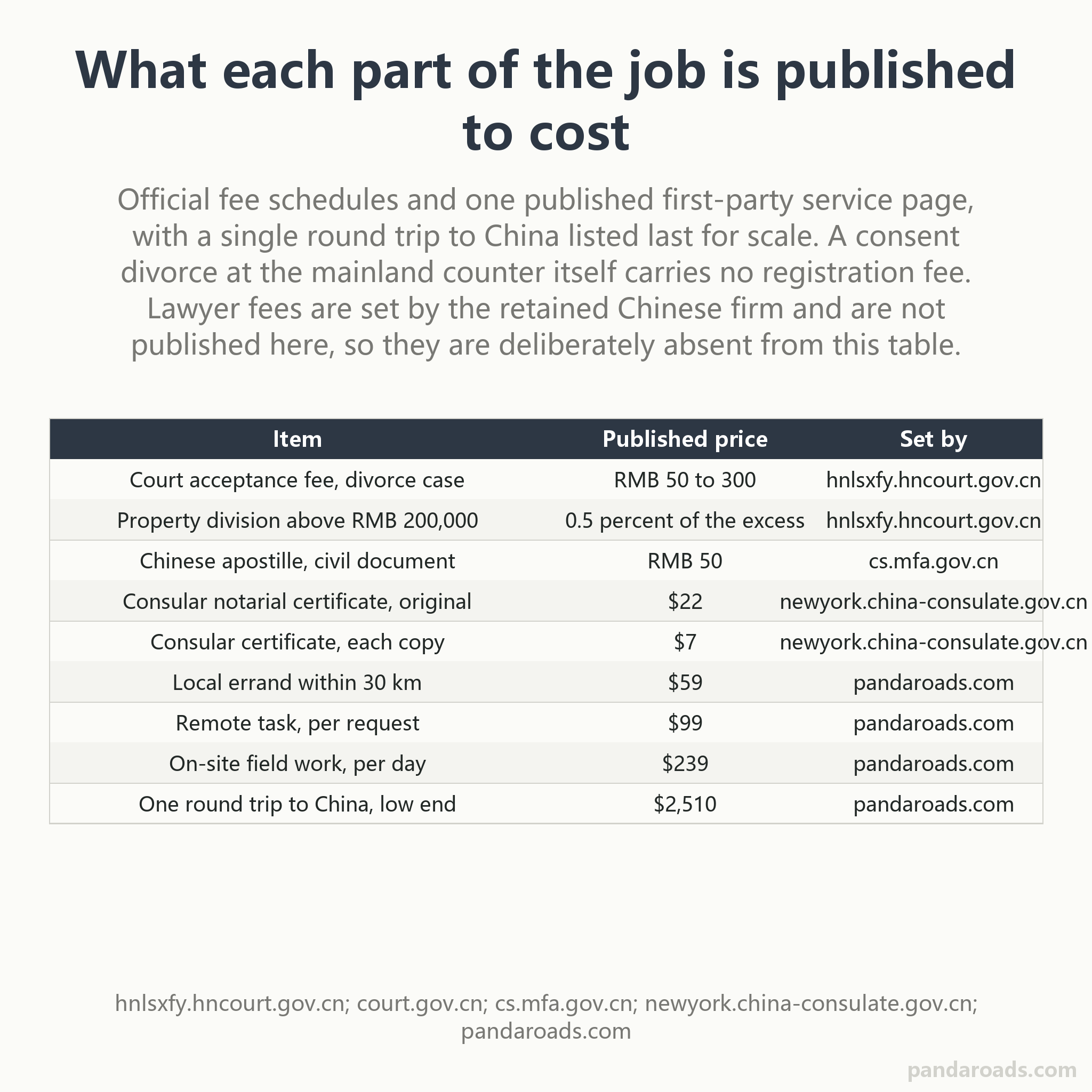
Every published official fee on this job is priced in tens or hundreds of yuan, and the trip that used to be attached to it is priced in thousands. A Chinese court charges RMB 50 to RMB 300 to accept a divorce case, with nothing further on divided property up to RMB 200,000 and 0.5 percent charged only on the portion above that (source: hnlsxfy.hncourt.gov.cn). A mainland registry charges nothing, because the marriage registration regulations bar the authority from charging for the registration documents (source: xzfg.moj.gov.cn).
The consular and notarial line items are equally public. A Chinese consulate in the United States charges $22 for the original notarial certificate on a civil document such as a litigation authorization, $7 for each copy, $25 to expedite to three working days and $37 to rush it to two (source: newyork.china-consulate.gov.cn). China's own issuance of an apostille on a Chinese civil document is RMB 50 (source: cs.mfa.gov.cn). A US state apostille, the step on the American side of the chain, is set by the state rather than fixed nationally, so it is quoted where you buy it.
Against that list sits the alternative. PandaRoads puts one round trip to China at roughly $2,510 to $9,250 once flights, hotels, meals, local transport and a lost work week are counted (source: pandaroads.com), and a consent divorce at a mainland counter needs that trip twice, thirty days apart (source: xinhuanet.com). That single comparison is why the delegation documents, not the air ticket, are the real budget line in an overseas divorce.
The on ground work has published rates. A Local Errand is $239 within 30 km, completed within two working days, with photos and receipts (source: pandaroads.com). A Remote task is $129 per request, on site field work is $239 per day billed from departure, and single errands run at $239 (source: pandaroads.com).
The boundary is worth stating as plainly as the company states it. PandaRoads is not a law firm, not a licensed marriage intermediary, not a notary office and not an authentication body. A divorce is granted by a civil affairs bureau, a people's court or a Chinese embassy or consulate, and a notarized certificate or apostille can only come from a notary organ or the competent issuing authority. What an on ground runner does around a divorce file is physical: accompanying a party or a representative to the civil affairs bureau or the courthouse, translating at the counter, queueing and submitting at the notary office and the consular document channel, couriering originals and receipts, and photographing each step so there is an evidence chain that the visit happened. None of that changes an outcome in a case, and none of it substitutes for a licensed Chinese lawyer.
Note: Lawyer fees are quoted by the retained Chinese firm and are not published here. A percentage band or a flat figure invented for this page would not be verifiable, and the fee a firm charges depends on the property in dispute and the court dealing with the file.
Frequently asked questions
Can I get divorced in China if I live in the United States? Yes, on two of the four routes. A contested divorce can be filed in a Chinese court while you live in the United States, once your letter of authorization is validly certified, and a divorce already granted by a US court can be put before a Chinese intermediate court for recognition (source: policy.mofcom.gov.cn) (source: sh148.org). A consent divorce at a mainland counter cannot, because it needs both spouses present.
Do both parties have to be present for divorce registration in China? Yes, twice. Article 1076 of the Civil Code requires a voluntarily divorced couple to sign a written divorce agreement and to apply for divorce registration in person at the marriage registration authority (source: xinhuanet.com). After the cooling-off period ends, both must personally apply again for the divorce certificate within thirty days, or the file is treated as withdrawn (source: xzfg.moj.gov.cn).
How long is the divorce cooling-off period in China? Thirty days, then a second thirty day window. Either spouse may withdraw the application alone within thirty days after the authority takes it, and once that period ends both spouses must personally go back within the following thirty days to collect the certificate (source: xinhuanet.com). Miss that window and the application is deemed withdrawn, which is why one trip is never enough.
Can a Chinese divorce case be heard online? Sometimes, and not by right. Article 65 of the Civil Procedure Law says a divorce party who has appointed an agent must still appear unless unable to express their own will, and otherwise must file a written opinion with the court (source: policy.mofcom.gov.cn). Article 21 of the Online Litigation Rules bars online hearings where identity or original documents must be examined at the venue (source: court.gov.cn).
How do I sign divorce papers for China from abroad? Through one of four validation paths: in person notarization at a Chinese embassy or consulate in the United States, a US notary followed by an apostille, overseas remote video notarization at a Chinese notary office, or online video signing of the authorization before the judge handling your case (source: newyork.china-consulate.gov.cn) (source: beijing.gov.cn) (source: court.gov.cn). Which path is open depends on what the document is about.
Does China accept an apostille instead of consular legalization? Yes for documents. The Hague apostille convention entered into force for the People's Republic of China on 7 November 2023, replacing the former three level double authentication with a two level chain, and Article 275 of the Civil Procedure Law already allows proof under an applicable treaty (source: beijing.gov.cn) (source: policy.mofcom.gov.cn). It changes the paperwork, not the in person attendance rules.
Can I hire a lawyer in China to handle my divorce without flying back? You must hire a Chinese lawyer, not a US one, and that is the start rather than the finish. Article 274 requires a foreigner appointing a lawyer for litigation in a Chinese court to appoint a lawyer of the People's Republic of China (source: policy.mofcom.gov.cn). Whether you can then stay in the United States is a separate decision by the assigned judge.
Will a Chinese court recognize a divorce I obtained in the United States? Only on application, and only for marital status. An intermediate people's court files a complete recognition application within seven days, a panel of three judges reviews it, and the ruling cannot be appealed (source: sh148.org). Article 2 of those provisions excludes the property division, maintenance and child raising parts of a foreign judgment from this route.
How much does it cost to file a divorce case in a Chinese court? RMB 50 to RMB 300 for the court to accept the case, with nothing further charged on divided property up to RMB 200,000 and 0.5 percent only on the portion above that (source: hnlsxfy.hncourt.gov.cn). A mainland registry charges nothing for the registration itself (source: xzfg.moj.gov.cn).
Which court in China handles a divorce when one spouse lives overseas? The court at the other spouse's address. Article 15 of the Supreme People's Court interpretation applying the Civil Procedure Law provides that where one Chinese citizen resides abroad and the other resides in China, the people's court at the domicile of the spouse living in China has jurisdiction, no matter which side files (source: njxwfy.gov.cn). For recognition of a foreign judgment, the applicant's domicile or former domicile decides.
The bottom line
Four doors and one clock, and two questions decide which door a marriage actually fits. If both spouses will sign the same agreement and can stand at the same mainland counter twice, thirty days apart, the registry route is the cheapest door in the system and the cooling-off clock decides the calendar (source: xinhuanet.com). If either of those fails, the court door is the one that can be opened from the United States, and the point of a consular notarization, an apostilled US notarial certificate or a video signing before the judge is precisely that it makes an absence something a court can accept on a written opinion rather than a body at the bar (source: policy.mofcom.gov.cn) (source: court.gov.cn). The fourth door goes the other way. Recognition of a foreign divorce judgment secures marital status inside China and nothing else, not the money and not the children (source: sh148.org).
What does not change with any of that is the limit of this page. It is procedure information current as of September 2026, gathered from published Chinese statutes, court provisions, consular notices and regulation text. It is not legal advice, it does not tell anyone what to claim or concede, and which route applies to one specific marriage is decided by a licensed Chinese lawyer, a civil affairs bureau or the court handling the file, not by this site.
References
- 新华社. (2020, June 1). 中华人民共和国民法典(婚姻家庭编)第一千零七十六条至第一千零七十九条 [Civil Code of the People's Republic of China, Marriage and Family Book, Articles 1076-1079]. Xinhuanet. http://www.xinhuanet.com/politics/2020lh/2020-06/01/c_1126061072_5.htm
- 司法部行政法规库. (2025). 婚姻登记条例(国务院令第804号,自2025年5月10日施行) [Regulations on Marriage Registration, State Council Decree No. 804, effective 10 May 2025]. Ministry of Justice Administrative Regulations Database. https://xzfg.moj.gov.cn/front/law/detail?LawID=1766
- 政策法规库(商务部). 中华人民共和国民事诉讼法 [Civil Procedure Law of the People's Republic of China, Articles 62, 65, 274 and 275]. Ministry of Commerce policy and regulation library. https://policy.mofcom.gov.cn/claw/clawContent.shtml?id=98636
- 南京玄武区人民法院. 最高人民法院关于适用《中华人民共和国民事诉讼法》的解释 第十二条至第十七条(管辖) [Supreme People's Court interpretation applying the Civil Procedure Law, Articles 12-17, jurisdiction]. Nanjing Xuanwu District People's Court. http://www.njxwfy.gov.cn/PublicColumn/Overview-Scope-of-jurisdiction/e9091710-3806-4ddb-8a79-dfc31dbeb210
- 最高人民法院. (2021, February 3). 人民法院在线诉讼规则 / 关于诉讼服务跨境在线办理的有关规定 [Supreme People's Court provisions on cross-border online litigation services, and the People's Court Online Litigation Rules (Article 21)]. People's Court. https://www.court.gov.cn/zixun/xiangqing/286331.html
- 北京市司法局. (2025, April 15). 涉外公证与海牙《取消外国公文书认证要求的公约》附加证明书 / 海外远程视频公证 [Beijing Municipal Bureau of Justice: Apostille under the Hague Convention and overseas remote video notarization]. Beijing Municipal People's Government. https://www.beijing.gov.cn/fuwu/bmfw/sy/jrts/202504/t20250415_4065241.html
- 中国驻纽约总领事馆. (2025, October 27). 公证办理须知 / 收费标准 [Notice on notarization services and fee schedule]. Chinese Consulate General in New York. https://newyork.china-consulate.gov.cn/zjfw/lshzhj/gzh/202510/t20251027_11741787.htm
- 外交部领事服务网. 婚姻登记须知 与 附加证明书收费标准 [Consular marriage registration guidance and apostille certificate fees]. Ministry of Foreign Affairs Consular Service. https://cs.mfa.gov.cn/zggmzhw/hydj/
- 河南省鲁山县人民法院. 诉讼费用交纳办法(国务院令第481号)收费标准(离婚案件每件50元至300元;财产总额不超过20万元不另交纳,超过部分按0.5%) [State Council Measures on Payment of Litigation Costs, Decree No. 481, fee schedule]. Henan Lushan County People's Court (PDF). https://hnlsxfy.hncourt.gov.cn/upload/file/20251209/20251209172523_53506.pdf
- 上海市法律援助中心. 最高人民法院关于中国公民申请承认外国法院离婚判决程序问题的规定(1991) [Supreme People's Court 1991 provisions on Chinese citizens applying to recognize a foreign court divorce judgment (Article 2 excludes property, maintenance and child support)]. Shanghai Legal Aid. http://www.sh148.org/law02/law04/430.htm
- PandaRoads. (2026). Errands in China from overseas: how a verified local team works [Service and pricing page]. PandaRoads. https://pandaroads.com/errands-in-china-from-overseas.html
Last reviewed and updated: September 2026. Author: our editorial team. For tailored guidance, contact our team.