Airport Pickup and Hospital Escort for Parents in China
The arrival-day run sheet and the hospital-visit anatomy for aging parents handled from the US: meet-and-greet through Pudong's Kind Help Passage, 挂号 versus 特需 international-department fees in RMB, the 50-billion-yuan 陪诊 companion industry, the sandwich-generation statistics, and the hard line between an escort and a medical decision-maker.
Last updated: July 2026 · By the PandaRoads team in China
TL;DR
For a parent landing alone at a Chinese airport or facing a hospital appointment while their adult child lives in the US, the one thing you cannot outsource across an ocean is physical presence. A cross-border errand runner supplies exactly that: meeting the parent at the arrivals gate, helping through immigration and customs, setting up a local SIM and mobile wallet, driving them home, then escorting them to the hospital, handling registration, translating the logistics, collecting the prescription and riding them back, from $99 per errand or $239 for an on-site day, with receipts and a written summary. The honest limit is scope and authority: an escort is a companion and translator of logistics, not a licensed 养老护理员 caregiver and not someone who signs consent or makes medical decisions, and for multi-day hands-on care or real treatment choices the family needs a credentialed caregiver and a licensed agent or power of attorney.
Abstract
A sourced, plain-English walkthrough for a US adult child arranging care logistics for an aging parent in or visiting China: how to get the parent physically met at a Chinese airport and walked through arrival, and how the same trusted person then escorts them to a hospital appointment, covering the real 陪诊 companion industry, the regular 挂号 versus 特需 / international trade-off, the identity and foreign-card payment mechanics, the trust chain a stranger-escort must satisfy, and the honest line between an errand runner, a licensed caregiver and a medical decision-maker.
Key Takeaways
- A stranger can be at the gate and in the corridor; you cannot from the US
- Getting met at the gate plus a SIM and wallet fix is one arrival errand
- Hospital registration is now app-and-passport gated, the step you cannot do remotely
- Regular 挂号 is cheap and crowded; 特需 / international is self-pay at 3 to 5 times
- 陪诊 is a real scaling Chinese industry, uneven and largely Chinese-language
- Trust needs photo ID, live location, receipts and a same-day written summary
- An escort is not a licensed caregiver and cannot sign consent or decide
Table of Contents
- Abstract
- Key Takeaways
- The moment you cannot outsource across an ocean
- Why this is a sandwich-generation problem, not a phone call
- The arrival half: an airport-to-home run-sheet
- The hospital half, part one: how a returning citizen or foreign patient actually registers
- The hospital half, part two: regular 挂号 versus the 特需 or international department
- What an escort actually does, and the trust chain a stranger requires
- The 陪诊 industry that grew up around absent children
- The honest line: an escort is not a caregiver and not a decision-maker
- Frequently asked questions
- The bottom line
- References
The moment you cannot outsource across an ocean
Your mother's flight lands at Shanghai Pudong at three in the afternoon. She is seventy-four. Her American phone will not roam the way it used to, she has not opened a Chinese hospital app since she left the country years ago, and you are in Ohio with a job, two kids and a nine-hour time difference standing between you. There is a second, smaller dread waiting a few days later: a hospital appointment she cannot reliably make, reach or understand alone.
Here is the honest summary of that scene. There are only two things in it you genuinely cannot do from eight thousand miles away. You cannot stand at the arrivals gate. And you cannot walk the hospital corridor beside her. Everything else, the booking, the paying, the translation, the driving, the reporting back, can be arranged, but the one scarce ingredient is a person physically present at two specific, frightening moments.
That is the whole subject of this article, and it has two linked halves that belong together because they are one job for one trusted person. The first half is the arrival: meeting a parent through the airport, helping with the immigration and customs questions an elderly traveler should not have to field alone, getting a working local SIM and mobile wallet at the terminal, and driving them home. The second half is the healthcare that follows: escorting that same parent to a hospital visit, handling the registration, translating the logistics, collecting the prescription and riding them back.
A cross-border errand runner exists to supply exactly that presence, and this guide explains how the two halves actually work in China, what they cost, how you trust a stranger with your mother, and, just as plainly, where an escort's role has to stop.
A cross-border errand runner provides the missing presence for both halves of the job, meeting a parent at the arrivals gate and later escorting them to a hospital appointment, with single errands from $99 and an on-site field day at $239 billed from departure, while stating plainly that such an escort is not a licensed caregiver and cannot sign medical consent.
Why this is a sandwich-generation problem, not a phone call
The first thing worth saying, to a reader lying awake about this, is that the difficulty is structural, not a personal failing. You are trying to parent from another country, and the arithmetic is against you.
On the American side, this is the sharpest edge of what researchers call sandwich-generation caregiving, adults caring for an aging parent while still raising a child of their own. A national profile published in the Journal of the American Geriatrics Society found that 24.3 percent of adult-child caregivers in the United States were also caring for a minor child, about 2.5 million people, and that these sandwich caregivers reported substantially more financial difficulty, at 23.5 percent, and emotional difficulty, at 44.1 percent, than caregivers who were not also parenting (source: pmc.ncbi.nlm.nih.gov). Add a time zone, a job you cannot leave and a trans-Pacific flight, and the pressure is not one phone call away from solving.
On the Chinese side, the demographics explain why there is often nobody simply nearby to ask. By the end of 2024 China had more than 300 million citizens aged sixty and above, close to 22 percent of the population, and almost half of them live without a child immediately nearby (source: chinadaily.com.cn). A 2025 report by the China Association of Social Welfare and Senior Service found that more than 80 percent of home-dwelling older people lack timely family help when they go to a hospital (source: chinadaily.com.cn). The families have scattered, the hospitals have digitalized, and the parent is alone in a queue.
Put the two facts together and the conclusion is not bleak, it is practical. When the responsible adult child is on a US income in another time zone, a paid, on-the-ground person becomes a legitimate line in the care plan rather than an admission that you have failed your parent. You are not an outlier doing something unusual; you are one of millions arriving at the same workaround. That is precisely the need that gave rise, inside China, to an entire hospital-escort industry, which we come to shortly.
The squeeze is common, not personal: a national profile in the Journal of the American Geriatrics Society found 24.3 percent of US adult-child caregivers, about 2.5 million people, were also raising a minor child, and they reported substantially more financial difficulty, at 23.5 percent, and emotional difficulty, at 44.1 percent, than caregivers without that double load.
The arrival half: an airport-to-home run-sheet
Start with the day the plane lands, because it is the half people underestimate. Getting an elderly parent from the aircraft to a car and home is a sequence of small physical tasks, and the airport helps far less than travelers assume.
The useful mental model is a run-sheet: a list of what has to happen between wheels-down and the front door, and who does it. Here is that sheet for a typical Shanghai Pudong arrival.
| Step | What has to happen | Who does it | Cost basis | Notes |
|---|---|---|---|---|
| Taxi and gate | Deplane, walk to arrivals, reach the hall | Parent, with airport help if eligible | No charge for the airport service | Passengers over 70 can use the Kind Help Passage for tickets, security, immigration, customs and boarding on request (source: english.pudong.gov.cn) |
| Meet at the gate | Someone waiting inside arrivals with a name sign | The escort | Part of one errand (source: pandaroads.com) | Commercial meet-and-greet operators send the greeter's photo and contact ahead of the flight (source: royalairportconcierge.com) |
| Immigration and customs | Answer officer questions, clear baggage | Escort walks beside them | Included in the errand | A greeter can help but cannot overrule an immigration or customs decision (source: royalairportconcierge.com) |
| Phone and wallet | Buy a local SIM, set up Alipay or WeChat Pay | Escort helps at the terminal | SIM cost at cost (source: pandaroads.com) | Foreign-card caps matter for what comes next (source: china-briefing.com) |
| The ride home | A booked car to home or hotel | Escort drives or meets at the curb | On-site day if chained (source: pandaroads.com) | Ground transfer, not sightseeing |
| Report back | A written same-day summary to you | The escort | Included (source: pandaroads.com) | Photos and receipts per task |
Two details on that sheet deserve prose, because they are where a lone elderly parent gets stuck.
The first is the wheelchair myth. Families assume the airport provides one. It does not; Pudong's own special-needs service assists passengers over seventy with the passages and the lanes, but a wheelchair has to be requested from the airline being flown, before you travel (source: english.pudong.gov.cn). The airport is a building with lanes and staff; it is not a person, and its help ends at the terminal exit.
The second is the money. Once through, a parent needs a working phone and a way to pay. The runner can help set up Alipay or WeChat Pay on the foreign card at the airport (source: pandaroads.com), but there is a ceiling worth knowing now, because it governs the hospital bill later: a foreign card inside the Chinese wallets is capped low, roughly 3,000 yuan per single transaction on Alipay, and 6,000 yuan per transaction with a 50,000 yuan monthly cap on WeChat Pay, which waives the fee below 200 yuan and charges about three percent above it (source: china-briefing.com). A large medical charge cannot simply be run on an American card. This is exactly why the paying is done locally, by a person on the ground, and then settled and evidenced by the service.
Note: Chaining the airport run with the hospital visit on the same day moves the job from a single errand toward an on-site day, priced in the next section at $239 billed from departure.
An airport is a building, not a person: Pudong's Kind Help Passage assists passengers over 70 with the lanes and paperwork but supplies no wheelchair, which has to be requested from the airline, and a foreign card in Alipay caps near 3,000 yuan per transaction, so a lone elderly arrival needs a human as much as a priority lane.
The hospital half, part one: how a returning citizen or foreign patient actually registers
The appointment is the second half, and it begins with a step no one abroad can do with a phone call: getting your parent into the hospital's system.
Chinese public hospitals have moved booking onto apps and mini programs. In Beijing that runs through the 京医通 platform and through individual hospitals' 公众号 WeChat accounts; the same pattern, a hospital account or a city platform, holds in most big cities (source: english.shanghai.gov.cn). The intended flow is simple: register a patient profile, book a department and a time slot, then check in and pay at a kiosk or desk.
The friction is the profile. A registration is bound to an identity document. A Chinese citizen uses a national ID card. A returning citizen whose household record has lapsed, or a foreign passport holder, generally has to establish the identity at the hospital first, sometimes in person at a service window, before the app does anything useful (source: english.shanghai.gov.cn). For an elderly parent alone, that is the wall. For an adult child in Ohio, it is the same wall seen through a screen.
This is precisely the kind of task the professional hospital escorts Shanghai is now training are meant to absorb. The municipal program has nine districts each training at least 100 professionals to help dependent and semi-dependent elderly patients with registration, examinations, payments, medication collection and, notably, communicating the outcome back to family afterwards (source: english.shanghai.gov.cn). That last item is the bridge to you.
So what does an escort actually perform here? In plain terms: create or update the hospital record against the passport, choose the correct department, secure the appointment slot, queue and pay the desk fee on a local account, carry the paper folder or imaging films, and photograph each step so the family abroad can see the registration receipt, not just be told it happened. None of this is medical. It is the logistics of being a body in a system that expects a body.
The honest boundary, stated early: the escort stands in the system's queue and speaks to its clerks. It does not speak as the patient's clinical representative, and that distinction becomes the most important line in the whole article once you are inside the consulting room.
How institutional this step has become is visible in Shanghai, where nine districts each train at least 100 professional escorts to walk elderly patients through registration, examinations, payments, medication collection and reporting back to family, because a first visit usually means creating an ID-linked record in person before any booking app works.
The hospital half, part two: regular 挂号 versus the 特需 or international department
Once registration is understood, a real fork opens, and it is the decision most English-language guides skip. A Chinese public hospital usually offers two paths, and they differ on price, waiting and language all at once.
| Path | Registration fee band | Wait and crowding | Language and insurance | What the escort does |
|---|---|---|---|---|
| Regular 挂号 outpatient | Set by city: about 14 to 25 yuan in Shanghai, 25 to 50 in Guangzhou, 50 to 100 by physician rank in Beijing (source: chinamedicalinfo.com) | Long queues, dense halls, often same-day crowding | Mandarin-dominant; public insurance does not cover a visiting foreigner | Registers, queues, pays the desk, relays scheduling |
| 特需 or international department | Several hundred to over 1,000 yuan for a top physician; total pricing typically 3 to 5 times regular (source: chinamedicalinfo.com) | Appointment-style, far shorter | English-capable staff; entirely self-pay or private insurance | Handles booking, translation of logistics, records |
Read that table aloud, because the trade is about comfort and comprehension as much as money. The regular outpatient path is cheap, but it is loud, slow and in Mandarin, and for a frail parent with an absent child the confusion has its own cost. The 特需 or international department is expensive and self-pay, since China's public insurance does not cover foreign visitors, but it is quieter, booked and far easier to navigate (source: chinamedicalinfo.com). For many families the second path is worth paying for, and the money that makes it worth it would, on the regular path, be spent instead on you flying over.
Why does that pricier lane exist at all? The demand is no longer marginal. China recorded about 1.28 million international patient visits in 2025, up 73.6 percent year on year according to the National Health Commission, and Shanghai alone designates thirteen pilot hospitals for international medical services (source: chinamedicalinfo.com).
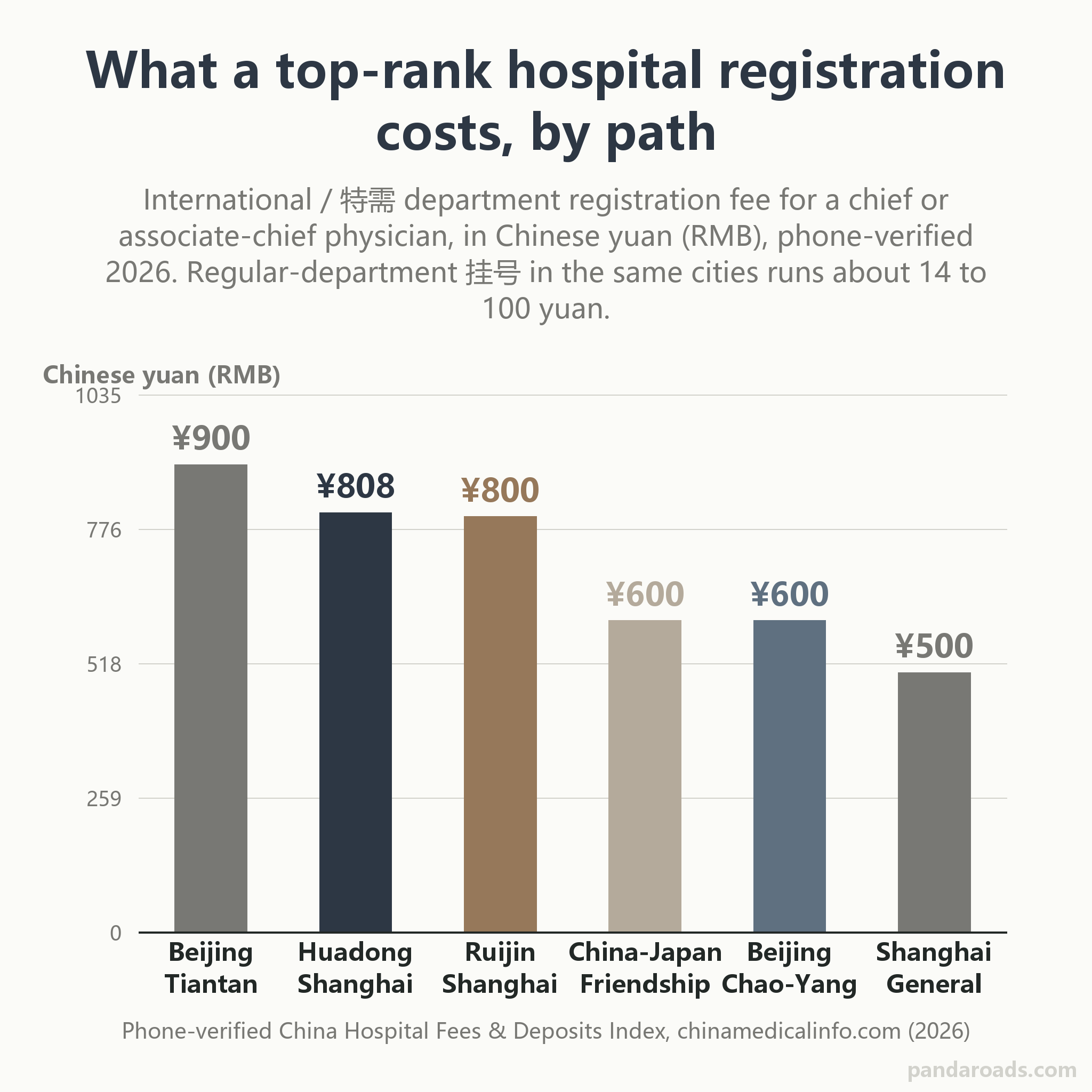
The chart makes the gap concrete: on the international side, phone-verified 2026 registration fees for a chief or associate-chief physician run from about 500 yuan at Shanghai General to 900 at Beijing Tiantan, while the regular-department registration for the same visit sits between roughly 14 and 100 yuan depending on the city (source: chinamedicalinfo.com). An escort's job in the decision is not to choose for you; it is to make either path navigable, to book the slot, to translate the logistics and to carry the records so the fee you pay buys an orderly visit rather than an exhausting one.
What an escort actually does, and the trust chain a stranger requires
Now the uncomfortable question every reader is really asking: how do I let a stranger take my mother through a hospital? The answer has two parts, what the person does, and how you make trusting them safe.
What the escort does is logistics, start to finish. At the airport they wait at the gate with a name sign, walk beside the parent through immigration and customs, help at the SIM and wallet counter and drive them home (source: royalairportconcierge.com). At the hospital they create or fix the registration, queue, pay the desk fee locally, carry the record folder and films, relay what the clinic needs in scheduling and paperwork terms, collect the prescription, and ride the parent back. That list mirrors, almost line for line, the tasks Shanghai's own escort program assigns to trained companions: registration, examinations, payments, medication collection and reporting to family (source: english.shanghai.gov.cn).
What makes it safe is not the person's charm, it is a chain of verifiable steps, and you should insist on every one of them.
Warning: Any provider who will not do all four steps below, or who promises to make a medical decision or sign a consent form, is telling you something you should heed.
The four steps are these. Before the gate: a photo, name and mobile number of the exact person, sent to you in advance. During the visit: live location sharing you can open on your own map. After the visit: a written same-day summary of who was seen, what was collected and what happens next. Throughout: payment and receipts handled by the service and evidenced, not cash passed from your parent's hand to a stranger's.
Those four, photo ID before, live location during, written summary after and receipts instead of cash, are the whole trust mechanism, and they are cheap to demand and expensive to skip. They also match how the service itself says it works: every task reported in English with a receipt, photo or confirmation, and standing instructions only ever set in writing (source: pandaroads.com).
The arranging is ordinary and the pricing is published. A single airport or hospital errand starts at $99; a local errand within 30 kilometres, with photos and receipts, is $59 inside a two-business-day window; and a full on-site field day, billed from departure so travel time counts, is $239 (source: pandaroads.com). Nothing is charged until you approve an itemized quote. The point of the trust chain is that by the time money moves, a stranger has already become a named, locatable, documented person.
The help is bounded and priced in the open: a single airport or hospital errand starts at $99, a local errand within 30 kilometres runs $59 inside two business days, and a full on-site day is $239 billed from departure, with nothing charged until the customer approves an itemized quote.
The 陪诊 industry that grew up around absent children
If it feels like this service must be something people invented because the need was so common, you are right, and inside China it has a name: 陪诊, roughly companion-visit service.
It emerged about a decade ago as urbanization pulled adult children away from their parents and hospitals digitalized the very steps that now confuse an elderly patient (source: english.shanghai.gov.cn). For years it was informal, not even listed in China's 2022 national occupational classification, and it still largely lacks standard procedures and published pricing; fees tend to be charged by the hour, and a four-hour Shanghai service has run around 300 yuan, about 41 US dollars (source: english.shanghai.gov.cn).
The scale has since become hard to ignore. Paid companionship is growing into a companion economy forecast to reach roughly 50 billion yuan by the end of 2025 in a Sinolink Securities estimate cited in the state press, with major platforms such as JD.com, Meituan and Alibaba moving into elder escorting and nursing care (source: chinadaily.com.cn).
That growth has a rough edge, and an honest article names it. The same coverage flags low entry barriers, weak regulation, false advertising and privacy-leak risks, and in May 2025 the national welfare association released a first set of standards for elderly hospital-escort services covering process, safety, training and complaints (source: chinadaily.com.cn). The domestic market is real but uneven, and almost all of it is Chinese-language and domestic-facing.
That last fact is the reason a reader in the United States cannot simply open a Chinese app and hire one of these companions the way a cousin in Shanghai might. When you are abroad, paying in dollars, and cannot vet a listing in Mandarin, you need a counterparty that answers in English, shows receipts, states its limits plainly and can be held to a written summary. That is the gap this service sits in, not a replacement for the domestic market, but a cross-border way to reach the same kind of help.
The honest line: an escort is not a caregiver and not a decision-maker
This is the section that should exist in a piece like this, and the reason to trust everything above is that it is here. There are three different people you might need, and an errand runner is only one of them.
The first is the escort, the person this article is about. They transport, queue, translate logistics, carry records, pay the desk locally and drive. What they do not do is give medical advice, sign a consent form for a procedure, or make a decision that binds your parent, and the service states those limits directly: it does not sign contracts or powers of attorney, does not make legal decisions, does not attend in person as the client where the law requires the person's own presence, and does not give medical advice (source: pandaroads.com).
The second is a licensed caregiver, and that is a different, credentialed occupation. China maintains a national occupational skill standard for 养老护理员, elderly-care workers, first issued in 2019 by the Ministry of Human Resources and Social Security together with the Ministry of Civil Affairs. The standard defines the role as the daily living care and nursing of older adults and grades it by vocational skill level (source: people.com.cn). If your parent genuinely needs multi-day, hands-on personal care, that is the person to hire, through a credentialed agency, and no errand runner should pretend to be one.
The third is a legal decision-maker. If a real treatment choice has to be made and your parent cannot make it, that authority comes from a licensed agent or a power of attorney, not from whoever happens to be standing in the corridor. The family keeps any decision that binds rights.
Note: The clean way to hold all three is to use an errand runner for presence and logistics, engage a certified 养老护理员 agency for sustained hands-on care, and arrange a power of attorney or licensed representative with the hospital before any decision is needed. The service's own limits page spells out what it will not do, and the general errand hub is the place for needs that reach beyond an airport and a clinic.
Drawing that line instead of blurring it is not modesty. In a scene this close to people's health and parents, the boundary is the product, and a provider who will not name it is a provider you should not hire.
China treats sustained hands-on elder care as a separate, credentialed job: the 2019 national occupational skill standard for 养老护理员, issued by the Ministry of Human Resources and Social Security with the Ministry of Civil Affairs, grades that role by skill level, which is why multi-day personal care belongs to a certified caregiver rather than an errand runner.
Frequently asked questions
How do I arrange for someone to meet my parents at the airport in China? Book an on-the-ground errand in advance and share the flight number. The escort waits inside arrivals with a name sign and walks your parent through immigration, customs and baggage, the same mechanic commercial meet-and-greet operators use, sending the greeter's photo and contact ahead of the flight (source: royalairportconcierge.com).
Can someone take my elderly parent to a hospital appointment in China for me? Yes. A trained escort registers the patient, holds the slot, queues, pays the desk fee locally, relays scheduling and paperwork, collects the prescription and rides your parent home, matching the registration, payment, medication and family-communication tasks Shanghai's escort program lists (source: english.shanghai.gov.cn).
What does a hospital escort or 陪诊 service do in China? 陪诊, or companion-visit service, is paid help for people navigating a hospital without family nearby: registration, finding departments, waiting, payment and medication collection, with reporting back to relatives (source: chinadaily.com.cn). It has grown up because so many older patients now attend alone.
Do foreigners or returning citizens need a passport to register at a Chinese hospital? A hospital registration is tied to an identity document, a national ID card for a citizen and generally a passport for a foreign or returning patient, and a first visit often means creating the record in person before the app works (source: english.shanghai.gov.cn). An escort handles that step on the ground.
What is the difference between regular 挂号 and the international or 特需 department? Regular 挂号 outpatient is cheap, crowded and Mandarin-dominant, roughly 14 to 100 yuan depending on the city, while 特需 or international departments are quieter, English-capable and self-pay, typically three to five times the cost and not covered by public insurance for foreigners (source: chinamedicalinfo.com).
How much does a hospital companion service cost in China? Domestic 陪诊 pricing is uneven and usually hourly; a four-hour service has run around 300 yuan, about 41 US dollars, in a major city like Shanghai (source: english.shanghai.gov.cn). There is no fixed national price, which is one reason a transparent, itemized quote matters.
How do I help my parents set up Alipay or a phone SIM when they land in China? A runner can help buy a local SIM and add the foreign card to Alipay or WeChat Pay at the airport, but note the caps: roughly 3,000 yuan per transaction on Alipay and 6,000 yuan per transaction with a 50,000 yuan monthly cap on WeChat Pay (source: china-briefing.com). Big bills are settled locally, not on the parent's US card.
Is an airport meet-and-greet greeter allowed to make medical or legal decisions for my parent? No. A greeter or escort can help with logistics but cannot overrule immigration or customs, cannot give medical advice, and cannot sign consent or make a decision that binds your parent; that needs a licensed agent or power of attorney (source: pandaroads.com).
How do I trust a stranger who is meeting my mother at the airport or in a hospital? Insist on a named person's photo and contact before the gate, live location sharing during the visit, a written same-day summary after it, and receipts handled by the service rather than cash handed over (source: pandaroads.com). Those four turn a stranger into a documented, accountable one.
How much does airport pickup and hospital escort help cost? On published pricing, a single errand starts at $99, a local errand within 30 kilometres is $59 within two business days, and a full on-site day is $239 billed from departure, with nothing charged until you approve an itemized quote (source: pandaroads.com).
The bottom line
Step back and the whole scene is this. The distance is real, the airport is a building and not a person, the hospital is now an app gated by an ID you cannot present from abroad, and you are one of some 2.5 million sandwich-generation caregivers trying to do right by a parent across an ocean (source: pmc.ncbi.nlm.nih.gov). The scarce resource was never information; it was a body standing at the arrivals gate and walking the clinic corridor.
That is what a cross-border errand runner supplies, and now you know how to ask for it well: a named person met before the flight, live location during the visit, receipts and a written summary after it, a parent gotten through customs, onto a working phone, and to and from a hospital appointment on whichever path, regular 挂号 or 特需, fits the money and the language. It is arranged from $99 per errand, or $239 for an on-site day billed from departure, approve-first and evidenced throughout (source: pandaroads.com).
And you know where it stops. An escort is a companion and a translator of logistics, not a licensed 养老护理员 caregiver for sustained hands-on care, and not a person who signs consent or makes a medical decision, which is a power of attorney and a credentialed carer's job (source: people.com.cn). The honest version of this help is narrower than a promise and wider than a phone call, and it exists for exactly the two hours in the middle where you cannot be there.
If that describes your week, say what flight lands and which appointment is coming up, and ask for a fixed quote.
References
- Shanghai Municipal Government (reprinted from China Daily). (2025, February 14). Nine Shanghai districts offer hospital escorts for elderly. Shanghai Government Portal. https://english.shanghai.gov.cn/en-Policies/20250214/c3d062890e6545feb29950d745f82734.html
- Xinhua. (2025, September 8). Aging population sparks need for medical escorts, hospital aides. China Daily. https://www.chinadaily.com.cn/a/202509/08/WS68be3168a3108622abc9f5b6.html
- Lei, L., Leggett, A. N., & Maust, D. T. (2023). A national profile of sandwich generation caregivers providing care to both older adults and children. Journal of the American Geriatrics Society, 71(3), 799-809. https://doi.org/10.1111/jgs.18138
- Shanghai Pudong New Area Government. (2017, July 19). Special service: passengers with special needs [Shanghai Pudong International Airport]. Pudong Government Portal. https://english.pudong.gov.cn/2017-07/19/c_84852_4.htm
- China Medical Info. (2026). China hospital fees & deposits index (2026). https://www.chinamedicalinfo.com/guides/china-hospital-fees-deposits-index
- China Briefing. (2023, July 24). WeChat enables foreigners to pay with overseas cards in China. China Briefing. https://www.china-briefing.com/news/wechat-enables-foreigners-to-pay-with-overseas-cards-in-china/
- People's Daily Online. (2019, October 16). 人力资源社会保障部 民政部颁布实施《养老护理员国家职业技能标准(2019年版)》 [MOHRSS and MCA issue the 2019 national occupational skill standard for elderly-care workers]. 人民网. http://politics.people.com.cn/n1/2019/1016/c1001-31404151.html
- Royal Airport Concierge. (2026). PVG airport meet and greet VIP services with fast track. https://royalairportconcierge.com/Airport/pvg/
- PandaRoads. (2026). China life errands for overseas Chinese [Service page]. https://pandaroads.com/china-life-errands-overseas.html
- PandaRoads. (2026). China sourcing & local task service [Service page]. https://pandaroads.com/china-tasks.html
Last reviewed and updated: September 2026. Author: our editorial team. For tailored guidance, contact our team.