How to Retrieve Documents in China From Abroad, Step by Step
Diploma stuck at the registrar, police certificate at the old police station, court file at the archive: which offices release to a third party, when a notarized power of attorney is unavoidable, what CHSI and the 2023 apostille solve digitally, and how a $99-239 runner with receipts beats a $2,510-9,250 flight.
Last updated: July 2026 · By the PandaRoads team in China
TL;DR
You usually do not have to fly back to China to recover a stranded diploma, transcript, 无犯罪记录证明 police certificate, court file or notarized original. A local runner can queue at the issuing office, submit what the office accepts from a third party, pay the fee, collect it with a signed receipt, arrange notarization or apostille where a receiving authority needs it, and courier it worldwide with tracking, from $99 per request or $239 per day for multi-office runs, against a $2,510 to $9,250 round trip. The honest limit is authority: many offices require a notarized power of attorney or your own presence and no runner can sign as you or obtain something the law reserves to you personally, and a slice of the old need is now solved digitally with no courier at all.
Abstract
A plain-English, sourced walkthrough for a graduate or expat living in the United States who needs official Chinese papers they left behind: which documents a person on the ground can lawfully collect and courier, which genuinely need your own notarized power of attorney or presence, how China's 2023 apostille accession and CHSI online degree verification shrink the problem, the honest fly-back-versus-hire cost math, the office-by-office friction, and the chain-of-custody step that gets a sealed, tracked envelope to your door.
Key Takeaways
- Most stranded Chinese documents can be collected and couriered without flying back
- The hard part is authority, not distance: what a representative may lawfully get
- Send your passport or ID copy ahead; the office matches your record to it
- The 2023 apostille and CHSI online verification already remove some trips
- Hiring a runner runs $99 to $239 plus fees, versus a $2,510 to $9,250 flight
- Offices keep weekday morning windows and close on public holidays
- Chain of custody is the deliverable: signed receipt, sealed envelope, tracked courier
Table of Contents
- Abstract
- Key Takeaways
- The three ways a stranded Chinese document actually gets back to you
- Sort what you need: diploma, transcript, police certificate, court file, or notarized original
- What a runner can actually do, and the authority ceiling it cannot cross
- The digital shortcut that already shrinks the problem: CHSI verification and the 2023 apostille
- Fly back or hire: the honest math
- The office-by-office reality: weekday windows, holiday closures, and come back Thursday
- A collection from start to finish: brief, authorize, collect, certify, courier
- Sealed envelopes, tracked courier and the customs line
- When you genuinely must go in person, and what to prepare first
- Frequently asked questions
- The bottom line
- References
The three ways a stranded Chinese document actually gets back to you
You finished your degree, moved to the United States, and the diploma or transcript is still sitting in a registrar's office that will not mail it abroad. Or a court case or divorce closed in your favor and the file is in a Chinese courthouse. Or an employer, a graduate school, or a US immigration filing now wants a 无犯罪记录证明 certificate of no criminal record, and the last time you lived in China was years ago. These are not rare problems. They are the quiet aftermath of a decade of students and professionals leaving with their paperwork still behind the wall.
The instinct is to book a flight, and before you spend that money it is worth knowing there are only three real routes from a Chinese issuing office to your hands in America.
The first is purely digital. Some things you are chasing no longer need paper moved across an ocean at all. A Chinese degree can often be proven with an online verification report, and a document you already hold can frequently be apostilled instead of put through the old consular legalization. We will take that route seriously, including the honest point where it does not help you.
The second is a per-job errand on the ground. A local runner stands in the queue, submits whatever the office accepts from a third party, pays the fee, collects the finished document against a signed receipt, arranges notarization or an apostille if a receiving authority needs it, and couriers it to your door with tracking. PandaRoads publishes this work at $99 per request for collection and courier coordination and $239 per day when several offices have to be hit in one run (source: pandaroads.com).
The third is flying back, and the later cost section tests that choice against the site's own published numbers rather than against a hunch.
The whole article exists to answer one practical question: of your specific papers, which route actually works, and where is the line a helpful stranger on the ground simply cannot cross on your behalf.
Three routes move a stranded Chinese paper to you: a purely digital fix, a per-job runner, or a flight. A local runner queues, submits what the office accepts from a third party, pays, collects with a signed receipt and couriers it from $99 per request or $239 per day for a multi-office run.
Sort what you need: diploma, transcript, police certificate, court file, or notarized original
Before you decide who is going to stand in a queue, get precise about which paper you actually need, because the route depends entirely on the document type. A diploma, a transcript, a police certificate, a court file and a notarized original are handled by different offices, with different rules about third parties, on different clocks.
Here is the matrix, with the parts you can verify marked to their source.
| Document type | Typical issuing office | Can a runner collect it, or is a power of attorney or your presence needed | Typical timeline once authorized | Cost basis |
|---|---|---|---|---|
| Diploma or degree certificate | University registrar or Graduate School | A representative can often collect under the school's own rules, but there is no nationwide right and some institutions want a notarized power of attorney or you in person (source: globalattest.com) (source: pandaroads.com) | Days to a few weeks, office by office | $99 collection basis plus any office fee reimbursed at cost (source: pandaroads.com) |
| Official transcript | Registrar, Graduate School, or University Archives | Identity is matched to the passport you studied on; older records may be archive-certified rather than a modern reprint, and access rules vary by institution (source: globalattest.com) | A few days to several weeks depending on the cohort | $99 basis, fees at cost (source: pandaroads.com) |
| Police certificate (无犯罪记录证明) | Exit-entry administration office of the local public security bureau | You apply in person, but the finished certificate may be collected by an authorized representative holding the original application receipt (source: english.shanghai.gov.cn) | Short, but gated by weekday windows | $99 basis, fees at cost (source: pandaroads.com) |
| Court judgment or divorce file | The court that heard the case | Some records are personal-only and authorization is checked; a family representative is often the safer path (source: pandaroads.com) | Varies by court and case age | $239 multi-office day if chained with other stops (source: pandaroads.com) |
| Notarized original or apostille | A Chinese notary office, then the Foreign Affairs Office or MFA | The notarial certificate is issued to the applicant; the apostille is then added by the authority (source: cs.mfa.gov.cn) | About 4 working days regular, 2 express at the MFA (source: cs.mfa.gov.cn) | Roughly RMB 50 civil per document at the apostille step (source: cs.mfa.gov.cn) |
Read that table aloud and one column keeps resurfacing: the third one. Distance is not what actually decides whether you fly. Authority does. A document a university is willing to hand to a named representative is a $99 errand; a document a court will only release to the person whose name is on it is not, no matter who is standing there politely.
This is also why a single request can quietly become a multi-office project. A graduate applying abroad often needs the degree certificate, a transcript, a notarized translation of both, and the apostille on the notarized set, which touches the registrar, a notary office, and a Foreign Affairs Office window in sequence. That is exactly the case PandaRoads prices at $239 for a day that chains several offices together (source: pandaroads.com).
What a runner can actually do, and the authority ceiling it cannot cross
Most confusion about retrieving documents in China from abroad comes from treating a runner like a lawyer or a stand-in. A runner is neither. The honest way to think about it is a list of what a person on the ground can do, and a harder line they cannot step over, and the whole service is worth nothing if the second list is hidden from you.
Here is what a runner can genuinely do. Stand in the queue at an office that is open to the public. Submit the application forms and supporting documents that the office accepts from a third party. Pay the government or office fee at the counter. Collect the finished document when it is released, sign the pickup receipt, and photograph the documents at collection. Arrange a notarized translation, or carry a notarized document to the Foreign Affairs Office window for an apostille. Then pack it and put it on a tracked courier to your door. On the money side there is a quiet reason the fee has to be paid by a local account rather than your US card: a foreign card linked inside Alipay or WeChat Pay is capped low, at about RMB 3,000 per single transaction on Alipay and about RMB 6,000 on WeChat Pay with a RMB 50,000 monthly ceiling, which is one more piece of plumbing that binds someone standing there with a domestic account, not someone paying from Ohio (source: china-briefing.com).
Here is the line nobody can erase. A runner cannot sign as you, cannot make a sworn statement in your name, and cannot obtain a record the law reserves to the person it is about. There is no nationwide representative right for retrieving academic records: a university may require its own authorization form, copies of your passport, and the representative's own identification, and application, record access and collection can each demand a different level of authority (source: globalattest.com). PandaRoads states the same limit plainly: a few universities and certain courts require the owner or a notarized power of attorney, and it will not manufacture permission, only make the legitimate path quicker through authorization drafts, notary coordination and appointment booking (source: pandaroads.com).
So which documents need your own ID moved ahead of you? Almost all of them, in some form. The office matches your record to the passport you studied or resided on, so send a clear copy of that passport, and if it has since been renewed, the identity bridge between the old number and the new one matters (source: globalattest.com). Where a paper is legally personal-only, expect to issue a power of attorney, and if you are abroad, have it notarized at a Chinese consulate or embassy before it is usable at a Chinese counter. The value of a good runner is that when a document turns out to be genuinely yours-only, you are told before a single dollar of effort is spent.
A runner can queue, submit third-party paperwork, pay the fee, collect against a signed receipt and courier, but cannot sign as you or obtain records the law reserves to you, and a foreign card inside Alipay or WeChat Pay is capped near RMB 3,000 per transaction in any case.
The digital shortcut that already shrinks the problem: CHSI verification and the 2023 apostille
A service page that only sold you the errand would be lying by omission, so this section is deliberately about the times you do not need one. Two real changes have quietly cut the number of documents that force a trip.
The first is digital verification of the degree itself. A Chinese higher-education credential no longer always has to be proven with the physical certificate. The Ministry-of-Education-designated body for this is the China Higher Education Student and Academic Credentials service, CHSI, known in Chinese as Xuexin, which issues online verification reports of qualifications and degrees on its chsi.com.cn portal (source: chsi.com.cn). If the employer, licensing board or school asking about your degree only needs confirmation that it is real, an online verification report can satisfy them with no plane ticket, no courier, and no paper original moving at all. The China Document Guides that walk graduates through the same reality put it the other way too, which is the useful warning: do not order a translation, a notarization, an apostille or a credential evaluation before you have confirmed what your university can actually issue and exactly what the receiving organization wants (source: globalattest.com).
The second change is about legalizing documents for use abroad, and it has a hard date. The Hague Apostille Convention, the Convention Abolishing the Requirement of Legalisation for Foreign Public Documents, entered into force for the People's Republic of China on 7 November 2023 (source: hcch.net). Under the aligned Chinese rule, a document issued by a Chinese agency can be used directly in another member country once it is apostilled by China's Ministry of Foreign Affairs or an authorized local Foreign Affairs Office, replacing the slower two-step route of getting both a Chinese authentication and a foreign embassy stamp (source: cs.mfa.gov.cn). The document types the MFA itself lists as eligible include non-criminal record, academic qualification, professional qualification, kinship, declaration, entrustment and power of attorney (source: cs.mfa.gov.cn).
Two honest caveats keep this from being a magic button. The apostille speeds up legalizing a paper you can already obtain; it does not conjure a physical original an office will only release to you in person. And a small number of countries still sit outside the convention, so a document headed to one of those keeps the older consular legalization path. The takeaway is a sequence, not a slogan: check whether your need is a verification, which the internet may already solve, before you pay anyone to move paper across a border.
Note: The apostille legalizes a paper you can already obtain. It does not create a physical original an office will release only to you in person, and a small number of countries still sit outside the convention.
Two changes already cut the number of trips: the CHSI portal issues online verification reports of Chinese degrees, and the Hague Apostille Convention entered into force for China on 7 November 2023, so some needs are met without moving any paper at all.
Fly back or hire: the honest math
Once you know which document you need and whether a representative is allowed to collect it, the decision collapses into a cost question, and it is fair to answer it with numbers rather than adjectives. The flight figures below are not invented; they are the trip cost the service's own proxy page publishes, and the task figures are its own published prices.
| Route | Upfront cost | Time away and hassle | What you still have to control |
|---|---|---|---|
| Fly a round trip to China | A single business trip typically runs $2,510 to $9,250 counting flights, hotels, meals and a week of calendar (source: pandaroads.com) | A week or more of work, plus visa paperwork and jet lag | The office windows and the authority rules, exactly like everyone else |
| Hire a runner for one office | $99 per request for collection and courier coordination, with government or office fees reimbursed at cost and shipping billed at cost (source: pandaroads.com) | None; you approve a quote by message | Confirming the office accepts a representative and sending your ID copy |
| A multi-office day | $239 per day, billed from departure, for a run that chains university, court and notary, with cross-city travel itemized and confirmed (source: pandaroads.com) | None; the run is on their calendar | The same, and the order the offices need to be visited in |
| The digital route | No travel at all where it applies (source: chsi.com.cn) (source: cs.mfa.gov.cn) | None | Checking that the receiving authority accepts the online report or apostille |
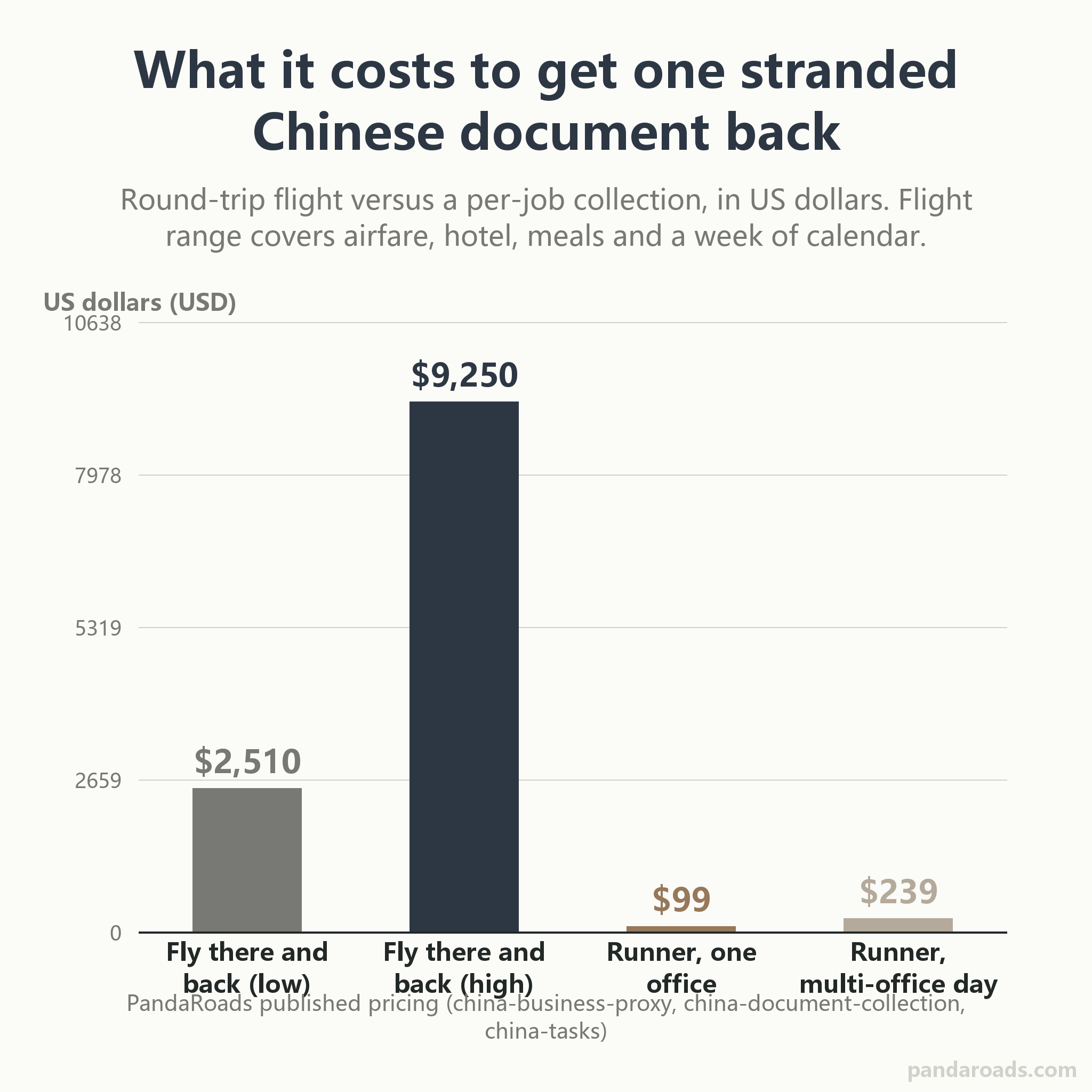
Read the first row against the chart. The cheapest plausible version of a flight, before you have taken a single sick day or booked a refundable hotel, is around the same order of magnitude as several months of small errands, and the top of that range is a round trip plus a week of your life for a document that may still sit behind a weekday-only counter when you land. That is not an argument against ever flying, sometimes you are going anyway. It is an argument against the reflex that retrieving the paper requires you to be the one standing there.
What actually drives the cost of hiring, in fairness, is scope rather than the flight saving. A single certificate collected and couriered is a $99 request. A degree plus a transcript plus a notarized translation plus an apostille, which is a very ordinary graduate errand in the real world, touches several offices and several fees, so it drifts toward a $239 multi-office day with the government and notary fees reimbursed at cost on top. None of that is hidden in a percentage; PandaRoads is explicit that nothing is charged until you approve an itemized quote, small fees are prepaid and settled item by item with receipts, and payment runs through PayPal after approval (source: pandaroads.com). The approve-first rule is the part that makes the cheaper column genuinely lower risk, not just cheaper, because the number you approve is the number you pay.
Set against a published round trip of $2,510 to $9,250, hiring a runner costs $99 per request or $239 per day for a multi-office chain, with government and notary fees reimbursed at cost, and nothing is charged until you approve an itemized quote settled through PayPal.
The office-by-office reality: weekday windows, holiday closures, and come back Thursday
Anyone who has flown twelve hours to collect a single signature knows the counters are not the obstacle. The hours are. These are government and institutional windows, not 24/7 service desks, and the shape of that time is the quiet reason an errand that sounds simple can eat a week.
Start with the actual published windows. The Ministry of Foreign Affairs legalization reception, the step where an apostille is added, keeps a morning window of 8:30 to 11:00 AM, Monday to Friday, and it is closed on Chinese public holidays (source: cs.mfa.gov.cn). The collection slip you are handed is what you bring back on pickup day. The Shanghai certificate of no criminal record is applied for in person at the exit-entry administration office, walk-in, without an advance appointment, which sounds easy right up until you arrive at 10:55 on a Friday before a long holiday (source: english.shanghai.gov.cn).
That narrow, weekday, government-hours footprint is where the "come back on Thursday" and "the system is down, come back later" culture comes from. A missing stamp, a form the office wants re-typed, or a seal that has to be checked against a file in another building can each cost a return visit, and a return visit from America costs a plane ticket. Add that records are often split across doors, so the office you remember is not always the office that holds your paper: the International Students Office, the registrar, the Graduate School and the University Archives can each keep a different part of the same student (source: globalattest.com). National holiday calendars and the receipt-for-pickup rule mean the sequence and the timing matter as much as the address.
None of this is meant to scare you. It is the concrete texture of why a body already in the city, who can make the 8:30 window on Tuesday and be back Thursday when they say come back Thursday, absorbs friction you would otherwise pay airfare to discover in person.
A collection from start to finish: brief, authorize, collect, certify, courier
It helps to see the whole thing as a sequence you can picture yourself in, because the value is in the order and the checkpoints, not in any single errand. Here is what a legitimate collection looks like from the first message to the tracking number, mapped to the published workflow.
- You say what is stranded and where. The document type, the city, and the issuing office if you already know it. A degree from a specific university and a divorce file from a specific court are different briefs, and the more precise yours is, the faster the next step.
- The service checks the requirements and replies within 24 hours with what the office will need from you and what a representative can lawfully do for that particular paper (source: pandaroads.com). This is where an honest "you cannot outsource this one" would surface.
- You get an itemized quote and approve it before any work or payment. Small government or office fees are prepaid and settled item by item against receipts, and nothing is charged until you approve the number (source: pandaroads.com).
- Where an authorization is needed, the service helps prepare the letter and coordinates the notarization, or, if you are abroad, the consular route, while you send a clear copy of the passport or ID the office will match your record against (source: globalattest.com).
- The appointment is booked, the run is made, the pickup receipt is signed, and the documents are photographed at collection (source: pandaroads.com). That photograph and that receipt are the beginning of your chain of custody.
- If the receiving authority needs more than the raw paper, the translation, notarization, or the apostille is arranged at this stage rather than guessed at before you knew what the office would issue (source: globalattest.com).
- The set is packed securely and couriered worldwide with a tracking number, and insurance is available for originals that cannot be reissued (source: pandaroads.com).
Two things in that list are the reason the middle route beats a DIY email to the registrar: a physical body who can stand in the queue and sign the release, and a tracked, signed chain that turns "I hope they mailed it" into "here is the receipt and here is where your parcel is right now."
A legitimate collection runs in seven beats: a brief, a 24-hour requirements check, an approved itemized quote, authorization plus a passport copy, the run with a signed receipt and photographs, any notarization or apostille, then a tracked courier worldwide.
Sealed envelopes, tracked courier and the customs line
The courier step is where trust is actually earned or lost, so it is worth treating as the product rather than an afterthought. A document that leaves an office without a record of leaving is only a rumor until it lands.
The chain starts at each collection point. The runner signs a pickup receipt and photographs the documents, so you have dated evidence of exactly what left which office (source: pandaroads.com). Irreplaceable originals go into a sealed, secure package, and insurance is available for papers that cannot be reissued, which is the correct instinct for a one-of-a-kind court judgment or a notarized original (source: pandaroads.com).
Then there is the border, the part most people never think about. Your own records move as documents, not as merchandise, so the customs paperwork describes them as personal documents rather than goods with a commercial value, and a tracked international courier lets you watch the parcel clear and travel instead of wondering (source: pandaroads.com). A tracking number is genuinely the difference between a document on its way and a hope.
A few handling notes keep the set valid once it arrives. Certified and notarized originals should travel flat and never be laminated over a seal, because a raised or embossed seal that you flatten or cover can be rejected by the authority that asked for it. An apostilled set has to physically leave China before an overseas body can accept it, so the courier is not a convenience, it is the step that completes the legalization. And if a receiving organization wants the apostille and the original together, confirm that before anything is packed, the same confirm-what-is-issued-first rule that governs the whole process (source: globalattest.com). No delivery percentages, no invented timelines, just the receipts and the tracking that let you verify it yourself.
The deliverable is the chain of custody: a signed pickup receipt and photographs at each office, a sealed insured package for irreplaceable originals, and a tracked courier you can watch to your door, with an apostille added beforehand at roughly RMB 50 per civil document.
When you genuinely must go in person, and what to prepare first
An honest guide has a negative space, a set of cases where hiring a runner is simply the wrong tool, and pretending otherwise is how these pages earn a bad name.
Some things still require you. A sworn statement has to be made in your own name. A record an office will only release to the holder cannot be talked out of the drawer. And where a legal step needs a signature witnessed as yours, no amount of local goodwill substitutes. PandaRoads is explicit about the same ceiling from the other side: it does not sign contracts for you, and it does not apply for visas, licenses or credentials on your behalf (source: pandaroads.com). If the pre-check shows your paper is genuinely yours-only, the honest answer is that a runner cannot retrieve it, and you should hear that before you spend anything.
Warning: A sworn statement, a holder-only record, or a signature that must be witnessed as yours cannot be outsourced. If the pre-check shows your paper is genuinely yours-only, that is decided before any $99 or $239 fee is spent.
When a visit really is unavoidable, the value of the same service shifts from doing it for you to making one trip succeed at once. The collection page frames this as preparing everything so the visit works the first time: the right office, the right forms, the passport copy matched to the record, the appointment in the weekday window (source: pandaroads.com). That is a different, smaller promise, and it is worth stating plainly rather than hiding behind the easier one.
Finally, the fence around this page. This article is only about documents, certificates and courier. If what you actually need is a broader on-the-ground errand for people living abroad, that lives on the general China done-for-you tasks page, and if your situation does not fit a fixed scope, a bespoke itemized price is on the task quote page, where nothing is charged until you approve it.
Some papers still require you in person: a sworn statement, a holder-only record, or a witnessed signature. PandaRoads will not sign contracts or apply for visas, licenses or credentials, but it does say so before any $99 or $239 fee is spent.
Frequently asked questions
How do I get my diploma from a Chinese university if I already left the country? Contact the university registrar or Graduate School that holds it. Many will release it to a named representative under the school's own rules, but there is no nationwide right, and some want a notarized power of attorney or you in person (source: globalattest.com). A local runner can check the specific rule, queue, collect against a signed receipt and courier it to you.
Can someone pick up my documents in China for me? Often yes, where the office accepts third parties. A representative can submit what the office takes from a third party, pay the fee, collect and courier (source: pandaroads.com). The limit is authority, not effort: a court or school may reserve release to you or to a notarized power of attorney.
Do I need a power of attorney to collect my transcript in China? Not always, but sometimes. Access rules vary by institution, and application, record access and collection can each need a different level of authorization (source: globalattest.com). Confirm the specific office's rule first; where a power of attorney is required and you are abroad, have it notarized at a Chinese consulate.
How do I apostille Chinese documents from the USA? China joined the Hague Apostille Convention on 7 November 2023, so a Chinese public document can be apostilled by the Ministry of Foreign Affairs or an authorized local Foreign Affairs Office and used directly in another member country (source: hcch.net) (source: cs.mfa.gov.cn). You generally need the underlying paper first; the apostille legalizes it, it does not create it.
Can I get a Chinese police certificate without flying back? The certificate of no criminal record is applied for in person at the exit-entry administration office, but the finished certificate can be collected by an authorized representative holding the original application receipt (source: english.shanghai.gov.cn). Residency and eligibility rules apply, so confirm them before arranging collection.
How long does collection and shipping take? It depends on the office. The MFA apostille step is about four working days regular, two express (source: cs.mfa.gov.cn). Add the issuing office's own release time and the courier leg, which is why a single-request timeline is quoted after the requirements are checked, not guessed.
Is my Chinese degree verifiable online without the paper certificate? Frequently, yes. The Ministry-of-Education-designated CHSI portal on chsi.com.cn issues online verification reports of higher-education qualifications and degrees, so an employer or school that only needs confirmation can accept the digital report with no trip and no courier (source: chsi.com.cn).
How much does it cost to have documents collected and couriered from China? On the service's published pricing, collection and courier coordination runs from $99 per request, or $239 per day for a run that chains several offices, with government or office fees reimbursed at cost and shipping billed at cost (source: pandaroads.com). Nothing is charged until you approve an itemized quote.
What ID do I need to send ahead? Usually a clear copy of the passport you studied or resided on, because the office matches your record to that identity document, plus the identity bridge if the passport has since been renewed (source: globalattest.com). For personal-only records, expect to issue a power of attorney as well.
Can a runner sign for me or get documents that only I can get? No. A runner cannot sign as you, make sworn statements in your name, or obtain a record the law reserves to you personally (source: pandaroads.com). If your paper is genuinely yours-only, a good service tells you before any effort or fee is spent.
The bottom line
The distance between you and a stranded Chinese document is real. So are the weekday morning windows, the holiday closures, and the authority ceiling no representative can cross. What you actually control is narrower and more useful than "go back or give up": whether a person on the ground can queue, submit what the office accepts, pay the fee, collect against a signed receipt, certify or apostille it, and courier it to you with tracking.
Run the model in one breath. Check the digital route first, because a CHSI verification report or an apostille on a paper you already hold may end the whole problem with no courier at all (source: chsi.com.cn) (source: cs.mfa.gov.cn). If it is a physical original, a per-job collection runs $99 per request, or $239 per day for a multi-office chain, with government and office fees reimbursed at cost, approve-first and settled through PayPal, tracked worldwide, set against a published round-trip range of $2,510 to $9,250 (source: pandaroads.com). And if a document turns out to be legally yours-only, the honest promise is that you are told before a cent of effort is spent.
That is the entire pitch, and it is a modest one. The China document collection page is where a specific paper becomes a fixed quote: say what is stranded and where, and see the itemized number before you decide. Most people who thought they needed a plane ticket find out they needed an afternoon and a tracking number instead.
References
- PandaRoads. (2026). China document collection: Pick up & ship worldwide [Service page]. PandaRoads. https://pandaroads.com/china-document-collection.html
- PandaRoads. (2026). China business proxy: We go so you don't have to [Service page]. PandaRoads. https://pandaroads.com/china-business-proxy.html
- PandaRoads. (2026). China sourcing & local task service from $99 [Service page]. PandaRoads. https://pandaroads.com/china-tasks.html
- Exit-Entry Administration of the Shanghai Municipal Bureau of Public Security. (2026, June 12). How can foreign nationals obtain a Certificate of No Criminal Record? Shanghai Government Portal. https://english.shanghai.gov.cn/en-FAQs-LivinginShanghai/20240813/2e02ae19a31340d5a486a2bd31616eae.html
- Consular Services of the Ministry of Foreign Affairs of the People's Republic of China. (2024, September 4). Consular legalisation/apostillisation in China. 中国领事服务网. https://cs.mfa.gov.cn/wgrlh/lsrz/lsrzjjs/
- Hague Conference on Private International Law. (2023, November 8). Apostille Convention enters into force for the People's Republic of China [News]. HCCH. https://www.hcch.net/en/news-archive/details/?varevent=947
- China Briefing. (2023, July 24). WeChat enables foreigners to pay with overseas cards in China. China Briefing. https://www.china-briefing.com/news/wechat-enables-foreigners-to-pay-with-overseas-cards-in-china/
- Global Attest. (2026, September 5). How to get a Chinese university transcript after graduation. Global Attest. https://globalattest.com/get-chinese-university-transcript-after-graduation.html
- China Higher Education Student and Academic Information (CHSI / Xuexin). (n.d.). Official portal for higher-education student and academic credentials verification. CHSI. https://www.chsi.com.cn/
Last reviewed and updated: September 2026. Author: our editorial team. For tailored guidance, contact our team.