SF Express: How to Send a Parcel Anywhere in China
A practical within-China runbook for sending a parcel with SF Express: which booking channel to use, how the fare is really calculated, the ID and address rules for a foreign passport, what you cannot ship, and the verified app download routes.
Last updated: July 2026 · By the PandaRoads team in China
TL;DR
Book an SF Express door-to-door pickup through the WeChat or Alipay mini program, the Chinese-first 顺丰速运 app, or the 95338 hotline; the fare is initial weight plus additional weight per route, with chargeable weight taken as the greater of actual and volumetric weight, and your passport is verified in person when the courier collects.
Abstract
A practical, English-only guide to sending a parcel within mainland China with SF Express (顺丰): the four booking channels, how the fare is really calculated, the passport real-name step, restricted items, tracking, and verified app download routes.
Key Takeaways
- SF is the default reliable mainland courier, pricier than economy carriers
- Four booking channels: app, WeChat mini program, Alipay mini program, hotline 95338
- No flat national price: initial weight plus additional weight, by route
- Chargeable weight is the greater of actual weight and volumetric weight
- Real-name ID is verified in person at pickup; a passport works
- Never ship spare lithium batteries or irreplaceable items
- Domestic app is Chinese-first; the international SF-EXPRESS app handles tracking
By the Numbers
- 1993 the year SF was founded, in Shunde, Guangdong (source: sf-express.com)
- 372nd SF Group's rank on the Fortune Global 500 (source: sf-express.com)
- 300+ mainland cities served, plus Hong Kong, Macao and Taiwan (source: sf-express.com)
- 12,000 volumetric divisor on Standard Express under 30 kg (source: sf-express.com)
- ¥150-200 a third-party rough fare for a 25 to 30 kg bag on a long lane (source: mychina.guide)
- 95338 the official SF booking and service hotline (source: sf-express.com)
Table of Contents
- Abstract
- Key Takeaways
- By the Numbers
- What SF Express is and why it is the mainland default
- Before you start: what you need to send a parcel in China
- The four ways to book an SF Express pickup, compared
- How SF Express pricing really works: initial weight, additional weight, and volumetric weight
- Pick the right service: Same Day, Next Morning, Next Day, Standard Express, or economy
- Book and hand over the parcel, step by step
- ID, address and packaging rules for foreigners
- Restricted and prohibited items you cannot ship
- Pay, get the waybill, and track the parcel
- English touchpoints, and the parts that stay in Chinese
- Troubleshooting and when to choose a different option
- Frequently Asked Questions
- Conclusion
- References
What SF Express is and why it is the mainland default
SF Express, known in Chinese as 顺丰, was founded in Shunde, Guangdong in 1993 and is headquartered in Shenzhen; it is the fourth largest logistics provider in the world and ranks 372nd on the Fortune Global 500. That scale, plus an all-cargo air fleet it created in 2009, is why a mainland parcel can cross a thousand kilometres overnight.
SF Express, known in Chinese as 顺丰 (Shunfeng), is the courier most people in China reach for when the item matters. It is not the cheapest way to move a box between two Chinese cities, and it is not trying to be. It is the default when you want a parcel to arrive on time, intact, and traceable, and when "will it actually show up tomorrow" outranks "will it cost two yuan less."
The company backs that reputation with infrastructure. SF was founded in Shunde, Guangdong Province in 1993 and is headquartered in Shenzhen; it describes itself as the largest integrated logistics service provider in China and Asia and the fourth largest in the world, ranked 372nd on the Fortune Global 500 list (source: sf-express.com). In 2009 it created SF Airlines, which made it the first express delivery company in China to operate its own all-cargo aircraft, and it later helped build the Ezhou Huahu freight airport (source: sf-express.com). That owned air fleet plus a dense ground network is why an inter-city parcel can clear a thousand kilometres overnight instead of waiting on a third-party airline's leftover cargo space.
For a foreigner already inside China, that scale translates into something concrete: a courier will come to your door in most cities within a few hours of a booking, take your parcel, weigh and measure it in front of you, and give you a tracking number that updates until it is signed for. The service reaches over 300 cities across the mainland and the Hong Kong, Macau and Taiwan regions (source: sf-express.com).
This guide is about doing exactly one thing with that network: sending a parcel from one mainland address to another, as a person who reads English and may not speak Chinese. It covers the four ways to book a pickup, how the fare is genuinely calculated, the identity and address rules, what you cannot ship, and how to track the result. If you instead need something collected and driven across the same city right now, that is a different tool, and it is covered elsewhere.
Before you start: what you need to send a parcel in China
Gather four items before you open the SF mini program or dial 95338: WeChat or Alipay installed, your passport for the in-person real-name check, the recipient address in Chinese characters, and a reachable mainland mobile number. China applies real-name verification to all domestic express delivery, so a foreign sender is verified by the courier at pickup, not online.
A few minutes of setup prevents the two failures that stall a first SF shipment: an address the courier cannot read, and an identity check you were not ready for. Gather these before you open any app.
You will need:
- A phone with WeChat or Alipay installed. The SF booking flow lives inside those two apps as a mini program, so if you already use either for payment, you already have the easiest way to book. If you still need to set up Alipay, the install-and-verify order for it is its own topic, covered in our China apps download and install guide.
- Your passport. China applies real-name verification to domestic express delivery, and for a foreign sender that check is done in person, by the courier, at the moment of pickup, not in an online form (source: english.shanghai.gov.cn).
- The recipient's address written in Chinese characters, plus a reachable local mobile number. A Latin-alphabet address often cannot be routed by the driver who handles the last kilometre.
- A way to pay on collection: WeChat Pay, Alipay, or cash handed to the courier.
- The item packed, but the box left openable. The courier inspects contents before sealing, and you may want SF's own packaging materials.
Two expectations worth setting now. First, a courier usually arrives within two to four hours of a booking in a tier-one city, so book in the morning if you want it gone the same day. Second, and most misunderstood, there is no single national price for an SF shipment; the quote depends on the specific lane, so treat any figure you read as an illustration rather than a sticker. (source: sf-express.com)
The four ways to book an SF Express pickup, compared
There are four main channels to schedule an SF door-to-door collection inside the mainland, plus one low-effort fallback. They all end at the same place, a courier at your door, so pick the one that matches how much Chinese you can read.
| Channel | How you open it | English level | Best for |
|---|---|---|---|
| 顺丰速运 app | App Store, a Chinese Android app store, or SF's official APK | Chinese-first booking flow | Frequent senders, saved addresses |
| WeChat mini program | Search 顺丰 in WeChat, or use the "SF Express" official account | Chinese UI inside an app you already use | Most first-time foreign senders |
| Alipay mini program | Open the SF mini program inside Alipay | Chinese UI | If Alipay is your main wallet |
| Phone hotline 95338 | Dial 95338 from any mainland number | Mandarin; 24h self-service, staff 08:00 to 21:00 | Booking without wrestling the interface |
| Hotel desk or a Chinese friend (fallback) | Ask them to place the order in the mini program | They handle the Chinese | A one-off or a heavy bag |
The domestic 顺丰速运 app is the full-featured option, and on iOS its store record (App Store id 899529698, bundle com.sf-express.waybillcn) lists both English and Chinese as supported languages (source: apps.apple.com). In practice, though, the booking screens are built for a Chinese user, so first-time foreign senders get further, faster by using the SF mini program inside WeChat or Alipay: it is the same order form, but inside an app they already open every day, and a translation pass over one address screen is easier than driving a whole new app. SF's own English site confirms the same set of order channels, listing the WeChat official account "SF Express", the app, and the mini program (source: sf-express.com).
If none of that appeals, the 95338 hotline takes the booking by phone, and hotel front desks in big cities book SF several times a day as a routine favor. The rest of this guide assumes the mini-program path, because it is where the pricing, ID and tracking steps are easiest to see.
How SF Express pricing really works: initial weight, additional weight, and volumetric weight
The number that surprises most people is that SF does not charge a flat fee per box. Its official charging standard is an initial weight plus an additional weight, and the prices vary by route and distance, so the same 2 kg parcel costs different amounts on different lanes (source: sf-express.com). What you can learn, and what actually saves money, is the two rules underneath: what weight you are billed for, and how that weight is rounded.
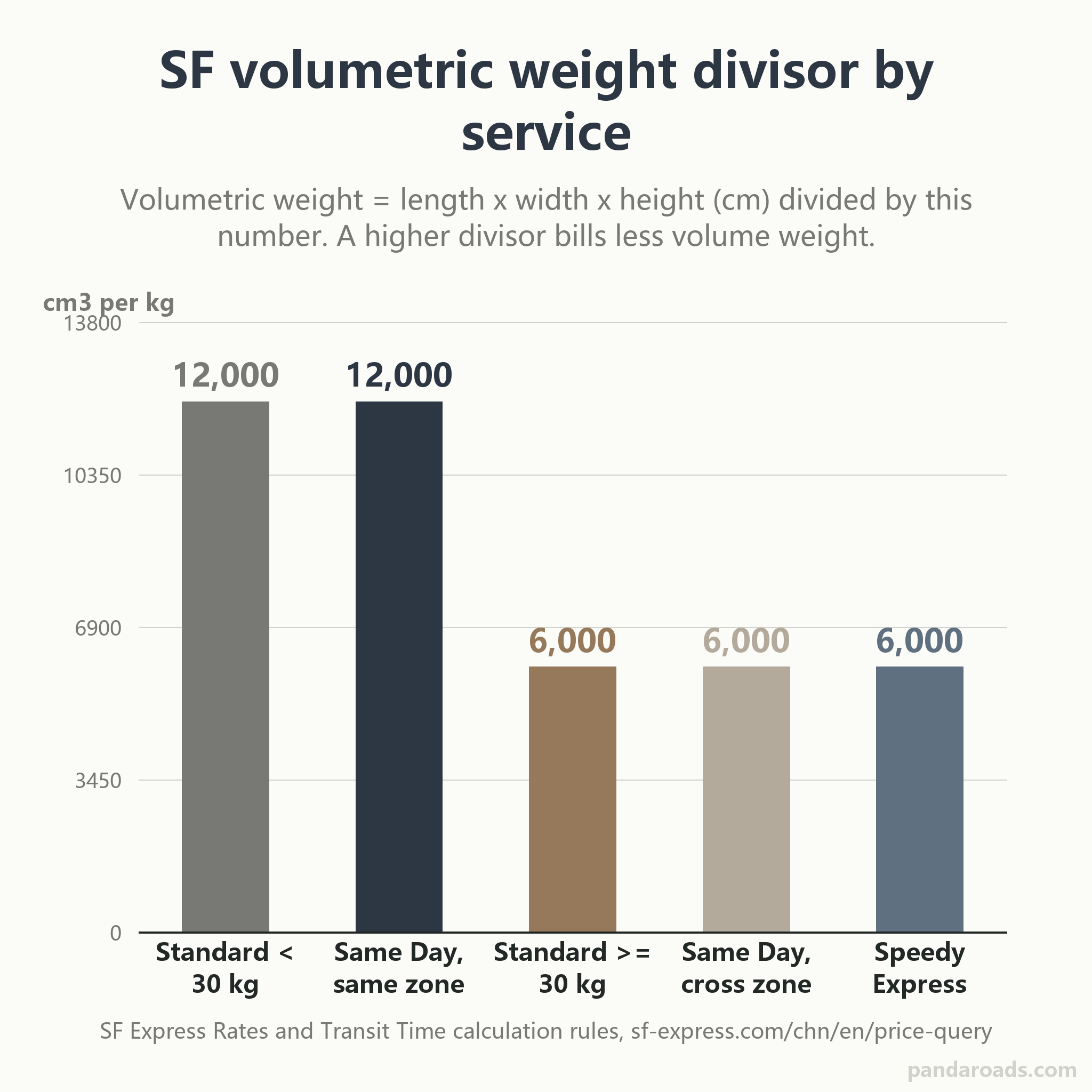
Rule one: you are billed the greater of actual weight and volumetric weight. Chargeable weight is defined as the heavier of what the parcel actually weighs on the scale and what its size "weighs" in air (source: sf-express.com). Volumetric weight is length x width x height in centimetres divided by a divisor, and that divisor changes with the service and the lane:
| Service and lane | Volumetric divisor | A 50 x 40 x 30 cm box (60,000 cm3) |
|---|---|---|
| SF Standard Express, actual weight under 30 kg | 12,000 | 5 kg |
| SF Standard Express, actual weight 30 kg or more | 6,000 | 10 kg |
| SF Same Day Express, same city, province or economic zone | 12,000 | 5 kg |
| SF Same Day Express, cross-zone | 6,000 | 10 kg |
| SF Speedy Express, most mainland lanes | 6,000 | 10 kg |
Read the worked column. That medium box, if it actually weighs 3 kg, is billed at 5 kg on Standard Express because 60,000 divided by 12,000 is 5, and 5 beats 3 (source: sf-express.com). The lesson is dimensional: a big, light box is charged on its size, so shrinking the carton often costs less than shrinking the contents. One rule of thumb falls straight out of SF's own divisor: on a Standard Express lane (12,000), any box lighter than about 1 kg for every 12,000 cm3 of carton, roughly 83 grams per liter, is billed on its dimensions rather than the scale, so the carton size is the only cost lever a sender controls.
Rule two is rounding, and it is small but real. For mainland shipments SF counts chargeable weight in 0.1 kg steps up to 10 kg, 0.5 kg steps from 10 to 100 kg, and whole kilograms from 100 kg up (source: sf-express.com). Freight is then rounded up to a whole yuan, and the base fare excludes any value-added service fees.
One honest caveat about money. SF publishes the rules, not a national rate card, so its own price calculator is the only reliable source for a specific quote. Independent, third-party observations can give a rough sense of magnitude: one travel guide reports a 25 to 30 kg checked bag from Shanghai to Beijing at roughly 150 to 200 CNY arriving in two to three business days (source: mychina.guide). Treat that as an outside estimate, not an SF price. For a firm figure, enter the lane in the calculator or ask the courier at pickup.
Pick the right service: Same Day, Next Morning, Next Day, Standard Express, or economy
SF sells speed as a ladder running from instant SF Rush through Same Day, Next Morning, Next Day, and Third Day delivery down to Standard Express, the everyday service that reaches over 300 cities. For a shipment inside the same province or economic circle, SF commits to delivery before 12:00 p.m. the next day at the soonest.
The English service names on SF's site map line up almost directly with how urgent your parcel is. Choose the rung that matches the deadline and stop there; the mistakes run both ways, paying for air on a box that could wait, or paying for ground on a document that could not.
From fastest and priciest to economy, the domestic rungs are: SF Rush, an instant same-city courier; SF Same Day Delivery; SF Express Next Morning, which lands by the next morning; SF Next Day Delivery; SF Third Day Delivery; and SF Standard Express, the everyday door-to-door service SF describes as offering better price, stable transit time and wide coverage (source: sf-express.com). Standard Express reaches over 300 cities, and for shipments within the same province or the same economic circle SF commits, at the soonest, to delivery before 12:00 p.m. the next day (source: sf-express.com).
That phrase, economic circle, is doing real work in the pricing and the transit promise. SF's own rules group the country into circles, and shipping inside one circle is faster and cheaper than a cross-zone move. The circles it names are Beijing-Tianjin-Hebei, Jiangsu-Zhejiang-Shanghai-Anhui, Sichuan-Chongqing, and Heilongjiang-Jilin-Liaoning (source: sf-express.com). Two cities in the same circle can be treated almost like a regional hop; two cities in different circles pay the distance.
A quick mapping:
- Documents across town today: SF Rush or SF Same Day.
- A sample a client needs tomorrow morning: SF Express Next Morning.
- A normal box on a normal deadline: SF Standard Express, the default.
- Something heavy, bulky, or not urgent: Standard Express or a slower economy rung.
- Anything you would cry over losing: add declared-value protection (see the tracking section), on any rung.
There is no fixed national price per rung, so compare them live in the calculator rather than trusting any remembered number.
Book and hand over the parcel, step by step
Handing over an SF parcel is one short motion you start in the WeChat or Alipay mini program or by phone on 95338: enter sender and recipient addresses in Chinese, describe the contents, choose a service and a collection window, then meet the courier, who inspects the box, weighs and measures it, verifies your passport, and prints a waybill you pay on collection.
Here is the whole motion, start to finish, through the WeChat or Alipay mini program. The same fields exist in the 顺丰速运 app; the mini program is just the version most foreigners can read with a translation pass.
- Open the SF mini program and tap the send (寄件) button.
- Enter the sender address. Your current location, in Chinese, with your own mobile number.
- Enter the recipient address in Chinese characters, with the receiver's name and a reachable local mobile. If it is a hotel, include the hotel name and tell them to expect a parcel.
- Describe the contents plainly, in Chinese. "Clothing", "books", "electronics, no battery" and similar short descriptions are what the waybill and the inspection expect.
- Choose a service rung and a pickup time window. Morning windows get collected earlier.
- Confirm the booking. A nearby courier is dispatched; in a tier-one city expect a knock within roughly two to four hours.
- When the courier arrives, they inspect the open box, then weigh it, measure it, and print a waybill. The chargeable weight you saw estimated may settle up or down here.
- Complete real-name verification by showing your passport, then pay by WeChat Pay, Alipay, or cash, and keep the waybill with its tracking number. (source: english.shanghai.gov.cn)
Two fields cause almost every first-timer's problem. The contents description wants Chinese and wants to be accurate, because the same words appear on the waybill an inspector may check. And the recipient mobile has to work, because the delivery driver calls it, not you. Get those two right and the eight steps run without a hitch. The official Shanghai resident guide describes the same skeleton: place a pickup order with your address, choose a method and a time, then pay the courier on collection (source: english.shanghai.gov.cn).
ID, address and packaging rules for foreigners
Three rules govern a foreign sender in China. Real-name verification is mandatory, and the courier completes it in person at pickup, on a visit that usually lands within 2 to 4 hours in a tier-one city, using your passport. The recipient address must be in Chinese characters with a working mobile, because the last-mile driver calls that number to reach the door.
Three rules trip up senders who are new to mainland shipping, and none of them are obvious from the booking screen.
Real-name verification is mandatory and it happens at the door. China requires domestic express shipments to be tied to a verified sender identity, and for a foreigner that verification is done in person when the courier collects the parcel, by showing your passport (source: english.shanghai.gov.cn). There is no online passport upload to pre-clear it the way some apps promise for other services, so have the physical document ready when the courier arrives. If you booked a pickup window and will not be there with ID, reschedule; an unverified sender means an unshipped box.
The address should be in Chinese, with a live mobile. The recipient's name, address and phone must match what ends up on the waybill, because the last-mile driver works from those details and calls that number (source: english.shanghai.gov.cn). A Latin-alphabet city name may be fine for the sorting hub but useless to the person standing outside a gated compound, so copy the Chinese address from a map or from the recipient directly. For a hotel destination, confirm in advance that the front desk accepts inbound guest parcels and note the date you expect it.
Packaging is something you can outsource. SF sells a professional Packaging Service and provides materials, described as more secure and more professional than a self-taped box (source: sf-express.com). The practical rule is to leave the parcel open until the courier has inspected it, then let them seal it with SF tape. If you packed it yourself, size it honestly: remember from the pricing section that an oversized carton is billed on its volume, not its contents, so a box twice the size it needs to be costs real money.
Restricted and prohibited items you cannot ship
Before you pack, check the item against SF's rules, because a prohibited parcel is caught at inspection or at the x-ray and comes back to you, and a returned shipment still costs money and days.
The hard prohibitions follow the standard international courier list and SF publishes them: weapons and ammunition, narcotics and controlled drugs, and flammable, explosive or toxic substances are all barred outright (source: sf-international.com). Beyond those, the category that catches ordinary travelers is batteries and things that contain them. Spare lithium batteries and power banks are restricted, which is the usual reason a suitcase full of gadgets is refused or turned around at the x-ray; high-proof alcohol and some liquids are likewise restricted, and fresh food needs a cold-chain service rather than a normal parcel (source: sf-international.com).
A short list of what to keep out of an SF box:
- Passports, cash, IDs and other irreplaceable documents. Never ship these; carry them.
- Spare lithium batteries, loose power cells and large power banks.
- Flammables, aerosols above the liquid limits, perfumes in quantity, and high-proof alcohol.
- Perishables unless you book a cold-chain product on purpose.
When you are unsure about a single item, do not guess and do not hide it in the contents description. Call the 95338 hotline or use SF's online customer service before booking and describe the item; SF itself points doubtful senders to that channel rather than to the packing tape (source: sf-express.com). The one-minute call beats a week chasing a box that was turned back at a sorting hub.
Pay, get the waybill, and track the parcel
Payment happens at the door, by WeChat Pay, Alipay, or cash, and the printed waybill carries the tracking number you watch on the SF site, the SF app, or China's unified Cainiao platform. For sellers shipping many parcels, SF adds 4 value-added mainland services: Shipment Protection Plus, Cash on Delivery, Return Proof of Delivery, and Packaging Service.
Payment is simple and it happens at the door. You pay the courier when they take the parcel, through WeChat Pay, Alipay, or cash, and the waybill they print carries the tracking number that follows the shipment to the recipient (source: english.shanghai.gov.cn). Keep that number; it is the only thing you need to watch the parcel or answer "where is it."
Tracking works across several surfaces. The SF site and the SF app or WeChat mini program both accept the waybill number and return status updates, and China's unified Cainiao platform also tracks parcels from many carriers in one place, so you are never locked into a single app to see progress (source: english.shanghai.gov.cn). Status changes as the parcel moves through pickup, line-haul and out-for-delivery, and the recipient is usually called on the mobile number from the waybill before the doorbell.
For a one-off personal box you can stop there. If you are a small online seller shipping many parcels, SF offers value-added mainland services worth knowing (source: sf-express.com):
- Shipment Protection Plus, which compensates up to a declared value if a parcel is lost or damaged, the answer to "this box is worth more than the basic liability."
- Cash on Delivery, where the courier collects the goods payment from the buyer at delivery and remits it to you.
- Return Proof of Delivery, a signed receipt returned to you after a successful delivery, useful for reconciling orders.
- Packaging Service, professional materials and packing at collection.
A declared value you set honestly, a working recipient phone, and the waybill number saved to your notes are the three habits that turn a shipment you have to worry about into one you simply watch arrive.
English touchpoints, and the parts that stay in Chinese
SF is easier to read in English than to book in. Its corporate website, product pages, and separate international SF-EXPRESS app (App Store id 1383101059, Google Play package com.sf.hmto) carry real English, while the domestic 顺丰速运 booking flow, the mini-program order form, and the 95338 hotline stay Chinese-first.
A straight answer is more useful here than a reassuring one: SF is far more English-friendly to look at than it is to book in. The company maintains a genuine English website and an English-facing international app, but the day-to-day domestic booking screens assume a Chinese reader, and pretending otherwise sets you up to stall at the address form.
What is comfortably in English: the corporate and service pages on sf-express.com, the product definitions, the rate-transit calculator's structure, and SF's separate international "SF-EXPRESS" app, which is aimed at tracking and cross-border shipment management and is the listing you will find on Google Play under package com.sf.hmto and on the App Store as id 1383101059 (source: play.google.com)(source: apps.apple.com). What stays Chinese-first is the domestic 顺丰速运 app's booking flow, the mini-program order form, the contents description field, and the phone hotline, which runs in Mandarin.
Workable patterns for an English-only sender:
- Use the SF mini program inside WeChat or Alipay and screenshot the address screen into your phone's translator; you only need to read one form, not learn one app.
- Keep a short Chinese phrase for the contents ("clothing", "no battery"), because the description is checked.
- Ask the hotel desk or a Chinese colleague to place the booking and hand them the recipient's Chinese address and phone.
And be clear about the boundaries of this tool. If what you need is a van to carry furniture or stock across the same city right now, that is an instant same-city job, and it is covered in our Lalamove and Huolala delivery guide. If you are receiving a parcel from outside China and forwarding it on, that is a different service again, covered by our package forwarding service. This article is only about putting a box on SF's domestic network from inside the mainland.
Troubleshooting and when to choose a different option
Most SF problems are one of 5, each with a fast fix: a battery inside gets the parcel returned at the x-ray, an absent recipient stalls a signature or real-name check, a Friday booking arrives Monday on long ground lanes, a bulky light box bills on volume not weight, and a Latin-alphabet address or dead mobile stops the last mile.
Most SF problems are one of five, and each has a fast fix if you recognize it.
- The parcel is refused or returned because of a battery. Symptom: it never leaves the origin, or comes back. Cause: spare lithium cells or a power bank inside (source: sf-international.com). Fix: open the box, remove the batteries, and re-book; carry batteries yourself.
- Nobody is there, and there is no locker. Symptom: delivery fails with the recipient absent. Cause: a live signature or a real-name check had no one to satisfy. Fix: rearrange the window from the tracking screen or route to an SF service point.
- A weekend pickup lands mid-week. Symptom: a Friday booking arrives Monday. Cause: ground transit does not compress over a weekend on long lanes. Fix: book earlier in the week, or pay an air rung if it truly matters.
- The bill is higher than the estimate. Symptom: a light, bulky box charges more than expected. Cause: chargeable weight is the greater of actual and volumetric weight, and volume won (source: sf-express.com). Fix: repack smaller or split the load.
- The address will not deliver. Symptom: the driver cannot find the door. Cause: a Latin-alphabet address or a dead phone number. Fix: resend a Chinese address with a working mobile.
Sometimes SF is not the right tool at all, and knowing which sibling to use saves more than any SF workaround. For the cheapest non-urgent domestic box, China Post or EMS can undercut express at the cost of speed. For a same-city van, furniture or cargo that needs to move within hours, book an instant courier instead, walked through in our Lalamove and Huolala guide. For errands, standing in a queue, or on-the-ground help, see our China life and errands guide and our guide to hiring help in China. And if you are receiving and forwarding from abroad, that is the separate package forwarding service.
Frequently Asked Questions
How do I send a package with SF Express within China? Open the SF mini program in WeChat or Alipay, enter sender and recipient addresses in Chinese, describe the contents, and book a pickup window. A courier arrives, inspects and weighs the parcel, verifies your passport in person, and you pay on collection (source: english.shanghai.gov.cn).
How much does it cost to send a parcel with SF Express in China? There is no flat national price. SF charges an initial weight plus an additional weight, and the rate varies by route and distance, so get the number from its price calculator for your specific lane (source: sf-express.com). Third-party travel guides cite roughly 150 to 200 CNY for a 25 to 30 kg bag on a long lane like Shanghai to Beijing, as an outside estimate (source: mychina.guide).
Does SF Express need my ID or passport to send a package? Yes. China applies real-name verification to domestic express delivery, and for a foreigner the sender's identity is verified in person by the courier at pickup using your passport (source: english.shanghai.gov.cn). Be present with the physical document, or reschedule.
What items are prohibited or restricted with SF Express? Weapons, narcotics, and flammable, explosive or toxic substances are barred, and spare lithium batteries, power banks, high-proof alcohol and unprotected perishables are restricted (source: sf-international.com). Never ship passports, cash or jewelry. If unsure, call 95338 before booking (source: sf-express.com).
Is the SF Express app available in English? Partly. SF's international "SF-EXPRESS" app and its website have real English, but the domestic 顺丰速运 booking flow is Chinese-first. The practical workaround is the SF mini program inside WeChat or Alipay plus a screenshot translation of the address form (source: sf-express.com).
How do I track an SF Express parcel inside China? Enter the waybill number on the SF site, in the SF app or WeChat mini program, or through the unified Cainiao platform; the recipient's driver also calls the mobile on the waybill before delivery (source: english.shanghai.gov.cn).
What is volumetric weight for SF Express? It is the box's size expressed as weight: length x width x height in centimetres divided by a divisor, usually 12,000 for Standard Express under 30 kg and 6,000 in other cases. SF bills the greater of that and the actual weight, so a large light box can cost more than a small heavy one (source: sf-express.com).
Can I use SF Express if I don't speak Chinese? Yes, for a basic shipment, with help. Use the mini program, keep a Chinese contents phrase and a Chinese recipient address with a working mobile, or ask a hotel desk to book it. The booking is simple once the two Chinese fields are handled (source: english.shanghai.gov.cn).
Conclusion
SF Express is the mainland courier you reach for when the parcel has to arrive on time and intact, and sending one as an English reader is genuinely doable. Book through the WeChat or Alipay mini program or by phone on 95338, hand the courier a Chinese recipient address with a working mobile, expect a real-name passport check at the door, and remember that you are billed the greater of actual and volumetric weight, so pack the smallest box that fits. Compare lanes live in the calculator rather than trusting a remembered price, keep batteries and irreplaceable documents out of the box, and save the waybill number to follow the shipment end to end.
References
- S.F. Express. (2024). About SF. https://www.sf-express.com/chn/en/about
- S.F. Express. (2024). SF Standard Express. https://www.sf-express.com/chn/en/express/delivery/standard
- S.F. Express. (2024). Rates & transit time. https://www.sf-express.com/chn/en/price-query
- Shanghai Municipal People's Government (English portal). (2023). A guide to using delivery services (Resident checklist). https://english.shanghai.gov.cn/en-ResidentChecklist/20231215/c492629c319e40929eaf103d8396af9e.html
- S.F. Express (Hong Kong) Limited. (2026). 顺丰速运 (Version 9.95.2) [Mobile application]. Apple App Store. https://apps.apple.com/cn/app/id899529698
- S.F. Express. (2026). SF-EXPRESS [Mobile application]. Apple App Store (Hong Kong region). https://apps.apple.com/hk/app/sf-express/id1383101059
- S.F. Express. (2026). SF-EXPRESS [Android application]. Google Play. https://play.google.com/store/apps/details?id=com.sf.hmto
- SF International. (2026). Prohibited and restricted items. https://www.sf-international.com/kr/en/support/querySupport/prohibited_and_restricted_items
- My China Guide. (2026). How to ship luggage between cities in China with SF Express. https://mychina.guide/questions/how-ship-luggage-between-cities-china-sf-express
Last reviewed and updated: September 2026. Author: our editorial team. For tailored guidance, contact our team.