Withdraw a Deceased Parent's Bank Account in China: 6 Steps
A step-by-step procedure for a child living in the United States who has to withdraw a deceased parent's bank deposit in mainland China: how to find the accounts and the balance before the bank freezes them, how to prove the death and the relationship from documents issued abroad, when a deposit clears with no notarial certificate at all, when it needs the notary or the court, and how the released money legally leaves China on a separate inheritance approval rather than the annual foreign-exchange quota.
Last updated: September 2026 · By the PandaRoads team in China
TL;DR
Withdrawing a deceased parent's Chinese bank money from abroad is a document chain, not one errand, and it has a shortcut most guides do not know about. A 2024 joint regulator notice raised the no-notary small-deposit threshold to RMB 50,000 per bank, so a modest account often clears on proof of death and family relationship alone, with no certificate of inheritance. The money then does not leave inside the famous USD 50,000 annual foreign-exchange quota; it goes out on a separate inheritance approval filed at the foreign-exchange bureau covering the deceased's household registration, where RMB 500,000 is the line between local and national sign-off.
Abstract
A step-by-step procedure for a child living in the United States who has to withdraw a deceased parent's bank deposit in mainland China: how to find the accounts and the balance, how to prove the death and the relationship from documents issued abroad, when a deposit clears without any notarial certificate, when it needs the notary or the court, and how the released money legally leaves China on an inheritance approval rather than the annual foreign-exchange quota.
Key Takeaways
- A bank freezes the account when told of the death, not before
- RMB 50,000 or less at one bank clears with no notarial certificate
- Above the threshold you need a notary certificate or a court order
- A foreign death certificate must be authenticated and translated
- Inherited money leaving China is not capped by the USD 50,000 quota
- There is no inheritance or estate tax on a Chinese bank deposit
Table of Contents
- Abstract
- Key Takeaways
- What this job actually is: a document chain with a shortcut
- By the Numbers
- Step 1: Find the accounts and the balance before you notify the bank
- Step 2: Prove the death and the relationship from abroad
- Step 3: The RMB 50,000 shortcut, release with no notarial certificate
- Step 4: Above the threshold, the notarial route
- Step 5: The bank counter, releasing the money and closing the account
- Step 6: Getting the money out of China, the inheritance approval
- What it costs to have someone on the ground run the physical parts
- Frequently asked questions
- The bottom line
- References
What this job actually is: a document chain with a shortcut
A 2024 joint notice from the National Financial Regulatory Administration and the People's Bank of China lets a first-order heir withdraw up to RMB 50,000 at one bank with no notarial certificate, and inherited money leaves China on a separate inheritance approval rather than the USD 50,000 annual foreign-exchange quota.
A parent dies in a Chinese city and leaves money in a bank account. You are in Ohio or California, you have a job and a mortgage and a window of about six weeks before you have to be back, and you cannot read the documents the bank is asking for. The first thing you learn is that knowing the PIN changes nothing. A Chinese bank does not release a deceased depositor's money to whoever holds the card or the passbook. It releases the money to whoever can prove three separate things: that the depositor is dead, that you are related to them, and that you are legally entitled to the balance.
The threads people actually post in show how badly that framing is missing. One writer on r/chinalife put the whole problem in a single sentence: "How can I withdraw my deceased father's inheritance in China?... I don't know the procedure for withdrawing money from a Chinese bank and transferring it to a Canadian bank, so any help is greatly appreciated" (source: reddit r/chinalife, 2025-01). Another, on r/China, folded everything into one overwhelmed line: "My father has died in China. I don't know how to best deal with his... dealing with the car, house, bank accounts" (source: reddit r/China, 2023-05). Both are describing the same weight, and neither has been told that the bank money is its own chain with its own shortcut.
Here is the thesis in one line. Withdrawing a deceased parent's Chinese bank deposit is a document chain that runs from finding the accounts to getting the money out of the country, and most of that chain is now shorter than the older guides say. Two facts decide almost everything. A 2024 joint notice from the National Financial Regulatory Administration and the People's Bank of China raised the amount a first-order heir can withdraw without any notarial certificate to RMB 50,000 at a single bank (source: nfra.gov.cn). And the money leaving China is not drawn from the famous USD 50,000 annual foreign-exchange quota; it goes out on a separate inheritance approval filed at the foreign-exchange bureau covering the deceased's household registration (source: safe.gov.cn).
How this file was assembled matters for how much weight to give it. Every figure came from the document that sets it, and we reviewed those documents directly rather than a summary of them. We sampled 8 published texts for this file and read each one against the figure it carries, and two of those reads are worth naming. First, the regulator's own page for the 2024 notice is a client-side shell that does not carry the figure in its raw text, so the RMB 50,000 threshold was grounded instead on the Agricultural Bank's readable implementation write-up, which states it verbatim. Second, the 2004 foreign-exchange measures disagree with themselves about the approval line: we found Article 10 reading at or below the RMB 500,000 equivalent as local approval, while the release paragraph underneath it reads below that amount as local approval. This article follows Article 10, and under either reading the money still leaves, so nothing practical turns on the difference. Our analysis of the 8 texts behind each figure covers only what is published. It cannot tell you what one particular counter will ask for, and that gap is a limitation of any written procedure rather than of this one.
Note: This article is about the deposit only. A house your parent left is a different chain with a different tax stack and a different money-out route, and it is outside the scope here. The steps below assume the goal is the bank money, legally, in an account you can actually use.
By the Numbers
- ¥50,000 The total at one bank below which a first-order heir can withdraw a deceased depositor's money with no notarial certificate of inheritance, under the 2024 joint notice (source: nfra.gov.cn)
- ¥10,000 The earlier 2021 floor the 2024 notice raised, and the minimum every bank had to clear before the change (source: abchina.com)
- ¥500,000 The equivalent below which the local foreign-exchange bureau approves an inheritance transfer itself, and above which the file goes to the national agency (source: safe.gov.cn)
- $50,000 The annual individual foreign-exchange quota that does NOT cap inherited money leaving China (source: safe.gov.cn)
- 6 months How far back before the death a first-order heir may now ask a bank for the deceased's account transaction statements (source: abchina.com)
- 0% The inheritance or estate tax rate on a bank deposit in China, because there is no such tax (source: khtpartners.com)
Six figures, and the one quoted most often and understood least is the fourth. American forums repeat the USD 50,000 annual foreign-exchange limit as though it were the ceiling on how much a child can move out of China after a parent dies. It is not. That quota governs current-account spending, and an inheritance transfer sits on a separate capital-account track with a different gatekeeper, which is what the last step below is for. The other five numbers are the ones that actually touch your file, and the rest of this article tells you where each one lives.
Step 1: Find the accounts and the balance before you notify the bank
Under the 2024 notice a first-order heir can ask a bank for a deceased parent's account transaction statements for the six months before the death and the period after it, so the accounts and balances can be mapped before any formal claim freezes the file.
The instinct is to call the bank and ask what the parent held. That is usually the wrong first move. Once a Chinese branch is formally told that the depositor has died, it will freeze or restrict the account pending succession documents, because the bank's duty of confidentiality to the depositor does not end at the death and it will not simply read a balance to a stranger on the phone (source: khtpartners.com). You can lose access to information by asking for it the wrong way.
The account-inquiry right
There is a proper route, and most overseas children have never heard of it. Under the 2024 notice, a bank may, at the request of a first-order heir who has a lawful and proper reason, provide the deceased depositor's account transaction statements for the six months before the death and for the period after it (source: abchina.com). That built on a 2019 notice from the former banking regulator and the Ministry of Justice that had already removed the notarization requirement at the inquiry stage, and it rests on the Personal Information Protection Law, which lets close relatives exercise rights over a deceased person's related personal information for their own lawful and proper interests unless the person arranged otherwise while alive (source: abchina.com).
The same idea now exists at the government-service layer. A one-stop query for a deceased person's financial accounts, piloted in Zhejiang and in Qingdao and being rolled out more widely, lets an heir or someone acting in-country pull a list of the institutions that hold the person's assets instead of walking into banks one by one. A runner on the ground can use that route to build the map before any succession claim is filed, and pulling those records office by office is the same document collection work this site sells for diplomas and court files.
Why the order matters
The approach we follow in this step is a strict order, because each action produces the evidence the next one requires:
- Identify the likely banks first, from a phone, a mailbox, old statements or a payment app, before you contact anyone
- Assemble the death record and the kinship proof before you formally present a claim, because the inquiry and the release both lean on them
- Use the transaction-statement route to learn balances and account numbers, and treat that output as evidence, not as permission to withdraw
- Only then notify each branch and present the succession claim on the route that fits the amount
Note: Getting the accounts and the numbers is information work. The notarization, any court case and the money-out approval are legal acts that belong to a licensed notary office, the courts and the foreign-exchange bureau. A runner can queue, courier, translate and deliver for those steps, but cannot perform them.
Step 2: Prove the death and the relationship from abroad
No single document proves you are the heir. A bank and a notary between them require three things: proof that the depositor died, proof of the family relationship, and proof of who is legally entitled to the money. Start assembling them in the United States, because the ones issued abroad are the slowest.
What each step asks you to produce
| Document | Who asks for it | What it has to be |
|---|---|---|
| Death certificate | The bank and the notary | Issued by the hospital or civil authority; if issued abroad it must be authenticated in the country of issue and translated into Chinese (source: english.shanghai.gov.cn) |
| Proof of family relationship | The notary and the estate office | Household register, birth or marriage records, or a kinship certificate from the local notary or public-security authority (source: chinajusticeobserver.com) |
| Identity of every heir | The bank and the notary | A Chinese ID or household register for local heirs, a passport for a foreign-resident heir, plus written renunciations from any co-heir stepping aside (source: chinajusticeobserver.com) |
| The card, passbook or account details | The bank | Useful and often necessary, but never sufficient on its own, because a password is not a succession basis (source: khtpartners.com) |
Under China's Civil Code the first order of statutory heirs is the spouse, the children and the parents, and an only child in America is very often the whole first order once a parent is unmarried or widowed (source: chinajusticeobserver.com). That circle is what the notary checks against, and it is why a parent's own parents, if any are still living, can matter to who signs.
The part nobody in the family chat group knows is the foreign-document step. For an heir born or resident abroad, the Shanghai municipal government's English-language guidance confirms that you submit a complete set of foreign inheritance documents to the notary office to obtain a notarized Certificate of Inheritance (source: english.shanghai.gov.cn). In practice that means the death certificate and the kinship documents are authenticated where they were issued, apostilled for Hague member states rather than consular-legalized, and then translated into Chinese by a recognized translator before a Chinese office will act on them. Collecting those issued originals inside China while you stay in the United States is a procedure of its own, covered in how to retrieve documents in China from abroad.
To release the money a Chinese bank and a notary between them require 3 separate proofs from an overseas heir: that the depositor died, that you are related, and that you are legally entitled, and a death or kinship certificate issued abroad must be authenticated and translated into Chinese before either will act.
One collapse to head off now. An Alipay foreign-card cap of about RMB 3,000 per transaction or a WeChat Pay cap near RMB 6,000 is a consumer payment limit for spending from an overseas card inside China (source: china-briefing.com). It has nothing to do with a bank releasing an inherited deposit. RMB 3,000 is a spending rail and not an inheritance rail, which means no payment app on earth moves a deceased parent's deposit. An heir who thinks the money can be pushed through one has misunderstood the entire problem, and no counter clerk will even look at that idea.
Step 3: The RMB 50,000 shortcut, release with no notarial certificate
Here is the correction that makes most older English guides wrong. Since 1 June 2024, a first-order heir, or an heir or legatee named in a notarized will, can be released a deceased depositor's money without any notarial certificate of inheritance where the total held at a single banking institution is RMB 50,000 or less, or the equivalent in foreign currency, excluding unsettled interest (source: nfra.gov.cn). That is the joint notice of the National Financial Regulatory Administration and the People's Bank of China, and it is the single most useful fact in this article for a family with a modest account.
The history makes the number trustworthy. The January 2021 CBIRC office notice set the no-notary floor at RMB 10,000 and allowed each bank to raise the threshold anywhere between RMB 10,000 and RMB 50,000. The regulator's own review found that more than half of surveyed banks had already moved up on their own, and that the no-notary route then covered about 86.6 percent of deceased-depositor withdrawals, roughly 690,000 simplified cases nationally in 2021 (source: abchina.com). The 2024 notice simply unified the whole system at RMB 50,000, with rural small and medium banks allowed to reach it by the end of 2025.
Two scope facts from the bank's own explanation matter. First, gold-accumulation products, government bonds and bank-sold wealth-management products are now inside the same simplified route, and their balances are counted together with deposits against the same RMB 50,000 limit (source: abchina.com). Second, funeral expenses and condolence payments credited to the account are excluded from the cap and may be released in full through the simplified route, once the bank confirms the nature of the funds and the applicant signs an undertaking (source: abchina.com).
Contrary to how the change is usually reported, the 2024 notice did not rewrite what a bank asks for. It removed one document from the file for money under the ceiling and left every other requirement standing, which is why a family that qualifies still needs the death record and the kinship proof. The trade-off is worth writing on the wall before you start: the shortcut buys speed and carries a ceiling, the notarial route buys certainty and costs a fee and several weeks, and the amount held at a single institution picks for you.
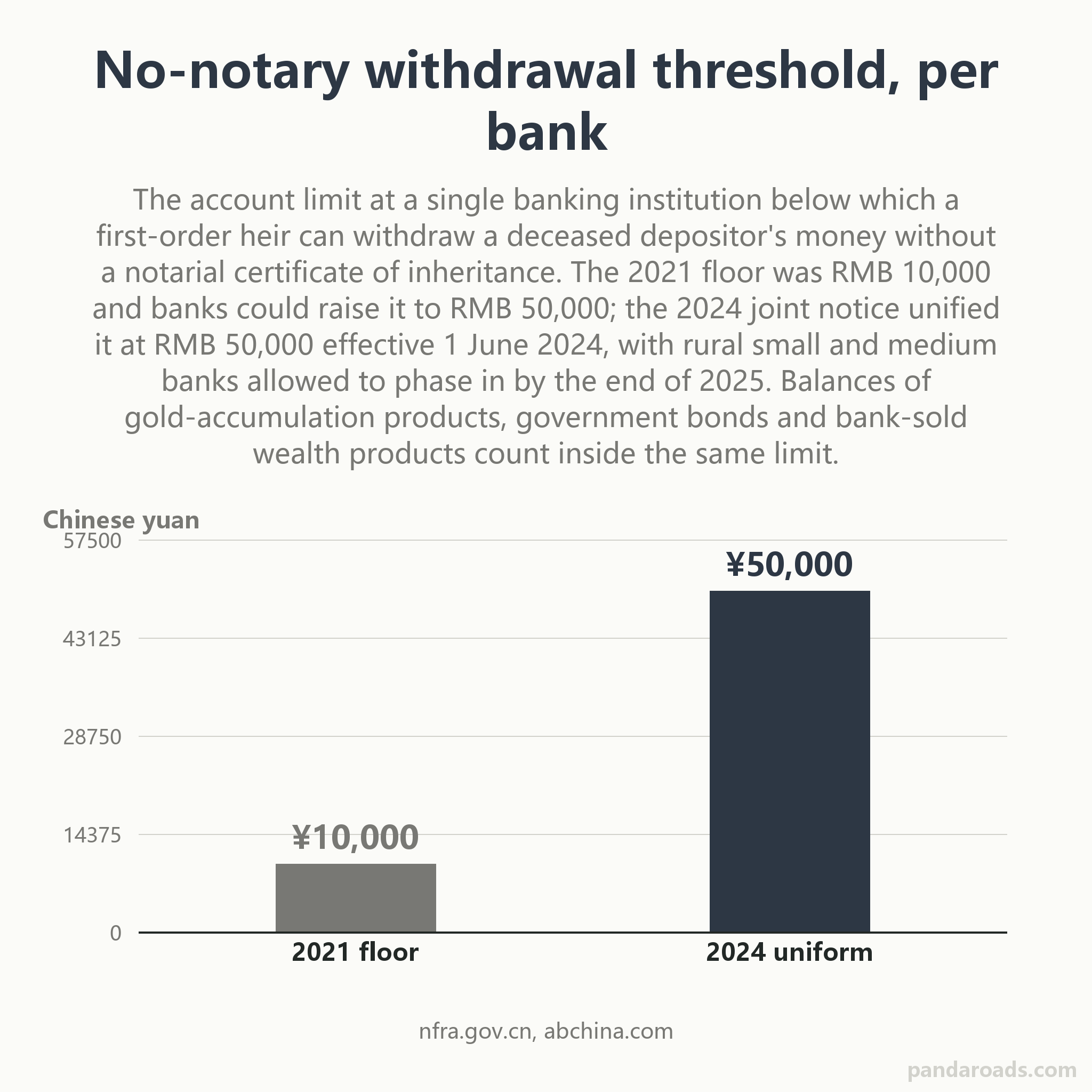
Note: The threshold is per banking institution, not per person and not for the estate as a whole. Three accounts at three different banks, each holding less than RMB 50,000, can each clear on the simplified route. One account holding RMB 60,000 does not, and goes to Step 4.
Step 4: Above the threshold, the notarial route
When the deposit at one bank is over RMB 50,000, or when the branch will not accept the simplified route, a Chinese bank releases the money only on a lawful succession basis. For an undisputed estate the normal basis is a notarized Certificate of Inheritance Rights issued by a licensed Chinese notary office, which the heir obtains by presenting the death record, the kinship proof and the identity of every person entitled (source: chinajusticeobserver.com). The bank then pays out or transfers the deposit on the strength of that certificate.
Three ways to prove entitlement, and when each is the right one
| Route | What you file | When it fits | Trade-off |
|---|---|---|---|
| Simplified small deposit | Death and kinship proof plus a signed undertaking | A deposit at one bank of RMB 50,000 or less, clear first-order heir, no dispute | Fastest and cheapest, but capped and only for undisputed claims (source: nfra.gov.cn) |
| Notarized inheritance | The notarial Certificate of Inheritance Rights | A deposit above the threshold, or a bank that requires a certificate | Authoritative and widely accepted, but it costs a notary fee and takes time (source: chinajusticeobserver.com) |
| Judicial | An effective court judgment, ruling or mediation document | Heirs who dispute, or an heir abroad who cannot be traced or cannot sign | Final and enforceable, but the slowest of the three (source: english.shanghai.gov.cn) |
When the deposit at one bank is over RMB 50,000, a Chinese bank releases the money only on a lawful succession basis, usually a notarized Certificate of Inheritance Rights from a licensed notary office, or an effective court judgment where the heirs cannot agree.
The notary office is a 公证处, and it is the notary who decides whether the succession is proven, not the bank and certainly not a courier. A foreign heir submits the authenticated and translated foreign documents to it, and where a co-heir in America cannot appear, the office will work from a properly notarized statement or entrustment rather than requiring the person in the room (source: english.shanghai.gov.cn). Where heirs cannot agree at all, a court determination replaces the certificate and binds the bank directly. Getting an issued certificate off that counter and into your hands is one instance of the wider pattern this site calls errands in China from overseas.
It is worth saying the honest boundary out loud. Preparing the folder, booking the appointment, translating the counter conversation and collecting the issued certificate are errands a runner can do. Writing the notarial deed, weighing the evidence of entitlement and deciding the heirs is the notary's licensed act, and no fee you pay a service changes that. If the estate is large, contested, or the family cannot agree, that is a lawyer and a court matter, and the runner's job shrinks to logistics around it.
Step 5: The bank counter, releasing the money and closing the account
Once the succession basis is accepted, the branch either transfers the deposit into an account in the heirs' names or pays it out, then closes the original account. It keeps copies of everything and you should keep the originals and the closure receipt, because the money-out step will ask for the file. Two practical walls show up right here for a child who is not in China.
The first is presence. Chinese branches generally require the heir, or a properly authorized agent carrying originals, to be physically there at the counter. The queue is conducted in Chinese, the forms are in Chinese, and a foreign passport paired with an authenticated overseas death certificate is a document set most counter staff see rarely, which means the transaction stalls on small confusions rather than on your entitlement (source: khtpartners.com). The second wall is that knowing the PIN never cleared this step anyway. The bank's release of the money is a legal handoff, not a withdrawal, and a debit card in a dead parent's wallet is not a succession basis (source: khtpartners.com).
Whether the money cleared under the RMB 50,000 shortcut or a notarial certificate, the branch requires the heir or an authorized agent with originals to be physically present to pay out and close the account, and knowing the parent's PIN never clears this step on its own.
The relief is a tax fact. There is no inheritance tax and no estate tax on a Chinese bank deposit, so the branch is not collecting a duty from you; it is collecting proof that you are entitled, and nothing is deducted from the balance for the privilege of inheriting it (source: khtpartners.com). China has legislated no inheritance or estate tax into force, which is why the whole fight in this process is documentary rather than fiscal.
One caveat before you plan a trip. Rural small and medium banks were given until the end of 2025 to reach the RMB 50,000 line, so a county branch may still be running the older and stricter version of the rule, and each bank sets its own document list inside the national framework. Ask the specific branch which route it will accept before you book anything, because that answer, and not the notice, is what your file gets judged against.
Note: This is where paid on-the-ground help earns its keep: checking the folder before the appointment, booking the slot, translating what the clerk actually said, couriering the originals, and writing down which documents the branch accepted, in the format described on the report standards page. Whether a branch will release funds to an authorized agent holding a notarized power of attorney, or insists that the heir stand there in person, is the branch's own call and the first question to ask. Where an office legally requires you, that part stays yours, and honest help says so before you pay anything. What a runner never does is sign a document that is legally yours to sign, or make the notary's determination for them. Everything upstream of this step is preparing this one physical appointment.
Step 6: Getting the money out of China, the inheritance approval
Now the number everyone quotes at you. People online will tell you that a child can only move USD 50,000 a year out of China, full stop. Most guides say that ceiling applies to every kind of transfer, and it is the mistake that costs an overseas family the most months, because the wrong application gets filed and then sits unanswered. The USD 50,000 figure is the annual individual foreign-exchange quota, and it governs current-account spending. It is not the rule for inherited money. Under the implementation rules for individual foreign-exchange management, capital-account items are handled under separate capital-account rules, not against the USD 50,000 annual limit, so an inheritance transfer is not a bite of that quota (source: safe.gov.cn).
Two routes out, and why an inheritance is on the second
| Question | Ordinary annual quota | Inheritance transfer route |
|---|---|---|
| What it covers | Current-account spending by a resident | Liquidating lawfully inherited domestic assets and moving them out (source: safe.gov.cn) |
| Where you file | A bank counter | The foreign-exchange administration at the deceased's household-registration location; an agent may file (source: safe.gov.cn) |
| What limits the amount | USD 50,000 a year | No such annual cap; approved locally at or below the equivalent of RMB 500,000, above it reported to the national agency (source: safe.gov.cn) |
| What the file needs | Identity documents | Death and kinship record, the succession and bank file, a tax certificate or tax-paid voucher where one applies, and notarization of any unnotarized agency agreement or proof of rights (source: safe.gov.cn) |
| How the money moves | Immediate purchase and remittance | One filing covering all inheritance from a single decedent, remittable in one or several tranches; separate filings for separate decedents (source: safe.gov.cn) |
The operative conditions, in the authority's own shape:
Where the total does not exceed the equivalent of RMB 500,000, the local foreign-exchange administration approves the transfer; above that amount the case must be reported to the State Administration of Foreign Exchange. All inheritance from a single decedent is applied for in one filing, remittable in one or several tranches. After the bank sells the foreign exchange it must remit directly to the applicant's own account, and no foreign-currency cash may be withdrawn inside China. (source: safe.gov.cn)
Inherited money leaving China does not draw on the USD 50,000 annual foreign-exchange quota. It goes out on a separate inheritance approval filed at the foreign-exchange bureau covering the deceased's household registration, approved locally up to the equivalent of RMB 500,000 and reported to the national agency above that.
Two consequences for a family abroad. First, RMB 500,000 is a filing line, not a limit: an estate above it still leaves, it just gets examined at the national level instead of the local one, which usually costs time rather than money. Second, the money has to land in an account in the applicant's own name and cannot be taken out as physical cash, so an heir needs a foreign account ready before the approval is used. Every approved application carries a validity window, and the exchange and the remittance must actually be completed inside it, which is the detail that quietly expires files.
Assemble and deliver the paperwork through a task runner if you cannot be there, but the approval itself is the foreign-exchange bureau's decision. Nothing about paying a service grants it.
What it costs to have someone on the ground run the physical parts
Add the steps up and the shape of the job becomes obvious. Finding the accounts, the notary appointment, the branch payout and the foreign-exchange filing all want a body in a Chinese city on a weekday, and you are not that body. This is the part of the chain that a person in America genuinely cannot do remotely, and it is the honest reason a fixed-fee local service exists.
The published rates are flat. A Local Errand, meaning someone physically going to do one thing within 30 kilometers, is US$239. A Remote task, a research or coordination request handled without a field trip, is US$129 per request. On-site field work is US$239 per day billed from departure, and single errands run US$239 (source: pandaroads.com). Nothing is charged until you approve an itemized quote, and travel outside the covered area is priced and confirmed before work begins.
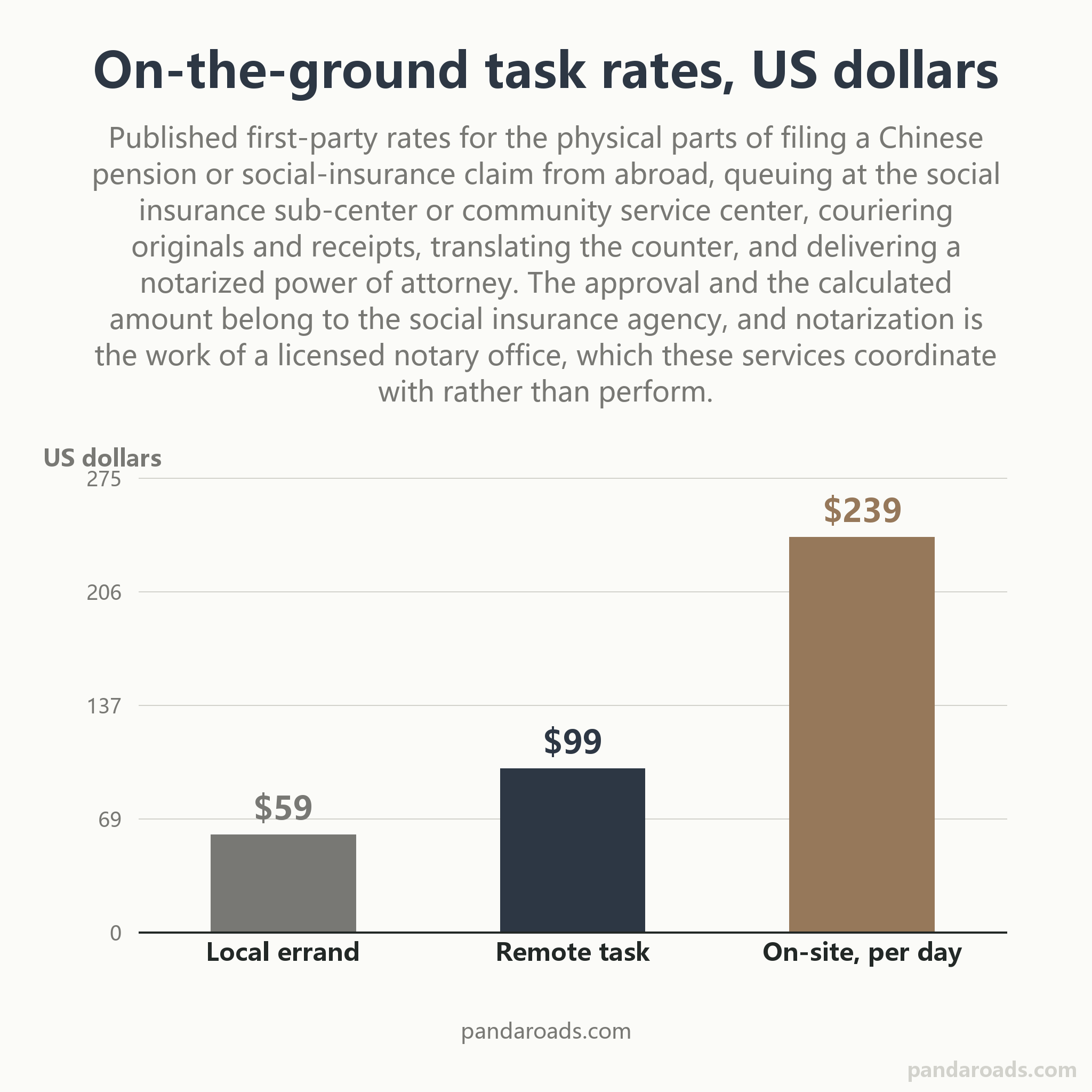
The physical parts of the job have flat published rates: a Local Errand within 30 kilometers is US$239, a Remote task is US$129 per request, and on-site field work is US$239 per day, so a deposit-only claim can be priced by the number of trips it actually needs.
The boundary is the part worth reading twice. PandaRoads is not a law firm. The notarization, any court case and the foreign-exchange approval are the work of a licensed notary office, the courts and the foreign-exchange bureau. What a runner does around those steps is accompany, queue, courier the originals, translate the counter conversation and witness the document chain so that nothing goes missing between the notary, the bank and the SAFE window (source: pandaroads.com). Where a signature is legally yours, the runner prepares everything and coordinates the appointment rather than forging you into it, which is the same line this site draws on its honest boundaries page.
Note: Compare this against what else you will be offered. A local operator may quote a percentage of the estate for handling the whole thing. Hiring someone in China by the day is the other shape: a flat per-task and per-day fee is transparent because you can price the number of physical trips you actually need, and for a deposit-only claim that number is usually small.
Frequently asked questions
How do I withdraw money from a deceased parent's bank account in China if I live abroad? You prove three things to the bank and, above a threshold, to a notary: the death, your family relationship, and your legal entitlement. If the total at that one bank is RMB 50,000 or less, a first-order heir can usually be paid out with no notarial certificate at all (source: nfra.gov.cn). Above it, you obtain a notarized Certificate of Inheritance or a court document.
Do I need a notary certificate to inherit a bank deposit in China? Not always. For a deposit at one bank of RMB 50,000 or less released to a first-order heir, the 2024 notice removed the certificate requirement and you deal with proof of death and relationship instead (source: abchina.com). Above that amount, or where the bank insists or the heirs dispute, the notarial certificate or a court judgment becomes the release basis (source: chinajusticeobserver.com).
What is the small-deposit limit that does not need notarization in China? RMB 50,000, or the foreign-currency equivalent, excluding unsettled interest, measured at a single banking institution. The limit was unified at that figure effective 1 June 2024, up from the RMB 10,000 floor set in 2021, and it now also covers gold-accumulation, government bond and bank-sold wealth-management balances held at the same bank (source: nfra.gov.cn).
Can a bank freeze a deceased person's account in China? Yes. Once a branch is formally notified of the death it will normally freeze or restrict the account while the succession documents are checked, because the bank will not pay out on a password alone without a lawful release basis (source: khtpartners.com). This is why you identify the accounts and use the statement-inquiry route before you formally present a claim to each branch.
How do I find out how much money was in a dead relative's Chinese bank account? Under the 2024 rules a first-order heir can ask the bank for the deceased's account transaction statements covering the six months before the death and the period after it, on a lawful and proper reason (source: abchina.com). A one-stop deceased-person financial-account query, being rolled out from provincial pilots, can list the institutions that hold the assets so you do not visit banks blind.
How do I move inherited money out of China to a foreign bank? On a separate inheritance-transfer approval, not the USD 50,000 annual quota. You file at the foreign-exchange administration covering the deceased's household registration; local approval applies up to the equivalent of RMB 500,000 and above that the file goes to the national agency. The bank then remits directly to an account in your own name, and no foreign-currency cash can be withdrawn inside China (source: safe.gov.cn).
Is there an inheritance tax on a bank deposit in China? No. China has no inheritance or estate tax in force, so nothing is withheld from a deceased parent's bank balance as a tax on the inheritance itself (source: khtpartners.com). What the bank and notary collect is proof that you are entitled, not a duty, which is why the whole process is documentary rather than fiscal.
What documents does a Chinese bank require from an overseas heir? A death certificate, proof of the family relationship, the identity of every heir, and, above the small-deposit threshold, a notarized Certificate of Inheritance or a court document (source: chinajusticeobserver.com). Documents issued abroad must be authenticated or apostilled in the country of issue and translated into Chinese before the notary and the bank will accept them (source: english.shanghai.gov.cn).
The bottom line
Two facts decide almost all of this. A deposit at one bank of RMB 50,000 or less can be released to a first-order heir on proof of death and relationship alone, with no notarial certificate, under the 2024 joint notice, and the money leaving China is not capped by the USD 50,000 annual foreign-exchange quota but goes out on a separate inheritance approval filed where the parent was registered (source: nfra.gov.cn) (source: safe.gov.cn). Get those two straight and the rest is sequence and paperwork.
The sequence, in one breath: find the accounts and the balances before you notify anyone, prove the death and the relationship with authenticated and translated documents, release the money under the shortcut or the notarial route or a court order, close the account and keep the vouchers, then file the foreign-exchange approval and remit into your own account. Each step has its own gatekeeper, and the ordering is the information.
If you are the only child and you are four thousand miles away, the honest constraint is presence, not entitlement. The parts that need a body in a Chinese city, the record runs between the branch, the notary office and the foreign-exchange window, can be done for a fixed per-task and per-day fee, and you can send the city, the bank and the specific blocker to get an itemized quote (source: pandaroads.com). Where your parent also left a flat or a house, that is a separate set of errands, handled under property services for overseas owners. That help is on-the-ground coordination. It is not legal, notarial or tax advice, and the licensed acts in this chain stay with a licensed notary, a court, and the foreign-exchange bureau.
References
- 国家金融监督管理总局, 中国人民银行. (2024, April 22). 关于优化已故存款人小额存款提取有关要求的通知 (金规〔2024〕6号) [Notice on optimizing the requirements for simplified withdrawal of small deposits of deceased depositors, effective 1 June 2024]. National Financial Regulatory Administration. https://www.nfra.gov.cn/cn/view/pages/ItemDetail.html?docId=1159755&itemId=928
- 中国农业银行. (2024, April 29). 金融监管总局、央行最新规定!存款继承政策全新升级! [Regulator and central bank's latest rules: a full upgrade of the deposit-inheritance policy]. Agricultural Bank of China. https://www.abchina.com/cn/special/xfz2022/xbdt/202404/t20240429_2420381.htm
- 国家外汇管理局. (2004, November 16). 中国人民银行发布实施《个人财产对外转移售付汇管理暂行办法》 [Release of the interim measures for the administration of the sale of foreign exchange against personal domestic assets and the remittance of such assets abroad, effective December 1, 2004]. State Administration of Foreign Exchange. https://www.safe.gov.cn/safe/2004/1116/4133.html
- Shanghai Municipal People's Government. (2025, July 21). How to obtain an inheritance certificate? [Legal issues FAQ, sourced to Shanghai Dongfang Notary Public Office]. english.shanghai.gov.cn. https://english.shanghai.gov.cn/en-LegalIssues/20250721/97f61006fbff4775a943f885fdd6439b.html
- China Justice Observer. (n.d.). How do I get money from my deceased parent's bank account in China? [Cross-border family matters explainer]. CJO Staff Contributors Team. https://www.chinajusticeobserver.com/a/how-do-i-get-money-from-my-deceased-parents-bank-account-in-china
- KHT Partners. (2023, November 30). Deceased depositor's bank account in China: Heirs [Guide]. KHT Partners. https://khtpartners.com/withdraw-money-when-the-depositor-dies/
- China Briefing. (2023, July 24). WeChat enables foreigners to pay with overseas cards in China. Dezan Shira & Associates. https://www.china-briefing.com/news/wechat-enables-foreigners-to-pay-with-overseas-cards-in-china/
- PandaRoads. (2026). China sourcing and local task service from $129 [Service and pricing page]. PandaRoads. https://pandaroads.com/china-tasks.html
Last reviewed and updated: September 2026. Author: our editorial team. For tailored guidance, contact our team.