Recover WeChat From Abroad When Your Chinese Phone Number Dies
A diagnosis-first recovery path for a person in the United States whose WeChat is locked and whose +86 number no longer reaches them: how to tell a short-term self-unblockable restriction from a permanent one, how to check whether the Chinese phone number still resolves before waiting on a code, the two online routes that work from abroad (a qualifying friend or non-friend assist and the in-app appeal), and the offline, phone and internal-connection recovery paths that plainly do not exist.
Last updated: September 2026 · By the PandaRoads team in China
TL;DR
Recovering a locked WeChat from the US is usually not a password problem, it is a phone-number and helper problem. A Chinese carrier can cancel an unpaid or abandoned +86 SIM (China Mobile after 120 days) and recycle it after a minimum freeze period, so the SMS code you keep being told to wait for may be routing to a stranger. The routes that actually work from America are the in-app assist flow, where the helper does not have to be your friend but must be an account over six months old, bank-card bound and inside the 1 per month, 2 per six months, 3 per year limits, plus the formal in-app appeal. No offline counter, no phone hotline, and no internal connection can unblock you, and anyone who says otherwise is running the scam WeChat itself names.
Abstract
A diagnosis-first recovery path for a person in the United States whose WeChat is locked and whose +86 number no longer reaches them: how to tell a short-term self-unblockable restriction from a permanent one, how to check whether the Chinese phone number still resolves before waiting on a code, the two online routes that work from abroad (a qualifying friend or non-friend assist and the in-app appeal), and the recovery paths that plainly do not exist.
Key Takeaways
- A short-term block you can self-unblock; a permanent one you cannot
- China Mobile auto-cancels an unpaid or abandoned number after 120 days
- A recycled +86 number routes your code to a stranger, not you
- The WeChat assist helper need not be your friend, but must qualify
- The in-app appeal is a real route; the phone hotline to fix it is not
- Paying an unblock service risks your data, money and the helper's account
Table of Contents
- Abstract
- Key Takeaways
- Why waiting for the SMS code is the wrong first plan
- First, know which lock you actually have
- The +86 number problem: is that number even still yours
- Route 1: the in-app assist, friend or non-friend
- Route 2: the in-app appeal and account activation
- The three routes side by side
- The doors that do not exist, and the scam in the gap
- Where a person on the ground in China genuinely helps
- Frequently asked questions
- The bottom line
- References
Why waiting for the SMS code is the wrong first plan
You tap the WeChat icon in a US apartment at 11 p.m. and get a wall of text: your account is locked for security reasons, or login is restricted, and to continue you must receive a verification code by SMS on your +86 mobile number. Every guide you can find, in English or machine-translated Chinese, reduces to one instruction, wait for the code. The instruction assumes something that may no longer be true. That +86 number has been sitting in a drawer since you flew out, the plan ran out of credit, nobody topped it up, and a carrier does not wait forever.
The community research makes the failure vivid, and this is not a hypothetical. A person on r/chinalife put the whole problem in one sentence, "How can I contact China Mobile from abroad to setup international roaming? I need to send and get a verification code via SMS for wechat" (source: reddit r/chinalife, 2024-09). That ask, recovering a suspended WeChat account or a Chinese phone number from abroad, shows up again and again across diaspora forums, because the locked account is not an inconvenience, it is the line to parents, to old friends, to a bank of saved chats, and sometimes to work.
Here is the reframe that saves you weeks. Recovering a locked WeChat from the United States is rarely a password problem. It is a phone-number problem and a helper problem, in that order. The code path can be permanently dead the moment your number is cancelled and recycled to a stranger, and once it is dead, waiting never helps. What actually works from abroad is a qualifying person completing an in-app assist, or a formal in-app appeal, and this article walks you through both, plus the list of recovery doors that do not exist and are only ever a scam dressed as one. If the account is one you are still setting up rather than recovering, the guide to installing and setting up Chinese apps from abroad covers the download and phone-verification side before a lock ever happens.
Note: This guide is about a locked or restricted WeChat account and the +86 number that receives its verification code. It is not about paying from a foreign card. The number that circulates most, the WeChat Pay foreign-card cap of about RMB 6,000 per transaction and RMB 50,000 per month, governs consumer payments from an overseas card inside China and has nothing to do with lifting an account lock, so it is mentioned here once and then dropped.
How this was checked. Every rule WeChat itself enforces on a locked account was read off the company's own pages, and each was re-opened this month before being written down. The one English help center the search engines keep surfacing answered a fetch with a 503 and then a 403, so nothing here leans on it. The carrier recycling clock and the paid-unblock pricing come from Chinese state-news reports of the published telecom rules and of the trade, because neither the carrier nor the platform publishes either in English, and that is why the recycling numbers below are framed as a clock to check your line against rather than a verdict on it.
Recovering a locked WeChat from the United States is rarely a password problem; it is a phone-number and helper problem. The verification-code path goes dead the moment a +86 number is cancelled and recycled, and the RMB 6,000 per transaction and RMB 50,000 per month WeChat Pay caps that circulate most govern spending, not unlocking an account.
By the Numbers
- 120 days Roughly how long before China Mobile auto-cancels an unpaid or abandoned +86 number, after which it can be recycled to a stranger (source: app.xinhuanet.com)
- 90 days The minimum freeze period a cancelled number must sit out before the carrier is allowed to release it again (source: app.xinhuanet.com)
- 6 months How long a helper's WeChat account must have been registered before it is eligible to assist your unblock (source: weixin110.qq.com)
- 3 / year The ceiling on how many times one account can assist an unblock, with 1 per month and 2 per six months inside it (source: weixin110.qq.com)
- 20-60 yuan What paid third-party unblock listings charged, a practice WeChat customer service tells you not to use (source: xinhuanet.com)
- $239 PandaRoads Local Errand, the entry price for the on-the-ground guidance parts of this job (source: pandaroads.com)
Six figures, and the one people act on most and verify least is the first. Overseas holders keep waiting on an SMS code as though the number were still theirs to receive on, but a dormant or unpaid SIM follows a clock, and once that clock runs out the code routes to whoever bought the recycled number. The two-day-unit numbers, 30 and 60 days before cancellation and a 90-day freeze after it, are what make that clock real, and the +86 number section below lays the whole timeline out. The 6-month and 3-per-year numbers belong to the helper, not to you, and they decide whether the route that actually works from America is open to you at all. The last two, the 20 to 60 yuan unblock listings and the $239 errand, are the difference between a scam and an honest service, which is the subject of the second-to-last section.
First, know which lock you actually have
Before you touch a single recovery step, work out what kind of restriction you are facing, because the answer decides whether self-service is even possible. Most English guides skip this, and readers burn weeks trying to self-unblock a lock that cannot be self-unblocked. WeChat distinguishes two kinds, and the difference is not cosmetic.
Short-term restriction
A short-term login restriction is temporary. The limit window runs from a few minutes up to about a month depending on what triggered it, and once that window passes you can lift it yourself through the app, normally by completing a friend-assist or non-friend-assist verification (source: xinhuanet.com). This is the recoverable case, and it is the one almost every overseas holder actually has when a dormant account suddenly asks for re-activation.
Permanent restriction
A permanent login restriction cannot be self-unblocked at all, no matter how long you wait or how many codes you request (source: xinhuanet.com). Worse, the way people behave under panic can turn a fixable block into this kind. WeChat's own account rules treat abnormal unblock behavior, batch requests, machine-generated instructions, submitted false materials, fabricated friend relationships, and the use of any third-party paid-unblock platform, as grounds to re-block the account or push it to a permanent ban (source: weixin.qq.com). That single line is the reason the whole paid-helper industry is a trap and not a shortcut.
Which lock are you facing
| Question | Short-term login restriction | Permanent login restriction |
|---|---|---|
| Can you self-unblock | Yes, once the limit window passes (source: xinhuanet.com) | No, there is no self-service path (source: xinhuanet.com) |
| What it usually needs | A qualifying friend or non-friend assist inside the app (source: weixin110.qq.com) | A formal in-app appeal to Tencent with supporting proof (source: weixin.qq.com) |
| How it is shown | An in-app countdown or a temporary login block message | A standing message that the account is permanently restricted (source: xinhuanet.com) |
| Does paying a helper change it | No, and a paid assist can worsen it (source: weixin.qq.com) | No, and it can convert a reviewable case into a ban (source: weixin.qq.com) |
Do one concrete thing right now. Screenshot the exact wording WeChat shows you, in Chinese if that is what renders, before you change anything or retry a login. That sentence is the tell. It determines which of the routes below are even open to you, and it is the single most useful document you can hand to a friend, a translator, or an on-the-ground helper later. If the message names a time limit, you are most likely in the self-unblockable lane. If it says permanent, stop retrying, because each failed cycle risks the escalation, and move to the appeal section instead.
WeChat splits a locked account into 2 kinds of restriction, and mixing them up costs weeks. A short-term login block runs from a few minutes up to about a month, then clears through an in-app friend or non-friend assist. A permanent restriction has no self-service unblock path, only an appeal to Tencent, and each failed retry risks pushing a fixable case toward that permanent lane (source: xinhuanet.com).
The +86 number problem: is that number even still yours
Everything downstream depends on one question nobody asks you: does that +86 number still exist as yours. If it does not, every code-based fix is chasing a message that is being delivered to someone else.
How a dormant number gets recycled
Chinese carriers recycle numbers, and they do it on a published clock. As Xinhua reported, citing the Telecommunications Regulations and the Telecommunications Service Norms, a carrier may suspend service about 30 days after a bill goes unpaid, may end the line about 60 days after that suspension, and must then hold the cancelled number through a minimum 90-day freeze period before it can be re-released (二次放号) to a new subscriber (source: app.xinhuanet.com). China Mobile goes further in practice: it auto-cancels an unpaid or simply abandoned number after about 120 days, then parks it roughly six months before putting it back into the sales system (source: app.xinhuanet.com). Add those together and a number you stopped paying in, say, 2022 was almost certainly gone, and almost certainly reassigned, long before you tried to log in this month.
The consequence is not abstract. Xinhua framed the whole story around exactly this risk: a new holder of a recycled number can receive the SMS that used to be yours, and because so many apps treat a phone code as proof of identity, that code can open a stranger's linked accounts (source: app.xinhuanet.com). For you, it means the WeChat verification code you keep being told to wait for may be landing on a stranger's handset. The reporter's advice to unbind accounts before you ever release a number is the same advice in reverse for someone whose number is already gone: the code path is a closed door, and the recovery has to come from the app and from a helper, not from a text message.
What roaming can and cannot rescue
International roaming is the one case where a code can still reach you abroad, and it is worth stating plainly because it is the reader's instinct. If the +86 line is still active, still in your name, and roaming with SMS reception is switched on, a verification code can arrive on that number while you sit in the United States. That is a real path, and it is the one the r/chinalife poster was groping toward when they asked how to enable roaming from overseas. Keeping that line topped up and able to roam from abroad is itself one of the life errands people hire for once they move away. But roaming rescues an active line, it does not resurrect a cancelled one. There is no line to roam on if the number was cancelled, and the same holds for a number whose plan simply lapsed and got swept into recycling. So before you spend effort chasing roaming settings, confirm the line is still yours, because if it is not, roaming is the wrong mountain.
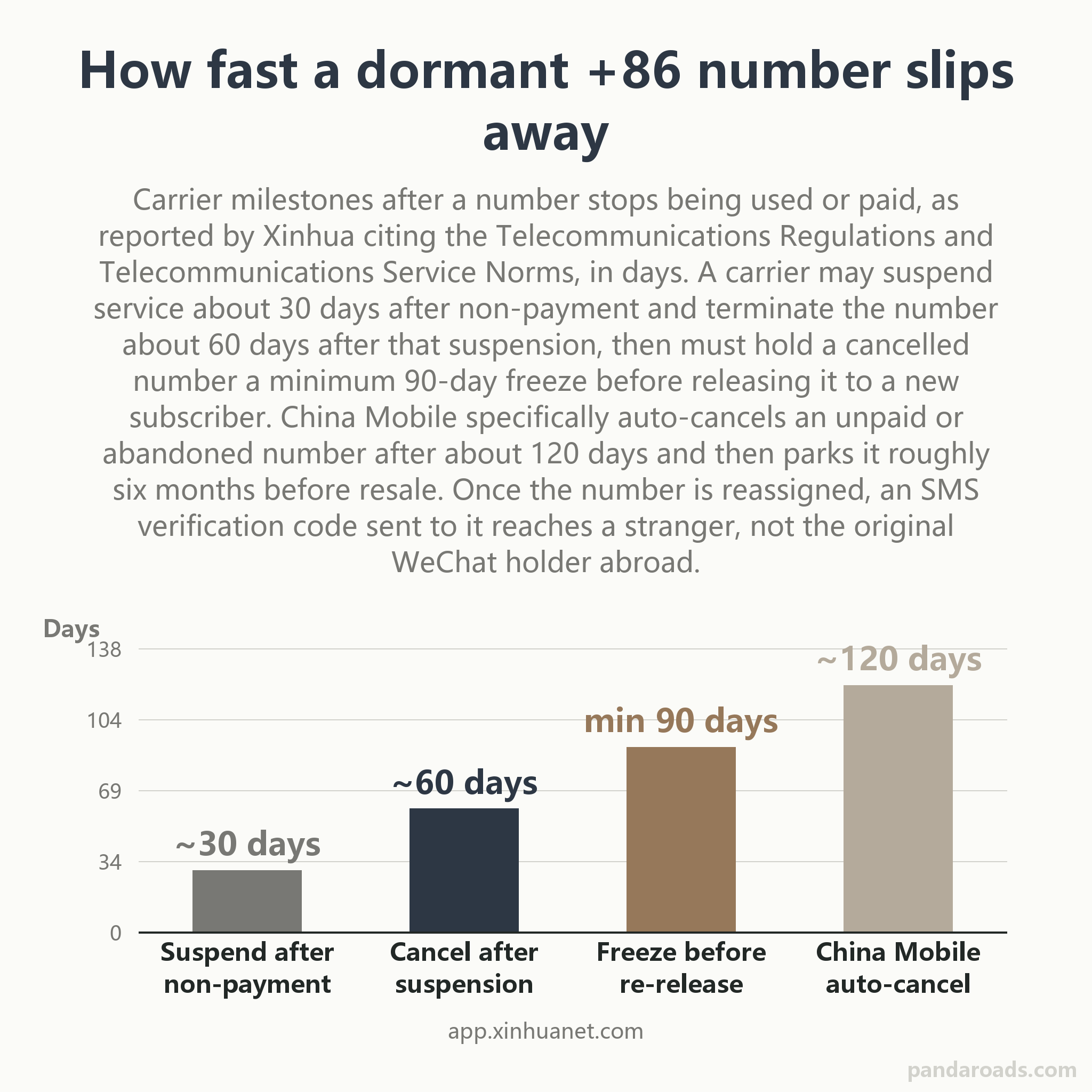
Note: The 30, 60, 90 and 120-day figures are the published rule as reported, and carriers and specific contracts can differ at the margin. Whether your particular number is still live is something only a check on the China side can settle, by attempting a top-up, dialing it, or querying the account, and that is precisely the kind of errand that is hard to do from a US time zone unless you hire someone in China to check the line for you. Hold that thread; it is picked up again in the last sections.
Route 1: the in-app assist, friend or non-friend
This is the route WeChat itself documents, and it is the one that can lift a short-term restriction while you never leave the United States. The app calls it 自助解封, self-unblock, and it hinges on a single idea: another WeChat user vouches that you are a real person doing a normal login, not a bot or a hijacker.
Who can be your helper
The most useful fact here is the one the English web almost never states, and it changes what you think you need. According to WeChat's own self-unblock screen, the helper does not have to be your WeChat contact at all. The person who assists you only needs to be a WeChat account that meets these conditions: registered longer than half a year and in normal use, already bound to a bank card, currently within the assist-count limits of 1 per month, 2 per six months and 3 per year, and otherwise qualified, meaning no violation record, no current security risk, and a login from a trusted, familiar environment (source: weixin110.qq.com).
That reframes your whole search. You are not looking for a friend, you are looking for any eligible account, and the scarce resource is a willing person on the China side whose own standing lets them tap the confirm button. A cousin, an old classmate, a former colleague, a shop owner you have added once, all qualify if their account passes those gates. It also explains why helpers say no: assisting an account that later gets re-blocked for fraud or worse can drag the helper's own account into restriction, so a person is spending their own account's safety on your behalf, and the assist-count limit means they only have a few of those favors a year to give (source: weixin110.qq.com) (source: xinhuanet.com).
WeChat applies a parallel eligibility set to an account that assists a new registration rather than an unblock, requiring a bound phone, WeChat Pay opened, sufficient account age and no current security risk, with one account able to assist only a single registration (source: support.weixin.qq.com). The lesson is the same from both directions: the helper's own compliance is what you are really asking about, so the question you should ask before you beg is not "will you help me" but "does your account meet these conditions".
How the flow runs from the US
The mechanics are short, and you do them on your side while the helper does one tap on theirs:
- Open the login restriction screen on your blocked account and choose the self-unblock or 解封 option.
- Complete the basic checks it presents, then pick the friend-assist or non-friend-assist path when it appears.
- Enter the helper's phone number so WeChat can route the request to their account.
- The helper receives an in-app notice and, inside their own WeChat, confirms the assist; timing follows the window the screen shows you.
- Retry your login once the assist registers, and read any follow-up message before trying again blindly.
Each step is one action, and none of it requires you to be in China. What it requires is an eligible helper who is on WeChat, awake, and willing, in your time zone or theirs. When you have that person, this route is fast. When you do not, the next section is your fallback, and the section on on-the-ground help is about exactly how to find and handle this person well.
The WeChat self-unblock assist has one non-obvious rule that reframes the whole search: the helper does not need to be your contact. Any qualifying account works, meaning one registered longer than half a year and in normal use, bound to a bank card, and inside the limit of 1 assist per month, 2 per six months and 3 per year (source: weixin110.qq.com).
Route 2: the in-app appeal and account activation
If you cannot reach an eligible helper, or if your account is restricted rather than merely short-term blocked, the second real path is inside the app: the formal appeal, or for a long-dormant account, the activation flow. WeChat's own personal-account rules describe both, and knowing what they are stops you from hunting for a phone number that will not help.
Re-activation, and why it is tied to the number
WeChat's usage norms state that an account which has gone a long time with no login and no access record has its login restricted, and that it must be re-activated before normal use returns, by means that include verifying an SMS code (source: weixin.qq.com). If the account was originally created through another account's assistance, the norms say WeChat may ask that assisting account to help the login, which is the same helper dependency as Route 1 arriving from a different door (source: weixin.qq.com). This is exactly the trap the +86 section set up: a re-activation prompt that wants an SMS code is, for a holder whose number was recycled, a request you physically cannot satisfy, so the code route is not a delay, it is a dead end.
The appeal, honestly scoped
The same norms carry a complaint-and-appeal mechanism: if your account was hit with a restriction and you dispute the result, you can submit proof materials to Tencent, and the route to reach a human review runs through the WeChat client itself, following the on-screen prompts and the in-app contact option (source: weixin.qq.com). Treat that for what it is. An appeal is a review request, not a guarantee, and the decision belongs to Tencent, not to you and not to anyone offering to decide it for you for a fee. And the honest ceiling still holds: a permanent restriction is not turned into a self-service unblock by an appeal form, so if you are in the permanent lane from the earlier table, an appeal is the only motion left, not a quick fix (source: xinhuanet.com) (source: weixin.qq.com).
Note: The one thing that connects the two routes is the number. An activation or re-activation step that asks only for an SMS code helps you if and only if that code can still reach you, which means a live +86 line. For a dead-number holder, the realistic combination is the in-app appeal plus, where the flow allows it, a qualifying assist, rather than any code, and that is worth deciding before you spend a week refreshing an inbox for a text that is going to someone else.
Route 2 runs inside the app and needs no helper, the fallback when no qualifying account is available. WeChat's account norms describe 2 mechanics here: a long-unlogged account must be re-activated, sometimes by an SMS code, and one created through another account's assist may need that account to log it in. A permanent restriction is not undone by an appeal form (source: weixin.qq.com).
The three routes side by side
You now have three motions that are real and documented, and one that is fake. This table puts them next to each other so you can see, in one look, what each route demands of you, what it demands of someone else, and whether it can carry you while you stay in the United States.
Friend assist vs non-friend assist vs in-app appeal
| Route | What it needs from you | What it needs from someone else | Works from the US alone |
|---|---|---|---|
| Friend assist | Start self-unblock in the app and enter a helper's phone number (source: weixin110.qq.com) | A qualifying account, over six months old, bank-card bound, inside the 1 per month and 3 per year limits (source: weixin110.qq.com) | Yes, once one such person is on WeChat in China and agrees |
| Non-friend assist | Same in-app start, then supply any eligible verifier (source: weixin110.qq.com) | Any eligible WeChat account that meets the same conditions, not necessarily someone you know (source: weixin110.qq.com) (source: xinhuanet.com) | Yes, but finding an eligible and willing account is the hard part |
| In-app appeal or activation | Follow the client prompts and submit proof to Tencent for review (source: weixin.qq.com) | Nobody else, though a code-based re-activation still needs a live +86 number (source: weixin110.qq.com) (source: weixin.qq.com) | Depends: appeal yes, but a code step fails if the number is recycled |
Read the pattern in the last column, because it is the whole article in miniature. The two assist routes can absolutely be run by someone sitting in America, but only through another person: the work happens on a qualifying account on the China side, and that account has to be found, reached and handled well. The appeal route needs nobody but you, yet it is only a review request, not a verdict, and it collides with the number problem the moment the flow wants an SMS. So the realistic ranking for a US holder is this. If you can get one eligible person to tap confirm, the assist is fastest and most reliable. If you cannot, the appeal is your lane, but expect a Tencent decision and not a guarantee, and know that a code gate can stall it if your +86 line is gone.
And there is a fourth option that is not a route at all: paying someone to make the lock vanish. It belongs in its own warning section, because WeChat's rules treat the very mechanics a paid service relies on, fabricated friend relationships and third-party paid-unblock platforms, as grounds to re-block or permanently ban the account, so the shortcut quietly creates the permanent case you were trying to escape (source: weixin.qq.com). Before you reach for money, read what does not exist. That is next.
For a US reader, 3 recovery motions are real and 1 is not. The two assist routes work from abroad but only through a qualifying account on the China side, and the in-app appeal needs nobody yet still stalls if a step wants a dead +86 code. Paying a fixer is not a fourth route; it turns a reviewable block into a permanent ban (source: weixin.qq.com).
The doors that do not exist, and the scam in the gap
Most of the pain in a recovery hunt comes from chasing options that are not real. This section says, with sources, which doors are simply not there, so you stop spending time and money on them. It is written as clear negations on purpose; hedging here helps no one.
No offline counter
Tencent's headquarters being in Shenzhen does not mean there is a window you can walk up to and have an account unlocked. The company's published service channels are an AI-assisted chat, telephone lines, and official WeChat accounts and mini programs, and the physical address it lists for the Anti-Fraud Investigation Department at Tencent Binhai Towers in Nanshan, Shenzhen is a mailing address and an email for reporting fraud, not a public queue where you present an ID and get your WeChat back (source: tencent.com). There is no advertised in-person account-unblocking office, and a diaspora reader in Ohio has no realistic way to use a mainland hotline anyway, since the main customer-service number is labeled for Mainland China (source: tencent.com).
No phone call that fixes this
This one is where people actually get hurt, so it is quoted in full from the WeChat Security Center warning issued on 22 April 2026.
Official customer service will not proactively place international calls. WeChat's 400 hotline is a nationwide mainland service line only and has never opened outbound international calling, so any incoming call to an overseas user claiming their account is in violation is not official. Violation handling is communicated only through in-app system notifications or penalty popups, with no phone pre-warning. Staff never ask for a password, verification code, bank card number or payment password, never request a transfer, and never transfer a user to police; any call claiming to connect you to a public-security bureau is fraud. (source: finance.sina.cn)
Read that as a checklist in reverse. If someone rings you about your locked WeChat, offers to transfer you to the police, or asks for a code or a payment to "protect" or "restore" the account, that call is the scam, not the rescue, and the correct move WeChat names is to hang up and answer nothing (source: finance.sina.cn).
No internal connection
There is also no one with special access who can flip your account back for money. A Xinhua investigation into the paid-unblock trade found listings on e-commerce sites, Weibo and QQ groups charging roughly 20 to 60 yuan per unblock, and WeChat customer service told users not to use third-party teams at all, both because your personal information and money are exposed and because helping a violating account get back online can get the helper's own account restricted (source: xinhuanet.com). The trade's own participants said roughly half of them were outright scams, taking payment and delivering nothing (source: xinhuanet.com). WeChat's rules then close the loop: the fabricated friend relationships and third-party platforms these services use are exactly the abnormal-unblock behavior that earns a re-block or permanent ban (source: weixin.qq.com).
The line to keep is blunt. Any person, website, or service that promises an internal, guaranteed, or back-door WeChat unblock is describing the scam WeChat itself warns about, not a service. What is real is small and boring: a qualifying in-app assist and a Tencent review, which is why we say plainly on our own page about the limits of what a runner can honestly do.
Three recovery doors people burn time on simply do not exist. Tencent publishes no walk-in unblock counter, only AI chat, mainland-labeled phone lines and a Shenzhen mailing address for reporting fraud. WeChat's own 22 April 2026 security notice states official service never places international calls, never asks for a password, code or card, and never transfers anyone to police (source: finance.sina.cn).
Where a person on the ground in China genuinely helps
Once you separate the myth from the mechanics, the honest shape of this problem is small. You need one eligible account to tap confirm on the China side, or you need to navigate a Chinese-language app screen and a carrier check while you sit eight to twelve time zones away. That is not a magic switch, and it is not something a runner can do for you by waving a wand at Tencent. It is a person, doing a few concrete steps, and that is exactly where having a real person on the ground in China changes your odds.
Here is what PandaRoads can actually do in this scene, and it is deliberately narrow. First, reaching and accompanying a qualifying helper: if your cousin or old colleague in China is willing but fumbles the in-app assist, or does it twice and wastes one of their three yearly favors, a local person can walk them through the 辅助验证 flow screen by screen so it is done right, done once, and backed by a screenshot or receipt under our report standards. Second, helping an elderly parent operate their own phone, because often the only eligible account in reach is a parent's, and turning on roaming, opening the notice, or tapping the confirm prompt is the hard part for them, not the decision. Third, translating and assembling the in-app appeal: taking the on-screen Chinese wording, any certificate you have to retrieve from a Chinese institution, the identity proof and the timeline, and shaping it into a submission you can file from the US. In every one of those, the work is guidance, translation, queueing and being physically present where a step must happen, the same paperwork and courier logistics we handle for other absent clients.
And the boundary, stated plainly because we state it that way. PandaRoads is not Tencent and has no internal channel. It cannot unblock anyone, cannot stand in as a fabricated friend, cannot pay an assist for you, and will never ask for your password, your verification code or your bank card. If a service, ours or anyone's, could guarantee a secret unblock, that would make it the exact scam the previous section names. What a real-name SIM transfer or a re-issued mainland number requires belongs to the carrier's own counter and to licensed offices, not to a runner.
A pattern worth naming, since it is the request we see most: a reader in California who is sure the block is temporary, waits on a code for two weeks, and only then checks whether the +86 number still exists, by which point it has been recycled. The order is almost always inverted from how people start, and fixing the order, confirm the number, identify an eligible helper, then run the assist or the appeal, is the cheapest advice in this whole guide.
The costs are fixed and published on the China task page, not a percentage of your account. A Local Errand runs US$239 within 30 km, a Remote task US$129 per request, on-site field work US$239 per day billed from departure, and single errands run US$239 (source: pandaroads.com).
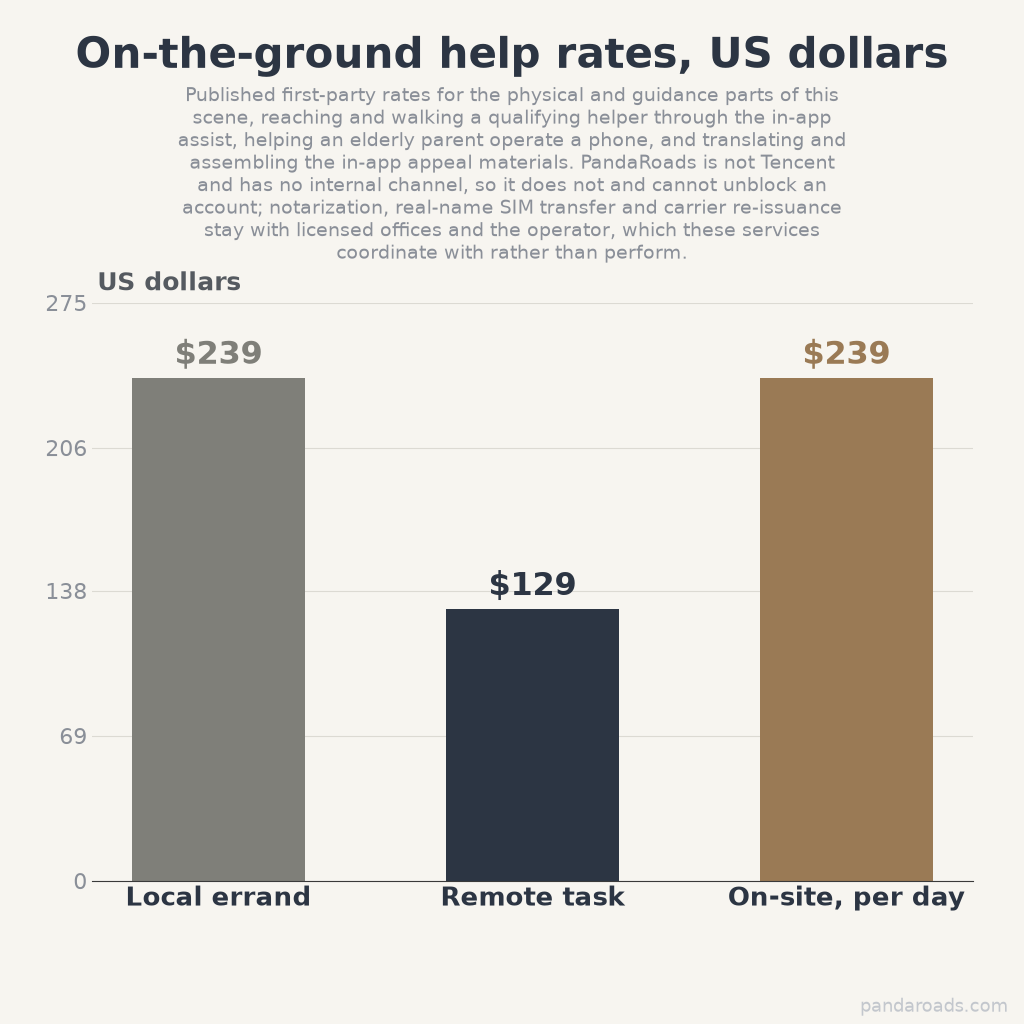
Note: Compare that fixed-fee model to the 20 to 60 yuan, ask-for-your-code offers circulating online, which charge a cut of the risk they create rather than the small, honest work of handling a helper well (source: xinhuanet.com). What you are buying here is not a switch, it is a qualified assist executed correctly and a submission that reads as if a Chinese speaker wrote it.
Frequently asked questions
How do I recover a WeChat account that is locked while I am in the United States? First read the exact on-screen message to tell a short-term restriction from a permanent one, since only the short-term kind can be self-unblocked (source: xinhuanet.com). Then run either an in-app assist through a qualifying helper or, failing that, the in-app appeal to Tencent. You do not need to be in China to start either one.
Can I get a WeChat verification code without my Chinese phone number? Not through the SMS path if the +86 number is gone. Codes land on the line, and a cancelled or recycled number routes them elsewhere. The routes that do not depend on receiving a code are a qualifying friend or non-friend assist inside the app and the appeal flow (source: weixin110.qq.com) (source: weixin.qq.com).
What is WeChat friend assistance and who can help me? It is a verification where another WeChat account confirms you are a real user so the restriction lifts. The helper does not have to be your contact; they need an account registered over six months, in normal use, bank-card bound, and inside the 1 per month, 2 per six months, 3 per year assist limits (source: weixin110.qq.com).
My Chinese SIM was cancelled for non-payment, can I get the number back? Sometimes only briefly. Carriers can suspend around 30 days after non-payment and cancel about 60 days after that, then must hold a minimum 90-day freeze, and China Mobile auto-cancels after roughly 120 days before recycling the number (source: app.xinhuanet.com). After it is released to a new subscriber, it is no longer yours to receive codes on.
How long until an unpaid Chinese mobile number is recycled by the carrier? A useful planning figure is that a China Mobile line left unpaid or unused can be auto-cancelled after about 120 days, then sits through roughly a six-month park before being resold, with a minimum 90-day freeze applying under the general rules (source: app.xinhuanet.com). Treat a years-dormant number as already gone until a China-side check proves otherwise.
Is there an offline Tencent office in Shenzhen that can unblock my WeChat? No. Tencent's published channels are AI-assisted chat, phone lines labeled for Mainland China, and official accounts, and the Shenzhen Anti-Fraud Department address is for reporting fraud, not a walk-in unblock counter (source: tencent.com). There is no advertised in-person window to unlock an account.
Are paid WeChat unblock services a scam? WeChat and Xinhua both say avoid them. Listings charged about 20 to 60 yuan, WeChat warns it risks your data and money and can get the helper banned, and the fabricated-friend and third-party-platform methods those services use are grounds for a re-block or permanent ban (source: xinhuanet.com) (source: weixin.qq.com). A guaranteed unblock promise is the red flag.
How do I appeal a WeChat account restriction from the app? Use the client's own prompts to dispute the result and submit proof materials to Tencent, which is the channel the account rules name for complaints and appeals (source: weixin.qq.com). An appeal is a review request, not a guarantee, and it does not turn a permanent restriction into a self-service unblock.
The bottom line
Two facts decide almost everything here. A locked WeChat from the United States is usually a phone-number and helper problem, not a password problem, and the SMS code you keep being told to wait for may be permanently unreachable because a dormant +86 number gets cancelled, frozen and recycled to a stranger. Once you accept those, the map is short: identify whether your block is short-term or permanent, check whether the number still resolves, then run a qualifying in-app assist or the in-app appeal, and stop there. Everything else, the walk-in office, the helpful phone call, the fixer with a back door, is a door that does not exist or a scam wearing its clothes (source: tencent.com) (source: finance.sina.cn) (source: xinhuanet.com).
If you work the sequence and still hit a wall, the practical next move is not a code, it is a person. Send the exact on-screen wording and the status of the +86 number, and you can get an itemized quote against the published per-request and day rates for the only parts a runner can honestly help with, guiding a qualifying helper through the assist, helping a parent work their phone, and translating the appeal into something you can file (source: pandaroads.com). To say it one last time so there is no confusion: this is on-the-ground coordination, not a guaranteed unblock, and not Tencent support. The account lifts or it does not inside WeChat's own review; what help changes is whether you run the real routes cleanly and in the right order.
References
- Tencent WeChat. (n.d.). 自助解封 [Self-unblock: helper-assisted verification]. WeChat Security Center. Retrieved 2026-09-30 from https://weixin110.qq.com/security/readtemplate?t=self_deblock/w_friend_info
- Tencent WeChat. (n.d.). 关于辅助注册的常见问题 [FAQ on assist registration]. WeChat Support. Retrieved 2026-09-30 from https://support.weixin.qq.com/cgi-bin/mmsupportacctnodeweb-bin/pages/7FSA3XvMmbH91RvA
- Tencent WeChat. (n.d.). 微信个人账号使用规范 [WeChat Personal Account Usage Norms]. WeChat. Retrieved 2026-09-30 from https://weixin.qq.com/readtemplate?&t=page/agreement/personal_account&lang=zh_CN
- Xinhua Net (via Beijing Youth Daily). (2017, December 3). 违规微商账号“解封”成生意:价格20到60元不等 [Unblocking violating micro-business WeChat accounts becomes a business: prices from 20 to 60 yuan]. Xinhua Net. http://www.xinhuanet.com/politics/2017-12/03/c_1122048750.htm
- Xinhua Net Client (via Yangcheng Evening News). (2024, April 21). “二次放号”引热议,我们还能换手机号吗? [Recycled-number reassignment sparks debate: can we still change our phone number?]. Xinhua Net Client. https://app.xinhuanet.com/news/article.html?articleId=b34745ef-3bdb-467d-9080-11782d09456a
- Shangguan News via Sina Finance. (2026, April 23). 有海外用户反馈接到自称“腾讯客服”或“微信安全中心客服”来电,微信官方提醒 [Overseas users report calls from self-styled Tencent or WeChat Security Center support; WeChat official warning]. Sina Finance. https://finance.sina.cn/2026-04-23/detail-inhvmrts3931647.d.html
- Tencent Holdings. (n.d.). Contact [Customer service and compliance channels]. Tencent. Retrieved 2026-09-30 from https://www.tencent.com/contact/
- PandaRoads. (2026). China sourcing and local task service from $129 [Service and pricing page]. PandaRoads. https://pandaroads.com/china-tasks.html
Last reviewed and updated: September 2026. Author: our editorial team. For tailored guidance, contact our team.