Can Someone in China Pick Up a Package for Me? Here Is How
A person in China can receive, hold and forward your parcel while you are abroad. Here is the three-leg method: name the failure, beat the courier and locker clocks, pay a local receiver from a foreign card, and prove it happened.
Last updated: October 2026 · By the PandaRoads team in China
TL;DR
Having a package picked up in China for you is three separate jobs, not one quick errand. In order: (1) identify which failure you face, because a parcel with no local address, a delivery the courier could not complete, a box sitting in a station or locker past its free window, and a supplier sample to re-ship are four different problems; (2) get the receiving leg done, which is a person presenting your tracking and collection code at a pickup point or locker, or taking a doorstep signature, under the express-delivery rule that the named recipient has the right to in-person receipt; (3) beat the holding clock, since a major courier stores an express parcel free for a set window from the first notification and community lockers charge a late fee after a short free collection period; (4) move the forwarding leg, a domestic transfer to a consolidation point then a cross-border ship; (5) fund a local receiver from abroad within the real limits of a foreign card; (6) demand proof: the tracking scan chain, a photo of the collection code and waybill, and an itemized receipt. This page is the single-scenario HOW for receiving, holding, and forwarding only; it does not cover buying the item for you, recovering a lost parcel, or bulk-import inspection.
Abstract
A bounded method for having a physical parcel inside mainland China taken in, held, collected, re-shipped, or returned when you are abroad and no one is at the delivery address. It separates the three legs of the job (receive, hold, forward), names the real courier and locker clocks you are racing, gives the payment path a foreign principal can actually use, sets the evidence standard that proves the work happened, and draws the honest legal line where a receiver cannot stand in for you.
Key Takeaways
- Name the failure first: no local address, an incomplete delivery, a parcel past its station or locker window, and a sample to re-ship need different fixes.
- The receiving leg is a person presenting your tracking number and collection code, or signing at the door, not a legal transfer of your identity.
- You are on a clock: a leading courier holds an express parcel free for a fixed number of days from the first notification, and lockers bill after a short free window.
- Forwarding is two hops: a domestic move to a consolidation point, then an international waybill out of the Chinese Mainland.
- A foreign card funds merchant charges only, roughly RMB 3,000 per Alipay and RMB 6,000 per WeChat Pay transaction, with a monthly ceiling, and cannot make person-to-person transfers.
- Judge the job by evidence: a tracking scan chain, a photographed collection code and waybill, and an itemized forwarding receipt.
- Customs declarations and signing for legally-noticed mail stay with the named recipient or a licensed broker, not a runner.
Table of Contents
- Abstract
- Key Takeaways
- What having someone pick up your package in China really involves
- Start here: identify which delivery failure you are facing
- The receiving leg: how a parcel gets taken in on your behalf
- The holding clocks you are racing
- The forwarding leg: getting the parcel re-shipped overseas
- Returns and refusals: sending a parcel back when you are not there
- Paying a local receiver from abroad without a Chinese bank card
- How to prove the pickup and forward actually happened
- Choosing who does it: managed service, freelance runner, forwarder warehouse, or your own contact
- The honest boundary: what a package receiver cannot legally stand in for
- Frequently asked questions
- The bottom line
- References
What having someone pick up your package in China really involves
You are in the United States. A parcel is physically inside mainland China, sitting at a courier station, waiting in a smart locker, or stuck because the driver could not reach the name on the waybill. The delivery system there assumes a person is standing at that door with a phone that buzzes when the courier calls, and you are twelve to fifteen time zones away, often with no mainland address, no Chinese phone number, and a waybill printed in characters you cannot read.
The honest first answer is yes, a person or a service on the ground can take that parcel in for you. The useful answer is that this is not one errand. It is three separable jobs with different rules, different deadlines, and different proof, and which one you need depends on which failure you are actually facing:
- Receiving: someone collects the parcel from a pickup point, a locker, or a doorstep handover, using your tracking number and the collection code.
- Holding: the parcel waits somewhere that enforces a clock, after which a storage fee accrues or the box quietly goes back to sender.
- Forwarding: the parcel moves on, either back to a Chinese seller or out of the country on an international waybill.
This page is the how-to for those three legs, and for the reverse flows that hang off them, a return or a refusal. It is not a catalog. The scene list for everything a person abroad can hand off lives in the hub, Getting things done in China from overseas. And it is not about buying the item in the first place. A parcel that already exists inside China is a different problem from one that still has to be purchased, and the buying leg has its own guide.
The people typing this question are not asking for a philosophy. A member of a Shanghai expat board, trying to move a box that was parked in a storage area, put the raw need plainly:
"Which leads me to the question: Is there any errand running service that is in English? I want to get someone to go to the storage area and put..." reddit r/shanghai, 2021-09 (source: reddit r/shanghai, 2021-09)
That ask is exactly the shape of the job: a reachable person, in a language you can work in, who goes to a specific spot and moves a specific box. What separates a finished job from an unanswered forum post is a method, and the method starts by naming which failure you have.
Start here: identify which delivery failure you are facing
Four distinct failures hide behind one query: no mainland address, a delivery the courier could not complete, a parcel already parked in a station or locker, and a supplier sample to forward. Naming the right one first matters because each runs a different clock, from roughly 18 hours for a community locker to about 7 days for a courier depot, and the fix differs for each.
One search query hides at least four different problems, and they are not solved the same way. Before you hire anyone or hand over a tracking number, work out which situation you are actually in, because each has a different fix, a different clock, and a different answer to the question of who is even allowed to touch the parcel.
The first situation is that you have no mainland address to ship to at all. The seller will only deliver inside China, or the checkout rejects your foreign address. Here the parcel has not moved yet; the problem is purely that the delivery system needs a domestic receiving point. The second is that a courier tried to deliver and could not reach the named recipient, so the parcel is undelivered and waiting, the driver left a notice, and the clock is already running. The third is that the box has already been parked, dropped into a community smart locker or left at a 驿站 pickup station, and a short free collection window is ticking down. The fourth is that a supplier or a factory sent a physical sample to a domestic Chinese address and you need that sample received, checked in, and forwarded to you overseas.
These pull in different directions. A no-address buyer mostly needs a receiving point plus a forwarding leg. A courier who could not reach the recipient needs someone to complete the collection the named person could not. A parcel already in a locker needs speed, because lockers bill and then clear out. A supplier sample needs the receive-and-forward chain wired together with proof of what actually arrived.
Four failures, and the leg that actually unblocks each
| Situation | What is really happening | The leg that solves it |
|---|---|---|
| No mainland address to ship to | The parcel has not been bought or booked; nothing is stuck yet | A receiving address, then the forwarding leg |
| Courier could not reach the recipient | A live delivery is undelivered and the hold clock is running | The receiving leg, fast, before it is returned |
| Parcel sitting in a locker or station | It is already parked and a short free window is burning | The holding clock, then a same-day collection |
| Supplier sample landed domestically | A box exists at a Chinese address with no one to receive or send it on | Receive, verify, then the forwarding leg |
The mistake that costs the most is treating these as one generic "have someone grab my package" task. If you hire a collector for a parcel that has not been shipped yet, you pay for errand legs there is nothing to run. If you set up a forwarding address for a box already in a locker with hours to spare, the free window can close while you are still comparing options. Name the failure first. The rest of this guide is the mechanics for each one: the receiving rules, the holding clocks, the forwarding and return paths, the way to fund a receiver from abroad, and the evidence that tells you it was actually done. For the buyer whose real blocker is that the item still has to be purchased before anything can be received, that is a separate task covered in having someone buy and ship an item for you, not the receiving method here.
The receiving leg: how a parcel gets taken in on your behalf
Three channels take a parcel in for an absent owner in mainland China: a community pickup station that releases the box against a collection code, a smart locker with a free collection window of about 18 hours, and a doorstep handover needing a signature. Handing a person your tracking number and code lets them physically collect the parcel, yet it never transfers your own right to in-person receipt.
The receive step has one job: get the box off the courier's hands and into someone's, when the named recipient cannot be the one standing there. On the ground in mainland China that happens through three channels, and knowing which one your parcel is in decides what you have to hand over.
The first channel is the 驿站 community pickup station, a shop or kiosk that accepts parcels for the neighborhood. When a courier cannot complete a door delivery, or when you asked for station drop-off, the parcel lands there and the system sends a collection code (取件码) to the recipient's phone. Someone physically goes to that station, states the code or the tracking number and the last few digits, and walks out with the box. The second channel is the smart locker, a bank of numbered compartments in a lobby or on a curb, opened by the same style of code. The third is a true doorstep handover that needs a signature, where a courier expects a person to take the parcel and sign.
What makes any of these work for an absent owner is that you pass the receiver exactly what the station or locker requires: the waybill or tracking number, the collection code, the last digits of the recipient phone, and the identity-tail number the courier system appends. Handing those over lets a person collect a parcel addressed to you. It does not turn them into you. Collecting a parcel with your code is a physical act of receipt; it is not a legal transfer of your identity, and it does not authorize that person to sign for something that the system requires the named recipient to sign for in person.
That distinction is not a technicality, it is codified. Under China's Provisional Regulations on Express Delivery, the named recipient has the right to in-person receipt, and a courier may not deposit a parcel into a smart locker or a station without the recipient's consent (source: chinadaily.com.cn). Practically that cuts both ways for you. It means a delivery dumped in a locker against your wishes was mishandled and you can push it back, and it also means some parcels are, by rule, yours to receive and cannot simply be claimed by anyone with a code. Knowing which of your packages carries that in-person requirement is the first thing to establish with whoever is acting for you.
The collection code arrives on a phone you may not hold in the country. The apps that surface those notices, and how a foreign user installs and reads them, are set out in the China apps install and download guide. Once the box is physically taken in, the next problem is the clock it has been running against, which is the subject of the next section.
The holding clocks you are racing
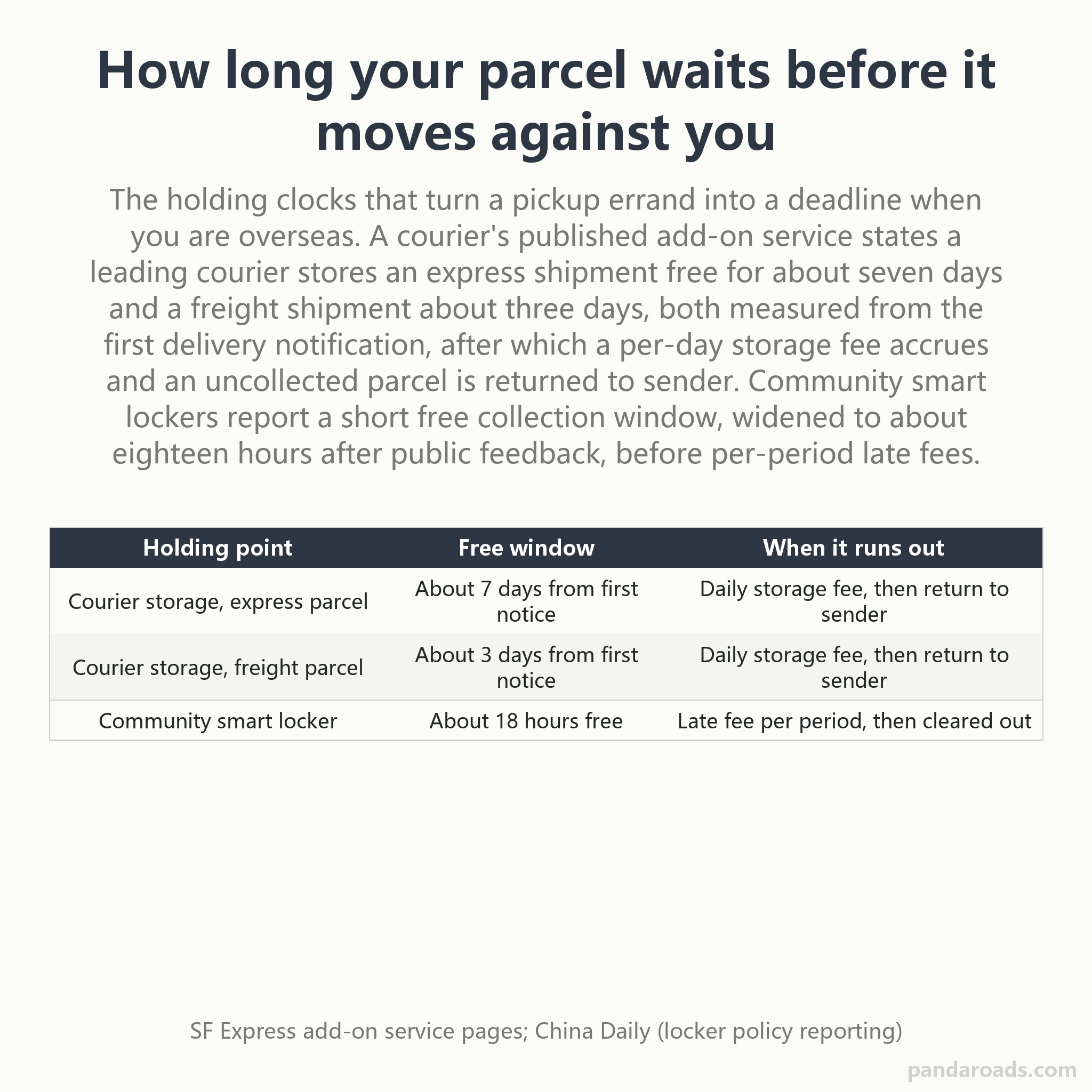
Two clocks govern a parcel waiting inside China. A leading courier stores an express shipment free for 7 days from the first delivery notification and a freight consignment for about 3 days, after which a per-day fee accrues until the box is collected or returned. A community smart locker is harsher, allowing roughly 18 hours free before a small late fee turns the clock against you.
Every parcel that is waiting for someone inside China is also counting down. This is the part a person abroad most often gets wrong, because the clock is invisible from another country and, when it expires, the parcel does not call you first, it moves against you. Two clocks matter: a courier's free-storage window and a smart locker's free-collection window.
The courier clock is published. SF Express, a leading mainland carrier, documents that an express shipment is stored free for 7 days measured from the first delivery notification, while freight consignments get a shorter window of about 3 days, and after the free period a per-day storage fee accrues until the parcel is collected or is returned to the sender (source: sf-express.com). The starting point is the notification, not the moment you happened to read it, so a notice that landed on a phone you never checked can quietly spend the whole window.
The locker clock is shorter and harsher. Community smart lockers, the dominant being the 丰巢 Hive Box network, originally allowed only a brief free collection period before charging a small late fee per block of time, and after public complaints about parcels being cleared out that free window was extended to about 18 hours (source: chinadaily.com.cn). Eighteen hours is not a comfortable margin when you are asleep through a fifteen-hour time difference and the code went to a number you rarely check.
The two clocks, side by side
| Where the parcel waits | Free window | What happens when it ends |
|---|---|---|
| Courier depot, express shipment | About 7 days from the first notification | Per-day storage fee, then return to sender |
| Courier depot, freight consignment | About 3 days from the first notification | Per-day storage fee, then return to sender |
| Community smart locker | About 18 hours | Small late fee per period, then cleared out |
The operational conclusion is simple and it is the reason to have a receiver lined up before the parcel ships rather than after: you are not managing a queue, you are managing a deadline. If you know a delivery is coming and no one is at the address, arrange the collection inside those windows, and treat a locker notification as same-day urgent rather than something to handle when you get back from work. A carrier's own redirect and return services, which are how you change what happens to a parcel already in the system, are explained in sending a parcel with SF Express and are the subject of the forwarding section below.
The forwarding leg: getting the parcel re-shipped overseas
Leaving China takes two hops. The domestic hop uses the carrier's published redirect fees: about RMB 2 per piece at a service point, RMB 5 plus RMB 0.2 per kilogram for a door-to-door redirect, and RMB 10 for the first kilogram plus RMB 1 per extra kilogram across different administrative regions. The second hop is a fresh international waybill out of the Chinese Mainland priced by destination and weight.
Once the box is taken in, the question for a person abroad is usually how it reaches you. A parcel cannot simply cross a border on the domestic waybill it arrived on. Leaving China is a second, separate shipment, and when you have no mainland address the practical route is two hops: a domestic move that gets the parcel to a place able to export it, then a cross-border waybill out of the Chinese Mainland.
The first hop is domestic. If the parcel is already inside the mainland courier system and you need it sent somewhere other than the original address, the carrier sells redirect and return services at published fees. SF Express prices these per piece or by weight: a redirect at a service point runs about RMB 2 per piece, a door-to-door redirect about RMB 5 plus RMB 0.2 per kilogram, a redirect that crosses different administrative regions about RMB 10 for the first kilogram plus RMB 1 for each additional kilogram, and a cash-on-delivery shipment that has been redirected or returned two or more times picks up an extra RMB 2 per piece on top of the standard charge for each such return (source: sf-express.com). These are domestic moves within the Chinese Mainland, not international shipping; the carrier states the coverage in those terms.
The second hop is the cross-border one. The parcel now has to travel from the Chinese Mainland to your country on an international waybill, priced by destination, weight, and service level as a fresh charge, not a bolt-on to the domestic fee. A major carrier's international arm, SF International, runs that leg out of the mainland to overseas destinations (source: sf-international.com). There is no single honest number for this hop that fits every parcel, so a service that quotes it should show you the destination, the weight, the carrier, and the line-item cost rather than a vague flat rate.
Domestic redirect and return, as the carrier publishes it (SF Express)
| Action on a parcel already in the system | Published charge |
|---|---|
| Redirect to a new address at a service point | RMB 2 per piece |
| Redirect with door-to-door pickup | RMB 5, plus RMB 0.2 per kg |
| Redirect across different administrative regions | RMB 10 for the first kg, plus RMB 1 per extra kg |
| Redirect or return a cash-on-delivery shipment twice or more | Extra RMB 2 per piece, on top of the standard charge |
The real trade-off on this leg is not just money, it is risk. Both the redirect rules and the storage rules carry the same warning: each extra domestic hop is more handling, more days in the system, and more chance of a damaged or mis-sorted box, and the international leg adds its own transit time (source: sf-express.com). That is why a commercial forwarding warehouse that receives on its own address and consolidates before export, the model PandaRoads sells on its package receiving and forwarding page, exists: it collapses two hops and one point of handoff into a single controlled chain. The buyer who only needs the parcel sent back to the seller, rather than to them, faces the reverse flow, which is the next section.
Returns and refusals: sending a parcel back when you are not there
Three reverse flows run off the same receiving chain: a return to a Chinese seller with a return waybill, a refusal that declines the parcel before it enters your holding chain, and a re-delivery after a failed attempt. A refusal is cheapest precisely because you never take possession, but it must happen before the default flow drops the box where the 18-hour locker clock or the 7-day depot window begins.
The same receiving chain that brings a parcel to you can run in reverse, and a surprising share of the real requests are reverse requests: send this back, or I do not want it at all. Three distinct flows live here, and the mechanics differ from the forward path enough to be worth separating.
The first is a return to a Chinese seller. You received an item, or a sample, and it is wrong, defective, or simply not wanted, and it has to go back to the shop that sent it, inside the domestic system, with a return waybill and often a return authorization from the seller. A person or service acting for you initiates that return, drops the parcel with the courier, and hands back the return tracking. This is a common enough job that a receiving-and-forwarding service folds it into the same on-the-ground chain it already runs for the outbound direction.
The second is a refusal. A parcel arrives that you never want accepted, and the correct move is to decline it so the courier takes it back rather than letting it enter your holding chain and start a storage clock. Refusing is cheap and fast precisely because you never take possession. The catch is that a refusal must happen at the delivery attempt or shortly after, before the default flow drops it into a station or locker where the 18-hour or 7-day timers begin.
The third is a re-delivery after a failed attempt. The courier could not reach the named recipient, left a notice, and the parcel is now held and counting down. Someone collecting with your code, or instructing the carrier to re-attempt to a different point, closes this loop before the depot returns the box to the sender.
It is worth being blunt about what is out of scope here. None of these is a lost-parcel claim. If a package has genuinely gone missing inside the network and you are chasing it down and having a recovered item mailed to you, that is a different job with different evidence, handled in recovering a lost item in China and mailing it abroad. A return, a refusal, and a re-delivery all assume the parcel physically exists and is sitting somewhere addressable, which is the whole premise of this guide.
Paying a local receiver from abroad without a Chinese bank card
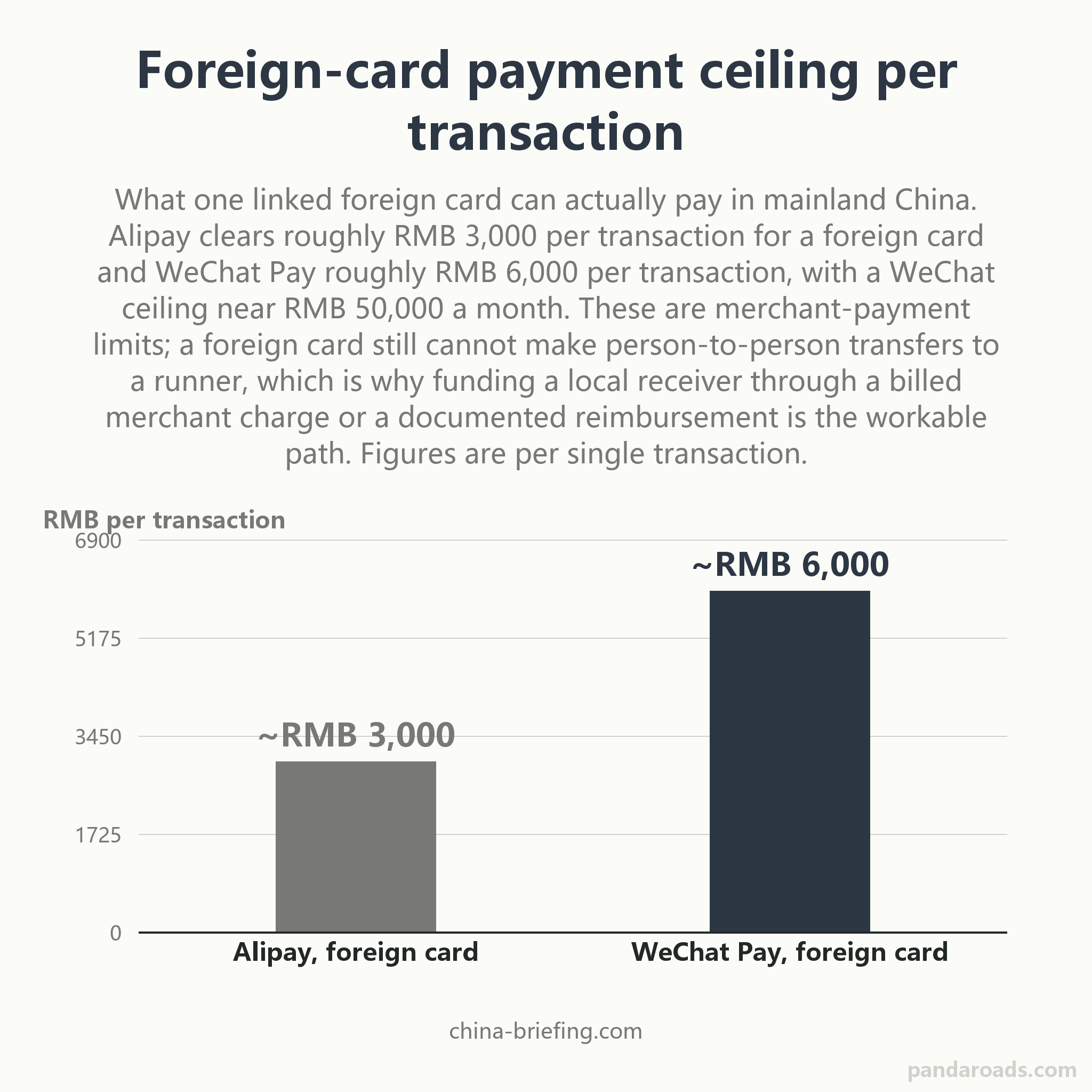
A foreign Visa or Mastercard linked into Alipay or WeChat Pay is cleared for merchant charges only and is explicitly blocked from red packets and person-to-person transfers, the exact move needed to fund an individual runner. The per-transaction ceilings are small, roughly RMB 3,000 on Alipay and RMB 6,000 on WeChat Pay with a monthly limit near RMB 50,000, and a 3 percent fee applies above RMB 200.
The wall that stops most absent owners is not the language on the waybill, it is money movement. The instinct, wire the person who grabs my box a few hundred renminbi through Alipay or WeChat, is the one move the system will not let a foreign card make.
The rule is specific. A foreign Visa or Mastercard linked into those wallets is cleared for merchant payments only, and it is explicitly blocked from red packets and direct person-to-person transfers, which is precisely how you would push money to an individual runner (source: china-briefing.com). You cannot simply send a stranger money the way you would text a friend. The ceilings on the merchant payments it can make are also small: Alipay allows a maximum of roughly RMB 3,000 per single foreign-card transaction, while WeChat Pay allows up to roughly RMB 6,000 per transaction with a monthly cumulative limit near RMB 50,000, a fee under RMB 200 is waived and about a 3 percent fee applies above that threshold (source: china-briefing.com). Those are per-transaction merchant limits, not a way to fund someone else's cash flow on your errand.
So the funding has to route around that. In practice a US principal pays for a receiving-and-forwarding job three ways.
Funding a local receiver from a foreign card
| Path | What it can actually fund | Foreign-card reality |
|---|---|---|
| Wallet transfer to the runner (Alipay or WeChat) | Cash to an individual | Blocked, foreign cards clear merchants only |
| Merchant checkout on a service platform | The platform's own fixed task fee | Works, it is a merchant charge billed in USD |
| The receiver fronts the local spend | The on-the-ground RMB cost, repaid later | Works, repaid inside the billed fee with receipts |
The route most absent buyers land on is the middle and third rows together. You pay a flat, itemized service fee through a platform's normal card checkout, in US dollars, which a foreign card clears without trouble because it reads as a merchant charge (source: pandaroads.com). The underlying renminbi spend, the redirect fee, the courier leg, the return postage, is fronted by the party on the ground and settled inside that same billed fee with the receipts returned to you, so no foreign card ever has to reach a domestic wallet directly. For a genuinely large sum, the honest answer is the same as for any other cross-border payment: a slow, documented bank transfer beats a fast transfer you are not permitted to make.
How to prove the pickup and forward actually happened
The deliverable is an evidence file, not a done message. Its strongest single item is a photograph of the collection code and waybill taken together at the station, and its spine is the carrier's timestamped tracking scan chain, ending in an itemized forwarding receipt that carries the new international tracking number for an outbound leg often quoted at roughly 3 to 7 days to the United States.
From twelve time zones away you cannot watch someone walk to a station, so the deliverable is not a message that says it is done. It is an evidence file you can read in another country and act on. This is where a paid, scoped arrangement earns its fee and where an informal private hand-off usually falls short, not because the other party is careless but because nothing in the process forced a record.
Four artifacts make the job verifiable, and the right move is to agree them before money changes hands, not after a problem.
- The tracking scan chain. Every real movement of a parcel leaves a timestamped scan in the carrier system, inbound, out for delivery, collected, re-booked on an international waybill. That chain is the spine; a claim that cannot be tied to it is just a claim.
- A photograph of the collection code and the waybill together at the station or locker. This proves the specific box was handled at the specific point, and it is the single cheapest, strongest piece of evidence in the whole chain.
- A dated proof of receipt or handover, the station sign-out, the courier confirmation, or a photo of the parcel checked in at a receiving address.
- An itemized forwarding receipt carrying the new international tracking number, so the outbound hop is on record and traceable to your door.
A legitimate service hands these back as the deliverable, in a language you can read, naming what was collected, from where, on what date, and the waybill it went out on. That returned record, not a chat bubble, is what you can dispute an insurance claim against, chase a stuck forwarding leg with, or reuse the next time. The written standard a proper task report should meet is defined in China task report standards.
The risk with a purely private arrangement is not distrust, it is structure: a hand-off done in good faith can still leave you holding nothing but a text message when a parcel is later declared damaged or never forwarded. Ask one question of whoever is acting for you, and let it decide your choice. When this is finished, what exactly will you be able to see, from here, with my own eyes and no re-explanation. If the honest answer is a screenshot of a code and a tracking number that keeps updating, you have a working arrangement. If it is a promise to let you know when it is sorted, you have a gap.
Choosing who does it: managed service, freelance runner, forwarder warehouse, or your own contact
A US buyer should choose the delegation mechanism like any vendor, on the evidence it hands back and the payment channel it can clear, not on sticker price. A foreign card funds a runner only as a merchant charge, up to roughly RMB 6,000 per WeChat Pay transaction, and cannot make the person-to-person transfer an informal private contact would need.
Once you know which failure you have and what proof you need, the delegation itself is a procurement decision, and a US buyer makes it the same way they would choose any vendor: match the mechanism to the legs the job actually requires, then weigh what each hands back as evidence, how a foreign principal pays it, and where its legal ceiling sits. There are four realistic mechanisms for a parcel inside mainland China.
A managed done-for-you service runs the whole chain, a person collects or receives on the ground, the parcel is checked in and photographed, and it is forwarded or returned on a waybill, with an itemized report and the tracking evidence as the standard output. A freelance individual found on a task board or a city board is cheaper and looser, good for one simple station pickup you can describe exactly, weak on what happens when the parcel is damaged or the code fails. A commercial forwarding warehouse does not chase a courier for you; it gives you its own mainland address to ship to, receives anything that arrives for you, holds briefly, and exports, which is the cleanest fit when your real blocker is that you have no domestic address at all. A personal contact you arrange privately can clear a single physical step, but it carries no service-level standard and no paper trail, and the payment friction of the previous section lands squarely on them.
Four delegation mechanisms for one parcel
| Mechanism | Legs it clears | Proof it hands back | How a foreign principal pays | Real ceiling |
|---|---|---|---|---|
| Managed done-for-you service | Receive, hold, forward, return | Tracking chain plus photos and report | Flat USD merchant charge | Not licensed customs or legal acts |
| Freelance individual | One pickup or drop | Whatever they choose to send | Small fee or reimbursement | No standard, thin trail |
| Forwarding warehouse | Receive on its address, hold, export | Inbound photo plus outbound waybill | Service fee plus courier cost | Only what ships to its address |
| A private contact you arrange | A single physical step | A message | You cover the cost | No proof, all risk on you |
The dimension that decides most cases is the proof column. A private contact may move faster than any warehouse on a single errand, and can still hand you nothing when the station refused the box for want of one detail, or the forward leg quietly stalled. A managed service is the option whose normal output is exactly the evidence file the previous section says you need (source: pandaroads.com). Weigh who can physically do the step against who can prove it was done and take the money through a channel a foreign card is actually allowed to use, and pick on those, not on sticker price.
When the blocker is that you have no mainland address at all, the forwarding-warehouse model, receiving on a service's own address and exporting on one controlled chain, is laid out in detail on the package receiving and forwarding page.
The honest boundary: what a package receiver cannot legally stand in for
A service that receives and forwards parcels should also be the one that tells you plainly what it is not. The receiving, holding, and forwarding legs in this guide are all physical and logistical acts: taking a box into custody with your code, holding it against the carrier's clock, re-booking it onto a waybill, photographing proof. A runner or a managed service can do those. Three things sit on the other side of a line, and a good one says so instead of promising to handle anything.
The first is the customs declaration on a cross-border shipment. Once a parcel leaves the Chinese Mainland toward your country, it crosses a customs border, and the declared contents, value, and category carry legal weight. A receiving and forwarding party prepares the box and the waybill, but the declaration itself is a regulated act, and mis-declaring to push a parcel through is a risk that lands on the named parties, not on the person who slapped a label on it.
The second is taking possession of another person's postal items in contexts where the law reserves them to the addressee. Collecting a parcel with a code you were given is ordinary. Intermediating mail that a system requires the actual recipient to receive is not, and it runs into the same in-person-receipt right under the express-delivery regulations described earlier (source: chinadaily.com.cn).
The third is signing for legally noticed or judicial mail. Court papers, official notices, and items the carrier must have the named recipient sign for cannot be absorbed by whoever happens to be holding a collection code. That belongs to the named party or to a licensed representative.
This is the candor a serious operator publishes rather than hides, and PandaRoads states its own limits in one place on its what we do not do page. It is also the point where this article stays in its lane. If the real job is not to receive a parcel that exists but to source and purchase one that does not yet, that is a different service, having someone buy and ship an item for you, not the receiving method described here.
Frequently asked questions
Can someone in China pick up a package for me if I am overseas? Yes, for a parcel that physically exists and is addressable. A person or a service can collect from a pickup station or locker, or take a handover, using your tracking number and collection code, and then hold, forward, or return it, subject to the limits on signing for items reserved to the named recipient (source: sf-express.com).
How do I receive a package in China without a local address? You need a domestic receiving point. Either arrange a collector for a parcel already inside the courier system, or use a forwarding warehouse that gives you its own mainland address to ship to and exports on a single chain, as explained on the package receiving and forwarding page.
What happens to a China delivery if nobody is there to sign for it? It does not vanish quietly. A courier typically leaves a notice and holds the parcel, then either drops it at a 驿站 station or a smart locker, or returns it to the sender after a fixed window, so the absent person must arrange collection inside that clock (source: sf-express.com).
Can a courier leave a parcel at a pickup point and someone collect it for me? Yes, a station handover is designed for it. The station issues a collection code, and anyone you give that code and the tracking details to can collect the parcel, provided it is not one the regulations reserve for in-person receipt by the named recipient (source: chinadaily.com.cn).
How long does a Chinese courier hold a package before returning it to sender? A leading carrier stores an express shipment free for about 7 days from the first delivery notification and a freight consignment for about 3 days, after which a per-day storage fee accrues and an uncollected parcel is returned to sender (source: sf-express.com).
Can someone collect my parcel from a locker in China? Yes, if they have the code, but the window is short. Community lockers allow roughly an 18-hour free collection period before a small late fee applies and the parcel is cleared out, so a locker notice is a same-day task across a large time difference (source: chinadaily.com.cn).
Can I have a supplier sample received in China and forwarded to the US? That is the receive-then-forward chain. Someone collects or receives the sample, photographs it on arrival so you see what actually came, then books it onto an international waybill out of the mainland, with the cross-border cost quoted by destination and weight as a separate charge (source: sf-international.com).
How do I get a package in China re-shipped overseas? In two hops: a domestic redirect or transfer to a place able to export it, priced at the carrier's published redirect fee, then an international waybill on the carrier's overseas arm such as SF International (source: sf-express.com).
Can someone return a package to a Chinese seller on my behalf? Yes, that is the reverse leg of the same on-the-ground chain. A receiver initiates the return, drops the parcel with the courier, and hands back the return tracking, while a refusal or a re-delivery after a failed attempt follow the same clock (source: sf-express.com).
How do I pay someone in China to receive and forward a package? Not wallet to wallet, since a foreign card is blocked from person-to-person transfers. Pay a flat, itemized service fee through a platform's merchant checkout in USD, and let the local renminbi spend be fronted and reimbursed inside it with receipts (source: china-briefing.com).
The bottom line
Someone in China can pick up a package for you while you are overseas, but the answer that actually protects you is that this is a method with three legs, not a single errand you hand to whoever is nearby. So run it as a decision, in order. Name the failure precisely: no mainland address, an incomplete delivery, a parcel past a station or locker window, or a sample to receive and send on, because each starts a different clock. Respect the holding windows, an express parcel waits about 7 days and a locker roughly 18 hours before it moves against you. Choose the delegation mechanism the way you would pick any vendor, on the evidence it hands back and the payment channel it can clear, not on a sticker price. Fund it within the foreign-card reality, a merchant charge you can pay and a local spend fronted and reimbursed, never a blocked wallet transfer. And verify with proof: the tracking chain, a photo of the code and waybill, and an itemized forwarding receipt.
Where the job crosses into a customs declaration or a signature the named recipient must give, no receiver can honestly stand in for you, and the right thing to do is hire one that says so. For the specific scene you landed on, and the rest of the on-the-ground tasks you can hand to a scoped service, the map is in Getting things done in China from overseas.
References
- SF Express. (2024). Shipment storage service [Value-added service page]. SF Express. https://www.sf-express.com/chn/en/express/add-service/keep
- SF Express. (2024). Return/Redirect [Value-added service page]. SF Express. https://www.sf-express.com/chn/en/express/add-service/return-back
- Zhang, K. (2020, May 18). Package locker operator Hive Box adjusts policy after storage fee outcry. China Daily. http://www.chinadaily.com.cn/a/202005/18/WS5ec1df3ca310a8b241156520.html
- China Briefing. (2023, July 24). WeChat enables foreigners to pay with overseas cards in China. China Briefing. https://www.china-briefing.com/news/wechat-enables-foreigners-to-pay-with-overseas-cards-in-china/
- SF International. (2026). Global shipping services [Service landing page]. SF International. https://www.sf-international.com/cn/en
- PandaRoads. (2026). China package receiving & forwarding [Service page]. PandaRoads. https://pandaroads.com/china-package-forwarding.html
Last reviewed and updated: October 2026. Author: our editorial team. For tailored guidance, contact our team.