Get a Lost Item in China Mailed Back to You, From Abroad
A plain guide for a US-based traveler who already flew home and left something in China. What happens to a forgotten item at an airport, on a high-speed train, in a hotel or in a ride, the two gates that decide the outcome (a venue releasing it to a third party, and clearing the lithium and customs rules to get it on a plane out), and how a local runner plus an international courier brings it back for a fixed, pre-approved fee.
Last updated: September 2026 · By the PandaRoads team in China
TL;DR
You can usually get a forgotten personal item picked up in China and mailed to you even after you have flown home, but the two hard gates are not the grab: they are getting the airport office, hotel, railway lost-and-found or driver to release the item to a third party, and clearing the courier rules, a loose lithium battery or power bank or a vape may not simply fly. The reliable route is to authorize a local runner with your booking details, have them collect and hand the item to an international courier, and budget for the shipping plus a US customs entry, since the 800 dollar duty-free de minimis exemption ended for China in 2025 (PandaRoads Local Errand pickup from US$239, remote request US$129, on-site day US$239, plus the courier and duty you approve up front).
Abstract
A plain-English guide for a traveler who has already flown home from China and realized a personal item was left at the airport, on the high-speed train, in a hotel room or in a ride: what happens to the thing you leave behind, the four real pickup points and how each one releases property to someone who is not you, the lithium-battery and vape rules that decide whether the item can legally leave China, the true cost to courier a small parcel and the post-2025 US customs reality, and an honest list of what nobody can hand back.
Key Takeaways
- The grab is easy; the release and the shipping rules are the hard part
- Four pickup points, four different ways to hand the item to someone else
- A loose lithium battery, power bank or vape may not fly at all
- You cannot simply pay the in-country costs from a foreign card
- US duty-free de minimis ended for China in 2025, expect a customs bill
- Authorize a runner with your booking reference, not your passport photo
- Some things nobody can hand back, and we say which
Table of Contents
- Abstract
- Key Takeaways
- The problem: you already flew home and something did not
- What actually happens to a thing you leave behind in China
- The four pickup points, and how each one lets someone else claim it
- Can you chase it yourself from the US, and where that stalls
- Authorizing a pickup: what the runner needs and what the venue needs
- The part everyone forgets: can the item legally leave China?
- What it costs to ship it, and the customs bill nobody expects
- How a pickup-and-mail runs, step by step
- What nobody can hand back: the honest limits
- Frequently asked questions
- The bottom line
- References
The problem: you already flew home and something did not
You are back in Los Angeles, your bag is on the floor by the door, and it hits you somewhere between the jet lag and the first shower. The drawing tablet is still in the Guangzhou hotel room you left two days ago. Or the reading glasses are in the seat-back pocket on the Beijing-to-Shanghai train. Or the AirPods case slid into a security tray at Pudong that emptied the wrong way, and you never saw which bin it went into. Nobody stole anything. You simply left a thing in a country you are no longer standing in.
This is a real, common ask, posted almost in those words in travel forums. One traveler, already home, wrote: "Is there anyone who could pick the item up for me and send it to my address in Germany? I can send you all the details in a DM and will of course compensate." That sentence is the whole job. Someone has to stand where you are not, in a language you may not read, at a counter you cannot phone from a US number, and ask for your thing back. Then someone has to get it on a plane, which is its own problem if the thing has a battery in it.
The honest picture is better than you fear and harder than the forum reply suggests. Most forgotten personal items are recoverable from abroad, and the reason they fail is almost never the grab. It is the two gates after the grab. The first is release, whether the airport office, the hotel, the railway lost-and-found or the driver will hand your property to a person who is not you. The second is export, whether the thing is even allowed to leave China, which turns on lithium watt-hours and a short list of categories.
This article is about getting a forgotten personal item back from those four places and mailed to your door. It is not about paperwork stuck at a registrar or a notary, which is a different problem with a different path. And it is not an insurance claim form. It is about the physical object, the desk that holds it, and the courier that brings it home.
What actually happens to a thing you leave behind in China
Every Chinese lost item lands with a specific holder, not on the empty seat. At an airport it moves to that terminal's lost-and-found or the operating airline, on a railway it goes to the China Railway lost-and-found reachable through the 12306 website or app, in a hotel to housekeeping then the front-desk log, and in a ride to the driver or the app's trip support.
Before you can get an item back, it helps to know where it went, because a lost thing in China does not sit on the seat waiting for you. It moves to whoever controls the space, and each holder runs its own counter.
At an airport, an item left in a security bin or found in a terminal goes to that airport's lost-and-found, or, if it was recovered on the aircraft, to the operating airline's office. China's airports are connected through an industry lost-property network you can search by airport, date and item category, which is the systematic first stop most travelers never learn about. At a railway station or on a train, the item is handed to the railway's own lost-and-found. China Railway states plainly that passengers can search for lost goods online through the 12306 website or mobile app, or by customer-service telephone, and that a passenger who lost something during the trip can fill in a service form describing where and what, after which the crew run the search and report back (source: china-railway.com.cn). In a hotel, a found item usually goes first to housekeeping and then to the front desk or lost-property log under your stay record. In a ride, it is either with the driver or routed back through the app's trip support.
Two things decide the outcome, and they decide it fast. Speed matters because storage windows are finite. An unclaimed valuables desk does not hold a phone forever; after a set period, unclaimed items are disposed of or, for some categories, turned over or auctioned. Precision matters because the desk can only return what it can match. "I lost a bag" loses to "black soft-shell roller bag, Didi receipt timestamp 19:40, seat row 23, a blue lanyard clipped to the handle." A date, a location, a distinguishing mark, and the booking or order reference are what let a stranger find your thing in a room full of found things.
Here is the thread that ties all four scenes together, and it is worth holding onto for the rest of this guide. Whatever the holder, your item has to clear the same two gates. It has to be released to someone, and it has to be allowed out of the country. The next section takes the gates one pickup point at a time.
The four pickup points, and how each one lets someone else claim it
Four pickup points release differently. Shanghai Airport's lost-and-found desk at Pudong lists service hours 06:00 to 24:00 and the number 021-68340096, while a hotel follows its own policy and a high-speed train routes losses through the 12306 lost-item search. What every desk wants is your booking reference plus a written authorization naming the collector.
People rarely lose a thing "in China." They lose it in one of four specific places, and each place holds it differently and releases it on different terms. Here is the map before you contact anyone.
| Pickup point | Who holds it now | What it takes to claim through a third party | Typical pace |
|---|---|---|---|
| Airport security bin or terminal (Pudong PVG, Beijing Capital PEK, Guangzhou Baiyun CAN, Hangzhou Xiaoshan HGH) | The airport lost-and-found, or the operating airline if it was found on the plane | Your flight or booking details plus a written authorization naming the collector; Shanghai Airport's desk publishes a service email and phone (lostandfound@shairport.com, 021-68340096, open 06:00 to 24:00) (source: avinex.com) | Fast to log, slower to release; hours matter |
| Hotel room or front desk | Housekeeping, then the front desk lost-property log under your stay | The booking name and dates, the property's willingness to hand to a named person, and sometimes a signed release or a card on file for the return shipping | Depends entirely on the individual property |
| High-speed train seat or seat-back pocket | The railway lost-and-found at the arrival or terminus station | A 12306 lost-item search or the hotline (dial 12306, press 2 for English) with the train number and seat; some offices will courier to a domestic address (source: china-railway.com.cn) | Systematic but paperwork-heavy |
| Ride-hailing back seat (Didi and similar) | The driver, or routed back through the app's trip support | The trip record plus the platform's or the driver's agreement to meet a collector or hand it over | Fastest if the driver is still holding it |
Read the third column as the constant across all four rows. Not one of these desks will hand your property to a stranger because you texted them a photo. Every one wants the same two ingredients, your reference that proves the thing was plausibly yours, and an authorization that names the person standing in front of them. That is why the practical question is rarely "can it be found," which it often can, and almost always "who is there to claim it with the right paperwork."
The airport row is the one people misjudge most. A large hub like Pudong, Beijing Capital, Guangzhou Baiyun or Hangzhou Xiaoshan is genuinely organized, and its lost-and-found is a real office with real hours and a real inbox, not a rumor. The catch is that a busy desk will match and store far more readily than it will release, especially internationally, so the item being "found" and the item being "in a courier van to Ohio" are two very different milestones, and the second is the one that needs a local person.
The hotel row is the softest and the strangest. A small independent property that remembers you may happily ship a charger to the card you paid with, no authorization drama at all. A branded chain with a strict policy may refuse to release anything to anyone but the guest, which is exactly the situation where a runner who can appear in person, with your ID copy and a signed release, is worth having.
Can you chase it yourself from the US, and where that stalls
A foreign card in China caps the small fees that block a remote release. Alipay limits a foreign card to about RMB 3,000 per transaction, WeChat Pay to about RMB 6,000 per transaction and RMB 50,000 a month, and WeChat waives the foreign-card fee under RMB 200 while charging 3 percent above it.
The first thing most people try is free, and it is worth doing in parallel with anything else, because it costs nothing and occasionally just works. Email the hotel with your stay dates. File the 12306 online lost-item search or call the hotline. Send the airport lost-and-found office a detailed description. Message the ride through the app's trip-support screen. Do all four the day you notice, while the trails are warm.
Then hit the three walls that stop almost everyone who is already abroad.
The phone wall. Several hotlines and web forms assume you are holding a Chinese mobile number, for the confirmation code or the callback. You are not. The 12306 English service exists, you dial the railway number and press for the English menu, but you are doing it at nine in the evening your time, which is the middle of the morning in Beijing, and you are navigating a queue in a system built for people physically at the station. It is doable. It is not fast.
The release wall. This is the real one. Even when the desk finds your item, most will not mail it to an unverified foreign address on your say-so. They will not hand it to whoever you happen to know in the city unless that person arrives with your references and a clear authorization. "Found" and "released to you" are different days, and the gap is a person, in the city, with paperwork.
The payment wall. Sometimes the hotel or the courier counter wants a small local fee, a shipping charge, a storage fee, a print-and-mail cost, before they release. Settling that from the US is harder than it sounds, because the two wallets that run everyday payments in China cap a foreign card hard. A foreign card on Alipay is limited to about RMB 3,000 per single transaction, and on WeChat Pay to about RMB 6,000 per transaction with an RMB 50,000 monthly cumulative ceiling; WeChat waives the foreign-card fee below RMB 200 and charges 3 percent above it (source: china-briefing.com). And plenty of counters still take a domestic transfer, a linked local wallet, or cash, not a US card at all. So the small in-country cost that stands between you and your jacket can be the very thing you cannot pay remotely.
None of this means the free route is pointless. Try it today. Just go in expecting that the last mile, a hand to collect and a way to pay the counter, is where a person who is already home usually needs local help.
Authorizing a pickup: what the runner needs and what the venue needs
A collection run stands on a five-part authorization packet: an item description and photo, the where-and-when filed the venue's way, the booking or order reference, a written authorization naming the collector, and a copy of the travel ID. PandaRoads quotes a Local Errand within 30 km at US$239 and approves larger cross-city jobs before the run.
Once you accept that a person in the city may have to collect the item, the job becomes concrete and unglamorous, and that is good, because concrete is what a busy desk responds to. The question is never "can someone go get it," it is "does the person standing there have the packet that makes saying yes easy."
Here is what you hand the collector, so they can hand it to the venue.
- A precise description of the item and, if you have one, a photo of it from your phone or your listing. Color, brand, a scratch, a keychain, anything that separates it from three identical items in the lost-property room.
- Where and when you left it, stated the way the venue files it. For a train, the train number and your seat. For a flight, the flight number, date and terminal, or the security-checkpoint time. For a hotel, the property name, your check-in and check-out dates, and the room number. For a ride, the date, the approximate time, and the pickup and drop points.
- The booking or order reference that proves the story, the ticket number, the reservation confirmation, the ride receipt ID.
- A short written authorization naming the specific person collecting on your behalf, with dates and the item described, which is the document a front desk or a station office can actually put in a file.
- A copy of the ID you traveled on, which many venues require to match the item to the claim.
Here is what the venue typically wants back from the collector, and it is the same list wearing different clothes: your authorization, the matching reference, the collector's own government ID, and, for anything high-value or for a passport, sometimes a police-report number or a signed release, because the local public-security bureau or the loss point's office sets those rules rather than the counter clerk.
Warning: Be clear-eyed about one thing, release is at the venue's discretion. A good runner does not bluff a determined "no." They show up with the paperwork that removes the reasons to say it, and if a desk still will not release, they tell you that plainly instead of inventing a workaround that gets nobody's property back.
This is exactly the shape of errand a local service is built for. PandaRoads takes these collection runs, arrives with the authorization packet, and returns photos of the actual item and the receipt, on a Local Errand within 30 km at US$239, with cross-city or larger jobs quoted itemized and approved by you before the run (source: pandaroads.com).
The part everyone forgets: can the item legally leave China?
Battery size, measured in watt-hours, decides whether a recovered item can fly. Up to 100 watt-hours is generally allowed in the cabin, 100 to 160 watt-hours may need airline approval, and over 160 watt-hours cannot go on a passenger aircraft, while a loose power bank shipped by air needs UN 38.3 certification and dangerous-goods handling.
Here is the trap that turns a successful recovery into a failed one. You get the item back in someone's hands, and then you cannot post it, because international air transport treats a few everyday lost items as restricted or outright dangerous goods. Lithium batteries are the big one, and they are inside far more forgotten objects than people realize.
| Item | Can it fly out of China internationally? | The rule that decides it |
|---|---|---|
| A phone or laptop, battery installed | Usually yes | A small lithium cell installed in the device travels far more easily than the loose cell on its own (source: iata.org) |
| A loose power bank or spare lithium battery | Generally no by ordinary parcel | IATA keeps spare lithium batteries and power banks out of the aircraft hold, and carriers refuse loose cells in normal parcels; shipping them by air needs UN 38.3 certification and dangerous-goods handling (source: dhl.com) |
| An e-cigarette or vape | Restricted to disallowed | The lithium cell plus the liquid makes it one of the most-refused small items, and rules differ by carrier and destination (source: iata.org) |
| Clothing, books, keys, most non-battery effects | Yes | No dangerous-goods friction; these are the easy recoveries |
| Anything China's exit rules or your country's entry rules bar | No | Weapons, counterfeit goods, certain foods, plant and animal products and protected items are out regardless of sentimental value |
Read the watt-hour label, because that number is the whole decision for anything with a battery. Under 100 watt-hours is ordinary, a phone, a laptop, a pair of earbuds, a small power bank installed in a device. From 100 to 160 watt-hours needs carrier or airline approval, the territory of big camera batteries and some drone packs. Over 160 watt-hours generally cannot go on a passenger aircraft at all (source: iata.org). The reason a power bank is such a recurring heartbreak is that a fully-recovered 20,000 mAh battery pack is exactly the loose-lithium object the rules are built to catch, so people are often surprised that the desk found their charger and the courier still will not take it.
The practical rule a good runner applies is simple. A device with the battery inside is far safer to ship than the battery by itself, so if what you lost is a phone or a laptop, do not try to send a spare cell or a loose power bank alongside it in the same box, because that is what tips an ordinary parcel into dangerous-goods territory. Vapes and e-cigarettes are their own problem, cell plus liquid, refused by a lot of carriers and restricted at both ends. And no one, runner or courier, is going to talk their way past a prohibited category, a blade, a seal of a protected species, a bottle that counts as a hazardous liquid.
If the thing you lost is a jacket, a book, a pair of glasses, a set of keys, or a wallet minus its cash, the export gate is a formality and the rest of this guide is just logistics. If it has a battery or a coil in it, check the label before you celebrate the recovery, because the battery, not the border, is the wall.
What it costs to ship it, and the customs bill nobody expects
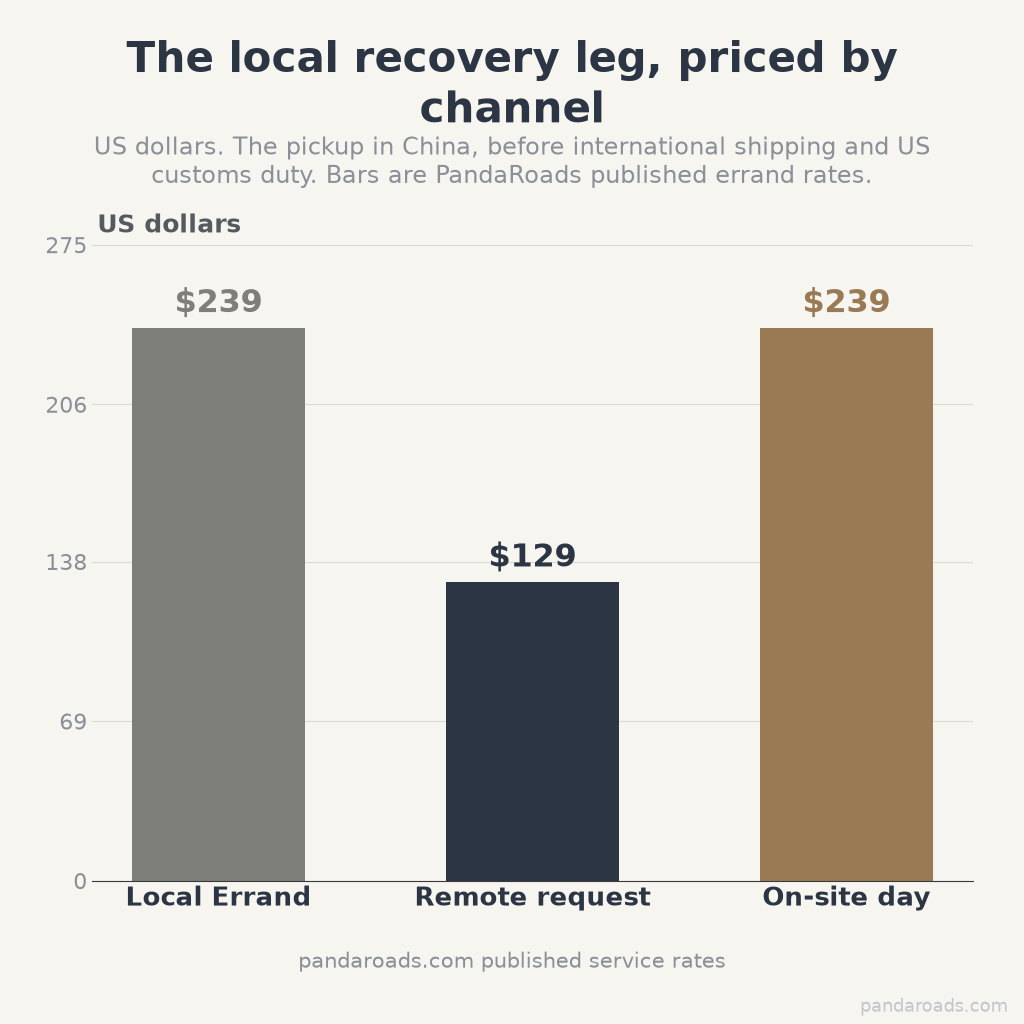
Budget the recovery as three buckets. The local leg is fixed, a PandaRoads Local Errand at US$239, a remote request at US$129, or on-site work at US$239 a day. The shipping leg bills on the greater of actual or volumetric weight plus a fuel surcharge. And customs now applies, since the 800 dollar de minimis exemption ended for China on May 2, 2025.
Cost is where the vague dread becomes a real number, so it helps to stop treating "ship it home" as one price and see the three separate buckets, the local pickup, the international shipping, and the customs duty.
The local pickup leg is the part a Chinese service prices and the part you can hold fixed. There is no single sticker for the shipping leg, though, and anyone who quotes you one without the parcel dimensions is guessing. International express like DHL and SF bills by the greater of the parcel's actual weight or its volumetric weight, and adds a floating fuel surcharge on top, so the honest number comes from the carrier's own rate calculator for the exact box and destination, not from a blog post (source: dhl.com). A small, dense personal item in a padded envelope is at the cheap end; anything light but bulky gets priced on the volume, not the scale.
For the local leg, the published PandaRoads rates give you a bounded starting frame. A Local Errand is US$239 for one trip within 30 km and returns photos and receipts. A remote request is US$129. On-site field work is US$239 per day, billed from departure, with cross-city or overnight travel itemized and confirmed before the run (source: pandaroads.com). So the recovery of a forgotten item usually rides on the errand-and-shipping model, a fixed local pickup you approve, plus a shipping quote you see before it is booked, rather than an open-ended retainer.
Then there is the part that genuinely catches people out, the customs bill. For years a low-value parcel into the United States slipped in duty-free under an 800 dollar de minimis threshold. That is gone. The duty-free de minimis exemption was eliminated for goods from China and Hong Kong effective May 2, 2025, and then for all countries effective August 29, 2025, so even a returned personal parcel is now a dutiable entry rather than a free pass (source: whitehouse.gov). You may also be asked for a proper customs declaration with a realistic value and a description of the contents, which is another reason the item should not be a mystery box even to you.
Tip: The practical move that ties the three buckets together is sequencing. Get the pickup priced and approved first, get the shipping quote on the actual packed dimensions second, and put a number on the likely duty third, so that by the time the runner walks to the desk you already know the whole stack, local fee plus shipping plus duty, and nothing new appears at your door that nobody warned you about.
How a pickup-and-mail runs, step by step
A structured run holds its approval checkpoints at steps 3 and 5. After the venue confirms the item, the runner returns an itemized quote covering the local pickup, the shipping estimate and the expected duty, and you approve it before anything is booked. The step-5 checkpoint tests the export rules, so a loose battery or a vape is flagged before anyone walks to the counter.
When a collection-and-courier job is done properly, it is not dramatic, it is a short sequence with checkpoints, and you approve the money before anyone spends it. Here is the order.
- You describe the thing and the scene. What it is, the city, whether it was at the airport, on a train, in a hotel or in a ride, and every reference you still have, the flight, the train number and seat, the hotel and dates, the ride time.
- We run the free-sounding outreach in parallel, the airport or railway lost-and-found, the hotel, the ride platform, and we tell you honestly who has confirmed the item is sitting there, because "found" is a milestone worth naming before you spend anything.
- We return an itemized quote, the local pickup price, the shipping estimate on the likely packed size, and any duty you should expect, and you approve it before anything is booked or collected (source: pandaroads.com). Nothing runs on faith.
- We assemble the authorization packet, your description, references, the written release naming the collector, and a copy of your travel ID, and the runner goes to the desk, shows their own ID and your paperwork, and collects the item, photographing the actual object and the receipt so you are not taking a stranger's word for it.
- We check the export rules before booking the courier, and if the item is a loose battery or a vape we tell you then, before a carrier turns it away, rather than after it has been collected and cannot move.
- We hand it to an international courier with your address and a declared value, and send you the tracking number the moment it exists.
- You get the item and the whole paper trail, the collection photos, the receipts and the waybill, so there is no mystery later about what you paid, who touched it, or where it went.
The through-line is the approve-first discipline at steps 3 and 5. A traveler who has already flown home is at their most anxious between "it is found" and "it is coming," and the worst time to discover the shipping cost, or that the battery cannot fly, is after someone has already gone to the counter. Sequence it so you know the total and the restriction while the item is still on the shelf and the run is still optional.
What nobody can hand back: the honest limits
A guide that promises you anything with a pulse is not worth trusting, so here is the candid list of what a recovery-and-mail run cannot do, stated plainly.
We cannot make a venue release something it has decided not to. A hotel that has already cleared its storage window, or a chain whose policy forbids giving property to anyone but the guest, is a closed door, and a good runner will tell you it is closed instead of working around it, because undocumented access produces a claim that falls apart the moment anyone questions it.
We cannot conjure back the categories that are simply gone. Cash left in a room or on a seat is almost never recoverable and rarely worth the pursuit. A passport that has been surrendered to the authorities is an embassy-and-police-report problem, not a courier problem; the fix there is a replacement travel document, not a runner. And an item a carrier or customs has already refused or seized because of what it is, a loose high-wattage battery, a vape where the route bars it, a prohibited category, has hit a hard rule, not our effort (source: iata.org).
We give no legal opinion and no guarantee on timing. A search can come back empty, a found item still has to clear release and export, and a desk open 06:00 to 24:00 in one timezone is closed to you at midnight in another. What we control is the sequence and the paperwork, not the outcome at some other organization's counter.
And we stay inside what is lawful and ordinary. PandaRoads is explicit that its errand work is research, collection and coordination, not legal or audit opinions, and it does not take on illegal, gray-market or sensitive-industry tasks at all (source: pandaroads.com). If a job only "works" by falsifying who you are or hiding what is in the box, it is not a job.
None of that should read as an excuse. It is the honest shape of a very winnable task. The realistic success case, a normal personal item, described fast, backed by references, clearing a release that wants paperwork and an export that is not a battery problem, is common, and it is exactly what a structured run is built to handle.
Frequently asked questions
How do I get something I left in China mailed back to me? File fast and be precise. Contact the airport or railway lost-and-found, the hotel, or the ride app with your exact reference and a detailed description. The hard part is rarely finding the item, it is getting the venue to release it to a third party and clearing the courier rules, so most people abroad end up needing a local runner to collect and an international courier to ship (source: china-railway.com.cn).
Can I claim a lost item from Shanghai airport after I have flown home? Usually the airport can confirm a match, but release to someone else needs your flight details and a written authorization. Shanghai Airport's lost-and-found lists service hours of 06:00 to 24:00, a phone number of 021-68340096, and a service email of lostandfound@shairport.com, which is where a remote claim starts (source: avinex.com).
What do I do if I left something on a Chinese high-speed train? Use the railway's own system. China Railway says passengers can search for lost goods online through the 12306 website or app, and you can also call the hotline and press for the English menu, giving the train number and seat; a service form describing where and what triggers a crew search (source: china-railway.com.cn).
Can someone pick up my lost item in China and ship it internationally for me? Yes, that is a defined service, not a favor. A local runner takes your written authorization, your travel-ID copy and your booking references, collects at the desk, photographs the item and the receipt, and hands it to a courier with your address and a declared value, on an approved, itemized fee (source: pandaroads.com).
Can you mail a power bank or a phone with a lithium battery from China? A phone or laptop with the battery installed is usually fine; a loose power bank or spare lithium cell generally is not, because IATA rules keep spare batteries and power banks out of the aircraft hold and carriers refuse loose cells in ordinary parcels, and air shipment needs UN 38.3 and dangerous-goods handling (source: iata.org).
How much does it cost to ship a small personal item from China to the USA? There is no fixed per-kilo price. Express couriers like DHL and SF bill by the greater of actual or volumetric weight plus a fuel surcharge, so the real figure comes from the carrier's own calculator for the exact box, which is why a good run quotes the local pickup and the shipping separately and gets your approval before booking (source: dhl.com).
Do I have to pay customs duty on an item mailed to me from China? Plan for it. The 800 dollar duty-free de minimis exemption was eliminated for goods from China and Hong Kong on May 2, 2025, and for all countries on August 29, 2025, so a returned personal parcel is now a dutiable entry with a proper customs declaration rather than a duty-free pass (source: whitehouse.gov).
What items cannot legally be shipped out of China? Anything that is a dangerous good or a barred category, most loose lithium batteries and power banks, vapes in practice, plus weapons, counterfeit goods, certain foods and protected plant or animal products. These are refused on the rules, not on effort, so check the label and the category before you celebrate a recovery (source: iata.org).
The bottom line
Leaving something behind in China after you have already flown home is usually recoverable. The reason these cases fail is rarely the grab. It is the two gates behind the grab: getting a venue to release property to someone who is not standing there, and getting that item legally onto a plane out.
So the move is unglamorous and specific. File fast, while the desk still has a record. Describe precisely, with the flight, the train number and seat, the hotel and dates, or the ride time. Put a local runner with the right paperwork between you and the counter, then let an international courier and an approved duty estimate finish the job. Power banks and loose batteries are the classic heartbreak, so check the export rule before you celebrate a match.
If that describes your situation, send the item, the city and the reference you still have. You will get an itemized quote for the pickup and the mail back before anything is booked, so the number is never a surprise.
References
- China Briefing. (2023, July 24). WeChat enables foreigners to pay with overseas cards in China. China Briefing. https://www.china-briefing.com/news/wechat-enables-foreigners-to-pay-with-overseas-cards-in-china/
- China State Railway Group. (2019, April 9). Lost & found service [Passenger services]. China Railway. http://www.china-railway.com.cn/english/businesses/passenger/201904/t20190409_93036.html
- Shanghai Airport (Group) Co., Ltd. (n.d.). Lost & Found [Pudong International Airport service page]. AVINEX. https://www.avinex.com/enpd/fuwusheshi/index_lcid_428.html
- International Air Transport Association. (2026). Safe travel with lithium batteries [Passenger guidance]. IATA. https://www.iata.org/en/youandiata/travelers/batteries/
- DHL Express. (2025). About shipping lithium batteries [Support center guide]. DHL. https://www.dhl.com/discover/en-hk/ship-with-dhl/start-shipping/dhl-account-support-center/lithium-batteries
- DHL. (2026). Get a free international shipping quote online [Rate calculator]. DHL China. https://www.dhl.com/cn-en/home/get-a-quote.html
- The White House. (2025, April 2). Fact sheet: President Donald J. Trump closes de minimis exemptions to combat China's role in America's synthetic opioid crisis [Fact sheet]. https://www.whitehouse.gov/fact-sheets/2025/04/fact-sheet-president-donald-j-trump-closes-de-minimis-exemptions-to-combat-chinas-role-in-americas-synthetic-opioid-crisis/
- The White House. (2025, July 30). Presidential action: Suspending duty-free de minimis treatment for all countries [Executive order]. https://www.whitehouse.gov/presidential-actions/2025/07/suspending-duty-free-de-minimis-treatment-for-all-countries/
- PandaRoads. (2026). China sourcing and local task service from $129 [Service page]. PandaRoads. https://pandaroads.com/china-tasks.html
Last reviewed and updated: September 2026. Author: our editorial team. For tailored guidance, contact our team.