Hire someone in China to buy and ship item for me safely
A sourced, step-by-step guide for overseas buyers who need someone in China to buy and ship item for me, priced lane by lane with the honest failure points.
Last updated: October 2026 · By the PandaRoads team in China
TL;DR
Yes, someone in China can buy a specific item and ship it to you, and for a consumer one-item job the deciding factor is not the courier menu but whether a physical person can reach the goods and pay for them. A buyer on the ground covers what a self-service proxy cart cannot: confirming the exact variant in a branch, paying through wallet rails that cap a foreign card at about 3,000 yuan per Alipay transaction and about 6,000 yuan per WeChat Pay transaction, photographing the receipt and serial before boxing, picking a lane that accepts the device's lithium battery, and handing over customs data now that parcels of 800 dollars or less no longer enter the United States duty free. It costs a flat errand fee plus the item at price and freight at cost, which is a different economic shape from the percentage-of-order model an agent uses.
Abstract
A sourced, step-by-step answer for a US buyer who needs one specific item bought inside China and couriered abroad: how to tell a shopping agent from a package forwarder from a buyer on the ground, what to settle before anyone walks into a store, how to specify an item so a stranger can price it, how to verify goods and pay through Chinese wallet rails that cap a foreign card, how a lithium battery and the end of duty-free de minimis entry change the courier choice, and exactly what one small parcel costs landed in 2026.
Key Takeaways
- A shopping agent needs a product URL; your item may not have one
- Someone must pay on Chinese rails, and foreign cards are capped
- Verify the goods with photos of the shelf, receipt and serial first
- A built-in lithium battery makes your parcel regulated air cargo
- Parcels of 800 dollars or less no longer enter the US duty free
- One 0.5 kg parcel ran about 11 to 34 dollars by lane in 2026
- A buyer pays locally, ships, and settles against receipts, not guesses
Table of Contents
- Abstract
- Key Takeaways
- The literal question, answered in one line
- Three jobs people confuse: shopping agent, package forwarder, buyer on the ground
- Before you start: what has to be true before anyone walks into a store
- Step 1: Specify the item so a person can actually price it
- Step 2: Verify the goods, pay on capped rails, and take delivery evidence
- Step 3: Pick the lane that will legally take your item
- Step 4: What the whole parcel costs, and what customs now adds
- What goes wrong, and when this stops being an errand
- Frequently asked questions
- The bottom line
- References
The literal question, answered in one line
Someone posts a photo from a shop floor in Shanghai. A limited run of a small camera, a museum-shop print, a regional edition of a keyboard, a secondhand unit whose seller states flatly that they only ship inside mainland China. You are in Ohio with a US debit card, no Chinese bank account, no Chinese phone number and nobody on the ground. The item will not come to you, so you type the question the way you would say it out loud, which is exactly how it gets asked in the places where people look for this help. One post in the reddit community r/shanghai put it this way: "Hey everyone, I'm looking for someone in Shanghai who can help me buy a specific item locally and then send it back to me overseas."

Yes, a person in China can buy a specific item and courier it to you. That answer is not in doubt. What decides whether your particular item arrives is something else entirely, and it is never the courier menu.
The deciding factor is whether a physical human being can reach the goods and pay for them. Somewhere between the shop counter and your doorstep, three things have to line up. A store or seller has to accept the order from a person standing in front of them. Somebody has to pay through rails that actually clear inside China, and a foreign card gets you only so far there. Then the boxed item has to move on a lane legally allowed to carry what is inside it, into a US customs process that now expects paperwork instead of waving small parcels through. That last part is new enough that much advice on this topic is quietly wrong, a parcel of $800 or less used to slide into the United States without duty, and that exemption is suspended (source: cbp.gov).
So this is not a shopping agent story, and it is not the same job as the sourcing agents importers hire at scale. A proxy cart needs a product URL, and for the items that generate this question there often is not one. It is a buyer-side errand, and the rest of this guide walks the sequence in order, what to settle first, how to specify an item so a stranger can price it honestly, what evidence to demand before money moves, how payment works on Chinese rails, which lanes accept a gadget with a battery inside, and what the whole thing costs in 2026, in dollars, line by line.
A specific-item errand has three gates in order, a seller who will release goods to a stranger, a wallet that clears inside China, and a lane that files US entry data. The courier, the part most people price first, is the last gate that decides anything, and $800 is the value line where duty-free entry was suspended.
Key point: The scarce resource is not a courier account or a warehouse. It is a body in a specific city, a wallet that works in that city, and a record of both that you can check before you pay.
Three jobs people confuse: shopping agent, package forwarder, buyer on the ground
Search this topic and three different businesses come back under one phrase. Most stuck requests are the result of hiring the wrong one, and the difference between them is structural: what has to already exist before the service can start.
| Job | What has to exist first | What it actually does | How it charges | Fits when |
|---|---|---|---|---|
| Shopping agent or proxy buyer | A live listing on Taobao, Tmall, JD or 1688 | Buys into its own warehouse, adds quality-check photos, consolidation and an international line | Percentage of order plus domestic shipping plus freight, commonly about 3 to 10 percent (source: blog.fishgoo.com) | The item is catalog listed and the seller ships domestically |
| Package forwarder | A domestic address you can ship to yourself | Receives, repacks, sometimes consolidates, bills a lane by weight | Handling or membership fee plus freight | You can buy it yourself and only lack a Chinese address |
| Buyer on the ground | A person, a store, a wallet that clears in China, a courier account | Locates the item, obtains it in person, photographs shelf, receipt and serial, then ships it | Flat errand fee, item and freight billed at cost (source: pandaroads.com) | There is no listing, stock sits in one branch, or the seller will not ship abroad |
The informal name for the third job is 代购, daigou. The hobby version of it is gone. China's E-Commerce Law, in force from January 1, 2019, requires e-commerce operators to register as market entities and obtain administrative licenses where the activity needs one, and it expressly requires cross-border operators to comply with import and export supervision rules (source: subsites.chinadaily.com.cn). Hiring a buyer now means hiring a registered service with a published scope, not a favor from a stranger with a smartphone.
The fee shapes matter more than they look. A percentage of order is efficient when a listing exists and the cart is full, which is what agent platforms are built for. A flat fee with goods at cost is priced around human time and does not inflate because the item happened to be expensive. This site publishes its numbers, a Local Errand at $239 one-time for work within 30 km inside a two-business-day window with photos and receipts as the deliverable, single errands at $239, remote tasks at $129 per request, and on-site work at $239 per day billed from departure (source: pandaroads.com).
Three services share one name and only one of them can reach an offline item. Agents charge a percentage of the order, commonly about 3 to 10 percent, and need a live listing. A buyer on the ground charges a flat fee, $239 for a local errand within 30 km on this site, with the item and the freight billed at cost.
The mistake to avoid: Sending a no-listing item to a proxy cart. An agent with nothing to add to a cart cannot start, and no negotiation changes that. The first question is not which service is cheapest but which one can physically reach your item.
Before you start: what has to be true before anyone walks into a store
Most failed buy-and-forward requests die before a buyer is hired, because one of the assumptions underneath them is false. Three things have to be settled on your side first.
What you must have
- The exact item identity. Brand, model, region edition, color and capacity, plus a photograph if the variant matters. "The blue one" is not a specification.
- A ceiling price in US dollars that includes freight, not just the sticker. Freight on one small parcel is a visible share of the total, and step 4 prices that difference lane by lane.
- A way to be reached that works in Chinese business hours, plus a shipping address that can receive a commercial courier and a person available to sign.
- A card that can be charged for the item, the errand fee and the freight as separate line items, because that is how an honest quote arrives.
What nobody can promise you
The honest limits here are unglamorous, and they are the difference between a smooth transaction and an argument. A store keeps an item only while a person is standing there paying for it, so no buyer can reserve stock for you while you think it over, and a quote that implies otherwise is selling a guarantee it cannot honor. A buyer is not the manufacturer's authorized channel, which matters on region-locked electronics: an item bought in a mainland store and shipped to the United States may carry no usable US warranty, and no errand fee changes that. Nobody signs documents or acts as your legal decision-maker, and a job whose completion requires your own physical presence is not an errand (source: pandaroads.com).
It is worth looking at how the requests actually arrive, because it shows how little of this is understood at the start. A post in a Facebook group for the DJI Osmo Pocket 3 asked it in five lines: "Hello everyone, I would like to purchase one Osmo Pocket 3. Is there anyone in China who can send it to me? Who can help me?" The item was a mass-produced gadget with listings everywhere, which is exactly why the ask surprised people. What the asker could not do from abroad was make a specific seller take a specific order and ship it to a specific country. Credit where the phrasing came from, reddit and Facebook groups are where this question gets asked out loud, and none of those replies are a service guarantee.
Time and money envelope
A same-city errand inside a published two-business-day window plus courier transit is a normal expectation, not a rush job, and travel beyond 30 km gets quoted separately before anyone confirms (source: pandaroads.com). Set your deadline before you ask for a price. A buyer who quotes instantly without asking about the variant, the battery or the destination is quoting a different job than yours.
Step 1: Specify the item so a person can actually price it
This step exists because a vague request cannot be quoted, only guessed at, and a guess is where disputes come from. The deliverable is one message a buyer can price from without calling you back.
Write the item card
Put these fields in the message, in this order. Item name and exact model, with the region edition if the device is one. A photograph or screenshot of the listing, the shop window or the box. The city, and the specific store if you know it. Quantity, usually one. Acceptable substitutes and the variants you refuse, stated as plainly as the ones you want. Your ceiling price for the item itself. Whether a used unit in good condition is acceptable. Your deadline. The destination country. One line that answers the question almost nobody anticipates, does the item contain a battery, built in or packed with it.
That battery field belongs in step one rather than at the courier stage because it decides whether the job is possible at all, and a buyer who learns about it after purchasing the item has a problem instead of a plan.
Say where it is, not just what it is
Location is the feasibility variable, and it sorts into four cases. An online listing whose seller ships only inside China is a purchase-and-forward job, and the buyer needs the listing link plus the seller's stated shipping region. A specific offline branch needs someone to walk in, check that shelf, and pay there. A market stall or secondhand seller adds an identity question and a negotiation, so name what you will and will not accept before anyone starts haggling. A museum shop or boutique item may not be shippable by the seller in any form, which is the cleanest case for hiring a person rather than a platform.
Set the terms before anyone moves
Agree in writing what the quote covers: item at cost, errand fee, domestic pickup if any, packing and estimated international freight, each shown separately. Ask for the freight estimate as a band with its basis, since a per-kg rate that excludes fuel surcharge and duty is not the same number as a delivered price (source: www.gerudologistics.com).
Three mistakes cause most of the friction. A screenshot with no model number invites the wrong variant. A request to hold stock until you decide cannot be honored, because a store keeps an item only while someone is paying for it. A ceiling price set without freight leaves both sides unhappy for reasons that were visible on day one. You did step one correctly when the reply you get is a split quote with a named store or seller in it, not one round number with no breakdown.
Location, not the product name, is what decides whether a stranger can price this at all. An online listing restricted to mainland delivery, one specific branch, a market stall, and a boutique that ships nothing are four different jobs. On freight, published 2026 quotes for one 0.5 kg parcel from China to the USA ran from about $11 to about $34 depending on the line (source: www.nextsmartship.com).
Step 2: Verify the goods, pay on capped rails, and take delivery evidence
This is the step where the errand either works or turns into a loss, and it has three parts that belong in a fixed order: proof, payment, paperwork. Proof comes before payment, always.
Proof before payment
Before any funds move, a buyer should send photographs taken at the location, the item on the shelf or in hand, the packaging, the price tag or the seller's screen, the receipt, and the serial number next to the box. For a high-value item or a variant that matters, a short live video call at the counter settles what a still photo cannot, whether the shop is real and whether the thing in hand matches the card you wrote in step one. On your side, verify the person rather than only the goods, a named contact, a stated service radius, a scope you can read. Someone offering to buy anything anywhere is describing availability, not capability.
The caps on a foreign card
Here is the mechanical reason this scene needs a local payer at all. For a buyer paying with a foreign card inside the Chinese wallet rails, Alipay caps a single transaction at about ¥3,000, and WeChat Pay caps a single transaction at about ¥6,000 with a monthly cumulative limit of ¥50,000; transactions below ¥200 have the fee waived and transactions above ¥200 carry a 3% fee (source: china-briefing.com). That is the whole story of the payment step. A $1,000 gadget sits above both per-transaction ceilings, so the purchase either splits, which sellers and platforms may not allow, or it is paid by an account that clears locally and settled with you afterwards.
The correct sequence follows from that arithmetic. The buyer or the service pays the store through rails that work in China, at the store's price, and you reimburse the item at cost against the receipt. Remote tasks at this site are quoted per request, from $129, with the item billed at cost and evidenced rather than marked up (source: pandaroads.com). What you are refusing is not a fee. It is paying a stranger in advance on the strength of a promise.
The evidence pack that settles the job
The packet that closes step two is small and boring, item photographs, the receipt with its amount visible, the serial number, the packed box with its label, the actual weight and dimensions, the tracking number, and a written summary of what happened and what could not be done. Published errand pricing here is tied to photos and receipts as the deliverable rather than to goodwill (source: pandaroads.com). Keep the receipt, because the declared value you need in step four is printed on it, and because the two arguments that can still happen later, damage and a customs question, are settled by paper you either have or do not.
Money moving before goods do is the shape of every complaint in these threads. The fix is sequencing rather than trust, proof then payment then the evidence pack, with each stage cheap enough to walk away from.
Payment on foreign cards is the mechanical blocker here, not price. Alipay caps one transaction at about ¥3,000 and WeChat Pay at about ¥6,000 with a ¥50,000 monthly cumulative limit, so a $1,000 item clears neither in one motion. Order of operations fixes it, counter evidence first, local settlement second, reimbursement against a receipt last.
Step 3: Pick the lane that will legally take your item
Ask which courier is cheapest and you are asking the wrong question first. The lane has to be chosen by what is inside the box, and only then by price.
Express, e-commerce line, postal, or consolidated
Three questions sort the options. Does the item contain a battery. What does it weigh, and what does the box measure, since carriers bill on whichever is larger. How much tracking and insurance does a thing you cannot replace need. Then the channel families, an integrated express carrier, a dedicated e-commerce line, a postal or EMS channel, and a consolidated or special line. Forwarders publish the weight logic plainly, roughly postal at the very light end, e-commerce lines for about 500 g to 2 kg, special lines for 2 to 5 kg and consolidation above that, with postal trading money for slower movement and thinner tracking (source: www.gerudologistics.com). For one consumer gadget this is nearly always a sub-2 kg decision, and a fast express line and a cheap e-commerce line can differ by a factor of three on the same parcel, which the next step prices. The site's own guide to shipping out of China covers the domestic handoff, including courier accounts and pickup send a parcel from China with SF Express.
The lithium battery problem
This is the constraint that surprises people, and it is not a courier preference, it is air-cargo law. Shipping a device that contains a lithium-ion battery is regulated air cargo rather than ordinary mail, the IATA Dangerous Goods Regulations classify carriage by battery configuration and watt-hour rating, lithium batteries packed with or contained in equipment move under packing instructions such as PI 966 and PI 967, and effective January 2025 those packing instructions added a 3-meter stack test packaging requirement for non-UN-specification packaging (source: iata.org).
What that means for a consumer errand is narrow but hard. A camera, a gimbal, a handheld console or a drone with a cell inside it is not a parcel, it is a dangerous-goods shipment in a small costume, and only some lanes carry it. A buyer who offers any courier for any item has not looked at yours. The watt-hour rating of a loose spare pack is usually the deciding number, which is why a spare battery is often a separate problem from the device and why a seller who ships a device domestically may still refuse to ship it with an extra pack in the box.
Two decisions hide here. Declared value drives both your insurance ceiling and the customs figure, so choose the coverage you want rather than letting someone else pick it. And under-declaring to dodge duty is not a shortcut, it is a misstatement that lands on the importer of record, which on most of these shipments is you.
You did this step correctly when you can name the lane, say whether the battery is installed or loose, and give the box dimensions before anyone books a pickup.
Lane choice follows the contents rather than the price list. Published weight bands put e-commerce lines at about 500 g to 2 kg and special lines at 2 to 5 kg, and a device with a lithium cell inside it is regulated air cargo under IATA packing instructions such as PI 966 and PI 967, tightened from January 2025.
Step 4: What the whole parcel costs, and what customs now adds
A quote is not a cost. Here is the difference, priced for the parcel this errand actually produces, one small item in a box.
| Lane | Published quote | Payment terms | Rate as of | Watch out for |
|---|---|---|---|---|
| 3PL dedicated line, economy | about $11.08 | line rate | Feb 26, 2026 | Slower, thin tracking (source: www.nextsmartship.com) |
| ePacket | $2.21 first 50 g plus $5.88 per kg, capped at $11.76 | postal e-commerce line | Feb 26, 2026 | Per-parcel cap and size limits (source: www.nextsmartship.com) |
| 3PL dedicated line, expedited | about $17.65 | line rate | Feb 26, 2026 | List rate assumes a shipper account (source: www.nextsmartship.com) |
| Prepaid USPS line | about $21.71, including $0.75 in charges | delivery duty paid | Feb 26, 2026 | Duty prepaid into the line (source: www.nextsmartship.com) |
| China Post EMS | roughly $25 to $30 first kg, about $15 to $18 per kg at 3 kg | postal express | 2024 comparison | Different weight basis (source: en.pfcexpress.com) |
| DHL Express | about $31.36 | duty unpaid | Feb 26, 2026 | Duty, fuel and brokerage billed separately (source: www.nextsmartship.com) |
| UPS | about $34.10 | duty unpaid | Feb 26, 2026 | Brokerage is a separate bill (source: www.nextsmartship.com) |
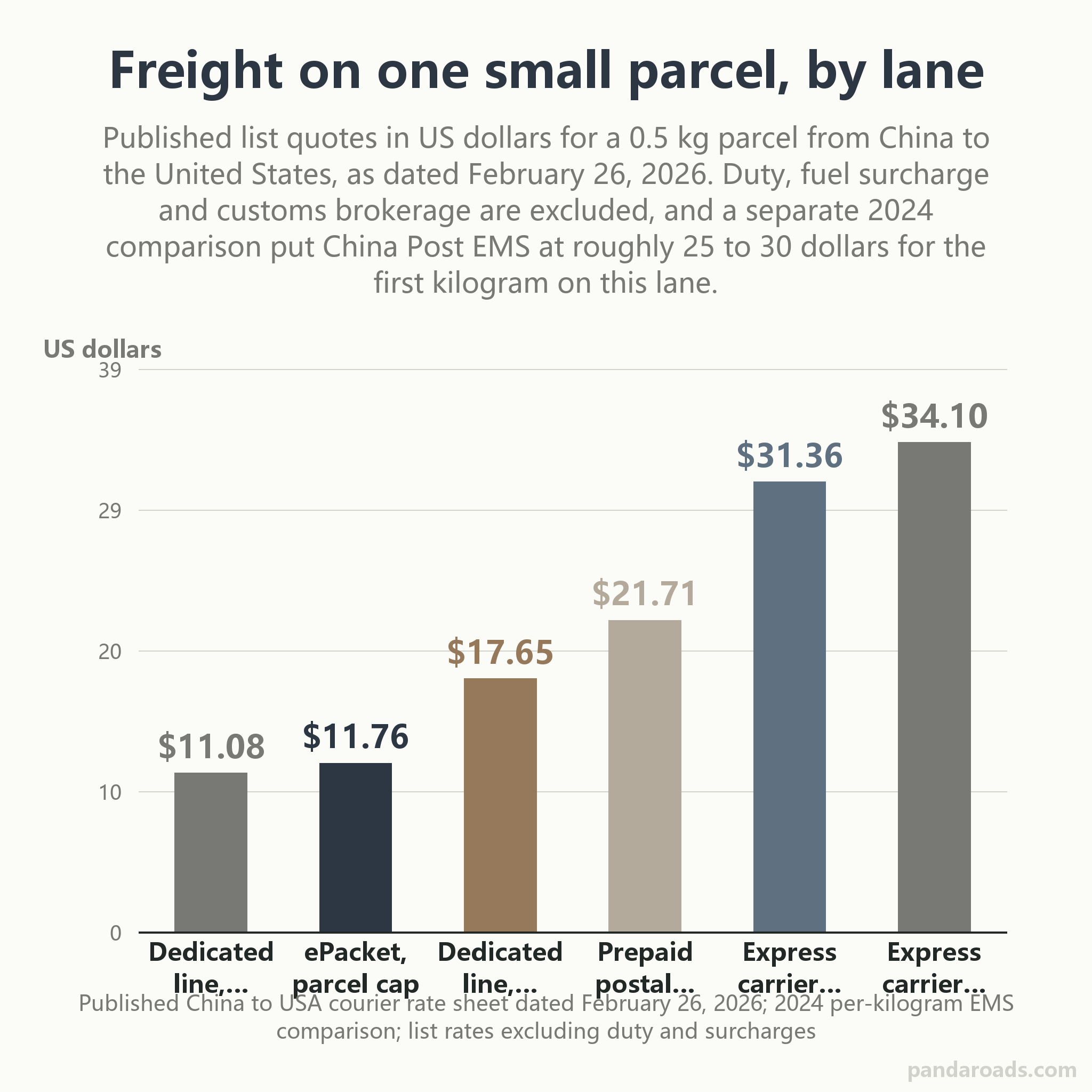
Two mechanical things sit behind those numbers. Carriers bill on whichever is larger, actual weight or volumetric weight, and the published divisors on these lines run 5000 to 8000 against box dimensions, so a light item in a big box costs what a heavy one costs (source: www.nextsmartship.com). And these are list rates that assume a shipper account, which is one of what you buy when a local buyer ships on their own courier relationship.
Then the line items nobody shows you. Advertised rates typically exclude duties and tariffs, remote-area surcharges, fuel surcharges and clearance fees unless the lane is delivery duty paid, and brokerage on a commercial entry can run $50 to $100 per shipment (source: www.gerudologistics.com). The honest formula is item, plus errand fee, plus domestic pickup, plus packing, plus freight, plus duty and fees.
That last term is what changed. The US suspension of the de minimis administrative exemption applies to merchandise valued at $800 or less arriving through all modes, including the international postal network, unless specifically excepted (source: cbp.gov). The timeline matters because so much advice predates it, Executive Orders 14256 and 14257 of April 2, 2025 directed suspension for China and Hong Kong effective May 2, 2025, Executive Order 14324 of July 30, 2025 extended it globally effective August 29, 2025. CBP published the indefinite suspension in the Federal Register on June 24, 2026 with a new mail informal entry process effective July 24, 2026 (source: cbp.gov). CBP reported de minimis volume grew from 134 million shipments in 2015 to 1.36 billion in 2024, more than four million a day, about 95 percent through express and general cargo carriers rather than the mail (source: cbp.gov).
In consumer terms, the small parcel that used to be invisible is now an entry. Informal entry is generally available at $2,500 or less, and mail informal entry filers must supply country of origin, a 10-digit HTSUS classification, quantity or weight, the duty rate and total duty owed, and the UPU S-10 13-character tracking identifier, with payment via Pay.gov no later than the 7th day of the month following arrival (source: www.cbp.gov). Bona fide gifts and a traveler's personal articles keep their exemptions, and a purchased item couriered to you is neither.
So price the job before anyone buys. A $150 item, a $60 errand fee and a $25 to $35 freight line puts freight at a third to a half of the non-item total, before duty. That is why step one asked for a ceiling price that already included shipping.
What goes wrong, and when this stops being an errand
Five things break in this flow. Each has a recognizable symptom, a cause, and a fix that costs less than the failure.
The buyer cannot pay. Symptom, the shop declines the card or the app throws a limit error. Cause, a foreign card is capped inside the Chinese wallets, roughly ¥3,000 per single Alipay transaction and ¥6,000 per WeChat Pay transaction (source: china-briefing.com), or the seller only takes a domestic transfer. Fix, a locally settled payment with the item invoiced at cost against a receipt, which is the whole reason a buyer with a working account is worth a flat fee.
The courier refuses the box. Symptom, a pickup is canceled or the label will not print. Cause, a lithium battery inside the device, or a loose spare pack, or packaging that does not meet the current stack-test requirement in the applicable IATA packing instruction (source: iata.org). Fix, change the lane and the packaging honestly. Re-labeling a battery device as something else is not a fix, it is an aviation safety problem with your name on the paperwork.
The parcel is held for data. Symptom, a request for classification, origin and value after arrival. Cause, the entry process now expects mail informal entry filings with a 10-digit HTSUS code, country of origin and total duty owed (source: www.cbp.gov). Fix, supply the commercial invoice and the receipt up front and treat duty as part of the price.
The wrong variant arrives. Cause, a description instead of a photograph. Fix, the shelf and serial evidence step before payment, and a written statement of the variants you refuse.
The total moves after the fact. Cause, fuel surcharge and volumetric weight on a box nobody measured. Fix, a stated box size in the quote and a delivery-duty-paid option compared side by side with the unpaid one (source: www.gerudologistics.com).
When a different tool is the right one
Use a package forwarder when you can complete the purchase yourself and only need a domestic address, because then you are paying for warehousing and a lane rather than for judgment. Use a shopping agent when a listing exists and the seller ships domestically, since a percentage of a single cart order will usually beat an errand fee there. Use a pre-shipment inspection service when the goods are a commercial order paid to a factory rather than one item for yourself, that is a balance-payment quality job and a different article covers what it costs China product inspection costs.
And sometimes nobody should take the job. Anything illegal or gray-market, goods whose export would put the buyer or the courier at legal risk, and anything whose completion requires your own signature or physical presence are all cases where an errand is the wrong instrument see what we will not do. Saying so early is the cheapest part of the service. The general trust and verification mechanics for any errand from abroad, including how a verified local team is structured, live in the hub guide rather than being repeated here: hire someone in China for errands from overseas. The same verified local team runs other presence-required errands for people who are abroad, so those scenes get their own pages rather than a paragraph here: viewing an apartment before you sign a lease, retrieving a document from a Chinese office, and meeting a parent at the airport or escorting them to a clinic.
Frequently asked questions
Is there anyone in China who can buy something for me and ship it internationally? Yes, in two forms. Shopping agents buy from existing Taobao, Tmall, JD or 1688 listings into a warehouse and ship worldwide. A buyer on the ground obtains a specific item, including from a physical store or a domestic-only seller, and couriers it. If there is no listing or the seller will not ship abroad, only the second applies, and it requires a Chinese payment account plus evidence you can check before money moves.
How do I get someone to buy an item in a physical store in China and send it to me? Send a specification, not a request. Exact model and region edition, a photograph, the city and store if known, acceptable substitutes, your ceiling price including freight, the deadline, and whether there is a battery. Then require counter photos, the receipt and the serial before payment, and let the buyer pay locally for settlement at cost.
What do I do when a Chinese seller says they will not ship to the United States? Treat it as routing, not refusal. A local buyer purchases, owns the domestic leg, and ships on an international lane themselves. Confirm the seller will release goods to a third party and what paperwork they provide, since an export declaration and invoice still have to exist. Many such sellers are simply not registered for export.
How much does it cost to ship a 1 kg parcel from China to the USA? A 2024 comparison put China Post EMS at roughly $25 to $30 for the first kilogram, easing to about $15 to $18 per kg at 3 kg (source: en.pfcexpress.com). A February 26, 2026 sheet quoted 0.5 kg parcels at about $11 to $18 on dedicated lines, $21.71 duty-paid prepaid, and $31 to $34 express with duty unpaid (source: www.nextsmartship.com).
Can I still send a low-value parcel to the US duty free under the $800 de minimis rule? No. The suspension applies to merchandise valued at $800 or less arriving through all modes, including the international postal network, unless a separate authority excepts it (source: cbp.gov). Informal entry is generally available at $2,500 or less. A bona fide gift keeps its exemption, an item you bought does not.
Can a gadget with a lithium battery be shipped from China by air? Yes, as regulated air cargo, not ordinary mail. Batteries contained in or packed with equipment move under IATA packing instructions such as PI 966 and PI 967, and from January 2025 those instructions add a 3-meter stack test requirement for non-UN-specification packaging (source: iata.org). Loose spare packs are the harder case, so ask before the purchase.
How do I pay for something in China if I do not have a Chinese bank account? Usually you cannot pay the store yourself, which is the point of the errand. A foreign card in Alipay caps at about ¥3,000 per transaction, and in WeChat Pay about ¥6,000 per transaction with a ¥50,000 monthly limit; fees are waived under ¥200 and 3% above it (source: china-briefing.com). The person on the ground pays and you settle at cost against a receipt.
How do I avoid being scammed when I hire someone to buy something for me overseas? Sequence the money so no single stage is large enough to hurt. Require a named contact and stated service radius, evidence at the counter before payment, receipt and serial photos before the balance, and a written summary with tracking. Paying an unverified account in full up front is the shape of every complaint. Hire a registered service, since China's E-Commerce Law requires market-entity registration and licenses where applicable (source: subsites.chinadaily.com.cn).
Is a package forwarder the same as a personal shopper in China? No. A forwarder assumes you already bought the item and gives you a domestic address, then repacks, consolidates and bills freight. A personal shopper performs the purchase itself, reaching the goods, paying on local rails and proving what was obtained. Consolidation is the forwarder's advantage and irrelevant to one boxed item.
What does it cost to hire someone in China to buy and ship an item for me? At published rates, a Local Errand is $239 one-time within 30 km in a two-business-day window with photos and receipts, single errands run at $239, a remote task is $129 per request, and on-site work is $239 per day billed from departure (source: pandaroads.com). Item and freight are billed at cost, so the fee does not scale with the price of the thing.
The bottom line
The reason this question is hard is not that nobody in China is willing. People ask it out loud in forum threads constantly, in the exact words of the search. It is the same reach-out that makes someone order a hot meal for family in China from a US phone. It is hard because three separate systems have to line up for one object, a store or seller that will take the order, a payment rail that will clear it, and a lane that may legally carry it, now feeding a US entry process that expects data instead of waving small parcels through.
A buyer on the ground is the only one of the three service shapes that covers an item with no listing, and the honest cost shape reflects that, a flat errand fee with the goods and freight billed at cost rather than a percentage of an order. What it cannot do is equally plain. Nobody can hold stock for you while you think, a mainland purchase does not conjure an international warranty, and no errand ends in your signature on someone else's form.
If you have one specific thing in one specific place, the useful next move is small. Write the item card from step one, name your ceiling price including freight, and send it for a split quote. That is how to start a buy-and-forward request, and you can ask for a fixed quote before anyone walks anywhere.
References
- U.S. Customs and Border Protection. (2026, September 2). E-commerce frequently asked questions [Web page]. CBP.gov. https://www.cbp.gov/trade/basic-import-export/e-commerce/faqs
- U.S. Customs and Border Protection. (2025, August 29). CBP ready to enforce end of de minimis loophole, securing borders and strengthening trade enforcement [Press release]. CBP.gov. https://www.cbp.gov/newsroom/national-media-release/cbp-ready-enforce-end-de-minimis-loophole-securing-borders-and
- NextSmartShip. (2026, February 26). Shipping from China to the USA: Pricing and times [Blog post]. NextSmartShip. https://www.nextsmartship.com/blog/ship-from-china-to-us/
- PFC International Express Logistics. (2024, November 5). China Post vs EMS vs DHL: Which shipping method is best for your business? PFC Express. https://en.pfcexpress.com/blog/china-post-vs-ems-vs-dhl-shipping-comparison
- Li, Z. (2025, December 4). The complete guide to cheap shipping from China to USA for small packages. Gerudo Logistics. https://www.gerudologistics.com/shipping-guides/china-to-usa-small-packages
- China Briefing. (2023, July 24). WeChat enables foreigners to pay with overseas cards in China. China Briefing. https://www.china-briefing.com/news/wechat-enables-foreigners-to-pay-with-overseas-cards-in-china/
- International Air Transport Association. (2026). Batteries [Dangerous goods guidance]. IATA. https://www.iata.org/en/programs/cargo/dangerous-goods/lithium-batteries/
- Standing Committee of the National People's Congress. (2018, August 31). Electronic Commerce Law of the People's Republic of China [Official English translation]. National People's Congress subsite, China Daily. https://subsites.chinadaily.com.cn/npc/2018-08/31/c_697283.htm
- Fishgoo. (2026, April 1). How Taobao agents work: Fees, steps and what to expect (2026). Fishgoo Blog. https://blog.fishgoo.com/taobao-agent-guide/
- PandaRoads. (2026). China sourcing and local task service from $129 [Service page]. PandaRoads. https://pandaroads.com/china-tasks.html
Last reviewed and updated: September 2026. Author: our editorial team. For tailored guidance, contact our team.