Hire Caretaker for Parents in China From Abroad: The Routine
Last updated: September 2026 · By the PandaRoads team in China
TL;DR
Hiring a caretaker for aging parents in China from abroad is not a search problem, it is a reporting problem, because 95 percent of the job is ordinary Tuesdays and you are not in the room. Shanghai's 2025 monitoring of 888 institutions and more than 26,900 care workers puts the average at 6,202 yuan a month and the median at 6,175, while a national household-services yearbook of 600,000 workers puts elder care at the bottom of the pay and certification ladder, 18.1 percent certified against 76.2 percent for postpartum nannies. That is why the durable asset is not the person but the cadence: a verifiable service certificate and credit record, a real contract on the revised national model text, a fixed weekly visit with a written and video report, and a named party in China who can be swapped without the family losing the thread.
Abstract
A working manual for an adult child in the United States who keeps a standing, twice-a-week helper in a mainland Chinese apartment for aging parents: what the three job titles cost in the 2025 and 2026 wage data, how to check a stranger's certificate and credit record when you cannot read the documents, what belongs in the contract, how the wage clears a border on a foreign card, what a Tuesday video report has to show to be worth anything, and the specific risk categories that mean the arrangement has failed.
Key Takeaways
- Three job titles, three prices: hire the right one
- Elder care is the worst-paid, least-certified corner of the trade
- A certificate and a national credit file can be checked before she enters
- The subsidy will not do laundry or cooking
- A foreign card caps what you can send in one payment
- A weekly video report is the actual product
- Silence is the first red flag, not the last
Table of Contents
- Abstract
- Key Takeaways
- The hire is easy. The nine months after it are the job
- Three job titles, three completely different bills
- What a week of help actually costs in 2026
- Why good elder help is so hard to find, in three numbers
- The subsidized route, and exactly where it stops
- How to check a stranger before you let her inside
- The two walls: a contract you cannot read, a wage you cannot send
- What a good week looks like: the Tuesday report spec
- Red flags, and what to do when one fires
- Frequently asked questions
- The bottom line
- References
The hire is easy. The nine months after it are the job
Someone who has already done this told you how it starts. A poster on r/expats, asked how they manage aging parents from another country, wrote: "I managed to hire a care taker twice a week. and the lady is nice and talk to me explaining..." Read that fragment twice, because it is the whole product. A person, twice a week, and an account of the visit. Everything else is downstream of whether the account keeps arriving.
Across the diaspora forums the ask is consistent: a set number of visits a week, proof the visit happened, and somebody who explains how it went. One poster reports hiring a caretaker twice a week and values her because she talks and explains. Shanghai officially sells the same shape, in packages of 13 hours a month at 660 yuan (source: sixthtone.com).
Here is the part nobody warns you about. The first month runs on relief. You have a chat thread, a start date, a photograph of an organized fridge. By month nine the thread has gone quiet, the reports are three sentences long, and you have stopped asking. That drift is not a character flaw in anybody. It is the natural decay of an arrangement held together by goodwill across eleven time zones, with no one on either end who has an incentive to keep the record straight.
Then there is the wall underneath all of it. If you are a Chinese American who cannot read Chinese, you may have done what one poster did and asked for the key words to look up, because the research is real and none of the documents are legible to you. The agency listing, the worker's certificate, the two page contract your mother signed at the kitchen table. All Chinese. Every verification tool described later assumes a reader who is not you.
So you are hiring a caretaker for your parents in China from abroad, and the honest version is this. The hiring event is a weekend. The relationship is years. What survives is the reporting line you build around it.
This piece is about the recurring week. Not a hospital day, not a delivered lunch, not a nursing home placement. Mainland China, a US income, a fixed weekday, and a person you will never meet. If what you need is one day of a local assistant instead of a standing relationship, that is a different purchase: hiring help in China by the day.
Three job titles, three completely different bills
The market does not sell "caretaker." It sells three separate occupations with different employers, different scopes, different price logic, and in two of the three cases different regulators. Agencies quote them interchangeably because the words sell. Ask for a caretaker and you may be offered any of them.
Three occupations sit behind the English word caretaker: the 保姆 who cooks and cleans, the 护工 who handles hygiene and mobility, and the 陪诊师 who escorts in hospital at about 300 yuan for four hours (source: english.shanghai.gov.cn). Shanghai's 2025 wage monitoring prices certified care workers from 6,124 yuan a month at junior level to 8,743 at technician (source: mzj.sh.gov.cn).
| Role | Chinese term | Who usually hires them | What they actually do | How they are billed |
|---|---|---|---|---|
| Household helper, day shift or live in | 保姆, 家政员, 住家阿姨 | A household directly, a matchmaking agency, or a community introduction | Cooking, cleaning, shopping, companionship, plus staying with the person | Monthly, live in or day shift, or by the hour |
| Care worker | 护工, 养老护理员 | A care institution, a home-care provider, or the family through a company | Personal hygiene, repositioning, bathing, feeding, rehabilitation support | Monthly through the institution, or per visit, on a published wage ladder |
| Hospital escort | 陪诊师 | Independent, platform-based, or a training program run by a district | Registration, examinations, payment, collecting medication, post-visit communication with family, and psychological comfort for dependent and semi-dependent patients | By the hour, roughly 300 yuan for four hours in a major city (source: english.shanghai.gov.cn) |
Read the table as a decision and not a glossary. The standing weekly job most overseas children want is almost always row one with a slice of row two: somebody who makes a meal, keeps the flat running, notices things, and can physically help in the bath. Row three is a different purchase for a different day, bought by the hour when there is a hospital appointment to get through, and it is trained and documented differently. Shanghai had nine districts each training at least 100 hospital-escort professionals by July 2025, recruiting nurses, care-home workers and social workers, with the city still writing common procedures and pricing (source: english.shanghai.gov.cn).
Two traps live in the middle column. A 护工 from an institution is used to a ward, not a kitchen, and may not cook or clean at all. A 保姆 who has spent twenty years with babies is not automatically able to lift, hold and reposition an adult who has gone down in the hallway. The 2025 wage monitoring of Shanghai care institutions prices the difference honestly: care-worker pay runs on certification, from 6,124 yuan a month at junior level to 8,743 at technician, so a woman qualified to do clinical tasks is visibly, expensively not the same person as one who is not (source: mzj.sh.gov.cn).
Ask the agency which of the three you are getting, in writing, by name. The answer changes the price, the liability and the report you get afterward.
What a week of help actually costs in 2026
Every person typing "how to hire caretaker for parents in China from abroad" wants one number, and almost no English page gives one from primary data. Here is what the published figures actually say, with the caveat that these are monitoring and survey statistics, not quotes.
| Arrangement | What you get | City | Monthly figure, yuan | Source |
|---|---|---|---|---|
| Care worker, citywide average | Institutional or company-run home care | Shanghai | 6,202 | Wage monitoring of 888 institutions, 26,900-plus workers (source: mzj.sh.gov.cn) |
| Care worker, median | The middle of that same distribution | Shanghai | 6,175 | Same monitoring (source: mzj.sh.gov.cn) |
| Care worker, central districts | Highest regional average | Shanghai | 6,743 | Same monitoring, district tier (source: mzj.sh.gov.cn) |
| Care worker, far suburbs | Lowest regional average | Shanghai | 5,515 | Same monitoring, district tier (source: mzj.sh.gov.cn) |
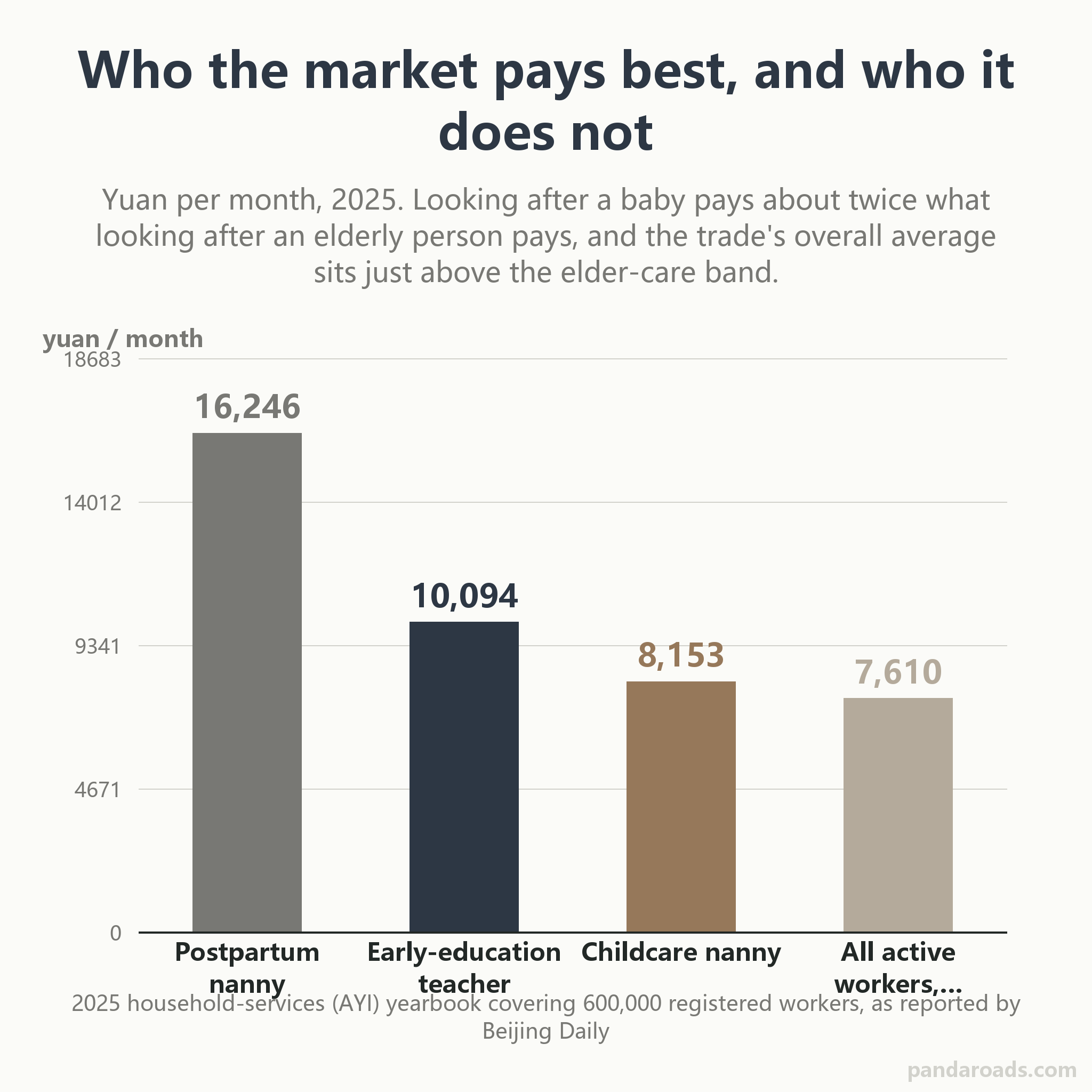
| Household worker, all roles | National platform average for active workers | China | 7,610 | 2025 household-services yearbook, 600,000 workers (source: xinwen.bjd.com.cn) |
| Subsidized door-to-door package, lowest tier | 13 hours of visit-based care a month | Shanghai | 660 | Shanghai Civil Affairs Bureau package pricing (source: sixthtone.com) |
| Subsidized top-tier package | 24-hour attendance | Shanghai | 8,220 | Same pricing (source: sixthtone.com) |
The full distribution is wider than the averages. That 2025 monitoring puts the high end at 10,706 yuan a month and the low end at 3,083, with the average up 597 yuan on 2024 (source: mzj.sh.gov.cn). Convert at whatever the rate is the week you actually pay, because that moving number is a real cost of paying a China wage from a US salary.
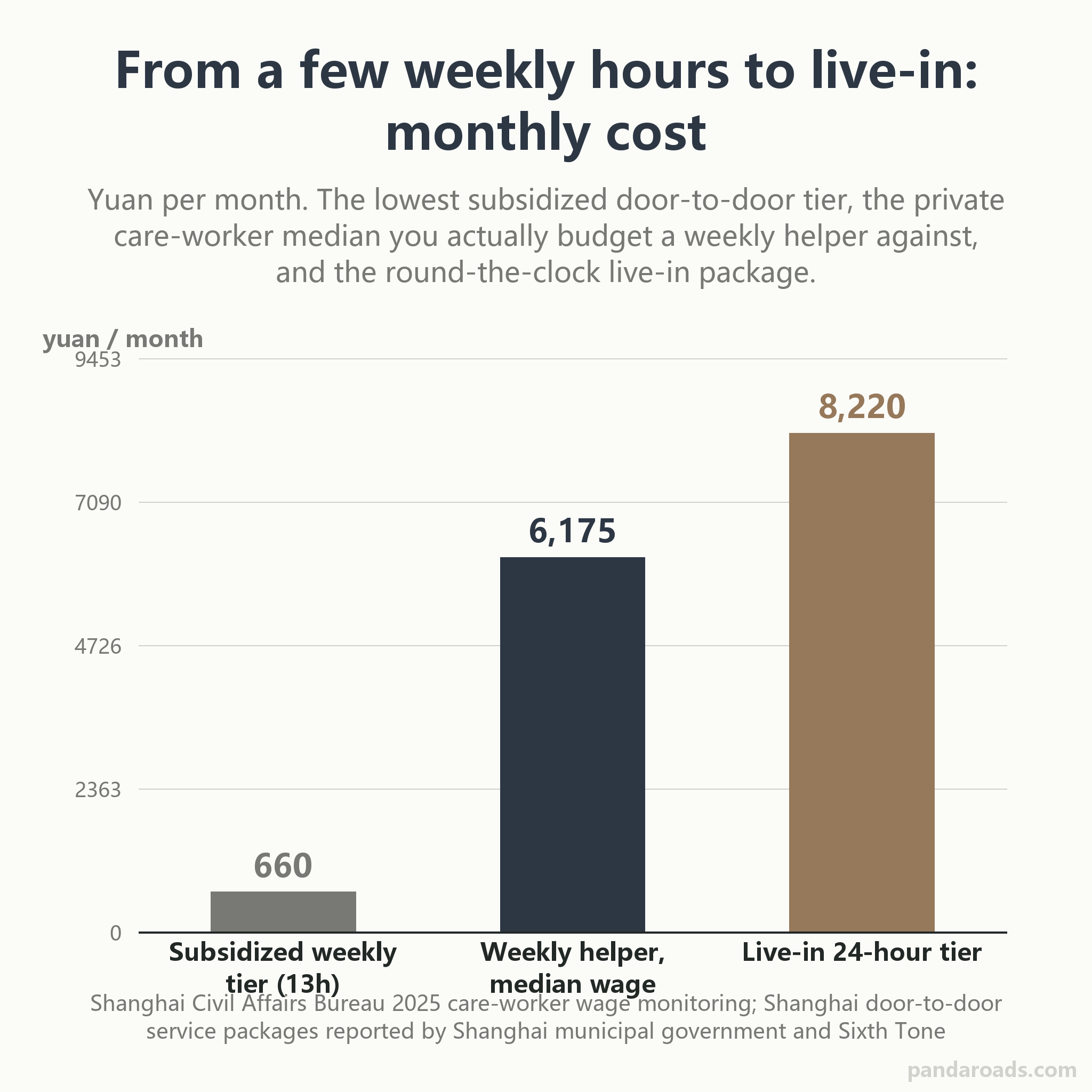
Now the sentence that matters more than the table. A private, weekly, in-your-mother's-home arrangement usually lands somewhere between the citywide median wage and the central-district average, plus an agency margin, plus room and board if the role is live in. Budget the person at 6,000 to 8,000 yuan a month in a tier-one city before margin, and treat the 660 yuan figure as a different product with 13 hours attached to it. For contrast, what a discrete job costs when it is bought from a verified local team is published per task, in US dollars.
Which is why the cost question is the smallest part of the cost. Somebody pays 660 yuan a month for thirteen hours and still ends up hiring a second woman informally for the shopping, the cooking and the Tuesday, because the subsidized hours are rationed and clinical. The number that blows up is not the wage. It is the turnover, the re-hiring, the month when the helper resigns without notice and you are back at the beginning, thousands of miles away, with a parent who is now less able to be alone than before.
Why good elder help is so hard to find, in three numbers
You have probably concluded that you are bad at this, or unlucky, or that Chinese agencies are deliberately hiding the good candidates from overseas families. The data says something less personal.
Start with the demand, because it explains the queues. By the end of 2024 China had 310.31 million people aged 60 or above, 22.0 percent of the population, and 220.23 million aged 65 or above, 15.6 percent, per the national annual bulletin on elderly development (source: cncaprc.gov.cn). Shanghai alone counted more than 5.68 million residents aged 60 and above as of 2023 (source: english.shanghai.gov.cn). Then look at the supply side, which is what the 2025 household-services yearbook actually measures.
Number one: pay. The 2025 household-services yearbook built on 600,000 registered domestic workers puts the average active monthly wage at 7,610 yuan, and breaks it by role. Postpartum nannies average 16,246 yuan. Early-education teachers 10,094. Childcare nannies 8,153 (source: xinwen.bjd.com.cn). Looking after someone's baby pays roughly twice what looking after someone's mother pays. That is not a moral statement, it is a labor market, and it explains who you will actually find available on a Tuesday afternoon.
Number two: certification. 41.9 percent of active household workers hold a vocational certificate. Among postpartum nannies it is 76.2 percent, among childcare nannies 41.2 percent, and among elder care workers 18.1 percent (source: xinwen.bjd.com.cn). The least certified corner of the trade is the one you are trying to staff, which is why "she has done this for years" is doing so much work in an agency listing, and why the verification checklist two sections down is not paranoia.
Number three: age. Workers under 40 are 11.7 percent of those active in household services, though they are 15.3 percent of newly registered ones, and 38.3 percent of surveyed workers say they would train in elder care at some point (source: xinwen.bjd.com.cn). There is a pipeline. It is just not flowing into your mother's flat yet.
Shanghai is trying to buy its way to the same destination. Its 2025 wage monitoring shows care-worker pay climbing with certification, from 6,124 yuan a month at junior level through 6,308 intermediate, 7,378 senior and 8,743 at technician, and the city pays a qualified worker an entry subsidy of 30,000 to 40,000 yuan spread over five years plus a monthly incentive of 548 to 2,740 yuan to stay in the job (source: mzj.sh.gov.cn). Read that as a signal about where the labor is going: into institutions that can register the worker and claim the subsidy, not into private households that cannot.
Tip: Design the arrangement for turnover instead of pretending you found the one irreplaceable aunt. Assume she leaves. Decide now who has her phone number, who holds the spare key, what the notice period is, and how the reporting continues while you re-hire.
The subsidized route, and exactly where it stops
Before you pay full private rate, know what the city already buys, because over-paying for something half-subsidized is the most common expensive mistake an overseas child makes. Under-paying the other way is worse.
Shanghai's long-term care insurance pilot, running since 2016, reimburses 90 percent of door-to-door care and caps the top tier at seven one-hour visits a week. It covers medical and hygiene tasks and explicitly excludes laundry and cooking. City packages are priced from 660 yuan a month for 13 hours up to 8,220 yuan for 24-hour attendance (source: sixthtone.com).
Shanghai's long-term care insurance pilot has run since 2016. It reimburses 90 percent of the cost of door-to-door care, so the family carries 10 percent, and the top tier provides seven one-hour visits a week. The catch is written into the benefit: it covers medical and personal hygiene care only, and explicitly excludes domestic tasks such as laundry and cooking, which is why most families buy an in-home service package on top of it (source: sixthtone.com).
Those packages are priced by the Shanghai Civil Affairs Bureau from a lowest tier of 660 yuan a month for 13 hours of door-to-door service up to 8,220 yuan a month for a 24-hour escort, with third-party providers subsidizing the rates (source: sixthtone.com). Do the division on the cheap tier. Thirteen hours a month is three hours a week. Somebody is sitting with your mother for the length of one episode of television, and the clock is running while she decides whether to mention the fall.
What the funded hours cannot buy is the thing the whole arrangement is actually for. One Shanghai care worker said some of the older people she visits tell her they are happy to see her, and that she is probably the only person they meet that day; a worker at a 24-hour emergency center said one hour a day, or two or three hours a week, is far from enough, and that the elderly keep talking to whoever visits because they need someone to talk to (source: sixthtone.com). Most in-home caregivers in the city are around 50 years old, work roughly ten hours a day across a queue of clients, and earn a little over 10,000 yuan a month, while the average age of long-term-care-insurance beneficiaries is above 80 (source: sixthtone.com). That is a stretched system, not a neglectful one.
So the public track pays for hygiene and medical tasks. It does not pay for a warm meal, a walked dog, a queue at the bank, or a Tuesday of company. That gap is precisely the job a privately hired helper fills, and it is why the realistic answer for most families is both: the assessed subsidized hours for the clinical floor, and your own hired woman for the life around it.
One more public lever gets misread from abroad. Shanghai's caregiver leave, effective November 1, gives an employee up to five working days a year, and it exists only while the parent is formally admitted for continuous inpatient treatment. Outpatient visits and emergency observation do not qualify, unused days cannot be carried over, and there is no payout for them (source: english.shanghai.gov.cn). Five days, and only after a hospital bed. That covers nobody's ordinary week.
How to check a stranger before you let her inside
There is a real verification system in China, and almost no English-language guide tells you it exists. It was built to solve exactly your problem, and it is in Chinese.
The machinery comes from a nine-department notice issued by the Ministry of Commerce and eight other bodies in April 2025. It directs the sector to build out a national household-services credit information platform collecting records on both companies and workers; to push the 家政信用查 app and mini-program onto every internet platform and link it to local credit systems; and to issue an electronic 居家上门服务证, an in-home service certificate that displays a worker's employment record to the consumer. The same notice asks local authorities to collect consumer evaluations of individual workers and display them lawfully, requires companies to observe fee-publication rules, revises the model household-service contract text and promotes electronic contracts, rolls out an industry pledge covering company, consumer and worker conduct, and supports accident and professional-liability insurance for workers who are real-name verified on the national platform and hold that certificate (source: mofcom.gov.cn). It also promotes household services plus elder care integration, so qualifying companies can take government-purchased door-to-door contracts, and encourages selling by the item and by the timeslot through neighborhood outlets (source: mofcom.gov.cn). That last line is the policy scaffolding under the hourly helper you are booking for two fixed days a week.
Here is the checklist to hand any agency, phrased as demands rather than questions.
- The company's registered legal entity, and a business license someone can actually look up. Not a brand name on a WeChat header. That record is searchable by anyone, and the ten-minute registry check costs nothing.
- The worker's certificate by name and issuing body. Only 18.1 percent of elder care workers hold one, so if she has none, that is information, not disqualification (source: xinwen.bjd.com.cn).
- Her record on the national platform and the electronic service certificate, screenshot in hand, sent to you and not merely shown to your father.
- The fee schedule in writing, because publication is a requirement and a company that resists it is telling you something.
- The contract on the revised model text, with the electronic-contract option taken up. A receipt is not a contract.
- Who her employer legally is, because the employee-based model changes who is liable when something goes wrong.
- Whether accident and professional-liability insurance are in place for her specifically.
- A named substitute and a stated notice period on both sides, in writing, before she starts.
Now the honest limits, because overstating this would be the actual failure. The platform is Chinese-language. It is unevenly populated, since only a fraction of the trade is registered anywhere. A certificate proves someone completed a course, which is a floor and not a character reference. And none of it tells you whether she is patient at 4pm when your mother has asked the same question nine times.
The one thing no platform supplies is continuity. Certificates do not arrive on a Tuesday. A person does, or she does not, and the only record of which is the report described below.
The two walls: a contract you cannot read, a wage you cannot send
Two people wrote the sentences that should have been the introduction to this article. On r/chinalife an adult child asked: "How can I research into private elderly care services? (I'm an ABC who can't read chinese, but I'd appreciate some key chinese words to look up..." Another, on the same board, wrote: "If they move back, they also need someone who can help them with their day-to-day stuff. The way things are done in China is so different..." Those two quotes are the walls named in this section's title: a research system you cannot read, and a set of local habits you cannot see coming.
Every national verification tool for Chinese household services, the credit platform, the electronic in-home service certificate, the revised model contract, is published in Chinese under a nine-department notice issued in April 2025 (source: mofcom.gov.cn). Payment is the second wall. Overseas cards cap at roughly RMB 3,000 per transaction on Alipay and RMB 6,000 on WeChat Pay (source: china-briefing.com).
Name the cruelty in the first one precisely. Every tool in the previous section is a Chinese-language document. The credit app, the service certificate, the model contract, the published fee schedule, the agency listing, the district bulletin about subsidies. The person with the money, the legal authority and the worry is the one person who cannot open any of them. This is not a translation problem you can solve with a screenshot at midnight. It is the structural condition of the whole arrangement, and it is why so many overseas families end up delegating the entire verification chain to whoever is physically in the room, which is usually the parent, who is the reason for the hire in the first place. When the document you cannot read is also a document you cannot reach, physical papers are a collection and shipping job.
Paste these into a search box or a message to a relative, and let a browser or a person translate the results.
| Term | What it means, and what you search it for |
|---|---|
| 保姆 | Household helper, generally cooking and cleaning, sometimes staying in |
| 护工 | Care worker, the hands-on hygiene and mobility role, hospital or home |
| 养老护理员 | Certified elder-care nurse aide, the credentialed version of the above |
| 住家阿姨 | Live-in auntie, room and board included, the 24-hour household version |
| 白班 | Day shift, in and out at set hours, no overnight |
| 钟点工 | Hourly worker, paid by the visit, the twice-a-week shape |
| 家政服务 | Household services, the industry term and the platform category |
| 居家上门服务 | Door-to-door home service, the government-purchased version |
| 长期护理保险 | Long-term care insurance, the assessed and subsidized track |
| 家政信用查 | The national household-services credit lookup app and mini-program |
| 陪诊 | Hospital escort service, the by-the-hour clinical errand |
Then the second wall, which is arithmetic and not language. A wage in the 6,000 to 8,000 yuan range does not clear as one card payment. Foreign-issued cards linked to the Chinese wallets are capped at roughly RMB 3,000 per single transaction on Alipay, and on WeChat Pay at RMB 6,000 per transaction with a monthly cumulative ceiling of RMB 50,000, while the transaction fee is waived below RMB 200 and charged at 3 percent above it (source: china-briefing.com). So a monthly wage either arrives as several payments, which trips a per-transaction ceiling somewhere, or it does not arrive on the day it is due.
Follow that consequence to the end, because it is the part nobody predicts. The payment that actually keeps a good woman from quitting without notice is the small one your mother makes herself, from her own phone, in yuan, on time. The system that runs on that is a household economy where your parent is the payer, which is exactly the parent who is forgetful, or being flattered by somebody who has learned which button to point at.
The workable shapes are unglamorous. An agency invoice paid as a service, which is a business payment and not a transfer to a person. A helper with her own wallet and her own card, receiving a fixed schedule of small payments with receipts she can see. Or a named party on the ground who settles the wage, shows the record, and is not family. None of these is a fintech trick. They are about who is holding the pen when the money moves. That same question, who is on the ground holding the receipt, is what running errands in China from overseas is built to answer.
What a good week looks like: the Tuesday report spec
The twice-a-week reader quoted at the top of this article did not describe the cleaning. They described the woman talking to them afterward, explaining how it went. That is the thing being purchased. Write the specification down, put it in the agreement, and hold whoever you hire to it.
Shanghai sells door-to-door care in fixed blocks, 13 hours a month at 660 yuan and 24-hour attendance at 8,220 yuan, which is the pricing shape a private weekly report should copy. Bill in hours, dates and observable items rather than a general impression. A report with 10 named items can be audited, and a sentence saying all is well cannot (source: sixthtone.com).
| Item in the report | Why it matters | Failure mode if it is missing |
|---|---|---|
| A short video of the parent moving, not a photograph | A still can be a month old | You are reassured by an image from a better week |
| The same fixed weekday and time every visit | The value is the pattern, not the visit | Nobody can tell whether a visit happened at all |
| A two-minute walk-through of the flat, including the bathroom floor and the inside of the fridge | Shows the actual condition of a person living alone | Small regressions accumulate invisibly |
| What was eaten that day, and roughly how much fluid | Intake is the earliest honest signal | Weight loss surfaces only at a hospital |
| Medication boxes photographed, pill count read to camera | Adherence is the difference between stable and declined | Twice-daily becomes occasional |
| Sleep, and any fall, asked as a question to the parent | The parent answers, on camera | Falls get reported to nobody, or reported late |
| One sentence in the parent's own voice | Proof of mood as much as proof of life | Loneliness stays invisible until a crisis |
| Money spent, with a receipt photographed | Protects both your parent and the helper | Cash goes missing and everyone is a suspect |
| One line of judgment from the worker, in Chinese, translated | The only part you cannot get from a checklist | You get evidence of presence and none of observation |
The cadence rule matters more than the content. Fixed days. One report per visit. Delivered to one named person in the family, not dumped into a group where everyone assumes someone else read it. And a missed report triggers a phone call the same day, not a negotiation next week. A schedule with no consequence is a hope. What a paid written deliverable has to contain, item by item, is published as a standard.
Now be honest about what a report is. It is a claim. It becomes evidence only when somebody independent can vary it, which produces two rules families skip. The person who writes the report must not be the person who chose the helper. And every few weeks, somebody should arrive unannounced, not to catch anyone out, but because the only thing that validates a report is an independent observation of the same room.
Expect the report to change character over a year, and watch for it. It starts as three minutes and a paragraph. It becomes ninety seconds and four words. Then it becomes a photograph of your mother asleep, which is technically compliance and functionally silence. The shortening is the signal, and the next section is what to do when you see it.
Red flags, and what to do when one fires
Anchor the fear to a document instead of to intuition, because the document is better than folklore. GB 38600-2019, the basic specification for service safety in elderly care institutions, was approved on 27 December 2019 and is the first mandatory national standard in China's elder-care field. It runs in seven parts covering basic requirements, safety risk assessment, service protection and management, and its service-protection half names nine risk categories to be prevented and handled: choking, pressure sores, falling out of bed, scalding, falls, wandering, harm by others and self-harm, accidental ingestion of the wrong medicine or food, and accidents during recreation and sport. Families summarize them as the nine preventions (source: xuancheng.gov.cn). The standard also makes day-and-night patrol and shift handover a basic requirement and calls for a safety risk assessment before admission, with a two-year transition period before enforcement (source: xuancheng.gov.cn).
Be exact about the limit. That standard binds institutions, not the woman you hired through a neighborhood agency for two afternoons a week. It is still the most useful checklist a family can hold anyone to, because those nine categories are precisely how people come to harm in a chair or a bed. Translate it into two questions for whatever company you sign with: who checks, how often, and what gets written down.
China's only mandatory elder-care safety standard, GB 38600-2019, was approved on December 27, 2019 and lists nine risk categories an institution must prevent, from falls and choking to harm by others. Read it as the family's flag list too. When one fires, book an unannounced visit and a medical appointment inside the same week (source: xuancheng.gov.cn).
Then the flags you can actually see from abroad, grouped by where they show up.
The report. It shortens. It arrives late. It becomes photographs of a sleeping person. Every video is shot from the same corner of the same room.
Your parent. They stop speaking on camera, or start answering questions for the helper. They sound flat, or apologetic, or rehearsed. They repeat a complaint about one specific person and then withdraw it when asked again.
The body. Unexplained bruising, especially on upper arms and wrists. A weight trend nobody can explain. A new fear of the bath. Untreated pressure sores. A smell reported on a fixed weekday, which is a laundry failure and not an accident.
The money. Cash going missing. Your parent's phone being used to pay the helper. A sudden loan request, a new "my nephew needs" story, or a request to move pay earlier in the month.
The household. Official notices unopened for weeks. A meter climbing while the parent says nothing changed. A neighbor who appears to know more than the report does. The same drift shows up in an apartment nobody in the family can visit, which is why looking after a Chinese property for an overseas owner is a standing service and not an emergency one.
Warning: The first flag is not the moment for a conversation. It is the moment for an unannounced visit and a hospital appointment booked for the same week. Questions get answered. Appointments do not.
Then know what a weekly helper is the wrong tool for, and buy the right one. A hospital workup is an escort job, billed by the hour and covered in our airport pickup and hospital escort article, where the escort's defined duties already include registration, examinations, payment, medication collection and telling the family what the doctor said. A bad week when cooking is off the table is a meal job, covered in sending food delivery to family in China. A care package is a courier job, and sending a parcel inside China has its own real-name rules. A live-in gap over Chinese New Year is a placement problem, and it is a real one: Shanghai reporting describes a family exposed the year their live-in caregiver asked for leave and the nursing home option was too far away with fixed visiting hours (source: sixthtone.com).
The thing to hold onto when a flag fires is this. The fix is never more surveillance of the helper. It is a second person who can walk in.
Frequently asked questions
How do I hire a caretaker for my parents in China while I live in the US? Choose the role before the person, then hire through a registered company rather than a private introduction, demand the certificate and credit-record checks listed above, and put the reporting schedule in the agreement. Your location is not the obstacle. The absence of a written reporting line is.
How much does a live-in helper for elderly parents cost in China? Shanghai's 2025 monitoring of 888 care institutions puts the average care-worker wage at 6,202 yuan a month and the median at 6,175, with central districts averaging 6,743 and far suburbs 5,515 (source: mzj.sh.gov.cn). A national yearbook of 600,000 household workers puts the all-role average at 7,610 yuan (source: xinwen.bjd.com.cn). Live-in roles add room and board.
What is the difference between a baomu, a hugong and a peizhen shi? A 保姆 is a household helper who cooks and cleans. A 护工 is a care worker doing hygiene, mobility and feeding. A 陪诊师 is a hospital escort billed by the hour, roughly 300 yuan for four hours in Shanghai, who handles registration, tests, payment and medication (source: english.shanghai.gov.cn).
Can I pay a caregiver in China from America with a foreign card? Not in one payment at wage level. Linked overseas cards are capped near RMB 3,000 per transaction on Alipay and RMB 6,000 on WeChat Pay, with a RMB 50,000 monthly ceiling, and transactions above RMB 200 carry a 3 percent fee (source: china-briefing.com). Pay an agency invoice, or fund a scheduled local payment.
How do I vet a home caregiver in China if I cannot read Chinese? Ask the agency to produce three things on screen: the company's registered legal entity, the worker's electronic in-home service certificate, and her record on the national household-services credit platform via the 家政信用查 app, all created by the 2025 nine-department notice (source: mofcom.gov.cn). Then have a translator render the contract text, not a summary.
Does Shanghai long-term care insurance cover help at home? It reimburses 90 percent of assessed door-to-door care, with the top tier buying seven one-hour visits a week, but it covers medical and personal hygiene tasks only and explicitly excludes laundry and cooking, which is why families add a private helper or a service package (source: sixthtone.com).
Can the same weekly helper take my parents to hospital appointments? Sometimes, and it should not be assumed. Registration, examinations, payment, medication collection and post-visit communication with family are the defined tasks of a trained hospital escort, a separate profession that districts had begun certifying at 100 people each by July 2025 (source: english.shanghai.gov.cn).
What are the warning signs that a caregiver is neglecting my elderly parent? Treat a shortening report, a parent who stops speaking on camera, unexplained bruising, a new fear of bathing, untreated pressure sores, missing cash, or the parent's phone being used to pay the helper as one event, not one data point. Book an unannounced visit and a medical appointment the same week.
The bottom line
You cannot be in the hallway on a Tuesday. That is the whole problem, and no amount of planning changes it. What you can build instead is a fixed weekday, a certificate and credit record somebody can screenshot for you, a contract on the revised national model text, a report that shows a moving person rather than a still photograph, and a rate you can see before anyone starts work.
That last part is why PandaRoads publishes one: a Local Errand at $239 including one trip within 30 km, with photographs and receipts, remote tasks at $129 per request, on-site field work at $239 per day, and single errands at $239, with an itemized quote approved before anything is charged (source: pandaroads.com). The limits are published alongside it, and they are worth repeating here. Coordination is not care. A report is not a witness. Nobody at PandaRoads signs your contract or collects a large payment on your behalf, and a weekly helper hired for your mother remains her employee or her agency's, not ours.
If you take one question to any provider, including us, take this one. Who writes the report, and who reads it if you do not?
Then the reason the whole unglamorous apparatus is worth building. A Shanghai woman who visits older people living alone told a reporter that some of them say they are glad she came, and that she is probably the only person they see that day (source: sixthtone.com). Twice a week, somebody talks to your mother and tells you how it went. That is the product. Everything above is how you keep it.
References
- Shanghai Municipal Civil Affairs Bureau. (2026, September 13). 2025年度上海养老护理员工资收入监测数据公布 [Wage and income monitoring data for Shanghai's elder-care workers, 2025]. Shanghai Municipal Civil Affairs Bureau. https://mzj.sh.gov.cn/2026bsmz/20260913/5b2901920c26474a83b794908f46aea8.html
- National Office on Aging of China, & Ministry of Civil Affairs. (2025). 2024年度国家老龄事业发展公报 [2024 national bulletin on the development of aging affairs]. China National Committee on Aging Research Center. https://www.cncaprc.gov.cn/u/cms/www/202507/24154203fka1.pdf
- Shanghai Municipal Government. (2025, February 14). Nine Shanghai districts offer hospital escorts for elderly. Shanghai Municipal Government. https://english.shanghai.gov.cn/en-Policies/20250214/c3d062890e6545feb29950d745f82734.html
- SHer Life. (2023, December 27). How Shanghai is redefining aging with in-home care. Sixth Tone. https://www.sixthtone.com/news/1014325
- Beijing Daily. (2026, February 11). 2025年阿姨年鉴发布:高学历干家政多浅尝未深耕 [The 2025 AYI yearbook is published: better-educated household-service workers sample the trade but rarely settle in]. Xinwen Beijing Daily. https://xinwen.bjd.com.cn/content/s698c707de4b0687a2891201f.html
- Shanghai Municipal Government. (2025, December 5). Caregiver leave rules and eligibility conditions in Shanghai [FAQ]. Shanghai Municipal Government. https://english.shanghai.gov.cn/en-FAQS-WorkinShanghai/20251205/acf55871f2a84a53844549811796ce38.html
- Ministry of Commerce, National Development and Reform Commission, Ministry of Human Resources and Social Security, & eight other departments. (2025, April 18). 商务部等9部门关于促进家政服务消费扩容升级若干措施的通知 [Notice of the Ministry of Commerce and nine departments on measures to expand and upgrade household-services consumption] (Document No. 商服贸函〔2025〕76号). Ministry of Commerce of the People's Republic of China. https://www.mofcom.gov.cn/zcfb/fwmy/art/2025/art_b00237fbc9194354a362511c9962b5c6.html
- China Briefing. (2023, July 24). WeChat enables foreigners to pay with overseas cards in China. China Briefing. https://china-briefing.com/news/wechat-enables-foreigners-to-pay-with-overseas-cards-in-china/
- Xuancheng Municipal Civil Affairs Bureau. (2020, January 16). 市民政局局长解读《养老机构服务安全基本规范》强制性国家标准 [Director of the Municipal Civil Affairs Bureau interprets the mandatory national standard GB 38600-2019 on basic service-safety specifications for elderly-care institutions]. Xuancheng Municipal Government. https://www.xuancheng.gov.cn/OpennessContent/show/1804904.html
- PandaRoads. (2026). China sourcing and local task service from $129 [Service page]. PandaRoads. https://pandaroads.com/china-tasks.html
Last reviewed and updated: September 2026. Author: our editorial team. For tailored guidance, read how the service runs or send the brief and get a fixed quote.