Send Food Delivery to Family in China From the USA
The 12-hour call that lands as a hot birthday dinner: how ordering a meal, cake or flowers for parents inside China works when you are abroad, what the apps block on foreign cards, real market prices, photo proof, and the honest limits of a remote surprise.
Last updated: July 2026 · By the PandaRoads team in China
TL;DR
You cannot order on China's delivery apps yourself from the US because they need a local phone number and a domestic wallet; for a one-off meal, birthday cake or bouquet to a parent in China, the workable path is a per-job concierge errand where someone on the ground places the order on the Chinese apps with a domestic wallet, schedules the date, calls the recipient ahead and sends you photo proof, with the item reimbursed at cost and the service priced per job (PandaRoads Local Errand from US$59) rather than as a big app.
Abstract
A plain-English answer for someone living in the United States who wants to send a hot meal, a birthday cake or flowers to parents or grandparents physically inside China: why the Chinese on-demand apps will not open to you from abroad, what a per-job concierge delivery actually costs and takes, how the order is placed on the local apps with a domestic wallet and confirmed with photo proof, and what no service can honestly promise.
Key Takeaways
- The Chinese delivery apps need a local number and wallet, so you cannot self-serve from the US
- For a parent, the real gift is proof it arrived, not the food itself
- Item cost is reimbursed at receipt; our service is priced per job, not a percentage
- A delivered meal is a restaurant meal, never home cooking, say so
- Call ahead and photo proof are the two things DIY cannot give you
- China is 12 to 15 hours ahead; order in Beijing time and a day early
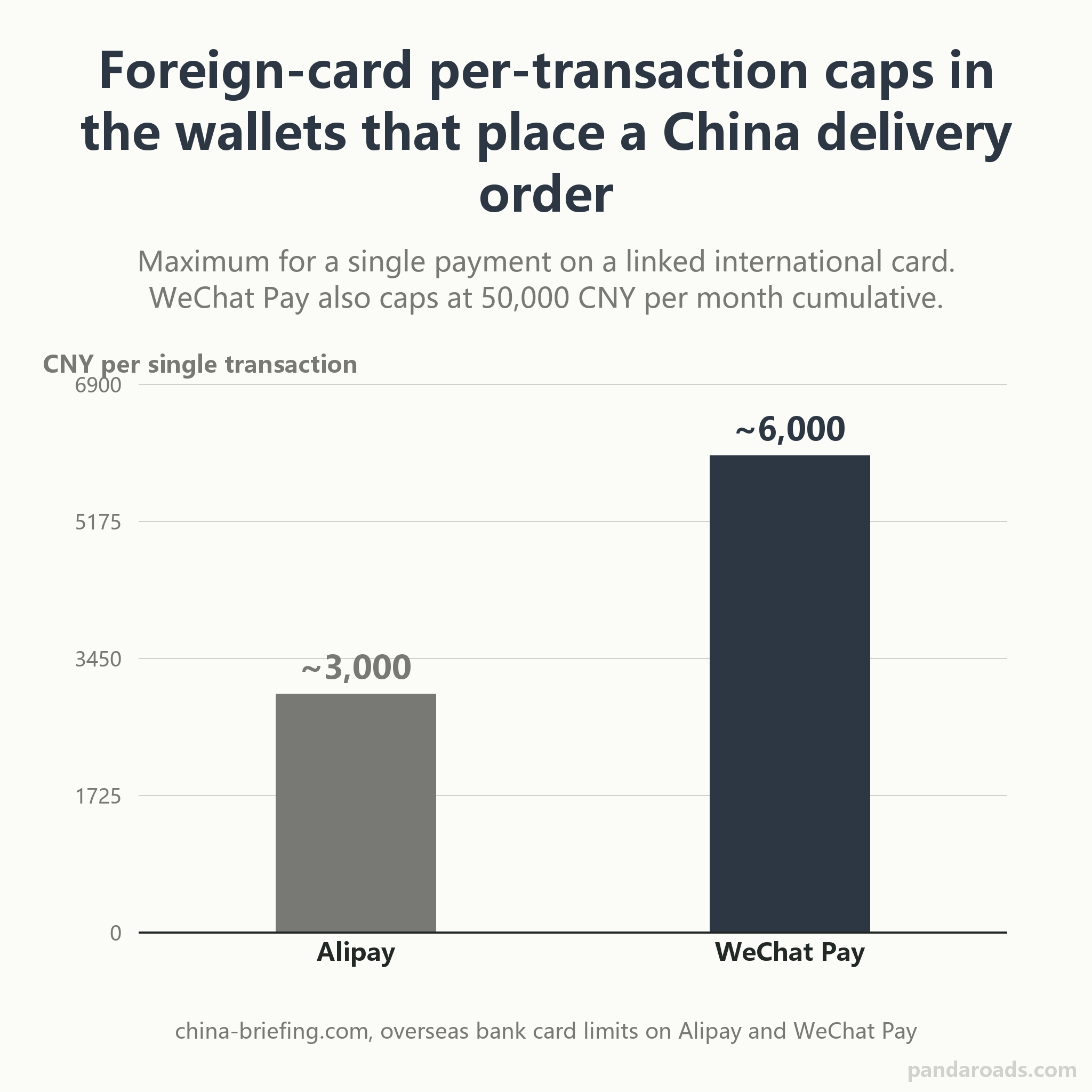
- A foreign card is capped low inside the wallet (Alipay ~3,000, WeChat ~6,000 CNY)
Table of Contents
- Abstract
- Key Takeaways
- The blocker: you cannot just open the app and order for Mom
- What sending a delivery to family in China really means
- The three scenes, priced honestly
- Can you do it yourself from the United States? A plain comparison
- How the plumbing works, and why the apps stay invisible
- A real order, step by step
- Time zones, lunar birthdays, and the calendar problem
- What no one can honestly promise you
- When this is the wrong tool, and what fits better
- Frequently asked questions
- The bottom line
- References
The blocker: you cannot just open the app and order for Mom
It is late in New Jersey and you are thinking about your father in Fuzhou. He lives alone since your mother passed, he is proud, and he has been quietly skipping proper meals. All you want is for someone to put a hot lunch on his table tonight, and for you to know, without guessing, that he actually ate it. A son in California wants the same thing for his mother's seventieth, only with a cake that says 生日快乐 and a card that came from him.
Here is the wall those plans hit. The Chinese delivery apps will not simply open for you in the United States. To register you need a phone number that can receive a text verification code, and to pay you need a domestic wallet, not the card in your American wallet (source: english.shanghai.gov.cn). The whole flow assumes you already live inside China and read the interface in Chinese. That is not a small inconvenience. It means the obvious answer, "just order it on the app", quietly assumes the one thing you do not have: a local account and a way to pay that actually works there.
So for a one-off delivery that carries real feeling behind it, the question stops being which app to open. It becomes who, on the ground, can place the order, time it right, make sure a parent answers the door, and send back proof that it landed. That is a person, not a button, and this page walks through exactly how that works, what it costs, and the parts no one can promise you.
Sending a hot meal to a parent inside China is blocked for most US residents because the Chinese on-demand apps require a local phone number for the sign-up code and a domestic wallet to pay, not an American card (source: english.shanghai.gov.cn). The workable path is a per-job concierge delivery, priced from US$59 plus the item at cost.
What sending a delivery to family in China really means
"Send food delivery to family in China" is a fuzzy phrase, and it helps to split it into the three concrete jobs people actually mean.
The first is the everyday hot meal. This is the "did mom actually eat lunch" errand, the quiet weekday worry that a parent who lives alone is getting by on leftovers and tea. It is not romantic, which is exactly why it matters. You are not trying to impress anyone; you are trying to make sure he sat down to something warm and fresh.
The second is the birthday. A cake is the modern version, and the traditional one is a bowl of longevity noodles, 长寿面, delivered so the person you love does not have to cook on a day that should be about them. The birthday scene is where distance stings the most: everyone is on a video call, and you wish you had put something real in front of them.
The third is the flowers, for a date you cannot be in the room for: Mother's Day, an anniversary, an apology, a get-well. A bouquet at a door is a message that arrived in person while you could not.
Notice what all three have in common. The object, the noodles or the cake or the roses, is not really the gift. The gift is reassurance that someone showed up, plus proof for you, thousands of miles away, that it happened. That is the job the service has to do.
One honest framing up front, because you deserve it: this is not a giant app with a checkout button and instant confirmation. Sending a meal to your parents in China is a concierge task, done one job at a time by a small local team, priced per job. Everything below follows from that.
The phrase breaks into three concrete jobs, an everyday hot meal, a birthday cake or longevity noodles, and a flower bouquet, and in each case the real gift is proof the item arrived rather than the food itself. PandaRoads handles these as a per-job concierge errand from US$59, with the item reimbursed at cost.
The three scenes, priced honestly
Cost is the question everyone asks second, after "can I even do this". Here is the shape of it across the three scenes, with the parts you can verify and the parts you cannot pin down until you see the receipt.
The single most important thing to understand about pricing: the food, cake or bouquet is not something we mark up and hide inside a flat fee. It is paid at cost, off the app, and returned to you as a line item with a receipt. PandaRoads settles small material fees item by item with receipts (source: pandaroads.com). That means no one can honestly hand you a fixed total for "lunch for dad", because the real number is whatever that restaurant charged, which you will see. What is fixed is the service, and what is comparable is the market price of the item itself.
| Scene | What the item tends to cost | How our service is priced | Typical lead time | Proof you get back |
|---|---|---|---|---|
| Everyday hot meal | Paid at cost off the app receipt; a single lunch is a modest RMB line item (source: pandaroads.com) | A Local Errand, published from US$59 per job, two business day window (source: pandaroads.com) | Same day once scheduled; the app shows an expected wait time and live rider tracking (source: english.shanghai.gov.cn) | Delivery photo plus the itemized receipt |
| Birthday cake | Comparable abroad-to-China listings run about US$58 for a hand-delivered 6 or 8 inch cake, with another site at roughly US$66 to US$87 (source: iweiyi.com) (source: floweradvisor.cn) | Same per-job errand basis, item reimbursed at cost (source: pandaroads.com) | Same-day or a chosen date; fast 1 to 3 hour delivery in many cities (source: iweiyi.com) | Delivery photo, receipt, and the card message sent |
| Flower bouquet | Abroad-to-China florists list from the low US$50s up to roughly US$60 to US$86 (source: 999florist.com) | Same per-job errand basis, item reimbursed at cost (source: pandaroads.com) | Same-day or next-day, with a free greeting message (source: 999florist.com) | Delivery photo plus the receipt |
Read the middle column as the constant and the second column as the variable. Your service cost is the same whether the meal is a twenty-yuan noodle bowl or a big fruit cake; what changes with the scene is the item you are reimbursing for. And because the item price is whatever the local shop charged, we never guess your parent's exact bill. It arrives on the receipt.
If you have seen the abroad-to-China florist and cake sites, you may wonder why you would not just use one. You can, and for a pre-made bouquet or a standard cake they are a real option; their listed prices are exactly what anchors the ranges above. Where a per-job concierge earns its fee is on the things those storefronts do not promise: a specific dish from a specific restaurant, a call placed to your mother before the rider knocks, and a photo sent to you that shows it actually reached her hands. We will come back to that difference.
The service fee is fixed per job at US$59 while the item is reimbursed at cost, so the bill depends on what you order. Abroad-to-China cake listings run about US$58 to US$87 and bouquets from the low US$50s to roughly US$86, with fast 1 to 3 hour delivery in many cities (source: iweiyi.com).
Can you do it yourself from the United States? A plain comparison
Let us be fair to the do-it-yourself route, because sometimes it genuinely is possible and you should know when. If you already have a Chinese phone number, a verified domestic wallet, and you read the interface comfortably, you can send a delivery yourself at no service cost at all. The blocker is for the person who does not have those three things, which is most people reading this from the US.
Here is the honest side-by-side.
| What the job needs | You try it from the US | A local runner does it |
|---|---|---|
| A Chinese phone number to receive the sign-up verification code | Usually no | Yes |
| A domestic payment wallet that the app actually accepts | No, and a US card sits inside a wallet you would have to build first (source: china-briefing.com) | Yes, already running |
| Reading a Chinese-language ordering interface | Rarely | Native |
| Picking a specific date and time across a 12 to 15 hour gap | Painful | Routine |
| Calling your parent before the rider arrives | Not something the app offers | Yes, and it is the whole point |
| Photo proof it reached their hands | None | Yes, sent back to you |
The pattern is obvious once you lay it out. Every row where the DIY column says "no" is not about the food. Nobody is failing to order noodles. The friction is the account, the wallet, and the last hundred meters, the part where a stranger at a door needs a heads-up and a parent needs to actually receive what you sent.
If you are physically in China and read Chinese, this article is not your problem to solve, and there is a plain self-serve walkthrough for you here: order food on Meituan as a foreigner in China. If you are in Ohio on a Tuesday night worrying about your parents, keep reading.
A US card is not the missing piece, because a foreign card is capped inside the Chinese wallet at about RMB 3,000 per transaction on Alipay and RMB 6,000 on WeChat Pay, and it must sit inside a domestic account the recipient does not have (source: china-briefing.com). A local runner already holds that account.
How the plumbing works, and why the apps stay invisible
This is the one technical section, and it stays technical for exactly one reason: so that the rest of the article can be about your parents and not about software. When a runner sends a meal on your behalf, the order is placed on China's mainstream on-demand apps (Meituan, and the Eleme platform, which now operates under Taobao Flash Shopping) from a domestic account with a domestic wallet, using the same flow Shanghai's official guide describes: an SMS-code sign-up, a delivery tab, payment through Alipay, WeChat Pay or the Digital RMB, and a rider note field, 订单备注, where you can leave an instruction like "leave it at the door" (source: english.shanghai.gov.cn).
Why can't a US card just be the answer? Two reasons. First, a foreign card is capped low inside the wallet: roughly RMB 3,000 per single transaction on Alipay, and about RMB 6,000 on WeChat Pay with a RMB 50,000 monthly cumulative limit, plus a 3 percent fee above RMB 200 (source: china-briefing.com). Ordinary meals clear those bars, but the caps exist and they bind the moment you try to do anything larger. Second, and more fundamentally, the card lives inside a buyer's wallet, and the recipient at the door does not have one. Payment has to come from the account placing the order, which is why the order has to be placed by someone with that account.
None of that plumbing is your job. That is the entire service. You do not download anything in Chinese, you do not chase a verification code you cannot receive, you do not fund a wallet from abroad. You describe the meal, or the cake, or the flowers, and a person on the ground runs the apps so you never have to. From here the article goes back to where it belongs, on your side of the phone.
A runner places the order on the mainstream Chinese on-demand apps from a domestic wallet, where a foreign card is capped near RMB 3,000 per transaction on Alipay and RMB 6,000 on WeChat Pay with a RMB 50,000 monthly ceiling (source: china-briefing.com). You never touch this plumbing, you describe the meal and the app work is done for you.
A real order, step by step
Here is what one of these actually looks like, start to finish. No mystery, no app you have to fight with.
-
You describe the scene. The city your parent is in, who it is for, the date, whether it is a working lunch or a birthday cake or a bouquet, and the short message you want them to get. This is the part only you can do.
-
You get an itemized quote. The service fee and the estimated item cost are shown separately, before anything runs. PandaRoads starts no work and charges nothing until you approve a quote, and payment goes through PayPal (source: pandaroads.com).
-
You approve, and the item is bought at cost. The food, cake or flowers are paid from the domestic account and settled back to you item by item, with the receipt, so your total is the real price and not a guess (source: pandaroads.com).
-
The order is placed on the Chinese on-demand app and scheduled for the date and time you asked for, in China time, not yours.
-
We call ahead. Before the rider knocks, someone rings your parent in Chinese and tells them a delivery is coming. This is the step that quietly decides whether a shy elderly father answers the door at all.
-
The rider delivers, and proof comes back to you. A photo of the delivered item, and the receipt. If a dish was sold out or something needed a judgment call, you hear about it rather than finding out a week later.
-
One revision is included. Swap an item, reschedule the day, add the note you forgot. If you need to go deeper, just ask.
The two steps the storefront apps cannot give you are number five and number six, the call and the photo. Ordering the food is the easy part. Making sure it reached your mother's hands, and that you know it did, is the job.
Seven numbered steps take a request from a city and a date to a photographed delivery, and steps 5 and 6, the call placed to your parent before the rider knocks and the photo sent back afterward, are the parts a self-serve app cannot give you. No work starts until you approve an itemized quote, and payment runs through PayPal (source: pandaroads.com).
Time zones, lunar birthdays, and the calendar problem
The logistics failure that catches people abroad is not the order, it is the clock. China runs about 12 to 15 hours ahead of most US time zones, so your Tuesday evening is already your parents' Wednesday morning. If you place an order at "7pm" thinking of your own dinner, you may be sending lunch to a man who has not woken up yet, or worse, a breakfast to a woman who already ate at noon.
The recipe that fixes it is simple. Decide the window in Beijing time, the hours your parent actually eats. Tell your runner the date in China's calendar, not the date on your wall, and say "morning" or "lunch" or "early evening" rather than an American time. Then send it a day early. A one-day buffer means the runner is placing tomorrow's lunch calmly, not racing your middle of the night.
Tip: Set the eating window in Beijing time, give the date in the Chinese calendar rather than your wall date, and book a day early, because a 12 to 15 hour gap turns your Tuesday evening into their Wednesday morning.
The other calendar trap is the birthday itself. A lot of older parents count birthdays by the lunar calendar, so the date your family marks can differ from the one on your phone's reminder. If you are unsure which one your mother celebrates, ask, or send a bowl of 长寿面 longevity noodles on the date she mentions and the cake on the one the calendar shows. Sending slightly too early is never the mistake; showing up on the wrong day is.
Finally, the calendar has seasons, and this work spikes in all of them: Mother's Day, Mid-Autumn when families think hard about the relatives they cannot reach, Chinese New Year, and every ordinary birthday in between. Those dates move faster than the apps expect, so if your parent's day falls in one of those weeks, booking ahead is not optional.
China runs about 12 to 15 hours ahead of most US time zones, so a Tuesday evening in America is already a Wednesday morning for your parents. The fix is arithmetic, choose the eating window in Beijing time, give the date in the Chinese calendar rather than your wall calendar, and book a day early.
What no one can honestly promise you
Any page can sell you the warm feeling. A useful one also tells you what it cannot deliver, so here is the honest list, and a specialist would hand it to you before you paid a cent.
We do not cook. A delivered meal is a restaurant meal or a market meal, and it will not taste like what your mother used to make, because nothing ordered on an app does. If the real wish is your grandmother's specific dish, the kindest thing is often a phone call plus a delivered cake, which admits the meal is not home food and leans on the care instead.
Warning: We do not cook, so a delivered meal is a restaurant meal and not your mother's recipe, and an elderly parent may still choose not to open the door for a stranger. That is exactly why the call ahead and the photo matter more than the order itself.
An elderly parent may not open the door, may not speak to a rider, or may take the food in, put it in the fridge, and forget it entirely. That is the single most common thing that goes quietly sideways, and it is exactly why the call ahead and the photo matter more than the order itself. Nobody who sells you "delivery to China" from an app can control whether Grandma answers. We can call her first and send you proof.
We cannot guarantee that a specific dish is in stock at a specific minute. Sold-out items are ordinary on these apps, and the honest response is to call you or pick the closest substitute you approve, not to swap silently and hope. Payment in China is app-only, not cash on delivery, which is one more reason the order has to run through a domestic account rather than meet your card at the door.
And our own limits are written down, not buried. There are no blanket authorizations, standing arrangements are set up only in writing and you can cancel them via the China life errands service, and we do not sign contracts or move large sums of money; those sit outside this service (source: pandaroads.com). This is a concierge task priced per job, done by a small local team in China, not a national app with a promise for every situation. We would rather you trust the honest version.
Honest limits come before payment, we do not cook, so a delivered meal is a restaurant meal, and an elderly parent may never open the door for a stranger. A Local Errand covers one trip within 30 km inside a two business day window, standing arrangements exist only in writing, and there are no blanket authorizations (source: pandaroads.com).
When this is the wrong tool, and what fits better
The meal, cake and flowers gift is one clear job, and it is what this page covers. But sometimes you arrive here and your actual need is a little different, so here is where to go instead.
If you want a one-time kindness for a date that matters, a birthday lunch, a Mother's Day bouquet, an "I should not live this far away" Tuesday, this is exactly the right service and you can stop reading.
If what you want is recurring care, a standing lunch several days a week, a weekly knock to check someone is up and eating, then a single delivery is the wrong shape and a standing errand is the right one. That kind of ongoing arrangement for people abroad is covered on the China life errands for overseas Chinese page, where you set instructions in writing and cancel anytime.
If what you need is not food at all, a bill paid, a package received and forwarded, a statement collected, a document moved, or a physical visit to check on a place, that is a wider category of on-the-ground tasks, listed on China done-for-you tasks. And if your situation does not fit any fixed package, describe it and get a tailored, itemized price on the task quote page; nothing is charged until you approve it.
This article deliberately stays on the emotionally-loaded gift scene. It will not pretend to be your errand catalogue, your document service, or a self-serve app tutorial. It is about getting a hot meal, a cake or flowers into the hands of someone you love who is far away, and proving it happened.
Getting the scene right matters, a one-time kindness for a date that matters lives on this page, while recurring care is a standing errand and non-food work like a paid bill or a moved document sits in the wider task catalogue. Describe what fits no package and PandaRoads returns an itemized quote within 24 hours, charging nothing until you approve (source: pandaroads.com).
Frequently asked questions
How can I order food delivery for my parents in China from the USA? You generally cannot do it directly, because the Chinese on-demand apps need a local phone number and a domestic wallet to sign up and pay (source: english.shanghai.gov.cn). The workable route is a per-job concierge errand: a runner on the ground places the order with a domestic account, schedules it, calls your parent, and sends you photo proof of delivery.
Can I use Meituan or Eleme myself from outside China? Usually not, and not easily. Registration asks for a phone number to receive an SMS verification code, and payment runs through Alipay, WeChat Pay or the Digital RMB, so the self-serve flow assumes you are already on the ground with a domestic account (source: english.shanghai.gov.cn). A foreign card only works inside a wallet you would have to build first.
How do I send a birthday cake to family in China? Either through a specialist abroad-to-China service, which lists hand-delivered cakes from local pastry shops at roughly US$58 to US$87 with same-day or chosen-date delivery (source: iweiyi.com) (source: floweradvisor.cn), or through a concierge who buys a specific cake, calls ahead, and photographs the delivery for you.
Can I pay for Chinese food delivery with a US credit card? Not on its own. A foreign card is capped inside the wallet at about RMB 3,000 per transaction on Alipay and RMB 6,000 on WeChat Pay, with a 3 percent fee above RMB 200, and it still has to sit inside a domestic wallet (source: china-briefing.com). That is why the payment has to come from the person placing the order.
Will the rider hand the food to my elderly parent or leave it at the door? It depends on the building and the person. Many buildings allow door delivery while others require lobby pickup, and the rider calls on arrival. For an elderly parent, the safe move is a call ahead so they expect it, plus a photo so you know whether it reached their hands or the doormat.
How much does it cost to deliver a cake or flowers in China? For the item itself, abroad-to-China florists and cake sites list roughly the low US$50s to about US$86 (source: 999florist.com) (source: floweradvisor.cn). Add the service: our concierge rides on a Local Errand published from US$59 per job, with the item reimbursed at cost from the receipt (source: pandaroads.com).
Do Chinese food delivery apps have an English version? The ordering flow is built around Chinese, and the interface, menus and rider notes assume you can read them (source: english.shanghai.gov.cn). That is one more reason a runner who reads Chinese natively clears friction you would otherwise hit.
How do I make sure my mom actually received the meal? This is the core of the service. A call ahead means she expects it, and a delivery photo plus the receipt means you see it landed. That combination, not the order itself, is what you are really buying from thousands of miles away.
The bottom line
The distance is real, and so is the wall between you and a Chinese delivery app: a phone number you do not have, a wallet you did not set up, an interface you cannot read, and a parent who will not open the door for a stranger unannounced. None of that is about the food. The food is the easy part.
What you actually control is whether a person on the ground, tonight in your parents' city, can place the order, ring the doorbell's advance warning, and send back a photo that lets you exhale. That is a small concierge job, not an app, and it is priced like one. The meal, cake or flowers are reimbursed at cost from the receipt; the service sits on a Local Errand published from US$59 per job; and nothing is charged until you approve an itemized quote, with payment through PayPal (source: pandaroads.com).
So if there is someone you love in China and a meal or a birthday or a date you cannot be there for, start small and specific. Tell us the city, the person, the day, and whether it is a hot lunch, a cake with their name on it, or a bouquet at the door. You will get a fixed quote first, and if your father actually ate lunch today, you will have the photo to prove it. That proof, more than the noodles, is the whole point.
References
- Information Office of the Shanghai Municipal People's Government. (2026, July 24). How to use food delivery apps. Shanghai Government Portal. https://english.shanghai.gov.cn/en-UsefulApps/20240109/89844b5729d64b199463a156bc8ef43d.html
- China Briefing. (2023, July 24). WeChat enables foreigners to pay with overseas cards in China. China Briefing. https://www.china-briefing.com/news/wechat-enables-foreigners-to-pay-with-overseas-cards-in-china/
- IWEIYI. (2026). Birthday cake delivery in China: fast, fresh and personalized [Product listing]. IWEIYI. https://www.iweiyi.com/en/61-birthday-cakes-delivery-china
- FlowerAdvisor. (2026, September 18). Online cake delivery China: birthday cakes [Product listing and price table]. FlowerAdvisor. https://www.floweradvisor.cn/collections/cakes
- 999 Florist. (2026). Send flowers to China: China flower delivery [Product listing]. 999 Florist. https://www.999florist.com/en/category/2-send-flowers-to-china
- PandaRoads. (2026). China sourcing and local task service from $99 [Service page]. PandaRoads. https://pandaroads.com/china-tasks.html
- PandaRoads. (2026, August). China life errands for overseas Chinese [Service page]. PandaRoads. https://pandaroads.com/china-life-errands-overseas.html
- PandaRoads. (2026). China task quote: get a fixed price today [Quote page]. PandaRoads. https://pandaroads.com/task-quote.html
Last reviewed and updated: September 2026. Author: our editorial team. For tailored guidance, contact our team.