Sell Inherited Property in China From Abroad, Step by Step
A step-by-step procedure for an heir living in the United States who has to sell an apartment or house in mainland China: the five separate transactions that make up one sale, the exact tax lines that fire at inheritance and again at transfer, the notary and registration routes that put title in your name, and the foreign-exchange approval that decides when the money can actually leave the country.
Last updated: September 2026 · By the PandaRoads team in China
TL;DR
Selling an inherited China apartment from abroad is five transactions with five different gatekeepers, not one sale with paperwork attached. Inheritance itself is exempt from individual income tax under Caishui [2009] No. 78, but the sale right after it is not, because the taxable base is measured against what your parent originally paid. The proceeds do not come out of the famous USD 50,000 annual foreign-exchange quota either; they leave on a separate capital-account approval, filed at the foreign-exchange bureau covering the deceased's household registration, where RMB 500,000 is the line between local and national approval.
Abstract
A step-by-step procedure for an heir living in the United States who has to sell an apartment or house in mainland China: the five separate transactions that make up one sale, the exact tax lines that fire at inheritance and at transfer, the notary and registration routes that put title in your name, and the foreign-exchange approval that decides when the money can actually leave.
Key Takeaways
- Inheriting the unit is exempt from income tax, selling it is not
- Your taxable gain is measured against what your parent paid
- Three registration routes exist, notarization is only one
- Sale proceeds are not limited by the USD 50,000 annual quota
- The bank will not move money without a tax clearance document
- Inheritance notary fees are per square meter with a published ceiling
Table of Contents
- Abstract
- Key Takeaways
- What this job actually is: five transactions in a row
- What the sale costs: the tax stack on a 3,000,000 yuan Shanghai apartment
- Stage 1: prove you are the heir and get title into your name
- Stage 2: put the unit on the market without flying out
- Stage 3: sign, transfer title, and settle the taxes that fire on the sale
- Stage 4: the tax clearance the bank will ask for before it touches the money
- Stage 5: which foreign-exchange route your money is actually on
- What it costs to have someone on the ground run the physical parts
- Frequently asked questions
- The bottom line
- References
What this job actually is: five transactions in a row
A parent dies in Guangzhou. Among the things left behind is an apartment, sixty-eight square meters on the seventh floor of a building you have not stood inside since you were a teenager, and the title certificate is in a drawer with your father's name on it. You are in Columbus. You have a job, two kids, and about six weeks before you have to be back, and the first thing you find out is that nobody is going to give you the whole answer. Not the agency, not the notary, not the bank, not the person in the comment thread who is very confident about a number he got wrong.
The reason is structural rather than anyone's fault. What reads as one errand, sell the flat, is really five transactions that have to happen in sequence, each with its own gatekeeper and its own paperwork.
Selling an inherited China apartment is 5 separate transactions, not one: inheritance registration, listing and showing, title transfer with tax settlement, a tax clearance for the bank, and a foreign-exchange approval where a filing above the equivalent of RMB 500,000 leaves the local bureau for the national agency. Each has its own gatekeeper and its own document.
A registration office has to be persuaded you are an heir before the unit is yours to sell. A market has to be run from another country with somebody holding a key. A transfer window has to take the taxes. The tax authority then has to issue the document a bank will demand. And the foreign-exchange administration has to approve the money leaving, on a route that most of the English-language advice online does not know exists.
The threads people actually post in show how badly that framing is missing. One writer on r/China put the whole estate in a single, overwhelmed sentence: "My father has died in China. I don't know how to best deal with his [belongings] ... dealing with the car, house, bank accounts" (source: reddit r/China, 2023-05). Another, working from an inherited Guangzhou apartment, offered the route a neighbor had used: "The cheapest way to handle the selling is to make a deal with a Chinese run foreign business service company in GZ to handle the property" (source: reddit r/China, 2018-04). Both are describing the same thing from different angles: the estate feels like one weight to lift, and nobody has told them it is five hitches that unfasten in order.
Note: Almost every bad outcome in this process is an ordering error. People try to sell before title is in their name, or try to remit before the tax clearance exists, or fly out for a signature that a notarized entrustment would have covered. The stages below are numbered because the order is the information.
How this was sourced. We sampled 10 primary documents for this article, government and tax-authority pages rather than blog summaries of them, and we compared the wording of two official texts on the same rule before we found that they disagree about a threshold. That disagreement is left visible in Stage 5 instead of smoothed over, because a filing line you cannot pin down is the kind of thing that costs you a season.
One boundary before we start. This is about selling. If the better answer for your family is to keep the unit and run it as a rental, that is a different chain, and the sibling article on hiring someone to view and check an apartment in China from abroad covers the condition-evidence and tenant-verification side of it. If the estate is bigger than one flat, the wider errands in China from overseas hub covers what is left over, the car, the accounts, the apartment full of belongings. Everything here assumes the goal is cash, legally, in an account you can actually use.
By the Numbers
- $50,000 The annual individual foreign-exchange quota that does NOT cap a house sale. Implementation Rules for the Measures for the Administration of Individual Foreign Exchange (source: safe.gov.cn)
- ¥500,000 The line where an inherited-asset transfer stops being approved locally and goes to the national foreign-exchange agency (source: safe.gov.cn)
- ¥80 The most a Beijing notary may charge per square meter of construction area for an inheritance, gift or bequest since November 30, 2021 (source: bj148.org)
- ¥10,000 The cap on the total notary fee for one residential unit in that same reform (source: bj148.org)
- 5% The value-added tax collection rate on the full price of a home held under two years, and zero at two years or more (source: shanghai.chinatax.gov.cn)
- 1% Both the deemed income-tax rate when no original-cost voucher exists, and the lowest deed-tax tier for a buyer at 140 square meters and under (source: shanghai.chinatax.gov.cn)
Six figures, and the one that gets quoted most often and understood least is the first. American forums repeat the USD 50,000 annual foreign-exchange limit as though it were the ceiling on how much of a house sale can leave China. It is not. That quota governs current-account spending, and a property sale sits on a different track with a different gatekeeper and no such cap, which is what Stage 5 below is for.
What the sale costs: the tax stack on a 3,000,000 yuan Shanghai apartment
Every tax and fee line in one place, on one concrete price, before the prose. The assumption: a 100 square meter apartment in Shanghai that your parent bought years ago, that your family lived in for well over five years, and that you sell for 3,000,000 yuan.
Every tax and fee line on a 3,000,000 yuan Shanghai sale
| Line | Who pays it | The rule | On this sale | When it fires |
|---|---|---|---|---|
| Individual income tax | Seller | Exempt where the flat was the family's sole residence used five years or more; otherwise deemed at 1 percent of proceeds where no original-cost voucher exists, otherwise on the computed gain | Zero, or 30,000 yuan deemed, or tax on the gain | At transfer (source: shanghai.chinatax.gov.cn) |
| Value added tax | Seller | Exempt at two years of ownership; below two years, 5 percent of the full sale price | Zero, or 150,000 yuan | At transfer (source: shanghai.chinatax.gov.cn) |
| Deed tax | Buyer | 1 percent at 140 square meters and under for a first or second family home; 1.5 percent and 2 percent above that threshold | 30,000 yuan, carried by the buyer | At transfer (source: shanghai.chinatax.gov.cn) |
| Brokerage commission | Both sides | Negotiated, and it varies widely by city and firm. Beijing Lianjia moved in October 2023 from 2.7 percent on the buyer alone to 1 percent on each of buyer and seller | About 30,000 yuan on the seller side (source: shcn.gov.cn) | At signing |
| Inheritance notary fee | You, before any of it | Priced per square meter of construction area with a per-unit ceiling under the Beijing standard | Up to 10,000 yuan (source: bj148.org) | At Stage 1 |
Four of those five lines are decided by a fact rather than by bargaining: how long the family held the flat, whether it was its only residential property, the floor area, and the published standard the notary has to charge by. The commission row is the only one you can actually talk about, and Stage 3 is where that conversation happens. The income-tax line is the clearest example, and it is also the one that inheritance changes. Caishui [2009] No. 78 exempts the inheritance itself from individual income tax altogether, and then, in Article 5, sets the basis for a later sale: taxable income is the proceeds minus the original purchase cost your parent actually paid, minus the relevant taxes and fees (source: guangdong.chinatax.gov.cn). Where the stated price is obviously low without justification, the tax authority may deem it at a market-assessed figure (source: guangdong.chinatax.gov.cn).
That is the mechanism a Reddit poster nearly had right, writing: "China doesn't immediately require capital gains tax on transfers between family members but you will have to pay it once you sell the property" (source: reddit r/chinalife, 2025-07). The exemption attaches to the death, not to the sale. Your cost base is what your father paid in 2006, not what the flat is worth in 2026, and that gap is the taxable number.
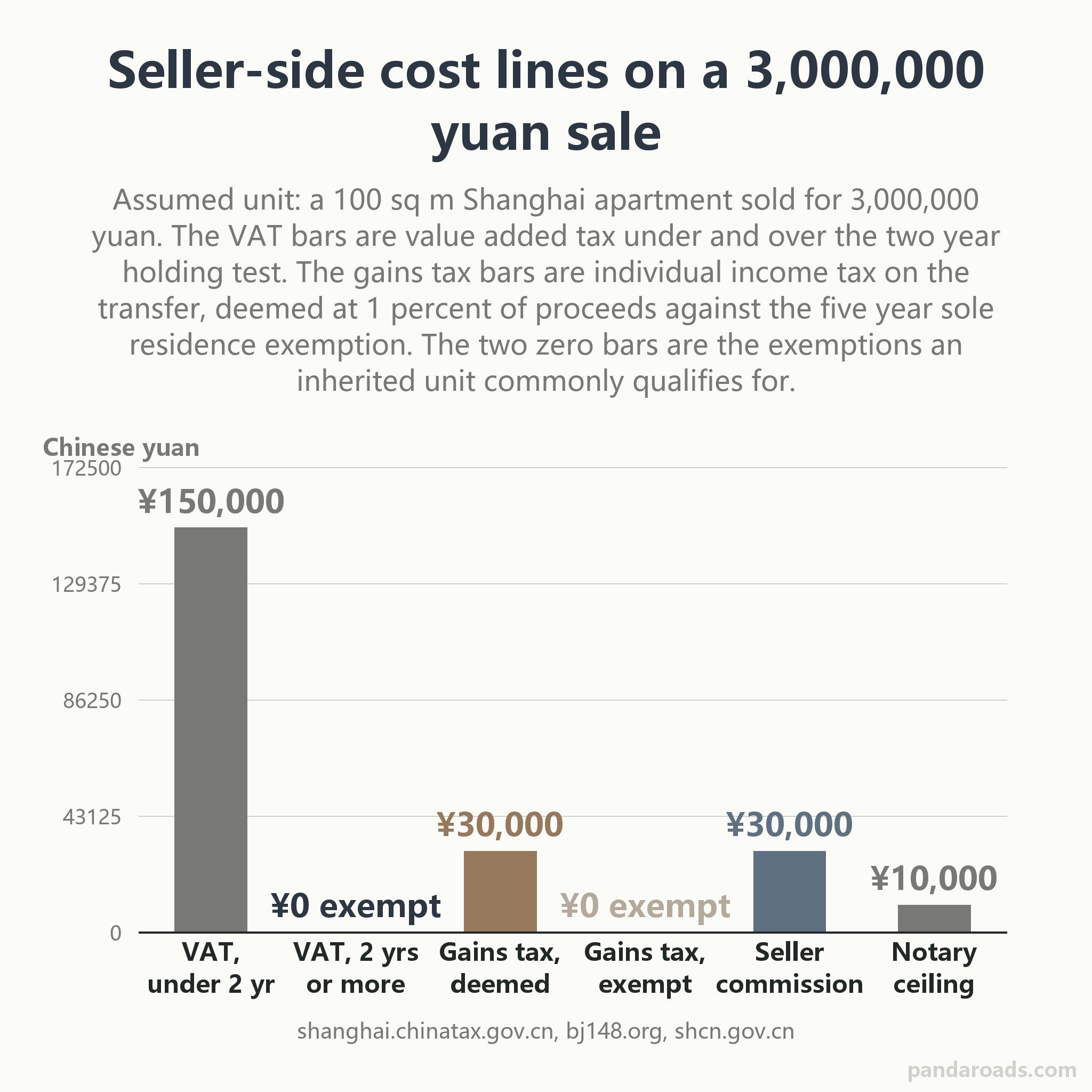
Two honest caveats. City practice varies: a first-tier assessment routine is not identical to a Guangzhou or second-tier counter, and the deed-tax tiers above are the national preference as published by the Shanghai authority effective December 1, 2024 (source: shanghai.chinatax.gov.cn). The commission row is the least rule-like line on the page, because brokerage service is intensely local and set by negotiation rather than by schedule (source: shcn.gov.cn). And this is arithmetic worked from published rules, not tax advice on your estate.
Stage 1: prove you are the heir and get title into your name
No single document proves you are the heir. The Shanghai tax authority lists 3 registration routes: notarized inheritance, an effective court judgment or mediation document, or a plain filing with a death certificate, proof of family relationship and a written statement claiming the deed-tax exemption (source: shanghai.chinatax.gov.cn). A statutory heir pays no deed tax at this stage; a non-statutory heir taking the flat under a will pays 3 percent.
You cannot sell what is not in your name. Everything downstream, the buyer's registration, the tax settlement at the window, the bank's willingness to move money, sits behind this one step, and it is the step that eats months when it is started in the wrong order.
The most damaging thing on the English-language web about this stage is the claim that a notarial certificate of inheritance rights is compulsory. The Shanghai tax authority's own page lists three routes, not one (source: shanghai.chinatax.gov.cn). There is notarized inheritance, which does require that certificate. There is judicial inheritance, which requires an effective court judgment, ruling or mediation document, the route families take when heirs disagree. And there is inheritance handled with neither notarization nor a court case, which requires a written statement on the deed-tax exemption for inherited property, proof of death, and proof of the family relationship (source: shanghai.chinatax.gov.cn). The English-language material a family finds at two in the morning names the notary counter and stops there, which is how one of three doors came to read as the only one.
Who counts as an heir is set by the Civil Code: spouse, children and parents in the first order, then siblings and grandparents (source: shanghai.chinatax.gov.cn). If a sibling is stepping aside, that has to be documented, not assumed.
The document checklist
Assemble the folder before anybody books a counter, and treat any paper held by a Chinese office as its own errand: how to retrieve documents in China from abroad walks the requester, the identity requirement and the pick-up route when you cannot appear in person.
- Death certificate and the household-registration cancellation record proving the person is deceased and their registration closed
- The property certificate and the title record held by the real-estate registration authority
- Proof of the family relationship between the deceased and each claimant, normally from the police station of the household register or the archives
- Identity documents for every co-heir, passport plus translation where the heir is foreign
- Written renunciation from any co-heir who will not take their share, executed before a notary
- Consular authentication for anything issued outside China, which is the step American-born paperwork needs before a Chinese office will act on it
- A written entrustment of an agent where you cannot appear, which the authority accepts, and which removes the need to produce the principal's original identity document when the entrustment itself is notarized (source: shanghai.chinatax.gov.cn)
What the notary is actually going to cost you
If you do use the notarized route, the price has changed and most guides have not noticed. Beijing moved inheritance, gift and bequest notarization off a percentage of the benefit value and onto floor area from November 30, 2021, capped at no more than 80 yuan per square meter of construction area (source: bj148.org). The example published with the reform is worth seeing: a unit of 121.14 square meters priced at 27,200 yuan per square meter cost 17,900 yuan to notarize under the old standard and 9,691.2 yuan under the new one, a 46 percent cut (source: bj148.org). The total fee for inheriting, gifting or bequeathing a single residential unit may not exceed 10,000 yuan (source: bj148.org).
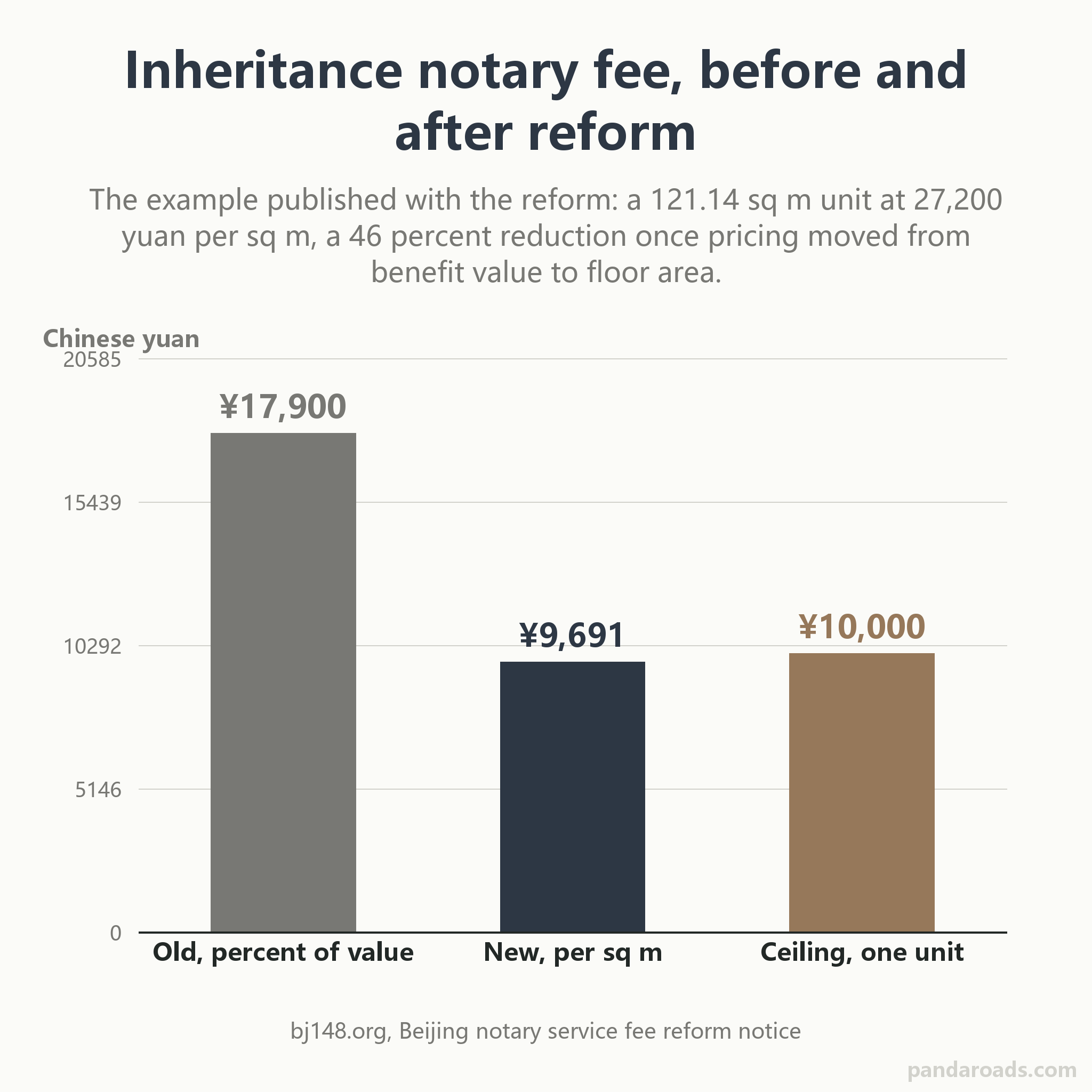
Two tax lines fire at this stage rather than at the sale. A statutory heir inherits free of deed tax; a person who is not a statutory heir but takes the flat under a will is treated as receiving a gift and pays deed tax at 3 percent (source: shanghai.chinatax.gov.cn). The document of transfer of title carries stamp duty at 0.05 percent (source: shanghai.chinatax.gov.cn). Small numbers, but they are the ones nobody budgets for, and the certificate you are paying for here is the same certificate the foreign-exchange administration will ask to see in Stage 5.
Stage 2: put the unit on the market without flying out
A Chinese second-hand sale has a shape, and once you know it the delegation question gets easy. An agency lists the unit and holds the key. Interested buyers come through in groups, sometimes with two agents at once. Price is agreed verbally, then written: a sale contract plus a supplementary agreement covering what is included, the payment schedule, and who bears which tax. The buyer's deposit sits in the escrow or supervised account the city uses. Then everyone physically appears, or is represented, at the real-estate registration hall.
Two things in that sequence cannot be done from Columbus. Somebody has to open the door, on a weekday evening, for a stranger with a coupon. And somebody has to stand at a counter with original documents, sign and submit, then come back days later for the receipts.
The legal answer to both is entrustment, and it has a real limit worth knowing before you plan around it. The Shanghai registration and banking procedures accept an entrusted agent where the entrustment is notarized, and the Bank of China sequence specifically requires a notarized power of attorney plus the agent's own valid identity documents (source: english.shanghai.gov.cn). The tax authority handling your Stage 1 registration likewise accepts a written entrustment of an agent (source: shanghai.chinatax.gov.cn). The limit is the word notarized, and for a document signed in Ohio that means authentication before a Chinese office will act on it. Get the power of attorney executed and notarized while you are still arranging the estate, because doing it later means a flight.
What delegation does not mean is handing the sale to a percentage. Be scrupulous here, including about us: PandaRoads is not a licensed real-estate brokerage. We do not list, price or negotiate a unit, and we do not take a cut of your sale price. The physical layer is what we can take: access and showings, photo and video capture of the unit as it actually stands today, and document and errand handling, quoted per task at fixed rates (source: pandaroads.com).
Note: Before you list, decide whether this is a sale or a hold. The arithmetic is genuinely close on a flat in a good school district that your family might want back, and the two branches need different ground work. If the answer turns out to be renting rather than selling, the sibling article on hiring someone to view an apartment in China from abroad covers the condition evidence and occupancy check that a landlord needs.
One practical warning about the market itself. An inherited unit usually goes out with an estate inside it: furniture, paper, a locked bedroom nobody has opened. Buyers price what they can see, and an agency will push for the empty version, which means a clearance decision and a cost before the listing photo is ever taken. Sort that out during Stage 1, not after the first lowball.
Stage 3: sign, transfer title, and settle the taxes that fire on the sale
This is the stage with the most people in the room and the fewest do-overs. The order below is the order a Shanghai transfer actually runs, and it is worth printing before anyone signs anything.
What you sign and what you pay, in the order you meet it
| Step | Where | Who is present | Money that moves |
|---|---|---|---|
| Sign the sale contract and the supplementary agreement | The agency branch | Seller or notarized agent, buyer, the agent | Nothing yet, and that is the point of the next row |
| Place the deposit | The agency's supervised or escrow account | Buyer, witnessed by the agent | Buyer's earnest money, held, not paid to you |
| Book the transfer appointment | The real-estate registration hall booking desk or online | Whoever will appear | None |
| Settle tax | The tax window inside or beside the registration hall | Seller or notarized agent | VAT, individual income tax, stamp duty, on the seller side; deed tax on the buyer |
| Submit the transfer application and hand over originals | The registration window | Both sides or their agents | None at the counter |
| Collect the buyer's new title record and your tax vouchers | The collection window, days later | The person named on the application | Nothing. This is where the paperwork for Stage 4 is picked up |
Three numbers get decided at that tax window, and you should know all three before you negotiate, not after.
The value-added tax line turns on one date. Where the flat was purchased two years or more earlier, the sale is exempt from VAT. Below two years, VAT is charged on the full sale price at a 5 percent collection rate (source: shanghai.chinatax.gov.cn). On a 3,000,000 yuan unit that is a 150,000 yuan difference swinging on a single anniversary, which is why the purchase date on your parent's original invoice matters more than the appraisal.
The individual income tax line turns on two facts about your family. It is exempt where the property was used as the family's residence for five years or more and it is that family's only residential property in China. Where the seller cannot produce complete and accurate original-cost vouchers, Shanghai assesses it on a deemed basis at 1 percent of the transfer proceeds under Guoshuifa [2006] No. 108, and the separate 2 percent deemed rate that once applied to non-ordinary housing has been canceled (source: shanghai.chinatax.gov.cn). Otherwise it is assessed on the difference between proceeds and what your parent paid plus the relevant fees (source: guangdong.chinatax.gov.cn). Inherited flats frequently land on the deemed rate precisely because the family cannot find a purchase invoice from two decades ago, which means the bill is a flat 1 percent of the price, 30,000 yuan on this sale, rather than a gain computation the authority reconstructs from whatever records survive.
The deed tax line belongs to your buyer, at 1 percent up to 140 square meters and 1.5 percent or 2 percent above that depending on whether it is their first or second family home, under the schedule effective December 1, 2024 (source: shanghai.chinatax.gov.cn).
Say this one out loud, because it costs real money: a buyer who learns the owner is abroad will try to move the seller-side tax onto you in the negotiation. The contract lines that allocate tax are where that gets decided, and an absent seller without a notarized agent has very little standing to refuse from across the Pacific. Keep the price basis, the taxes paid and every voucher in one folder. Stage 4 asks for all three.
Stage 4: the tax clearance the bank will ask for before it touches the money
The failure mode at this stage is specific and extremely common. The sale is done. The money is sitting in a Chinese bank account in the seller's name. The heir goes to buy US dollars and the counter refuses, because one document is missing and nobody can say which one. It is missing because it had to be requested at the tax window in Stage 3, weeks earlier, and no one told them.
Here is the sequence in the authority's own shape. The Shanghai municipal portal, answering through the Bank of China, lays out what a non-resident seller actually has to produce:
Selling a property in China and remitting the proceeds abroad as a non-resident follows five steps in order. First, complete the ownership and qualification review and sign the housing transaction contract. Second, process the transfer of title at the local real estate authority before payment. Third, go to the local tax authority to settle the tax on the sale proceeds and obtain proof of that payment. Fourth, obtain the Tax Filing Form for External Payments for Trade in Services and Other Accounts where it is required. Fifth, purchase foreign exchange and remit it at a bank outlet.
The documents are a passport or other valid identity document, the commodity housing transfer contract and the registration certificate, and the tax voucher. The external-payment tax filing form is additionally required where the transaction amount exceeds USD 50,000. Where another person is commissioned to handle the transaction, a notarized power of attorney and that agent's valid identity documents must also be produced (source: english.shanghai.gov.cn).
Read that threshold again, because it is the one people misread in the opposite direction. It is not a limit on how much can leave. It is a trigger for an extra form. A single apartment sale is far above 50,000 US dollars, so the filing form applies, and the form exists precisely to prove the tax on that money was already paid.
Inheritance adds its own version of the same demand. The measures governing transfer of inherited assets abroad require, as part of the application file, a tax certificate or tax-paid voucher issued by the competent tax authority where the inherited property is located (source: safe.gov.cn). Different office, same document class. Which is the discipline this whole article has been pushing toward: you collect vouchers as you go through the windows, in the order the windows come, because chasing them afterwards means either a flight or a notarized entrustment sent backward in time.
Stage 5: which foreign-exchange route your money is actually on
Get this wrong and you will wait a year for permission you never needed. It is a common mistake, and the misconception runs like this: your house sale is capped by the USD 50,000 annual foreign-exchange quota, so a three-million-yuan apartment has to leave in slices across several years.
What the quota actually is: an individual's annual limit for settlement and purchase of foreign exchange, the equivalent of USD 50,000 per person per year, under the Implementation Rules for the Measures for the Administration of Individual Foreign Exchange. Inside that limit, current-account purchases go through at a bank on identity documents. Above it, current-account items are handled with supporting evidentiary documents, and capital-account items are handled under capital-account rules instead (source: safe.gov.cn). Property-sale proceeds are not a bite of that quota. They are a capital-account item on their own track, and that track has no annual ceiling of the kind people fear.
Two routes out, and where they split
| Question | Ordinary annual quota | Inherited-asset transfer route |
|---|---|---|
| What it covers | Current-account spending: travel, study, subscriptions, goods | Liquidating lawfully inherited domestic assets and moving the money out |
| Where you file | A bank counter, no approval stage | The foreign-exchange administration at the location of the deceased's household registration, by agent if needed |
| What governs the amount | USD 50,000 equivalent per person per year | No such cap. Approval sits with the local administration at or below the equivalent of 500,000 yuan, and is reported to the national agency above that (source: safe.gov.cn) |
| Core documents | Identity documents, and evidence above the quota | Death and kinship record, the property rights document, a tax certificate or tax-paid voucher, and notarization of any agreement or proof of rights not already notarized |
| How the money moves | Purchase and remit on the spot | One application covering all inheritance from a single decedent, remitted in one or several tranches; different decedents need separate applications |
| Cash | Ordinary rules | No foreign-currency cash may be withdrawn inside China on this route. The bank remits directly to the applicant's own account (source: safe.gov.cn) |
The named category is real and old. The Measures for the Administration of the Sale of Foreign Exchange Against Personal Domestic Assets and the Remittance of Such Assets Abroad, effective December 1, 2004, cover a foreign citizen liquidating lawfully inherited domestic property and buying foreign exchange to move it out (source: safe.gov.cn). So the correct mental model is not "how do I get around a limit." It is "which office has jurisdiction over the city my parent's household registration was in, and what does that office want to see." One ambiguity to plan around rather than argue: Article 10 puts files at or below the equivalent of 500,000 yuan with the local bureau and anything above it with the national administration, while the official release announcing the rule reads the line as 500,000 yuan and above going to the national agency (source: safe.gov.cn). If the estate is anywhere near that number, budget for the longer track. That is a limitation of the published material rather than of this article. Both texts are live, they disagree, and no summary can make them agree on your behalf.
A foreign individual who simply sells a home they owned, without the inheritance layer, uses the bank sequence from Stage 4 instead: the tax voucher plus the external-payment filing form in hand, purchase foreign exchange and remit at the outlet (source: english.shanghai.gov.cn). Different file, same principle, nothing moves before the tax is proven.
Two operational warnings. An approval carries a validity window, and the exchange and the remittance both have to be completed inside it, so do not file early and let it lapse. And the one-application rule bites families: if two parents die, that is two inheritances from two decedents, and the administration expects two applications even where the apartment was joint property.
What it costs to have someone on the ground run the physical parts
Count the bodies this job needs. Stage 1 wants someone at a notary office and a registration hall on a weekday. Stage 2 wants someone with a key and a camera. Stage 3 wants someone at a tax window and a counter with originals. Stage 4 wants somebody physically collecting vouchers. Stage 5 is the one stage where a licensed professional and, eventually, you in person or by notarized entrustment are unavoidable.
Most of it is errands with consequences, and errands have published prices. On PandaRoads, the recurring tiers are Property Check & Report at US$129 per day (remote service), which covers a monthly visit with a photo report, property-fee payments and mail handling, and Full Rental Management at US$239 per month once there is a tenant to administer (source: pandaroads.com). One-off tasks run US$129 to US$239 per day. On-site field work is US$239 per day, billed from departure, and remote work, the research and phone-call layer, is US$129 per request (source: pandaroads.com).
The commercial terms matter more than the numbers on an estate job, because you are hiring from a distance and cannot walk in. Terms are month to month with no annual contract. Nothing is charged until you approve an itemized quote. Travel beyond the covered area is itemized and confirmed before work begins (source: pandaroads.com).
Where we stop, stated plainly: PandaRoads manages, executes and reports. We do not give legal or tax advice, we do not sign documents pretending to be the owner, and we are not a licensed real-estate brokerage (source: pandaroads.com). Where a signature or a notarization is legally your own act, we prepare everything around it and coordinate the visit, and you or your attorney do the signing. The trade-off is worth naming plainly. A licensed brokerage markets and negotiates and charges a percentage of the price for it. A fixed-fee runner coordinates, documents and reports, and does not. That is also why the quote you approve here is priced against the physical errands and never against the value of your parent's apartment.
Note: Compare on structure, not on headline. Local operators will quote an estate a percentage of the property value, which sounds reasonable at zero effort and is not: a percentage of a 3,000,000 yuan sale dwarfs the fixed day and monthly rates above, and it pays for the same physical errands. Ask any vendor for the task list before the fee.
The thing you are actually buying is not paperwork. It is not being in China.
Frequently asked questions
How do I sell an inherited apartment in China if I live in the US? In five ordered steps. Prove the inheritance and register title in your name, put the unit on the market through an agency using a notarized entrustment, settle the taxes at the transfer window, obtain the tax clearance documents, then file for the foreign-exchange approval and remit (source: safe.gov.cn) (source: shanghai.chinatax.gov.cn). Only the last two require a Chinese bank.
Do I pay capital gains tax when I inherit property in China? No. Under Caishui [2009] No. 78, an heir who acquires a house by inheritance is not subject to individual income tax on that transfer (source: guangdong.chinatax.gov.cn). The tax arrives when you sell, and the same circular sets your cost base at what your parent originally paid, which is why the bill can be larger than people expect.
Can a foreigner sell inherited property in China? Yes. A foreign citizen may liquidate lawfully inherited domestic assets and remit the proceeds, which is a named category in the 2004 measures governing sale of foreign exchange against personal domestic assets (source: safe.gov.cn). The application goes to the foreign-exchange administration covering the deceased's household registration, and it may be filed through an agent.
How do I move money from selling a house in China out of the country? Not through the USD 50,000 annual quota, which governs current-account spending. Inherited-asset transfers are approved on their own track: local administration approval at or below the equivalent of 500,000 yuan, reported to the national agency above it, then the bank sells the foreign exchange and remits to your own account (source: safe.gov.cn).
What is the notary fee for inheriting property in China? It is no longer a fixed percentage of the apartment in the cities that reformed. Beijing prices inheritance, gift and bequest notarization by floor area at no more than 80 yuan per square meter since November 30, 2021, with the total for one residential unit capped at 10,000 yuan (source: bj148.org). Ask the office for its current published standard, and also check whether notarization is even required for your route.
Do heirs pay deed tax when transferring inherited property in China? A statutory heir does not; that transfer is exempt from deed tax. A person who is not a statutory heir but takes the flat under a will is treated as receiving a gift and pays deed tax at 3 percent, assessed on a price the authority sets by reference to the market. Stamp duty on the title-transfer document runs at 0.05 percent either way (source: shanghai.chinatax.gov.cn).
What documents do I need to sell a deceased parent's house in China? At the inheritance stage: proof of death, the household-registration cancellation record, the property certificate, kinship proof, identity documents for every co-heir, and written renunciations where applicable (source: shanghai.chinatax.gov.cn). At the money stage: the transfer contract, the registration certificate, the tax voucher, and the external-payment tax filing form above USD 50,000 (source: english.shanghai.gov.cn).
Can I sell property in China using a power of attorney from abroad? Yes, and it is the standard solution for non-resident sellers. The Shanghai registration procedures accept a written entrustment of an agent, and the bank sequence requires a notarized power of attorney plus the agent's own valid identity documents (source: shanghai.chinatax.gov.cn) (source: english.shanghai.gov.cn). Documents signed overseas generally need consular authentication before a Chinese office will act on them.
The bottom line
Two facts decide almost everything in this process. The first is that inheritance is exempt from individual income tax while the sale that follows it is not, and that the taxable gain is measured against what your parent actually paid rather than what the flat is worth the day you inherit it (source: guangdong.chinatax.gov.cn). The second is that the money does not leave on the famous USD 50,000 annual quota. It leaves on a separate approval filed with the foreign-exchange administration covering the deceased's household registration, where 500,000 yuan is the line between local and national sign-off, and where no tax voucher means no approval (source: safe.gov.cn).
The sequence, in one breath: prove you are the heir, register the title in your name, put the unit on the market, settle the tax at the window, collect every clearance document, file the approval, remit. Five gatekeepers, and every one of them will refuse an out-of-order request.
One limitation to carry out of this article: the fee and rate figures here are the published Shanghai and Beijing numbers, and each city sets its own multipliers inside the same national rules. Read them as the shape of the bill rather than as the total, and confirm the local standard with the bureau that has jurisdiction over the address.
If you want the physical parts handled from another continent, send us the city, the address of the unit, and the specific thing that is stuck right now, and you will get an itemized quote against published day and monthly rates before anything is charged (source: pandaroads.com). What we sell is on-the-ground coordination: access, showings, capture, document runs. It is not brokerage, and it is not legal or tax advice. Those two still need a licensed professional, and on Stage 5 they always do.
References
- 国家税务总局上海市税务局. (2024, November). 关于个人转让住房、购买住房有关个人所得税、增值税和契税政策的解读 [Policy interpretation on individual housing transfer and purchase taxes, effective December 1, 2024]. Shanghai Municipal Tax Service, State Taxation Administration. https://shanghai.chinatax.gov.cn/zcfw/zcjd/202411/t474079.html
- 国家税务总局上海市税务局. (2022, August). 继承房屋涉及哪些税费? [Which taxes and fees apply to inheriting a house?]. Shanghai Municipal Tax Service, State Taxation Administration. https://shanghai.chinatax.gov.cn/xwdt/ztzl/grsx/fwjy/tslsx/202208/t463874.html
- 广东省国家税务局. (2011, February 23). 财政部 国家税务总局关于个人无偿受赠房屋有关个人所得税问题的通知 (财税〔2009〕78号) [Ministry of Finance and State Administration of Taxation circular on individual income tax on houses transferred without consideration]. Guangdong Provincial Tax Service, State Taxation Administration. https://guangdong.chinatax.gov.cn/gdsw/zjfg/2011-02/23/content_42b15e02bfc24faabe05446896bfe7f7.shtml
- 国家外汇管理局. (2007, January 4). 个人外汇管理办法实施细则 (汇发〔2007〕1号) [Implementation rules for the measures for the administration of individual foreign exchange]. State Administration of Foreign Exchange, Tianjin mirror. https://www.safe.gov.cn/tianjin/2024/0430/2464.html
- 国家外汇管理局. (2004, November 16). 中国人民银行发布实施《个人财产对外转移售付汇管理暂行办法》 [Release of the interim measures for the administration of the sale of foreign exchange against personal domestic assets and the remittance of such assets abroad, effective December 1, 2004]. State Administration of Foreign Exchange. https://www.safe.gov.cn/safe/2004/1116/4133.html
- Shanghai Municipal People's Government. (2024, February 4). Can I buy foreign exchange using the proceeds from selling my house? [FAQ, sourced to Bank of China]. english.shanghai.gov.cn. https://english.shanghai.gov.cn/en-FAQHome/20240204/b4426264395b4fa3adfde73778c94ad4.html
- 北京政法网. (2021, October 31). 北京下调2项公证服务收费标准,涉及房产继承赠与和遗赠公证 [Beijing cuts two notary service fee standards, covering real-estate inheritance, gift and bequest notarization, effective November 30, 2021]. 中共北京市委政法委员会. https://www.bj148.org/fwts/202110/t20211031_1620580.html
- 上海市长宁区住房保障和房屋管理局. (2023, October 12). 北京链家下调二手房交易服务费,中介收费模式会否生变 [Beijing Lianjia cuts second-hand housing transaction service fees; will the brokerage commission model change?]. 长宁区人民政府, republishing 中国消费者报. https://www.shcn.gov.cn/col5943/20231016/1246173.html
- PandaRoads. (2026, August). China property management for overseas owners [Service page]. PandaRoads. https://pandaroads.com/china-property-owner-services.html
- PandaRoads. (2026). China sourcing and local task service from $129 [Service and pricing page]. PandaRoads. https://pandaroads.com/china-tasks.html
Also settling a deceased parent’s bank accounts alongside the property? Our guide to withdrawing a deceased parent’s bank account in China from abroad covers the notary chain.
Last reviewed and updated: September 2026. Author: our editorial team. For tailored guidance, contact our team.