Hire Someone to View an Apartment in China From Abroad
The sight-unseen risk math for overseas owners: what actually goes wrong with an unseen apartment or vacant home, what a real viewing report contains, US home-watch price anchors, and how a $99-239 fixed-fee photo-evidenced visit replaces a $2,510-9,250 round trip.
Last updated: July 2026 · By the PandaRoads team in China
TL;DR
You cannot verify a China apartment from listing photos or a live video call, because the failures that matter, misrepresented condition, a sublet you did not approve, unpaid utility arrears, or storm or leak damage nobody reported, are exactly what a screen hides; the reliable substitute is a fixed-fee visit by someone on the ground who returns timestamped photos, meter readings and a written condition note, at a fraction of the $2,510 to $9,250 a self-arranged trip to China costs (PandaRoads Property Check from US$99/month, one-off on-site day US$239).
Abstract
A plain-English guide for a US-based owner, buyer or tenant-arranger who needs an apartment or house in China physically looked at from abroad: what actually goes wrong when you decide sight-unseen, what a trustworthy viewing report must contain, why a relative is not a reliable substitute, how a fixed-fee on-the-ground visit with timestamped photo evidence replaces a $2,510 to $9,250 round trip, and the honest limits of what a viewing service can promise.
Key Takeaways
- Listing photos and a video call hide the failures that matter most
- The real deliverable is timestamped photo and meter evidence, not a vibe
- A relative will not run the awkward checks or report bad news reliably
- A fixed-fee visit costs far less than a $2,510 to $9,250 round trip
- Home watch is not a licensed inspection, know which you need
- Keys and access always require the owner's authorization
- No appraisals, no structural engineering opinion, and we say so
Table of Contents
- Abstract
- Key Takeaways
- The problem: a China apartment you cannot stand inside
- What actually goes wrong when you decide sight-unseen
- The four jobs an overseas owner actually hires for
- What a good viewing report actually contains
- Can a friend or relative in China just do it?
- How a fixed-fee visit replaces the $2,510 to $9,250 round trip
- How a viewing runs, step by step
- Home watch versus inspection: the line you need to understand
- The honest limits of a remote property check
- Frequently asked questions
- The bottom line
- References
The problem: a China apartment you cannot stand inside
Overseas owners routinely face a China apartment they cannot enter, and the honest fix is a documented on-the-ground visit rather than a video call. Listing photographs and live walkthroughs hide misrepresented condition, unapproved sublets, unpaid utility arrears, and storm or leak damage. A timestamped photo and meter report converts that unseen risk into evidence, for a fraction of the $2,510 to $9,250 a self-arranged round trip costs.
You are in Phoenix. The apartment is in Chengdu. Your parents move in next month and the only thing you have seen of it are the agent's photos, taken with a wide lens on a bright afternoon. A different version of the same scene: you own a flat in Shanghai that has been empty since you left, and the last time anyone stood in it was three years ago. Or the tenant in your Guangzhou unit stopped replying and you genuinely do not know who is sleeping there now. Or a typhoon crossed Hainan last week and you cannot sleep because nobody can tell you whether water is getting in under a door you cannot open.
These are four different people and one problem. Something you own, or are about to rent, or are accountable for, in China needs a human eye on it, and you are an ocean away. Not a video call. Not a screenshot someone texts you. A person who can turn a tap, flush a toilet, read a meter, knock on a neighbor's door, and send back dated photographs you can trust.
This article is about that one job: getting a China property physically looked at from abroad, and getting evidence you can act on. It is not about the recurring rental-management subscription, which is a separate service with its own page and pricing, and it is not about the general errand catalog. We will stay on the viewing, the check, the walkthrough, and the watch, and we will be honest at every step about what a check can and cannot tell you.
The short version, before the detail: what goes wrong sight-unseen is almost never visible on a screen, and the fix is a fixed-fee visit that turns a place you cannot reach into a record you can.
What actually goes wrong when you decide sight-unseen
The failures that matter most in a China rental are invisible on a screen. Listing photographs are staged and often months old, a tenant can quietly re-let a unit and collect months of rent up front, and unpaid property-fee arrears compound in a mailbox nobody opens. Sublease scams are documented by landlord associations (source: american-apartment-owners-association.org), and each stays hidden until a person stands in the room, 12 time zones away.
The reason a photo is not a check is that the failures that matter most are exactly the ones a lens hides. Run the list honestly.
Misrepresented condition. Listing photographs are staged, wide-angle, and frequently months old. A damp stain spreading across a ceiling, a window boarded after a break-in, a cracked tile line under a rug, a bathroom door hanging on one hinge: none of these survive a flattering angle. What a listing shows you is the best hour of the best room.
Sublet and occupancy surprises. A tenant can quietly re-let a unit to a third party without the landlord knowing and collect months of payment up front. Landlord associations document this as a standard rental scam, and the person it burns is the owner who cannot drop in (source: american-apartment-owners-association.org). From abroad, a unit that is rented may in fact be rented again, to someone you have never screened.
Holdovers and squatters. Someone inside who will not leave is a completely different problem from an empty flat, and the difference is invisible from another country. You cannot negotiate with, serve, or evict a person you have not confirmed is there.
Utility and property-fee arrears. The property-fee notice goes to a mailbox nobody opens. Water, electricity and management fees quietly compound into a number that blocks a sale or a deposit return. A quick look at a meter face, or a question to the property-management office, turns a surprise into a known figure.
Weather and water damage nobody reports. After a typhoon, a burst pipe, or a slow leak from the unit above, the swollen floor and the mold behind a wardrobe are precisely what a scheduled video tour skips, because the seller or the neighbor with the key has no reason to point at them.
The common thread is that every one of these is a physical fact about a place you cannot reach. More pixels do not fix it. A person standing in the room does, and the point of hiring one is to convert an unseen risk into dated, written, photographed evidence you can act on from twelve time zones away.
The four jobs an overseas owner actually hires for
An overseas owner usually needs one of four jobs: a single viewing, a pre-purchase walkthrough, a vacant-home watch, or a tenant check. A one-off on-site visit prices at US$239 per day, a recurring monthly check at US$99, and the full rental-management tier at US$239 per month on a separate page (source: pandaroads.com). Every quote is fixed and approved before work starts, never a percentage of the transaction.
People rarely want a property inspection in the abstract. They want one of four concrete jobs done, and each has a different shape, cadence and price basis. Here is the map before you talk to anyone.
| Job | What you get | Cadence | Price basis |
|---|---|---|---|
| Single viewing or condition check | A documented look at one unit: room-by-room photos, working fittings, a written condition note | One-off | On-site field work, published at US$239 per day, billed from departure, with cross-city travel itemized and confirmed before you approve (source: pandaroads.com) |
| Pre-purchase walkthrough | A buyer-side look at condition, water pressure, sound, damp and the building before you commit money | One-off, before a decision | Same on-site day basis; a licensed building survey, if you want one, is engaged separately, because that requires credentials a viewing service does not hold |
| Vacant-home watch | Periodic eyes on an empty unit, the China version of a home-watch visit, with a report after each one | Recurring | Property Check and Report at US$99 per month, which includes a monthly visit and a photo report (source: pandaroads.com) |
| Tenant or occupancy check | Confirmation of who is actually inside and the state of the unit, with evidence | Periodic or on suspicion | Part of a check on the same basis; the full rental-management tier at US$239 per month sits on a separate page and is not this article |
Read the last column as the constant: the price is fixed and quoted before work starts, never a percentage of a transaction. The variable is how often you need eyes, once or every month.
It helps to know the category already has a mature version where you live. In the United States, home-watch companies charge roughly $100 a month for bi-weekly visits and $200 for weekly, each visit returning a written report with timestamped photographs (source: suncoasthomeswatch.com), and some price by square footage at around $220 to $340 a month. Those firms will not touch a Shanghai flat, which is the gap a China team on the ground fills at a comparable per-visit basis.
The practical question to answer before you ask for a quote is simple: do you need the unit looked at once, because you are deciding something, or watched over time, because you own something empty or let? Single viewing and pre-purchase walkthrough are decision tools. Vacant-home watch and tenant check are insurance against silence.
What a good viewing report actually contains
A trustworthy viewing report is defined by evidence you can date and verify. That means timestamped photographs of every room, both the water and electricity meter faces, a run-the-taps and flush-the-toilets test, exterior shots of doors and windows, and a roughly 2-hour before-and-after water-meter read that exposes a hidden leak. US home-watch firms already sell to this timestamped-report standard (source: suncoasthomeswatch.com).
A photograph is only useful if you can trust when it was taken and where. That single principle separates a report you can act on from a handful of WhatsApp pictures. The home-watch industry already sells to this standard: the leading US firms promise a written report with timestamped photographs after every visit (source: suncoasthomeswatch.com). Here is the equivalent evidence set for a China unit.
| Evidence item | What it proves |
|---|---|
| Timestamped photos of every room, plus both meter faces, water and electricity | That the visit really happened on the date claimed, and what the readings were at that moment |
| Run-the-taps and water-pressure check, every toilet flushed | That the interior water supply and drainage actually work, the same basic operation a standard inspection verifies at all fixtures (source: propertihc.com) |
| A water-meter read before and after about two hours with nothing running | Whether there is a hidden leak, using the plain public-utility test: if the meter moved, something is drawing water (source: broomfield.org) |
| A sound and signal test | Drain noise, a working intercom, and honest cell reception in the unit, none of which a listing discloses |
| Exterior and entry photos of doors and windows | Signs of forced entry or tampering, a core home-watch check (source: propertihc.com) |
| A neighbor or property-manager question set | Arrears, disputes, and who actually lives there, the facts a seller will not hand you |
| A written condition note on damp, mold, cracks and fixtures | A record you can read in English and keep, not a memory |
The point of the meter readings and the two-hour leak test is that they turn a guess about an empty apartment into a measured, dated finding. You cannot tell from a photo whether a pipe is weeping behind a cabinet; you can tell whether the water meter advanced overnight.
Note what this list deliberately does not include. A good viewing report is a condition and occupancy record, not a valuation and not an engineering opinion. A viewer can photograph a crack and say how large it looks and whether it was there last visit. Deciding whether a structural engineer should look, or what a unit is worth, is a different, credentialed job, and a provider who blurs that line is telling you less than you think. That boundary is its own section below.
Tip: If you take one test to any provider, foreign or local, ask for a sample report. If it has no timestamps, no meter readings, and no written condition note, you are buying a tour, not evidence.
Can a friend or relative in China just do it?
A relative in China stays warm but unreliable as an evidence source, and the job fails in 4 predictable ways. Family visits skip the awkward checks, soften bad news, leave no durable timestamped record, and cannot be scheduled for the exact morning a deposit falls due or a typhoon passes. A paid third party runs a full checklist and documents access, the difference between a claim and proof.
Usually the first instinct is yes: there is always a cousin, an old classmate, a colleague still in the city, and asking them seems free, trusted and easy. Sometimes that is genuinely the right call, for keeping a plant watered or collecting a parcel. For evidence you can act on across an ocean, it quietly fails in four predictable ways, and none of them is anyone's fault.
A relative does not run a checklist. Nobody flushes every toilet, reads a water meter, or presses an ear to a wall for drain noise as a favor to an aunt. The awkward checks are exactly the ones social visits skip, which is why a family photo set tends to be four happy pictures of the living room.
The reporting is filtered. Family softens bad news. A cousin will tell you the flat looks fine long before they will tell you the tenant was rude, the ceiling is staining, or the property-management office would not answer their questions. A paid third party has no relationship to protect and reports what they find.
There is no durable record. Photos on a phone are perishable and carry no consistent format you can later hand to a buyer, an insurer, or a lawyer. The absence of timestamps is not pedantry: it is the difference between "there was no leak on the fourteenth" as evidence and as a claim.
And you cannot schedule a favor. The moment it matters, the Tuesday after a typhoon, the morning a deposit is due, the day you suspect the unit is sublet, is precisely when you cannot ask someone to drop everything and go.
The honest framing is to separate the two roles. Let a relative keep a warm eye on things. Hire a fixed-fee check when you need dated evidence, an unvarnished report, and someone who can knock on a property-manager's door without it becoming a family matter. They are not the same job, and asking one person to do the other is where overseas owners get hurt.
How a fixed-fee visit replaces the $2,510 to $9,250 round trip
The realistic choice is a fixed-fee visit against a self-arranged trip. PandaRoads prices a single business trip to China at $2,510 to $9,250 once flights, hotels, local transport and a lost work week are counted, while an on-site property check runs $239 per day and a recurring vacant-home check $99 per month (source: pandaroads.com). A proxy day replaces the flight and the guessing at a small fraction of the cost.
For most owners the real comparison is not check versus nothing. It is check versus flying out, because the moment something feels important enough, the instinct is to get on a plane. So put the two numbers side by side.
PandaRoads states plainly that a single self-arranged business trip to China typically runs $2,510 to $9,250 once you count flights, hotels, meals, local transport and, just as costly, the week of your calendar it consumes (source: pandaroads.com). Against that, an on-site visit for a check is priced at $239 per day, billed from departure, with cross-city or overnight travel itemized and confirmed before you approve (source: pandaroads.com). A recurring vacant-home check is the $99 per month Property Check and Report with a monthly visit and a photo report (source: pandaroads.com).
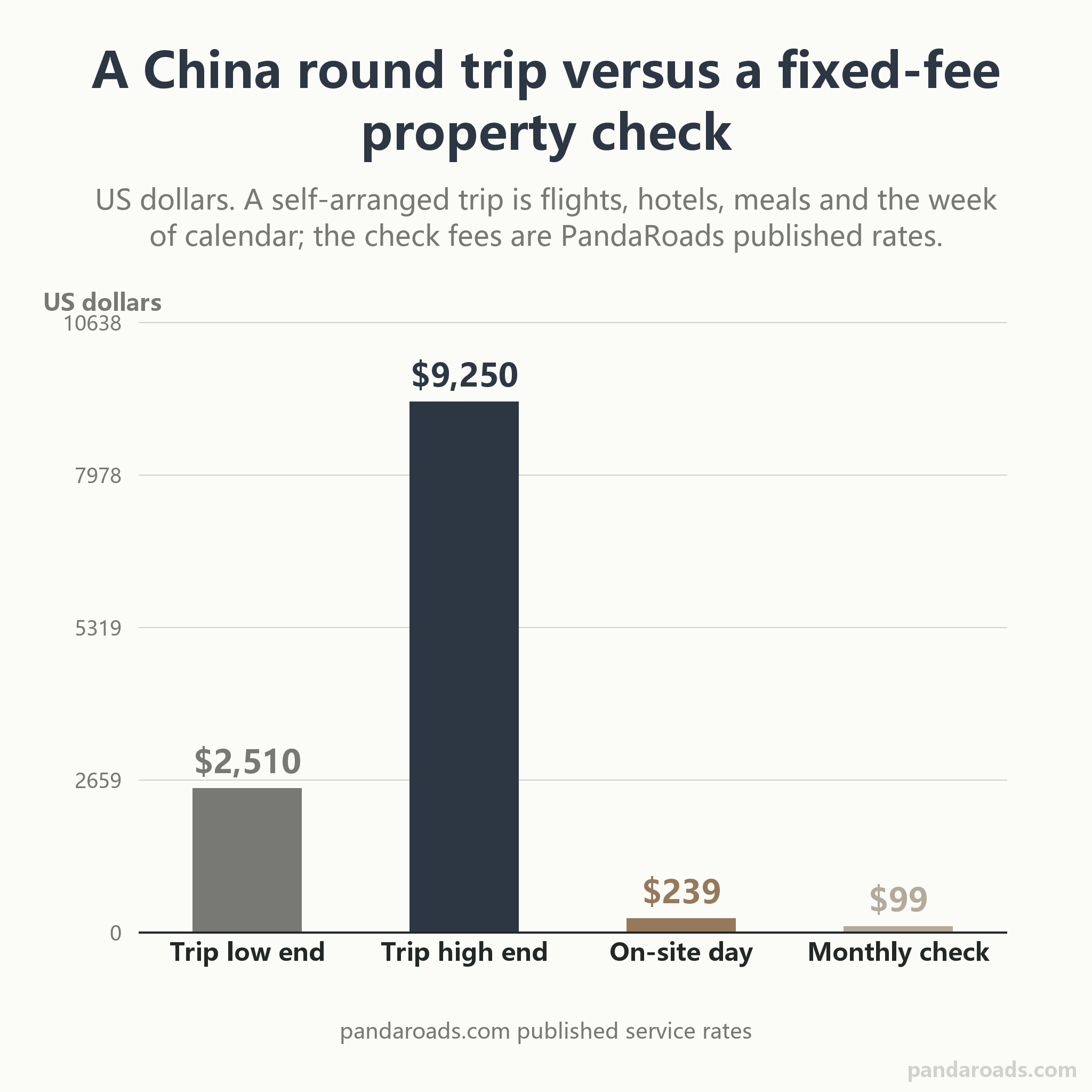
The arithmetic is not subtle. One round trip buys many weeks of someone standing in the unit on the days you choose, photographing and metering what you asked about, and reporting the same day. And a trip taken on speculation still leaves you without the thing the visit produces: a dated, written record. You land, you look around for a day, you fly home, and none of it is timestamped or itemized.
There is a payment assumption worth killing here, because it recurs in this scene. Owners often reason that if the only problem is an unpaid property fee or a water bill, they can settle it themselves from a US card. In practice a foreign card is capped inside the Chinese mobile wallets at about RMB 3,000 per single transaction on Alipay and about RMB 6,000 per transaction on WeChat Pay, with an RMB 50,000 monthly cumulative ceiling (source: china-briefing.com), and a great deal of China utility and property-fee payment still routes through a domestic account or an office counter, not an international card. Paying a compounding arrears from abroad is often the very thing that needs hands on the ground.
Be honest about what a proxy day does not replace: your own judgment on the spot, a licensed surveyor's instrument, or a lawyer's letter. It replaces the flight, the visa week, and the guessing. For the specific job of seeing the unit and documenting it in English, it is a fraction of the cost of being wrong.
How a viewing runs, step by step
A viewing follows a fixed approve-first sequence in seven steps. You describe the property and the question, we return an itemized quote with remote requests from $99 and on-site field work from $239 per day, access is arranged through the owner or manager, then the checks run and a same-day written report returns timestamped photos and meter readings before anything is charged (source: pandaroads.com).
The mechanics are deliberately simple, and they follow the same approve-first rule PandaRoads publishes for every task: no work starts and nothing is charged until you approve an itemized quote (source: pandaroads.com).
-
You describe the property and the question. City, address, whether it is empty, rented, or in a dispute, and the specific thing you need settled: is the ceiling stained, is the tenant really who the listing says, did the storm get in.
-
We return an itemized quote. The service fee, and any travel beyond the local radius, are broken out and confirmed before you approve. Remote requests start at $99 and on-site field work at $239 per day, with travel itemized (source: pandaroads.com).
-
Access is arranged honestly. Keys and entry require the owner's authorization or the building manager's sign-off. If a unit is locked and nobody is authorized to open it, we tell you the visit is blocked rather than improvising, because access you cannot document is evidence you cannot use.
-
We visit and run the checks. Room-by-room timestamped photos, both meter faces, taps run and toilets flushed, the two-hour meter read for hidden leaks, a sound and signal pass, exterior shots of doors and windows, and questions to the property-management office or neighbors about arrears and occupancy.
-
You get a written report and the photo set. The scope is small enough that a same-day report is the norm where timing allows, the same standard a US home-watch visit promises with its timestamped photographs (source: suncoasthomeswatch.com).
-
You decide from evidence, not phone tag. Whether that is telling a tenant to regularize, arming a buyer's survey, budgeting a repair, or finally paying the arrears, you act against a dated record while you are still at breakfast in Ohio.
-
If you want it on a schedule, that is the next tier up. A recurring monthly visit sits on the property-owner service, and the full rental-management scope, with tenants, leases and rent collection, is its own page and pricing, linked rather than duplicated here.
Each visit is scoped and fixed before it happens, so the number you approve is the number you pay. That is the whole design: turn an unseen, un-schedulable problem into a short, dated, evidence-backed task.
Home watch versus inspection: the line you need to understand
Home watch and a licensed inspection are 2 different jobs, and confusing them is costly. The National Home Watch Association defines home watch as a visual check for obvious issues during routine visits while the owner is away, whereas a home inspection requires special licensing, instruments, and a signed professional opinion (source: propertihc.com). A China property check is the first, and a surveyor is commissioned separately.
Two words get used loosely in this market, and getting them straight protects you. The National Home Watch Association defines its trade as a visual inspection of a home or property, looking for obvious issues, carried out through routine visits while the owner is away (source: propertihc.com). That is a watch-and-report job: frequent, cheap, evidence-generating, and deliberately shallow.
A licensed building inspection is a different animal. The same industry is blunt that home watch is not a home inspection, precisely because a home inspection requires special licensing (source: propertihc.com). A surveyor uses instruments, opens panels, measures, and signs an opinion that a bank, a court or a buyer can rely on. That credential, and the liability that comes with it, is not something an errand team can honestly offer.
Map that onto the China job. A property check is your recurring eyes and your evidence: it catches the leak, the arrears notice, the unapproved sublet, the storm damage nobody reported, the ceiling that was clean last month and is not clean now. A licensed structural or buyer survey is what you commission once, separately, before a large purchase or when a check surfaces a crack that matters.
The two are complements, not rivals. The check is cheap enough to run monthly and fast enough to catch a problem while it is small; the survey is thorough enough to price a defect properly, and worth paying for at the moments the money at stake justifies it.
So the single best question to ask any provider, in China or at home, is whether this is a watch-and-report visit or a licensed inspection. An honest one answers immediately. In our case the answer is the first, and we say so everywhere, because pretending to the second is how owners end up trusting a document no professional will stand behind.
The honest limits of a remote property check
A remote property check has firm limits, and stating them protects you. There is no valuation or market opinion, no structural engineering judgment, no entry into a locked unit without the owner's authorization, and no legal or tax advice or signed documents. A $99 monthly check or $239 on-site day is an early-warning layer (source: pandaroads.com) that tells you when to hire a licensed surveyor for the bigger money.
Warning: A service that tells you it can do anything is telling you nothing. Here is the fence, drawn clearly.
We are not licensed appraisers. We will not give you a valuation or an opinion on market value, because that is a credentialed judgment and a wrong number from us could cost you real money.
We give no structural engineering opinion. If you want to know whether a crack means a slab has moved, that is a structural surveyor with the right tools and insurance. We can photograph a crack, measure it against a scale, note whether it changed since the last visit, and recommend you get it surveyed. Deciding it is safe is not our call to make.
We cannot enter a locked or owner-controlled unit without authorization. Keys and access always require the owner's or the manager's sign-off, and where a visit is genuinely blocked we will tell you so instead of working around it, because undocumented access produces evidence that falls apart the moment anyone questions it.
We do not give legal or tax advice and we do not sign documents pretending to be you. PandaRoads is explicit about this boundary on its own property page: it manages, executes and reports, and where a signature or notarization is legally the owner's, it prepares everything and coordinates your visit rather than forging the last step (source: pandaroads.com).
A single visit is a snapshot, not a guarantee. It tells you the truth about the unit on one afternoon. What happens the following week is exactly why the recurring watch exists.
And a check is the wrong tool for some needs. If you require a certified condition survey for a mortgage, a legal occupancy dispute resolution, or tax documentation, hire that specialist on top of a check, and treat the check as the early-warning layer that tells you when to spend the bigger money. For everything that is just someone needing to stand in that apartment and say what is true, with proof, this is the right and honest size of the job.
Frequently asked questions
Can I hire someone to physically view an apartment in China for me? Yes. The service exists precisely for owners and buyers abroad. A runner on the ground visits, runs the taps and meters, photographs every room with timestamps, asks the property office questions, and returns a written English report, on a fixed, approved quote that starts from a $99 remote request or a $239 on-site day (source: pandaroads.com).
How do I check a vacant home I own in China from the US? Either commission a one-off on-site check, or set up a recurring Property Check and Report at $99 per month, which includes a monthly visit and a photo report, month to month with no annual contract (source: pandaroads.com). This is the China version of the home-watch visit US owners buy for second homes.
What should be included in a property viewing report from China? Timestamped photos of every room and both meter faces, a run-the-taps and flush-the-toilets check, a two-hour meter read to catch hidden leaks, exterior shots of doors and windows, neighbor or manager answers on arrears and occupancy, and a written condition note on damp, mold and cracks.
Can someone verify a tenant is actually living in my China apartment? Yes, and it matters: a tenant can re-let a unit to a third party without the owner's knowledge, a documented rental-scam pattern (source: american-apartment-owners-association.org). An in-person occupancy check confirms who is really inside and in what state the unit is, with photos.
How much does it cost to have a property checked in China? A one-off visit rides on the $239 per day on-site basis with travel itemized and confirmed first; a recurring monthly check is $99 per month (source: pandaroads.com). Compare that with the $2,510 to $9,250 PandaRoads quotes for a self-arranged round trip (source: pandaroads.com).
Is a home watch service the same as a property inspection? No. Home watch is a visual check for obvious issues on routine visits, while a home inspection requires special licensing (source: propertihc.com). A viewing service is the first; commission a licensed survey separately before a major purchase.
Can I rent an apartment in China for my parents without flying there? You can have it viewed and documented from abroad, which is the part that protects them. Confirm condition, water pressure, sound, damp and the building in person through a dated report before money changes hands, instead of trusting listing photos.
What if a typhoon hit my China apartment and nobody told me? That is the classic case for a post-event check: an on-site visit after the storm photographs water entry, ceiling staining and exterior damage, and reads the meters, turning your worst guess into a dated record you can act on and, if needed, insure against.
The bottom line
The distance is real. A listing photo is not evidence. And the one thing you actually control, from another continent, is whether an independent person stands in the unit, runs the checks, and sends you a timestamped record you can act on.
That reframes the whole decision. You are not choosing between nothing and a plane ticket. You are choosing between guessing at the condition and occupancy of a place you own or rent, and knowing it, for a fixed fee quoted before anyone walks through the door, from the published on-site day and monthly-check rates, with the recurring management tier one link away if your situation grows into it (source: pandaroads.com).
So start from the specific worry, not a generic request. The parents move in a month and you have not seen the flat. The tenant stopped answering. The typhoon passed and silence is not an answer. Describe that one thing, with the city and the address, and get an itemized quote for a visit that turns it into a dated, photographed fact.
That is the entire promise this page makes, and it is deliberately narrow: we look, we measure, we photograph, we report, and we tell you honestly what a look like this cannot tell you. The apartment in China stops being a place you hope about and becomes a place you know, with proof, from where you already are.
References
- PandaRoads. (2026, August). China property management for overseas owners [Service page]. PandaRoads. https://pandaroads.com/china-property-owner-services.html
- PandaRoads. (2026). China sourcing and local task service from $99 [Service page]. PandaRoads. https://pandaroads.com/china-tasks.html
- PandaRoads. (2026, August). China business proxy: we go so you don't have to [Service page]. PandaRoads. https://pandaroads.com/china-business-proxy.html
- Suncoast Home Watch. (2026). Home watch pricing: $100/month Silver, $200/month Gold [Pricing page]. Suncoast Home Watch. https://suncoasthomeswatch.com/pricing/
- Schmidke, B. (2026, January 30). Home watch versus property management. Properti Home Concierge. https://propertihc.com/2026/01/30/what-is-home-watch/
- City and County of Broomfield. (n.d.). Fix a leak week: check your water meter before and after a two-hour period. Broomfield.org. https://www.broomfield.org/2161/Fix-a-Leak-Week
- American Apartment Owners Association. (2026). 15 common tenant scams and how landlords can avoid them. American Apartment Owners Association. https://american-apartment-owners-association.org/property-management/collections/15-common-tenant-scams-how-landlords-can-avoid-them/
- China Briefing. (2023, July 24). WeChat enables foreigners to pay with overseas cards in China. China Briefing. https://www.china-briefing.com/news/wechat-enables-foreigners-to-pay-with-overseas-cards-in-china/
Last reviewed and updated: September 2026. Author: our editorial team. For tailored guidance, contact our team.