Use Meituan Without Chinese Phone Number: 4 Realistic Paths
How to use Meituan without Chinese phone number: four realistic paths scored on success odds, whether you must be in China, account survival and proof.
Last updated: October 2026 · By the PandaRoads team in China
TL;DR
Meituan's standalone signup wants a mainland +86 mobile number for a one-time code, and a foreign number generally cannot complete that step. You have four realistic ways past it: a rented or virtual number, a physical Chinese SIM you register in person with a passport, reusing somebody's existing account, or a done-for-you service that never asks you for a number at all. Which one is right depends on whether you will be physically in China and whether the account has to still work after you leave.
Abstract
A working guide to the single obstacle that stops most overseas users dead on Meituan, the +86 SMS verification code, scored as four realistic paths instead of one travel anecdote.
Key Takeaways
- The standalone Meituan app generally needs a +86 number for the signup OTP.
- Rented and VoIP numbers commonly fail to receive Chinese app codes.
- A Chinese SIM requires in-person passport registration at a carrier branch.
- Reusing an account means someone else's wallet, address history, and refunds.
- A number that goes inactive can be recycled, locking you out of the account.
- Keeta is Meituan's international brand, not your mainland Meituan account.
Table of Contents
- Abstract
- Key Takeaways
- The short answer if you are in a hurry
- Why Meituan stops everyone at an +86 SMS code
- Decide your scenario first: on the ground or fully remote
- Path 1: Rented numbers and code-receiving services
- Path 2: Buy a Chinese SIM with your passport
- Path 3: Use somebody else's existing account
- Path 4: A done-for-you service that needs no number at all
- The four paths side by side
- If you already have a +86 number but live abroad
- What Meituan does not do, no matter which path you pick
- Frequently asked questions
- The bottom line
- References
The short answer if you are in a hurry
You want Meituan, the Chinese app for food delivery, instant retail, errand runs and local deals, and you are stuck before the menu even loads: the app wants a mainland +86 mobile number to text you a code, and your US or other foreign number does not complete that step. That one screen is the whole obstacle. Everything else in the app is ordinary.
Here is the honest position. There is no trick that flips Meituan into accepting a foreign number the way a Western app would. What there is, are four realistic ways past the gate, each trading one cost for another:
- Rent a number or use a code-receiving service. Fast and cheap to try, but this usually fails on Chinese apps and the account is never really yours.
- Buy a Chinese SIM in person with your passport. The legitimate route if you will be physically in China; it takes a half day in a carrier store and works, but only while the number stays alive.
- Use somebody else's existing account. It gets an order placed, but the wallet, the address history and the refund path all belong to that other person, not you.
- Commission a done-for-you errand service. Nobody builds you an account at all; a runner on the ground places and pays for the order and sends you proof. No number, no registration, no Chinese wallet on your side.
The right pick depends on two questions and nothing else: will you actually be standing in China, and does the account have to still work after you leave. A traveler with a two-week trip and a real need for Meituan deals wants path two. Someone in Ohio who just wants one thing bought, delivered or checked does not want any account at all, and path four is cheaper than the days you would burn trying to build one.
We will take each path in turn, score them against the checks a buyer cares about, then draw the honest boundary on what Meituan does and does not do no matter which path you pick.
Why Meituan stops everyone at an +86 SMS code
Meituan's signup wall is two rules stacked, not one app being difficult. National real-name telecom rules mean a mainland number is issued only after an in-person passport registration, per Shenzhen's official municipal visitor guide, and the app then keys its one-time password to that +86 number, so a foreign mobile number cannot finish standalone registration.
To fix the obstacle you have to see what is actually behind it, because it is not one policy, it is two that stack.
The first is national. Chinese telecom rules require real-name registration for every mobile number, and that identity step happens when a SIM is issued, not when you download an app. The government guidance is unusually concrete about it. Shenzhen's official municipal visitor guide states that to get a SIM card from a major telecom provider on the Chinese mainland you need to visit one of the provider's physical stores and present valid identification, such as your current passport, for real-name registration. The SIM guides written for foreign visitors add the field detail: bring the original passport, expect a face scan at the counter, and do it at an official carrier store or an airport counter. So the +86 number Meituan wants is, upstream, a number already tied to a scanned identity.
The second is app-side. Meituan uses a mainland mobile number as the account key and delivers the signup one-time password (OTP) by SMS to that number. The guides that walk foreigners through setup converge on the same line. One widely shared Meituan guide lists a Chinese phone number as prerequisite one, states that the app requires it to receive the OTP at signup because that step will not work with a foreign number, and adds that once you are logged in the app generally stays logged in. That last part is why people who set it up on arrival stop thinking about it entirely.
Here is the wrinkle that makes the question so inconsistent on the internet. Meituan also runs inside WeChat, and inside Alipay, as a mini-program, an app-within-an-app. When you open Meituan through WeChat you are already logged into WeChat, and that wallet account is one a foreigner can hold without a mainland SIM. The guides that cover this configuration hedge it the right way: the standalone app "often wants a +86 number," while the WeChat mini-program is the foreigner workaround because Meituan may never ask for a separate Chinese number, or asks only later, at purchase rather than at signup. An Alipay-focused guide goes further and claims the mini-program route needs no separate app download and no Chinese phone verification at all, since you reuse the Alipay identity and payment method you already set up. The operative words are "may" and "claims." Whether it inherits your verified wallet identity depends on that wallet's status and on which flow the app serves you that day, and plenty of people still hit the +86 wall.
| What you expected | What is actually true |
|---|---|
| A global "sign up with any number" flow | Standalone app keys the account to a +86 SMS number |
| The obstacle is one app being difficult | It stacks a national real-name SIM rule on top of app OTP |
| A foreign WeChat login always bypasses it | Mini-program reuse of the wallet identity is inconsistent, not guaranteed |
So the correct framing is not "Meituan blocks foreigners." It is that the number you can receive a code on is the real key, and getting or borrowing one is the whole game. That reframing is what makes the four paths below comparable.
Decide your scenario first: on the ground or fully remote
Most wasted effort on this problem comes from copying advice written for the wrong person. The guides that say "just grab a SIM at the airport" are written for someone landing in Shenzhen next week. They are useless to you if you are sitting in Chicago and will not set foot in China this year. Your scenario, not your nationality, picks the path.
Sort yourself into one of three buckets before reading on.
Bucket one, you will be physically in China soon, for a trip or a stay. You can stand in a store with a passport and you want Meituan for yourself while you are there. This is the clean case, and path two (your own registered Chinese SIM) is almost always the right answer because it is the only one that leaves you with a real, durable account.
Bucket two, you are fully remote and just want a thing done: food sent to an address, a package collected, a price checked, a document queued. You do not want to own a Chinese phone plan, learn a Chinese-only interface, or hold a Chinese wallet. Your real goal is the outcome, not the app. This bucket should read paths one and three as distractions and go straight to path four.
Bucket three, you already have a +86 number from a past stay but you are abroad now, and the account is drifting out of reach because codes are not arriving. You do not need a new path so much as you need to not lose the account you have. Jump to the continuity section.
| Your scenario | Paths that actually work | Paths to skip |
|---|---|---|
| Visiting or living in China soon | Own SIM (2), borrowed account (3) | Rented number (1) |
| Fully remote, want an outcome | Done-for-you (4) | 1, 2, 3 all burn time |
| Have +86, now abroad, codes failing | Fix continuity, then keep using | Do not rebuild on a rented number |
The tell that you are in bucket two is the American instinct behind the question itself, and it shows up word for word in community threads. One r/AskAnAmerican thread puts the whole need in a single sentence:
"Is there a food delivery app you use when traveling to send food to friend or family back home while you are overseas?" (reddit r/AskAnAmerican, 2025)
Read that the way a buyer reads it. The person is not asking how to become an account holder inside a foreign telecom system; they are asking which tool gets food sent to an address they are nowhere near. That is a buying decision, and treating it as a registration puzzle is the mistake that costs people the most time. If that is you, the fastest honest answer is to stop trying to become a Meituan account holder and instead commission the task. The full method for getting something done in China from abroad covers the whole map, including how to scope and price a request.
Path 1: Rented numbers and code-receiving services
Path 1 is a five minute test, not an account. Virtual and VoIP lines are routinely rejected by services that demand a real mobile number for SMS delivery, shared receive-online numbers are often public or already recycled, and because the phone number is the account key, any later re-verification lands on a line you no longer control.
This is the path almost everyone tries first because it looks instant and costs little: rent a virtual number, or use a site that shows you codes sent to shared numbers, receive the Meituan OTP on a screen you never hold a SIM for, and register.
Warning: Do not attach a payment method or a saved delivery address to an account built on a rented line. If that line is reclaimed, the login goes with it, and everything you saved inside the account goes with the login.
Treat this as a short experiment with a low ceiling, not a solution, for three reasons.
First, the raw mechanism is fragile. Virtual and VoIP numbers are routinely rejected by services that want a real mobile line for SMS verification; that is a widespread pattern across many platforms, not a Meituan quirk, and Chinese super-apps are aggressive about it. Many "receive SMS online" numbers are public or recycled, so the code you need may already be stale, or the same number may be handed to the next person shortly after you get it. Nothing here is a measured failure rate; the honest summary is simply that it often does not work, and nothing about a rented number is under your control.
Second, even when the code lands, you built the account on a number you do not own. The phone number is the account key. If the number later needs to re-verify, for a new device, a security check, or a dispute, you cannot get a fresh code, because you no longer control that line. Reports of exactly this lockout are common enough across Chinese apps that you should assume the account is on borrowed ground the entire time you hold it.
Third, disposable numbers are the signature of promo abuse. Chinese apps tie new-user discounts to the number, and rented-number registration is a known gaming vector that risk systems are built to catch. An account flagged as one of many throwaway registrations is an account that can silently lose functions or get shut down, and you will have no standing to appeal, because you cannot prove you are the person behind the number.
So path one earns its place on the list only as a fast, disposable test: if you just want to see a menu or a price for five minutes and you do not care whether the account survives afterwards, a rented number that happens to work is fine. The moment you care about keeping the account, paying real money, or getting a refund, it is the wrong foundation. A buyer would not run a purchase through a payment card that might be revoked tomorrow, and a rented verification number is that card.
Path 2: Buy a Chinese SIM with your passport
If you will be in China and you want Meituan as your own account, this is the path that actually produces a durable result, and it is the only one where the account legitimately belongs to you.
The requirement is a physical one, and it is not really a Meituan requirement; it is the national real-name rule doing the work. To register a mainland SIM you go to a carrier store with your passport. The official Shenzhen guide says exactly that, visit a physical store of a major mainland provider and present valid identification such as your current passport for real-name registration. The visitor-focused SIM guides add the operational detail: bring the original passport, expect a face scan at the counter, and go to an official carrier store or an airport counter, because a random phone shop or a mall kiosk is the single most common dead end and routinely turns foreigners away. The big international airports are the standard first stop, and guides name the arrival desks at Shenzhen Bao'an, Shanghai Pudong and Beijing Capital. Among the state carriers, China Unicom is the one most often recommended to visitors for how cleanly it plays with a foreign handset.
What you walk out with matters. You now hold a +86 number that can receive the Meituan OTP and any later re-verification code. That is exactly what path one cannot give you, and it is why this path scores high on the checks that count.
The costs are real and worth naming before you commit:
- Presence: you must be in China and physically stand in a store. There is no remote way to complete passport registration.
- Time: the counter step is slow even when nothing goes wrong, because real-name registration happens in person at a counter with your passport and a clerk; add finding the right branch and queueing, and budget about half a day.
- Carrier fit: all of the big state carriers do real-name registration, visitor guides usually point foreigners at China Unicom first for handset compatibility, and after that the best branch is the closest official one.
- Upkeep: the number stays yours only while it stays funded and active, which is the subject of the continuity section and the whole risk of this path for someone who leaves.
Here is the trap that costs people the most time, because it looks like the modern answer: a travel eSIM is not a Chinese phone number. The data-only plans most travelers install by scanning a QR code before they fly, from the usual international eSIM brands, give you internet without giving you a mainland number, and the specialist comparisons spell out the consequence: a physical mainland SIM gets you a Chinese number and can receive SMS verification codes, a travel eSIM does neither. Since the code is the entire key to Meituan, an eSIM with no +86 number attached gets you wifi on the train and nothing else here. Buy the physical SIM if Meituan is the reason you are doing this at all.
Warning: Before you pay for any connectivity product, check whether it issues a mainland mobile number at all. A data-only eSIM installs in minutes from where you are sitting now and still leaves the verification code with nowhere to arrive, so it cannot finish this job however convenient it looks.
For a short trip the math is simple. If you are there for two weeks and want Meituan delivery and local deals for yourself, a prepaid SIM you can top up is the right, honest answer, and it also happens to unlock the same number for other Chinese apps and for maps and ride-hailing. Do it on arrival day at the airport counter, or at an official carrier store the next morning rather than the kiosk down the corridor.
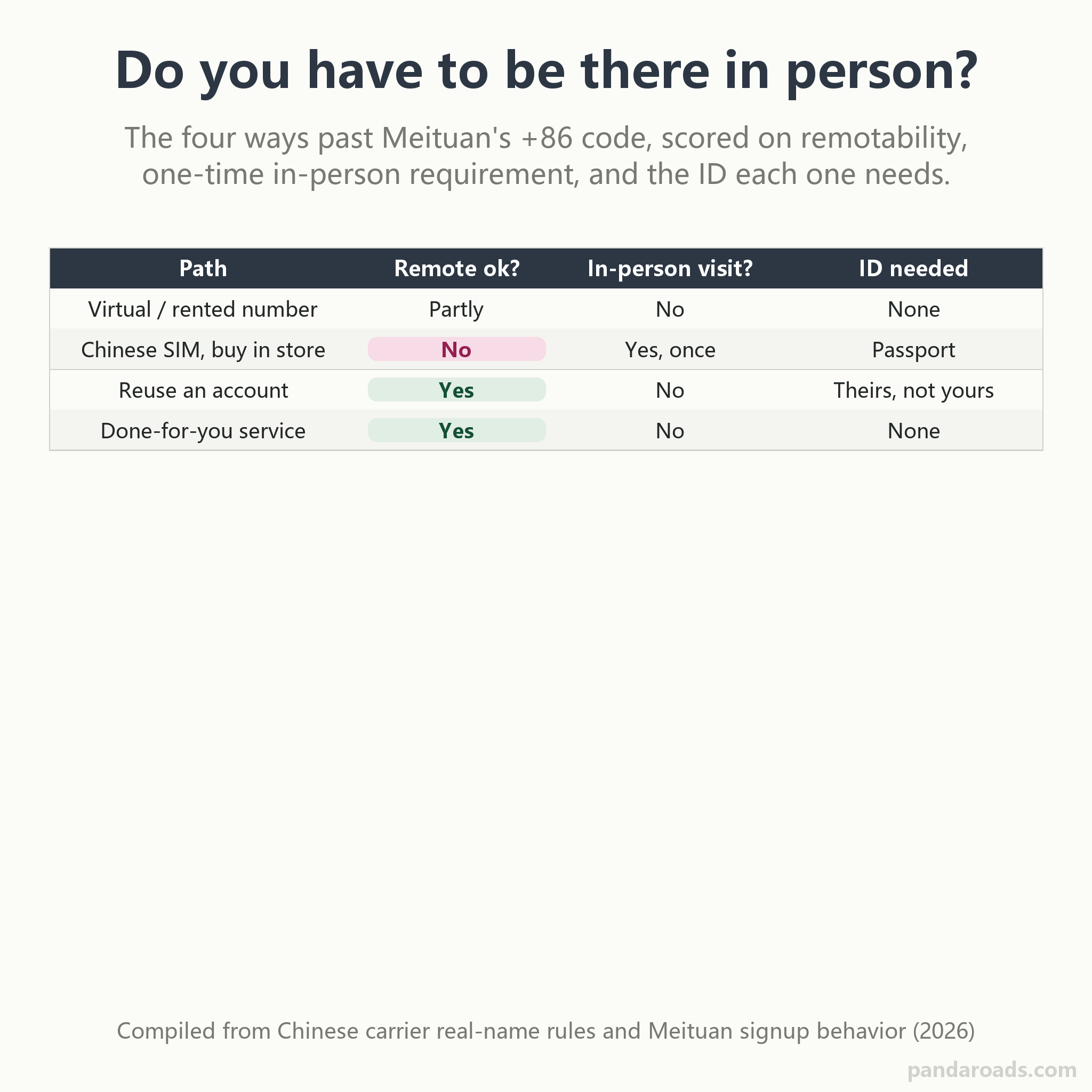
One boundary: a Chinese SIM is a phone number, not a payment method. Getting the number solves the registration obstacle here; it does not solve the separate problem of a foreign card hitting ceilings inside a Chinese wallet. That is a different objection, and our no-WeChat-Pay guide covers it.
Path 3: Use somebody else's existing account
Path 3 moves the order but not the accountability. Whoever places the order owns the trail: the stored payment method, the order history and the delivery addresses sit under the other person's registration, so refunds and disputes resolve in their name and you keep no receipt in yours.
The third option is the simplest mechanically: someone who already has a working Meituan account, usually someone inside China, places the order and you settle with them afterward.
We are keeping this one deliberately short, because as a buying decision it does not really compete with the others, and the reason is structural rather than personal. The account is the key to everything, and in this path the account is not yours. That means:
- The payment method on file belongs to that person, so the charge, and any chargeback or refund, lands in their account, not yours.
- The order history, delivery addresses and any stored identity sit under their name.
- If something goes wrong with the order, the recourse runs through whoever owns the login, and you are downstream of them.
None of that makes this path impossible; it makes it un-accountable. You cannot hold a receipt in your own name, you cannot open a dispute you are a party to, and you cannot prove what you paid if you settle up privately and off-platform. It works for a one-off request that both sides understand, and it is a poor foundation for anything you would want to buy, track, or get money back on.
If you will genuinely never be in China and just need a specific task done, this is the moment to notice that "find a person to run the order through their account" and "hire a service that runs it through theirs and gives you a receipt" are the same mechanism, with the second one carrying the paperwork a buyer needs. That is path four, and it is the version of "someone does it for you" that produces an invoice, photos and a dispute path instead of a text message.
Path 4: A done-for-you service that needs no number at all
Path 4 removes the +86 obstacle instead of solving it. You never register a SIM or a wallet, because a mainland runner places the order through their own accounts, you approve an itemized quote before anything is charged, payment runs through PayPal with its buyer protection, and you keep the quote, the receipt and the delivery photos.
The fourth path does not solve the +86 obstacle. It removes it. You never build a Meituan account, never buy a SIM, never register a passport with a carrier, and never hold a Chinese wallet, because you are not the one operating the app. A runner on the ground in mainland China uses their own established accounts and rails to place the order, and you transact with that provider directly, in dollars.
This is the shape a US buyer already recognizes: it is closer to hiring a TaskRabbit person or placing a managed service ticket than to configuring a foreign consumer app. You define the task and the address, you get an itemized quote, and nothing starts and nothing is charged until you approve it. You pay the company, not a stranger, and the payment runs through PayPal, whose buyer protection applies, rather than through a Chinese wallet, so the foreign-card ceilings and the person-to-person blocks that make Chinese wallets painful never enter the picture. The item itself is settled at cost against a receipt, and the work is priced by the task or the day rather than by a commission. The mechanics of paying for a China errand with no WeChat Pay are covered in that companion guide.
Why this matters specifically for the number obstacle: the reason paths one and three leave you exposed is that the phone number is the account key and you did not own it. Here, neither you nor your money depends on you owning a Chinese number. The provider's account, provider's number and provider's wallet are the operating layer; you keep the quote you approved, the receipt, and the delivery photos, and the money sits on a rail that has its own dispute process. That is the accountability you could never get by borrowing a login.
The trade-off is honest too. It costs more than doing it yourself, because a task is priced as a service rather than free, and you give up browsing the app yourself and redeeming an in-person deal at the counter. There is a boundary on the other side as well: a runner cannot sign as you, pull a visa, or do anything that legally requires your own personal presence. If your goal is to be a Meituan user, this is the wrong path. If your goal is to get a specific outcome, it is the only path that never asks you to become a Meituan user at all.
For the plain mechanics, get a fixed quote before anything is spent. Our china tasks catalog lists the standard task types with published pricing, and you can request a task quote here. If the actual scene is ordering food for a family member inside China rather than a task for yourself, that is a different, well-covered case, and the dedicated guide on sending food delivery to family in China goes deeper than this overview can.
The four paths side by side
Now score them the way you would score a vendor, on the checks that actually decide the purchase. These are qualitative verdicts drawn from the mechanics above, not invented statistics.
| Path | Success odds | Must you be in China | Account survives | Proof and recourse | Time cost |
|---|---|---|---|---|---|
| Rented / virtual number | Low | No | Weak, not really yours | Little or none | Minutes to a day |
| Own Chinese SIM (passport) | High | Yes, one store visit | Strong while kept active | Your own account and bills | About half a day |
| Borrow someone's account | Medium | No | It is theirs, not yours | Their receipt, not yours | Minutes |
| Done-for-you service | High | No | You keep none (by design) | Approved quote, receipt, photos | 1 to 2 business days |
Read it as a set of trade-offs, because no path wins every column.
On odds, the in-person SIM and the done-for-you service both clear the obstacle reliably; the rented number frequently does not, and the borrowed account only works as long as the other person is willing and available.
On presence, this is the column that splits the whole article. If the "must you be in China" answer is unacceptable to your situation, path two is already out, and you are choosing between one, three and four.
On account survival, only path two gives you a durable account that stays yours, and it only holds if you keep the number alive. The others are all, in different ways, on borrowed ground.
On proof and recourse, which is the buyer's real question, there is a hard split: path four is the only one that hands you an approved itemized quote, a receipt and delivery photos in your own name, on a payment rail with its own dispute process. Path two at least gives you a bill under your own registration. Paths one and three give you nothing you can point to.
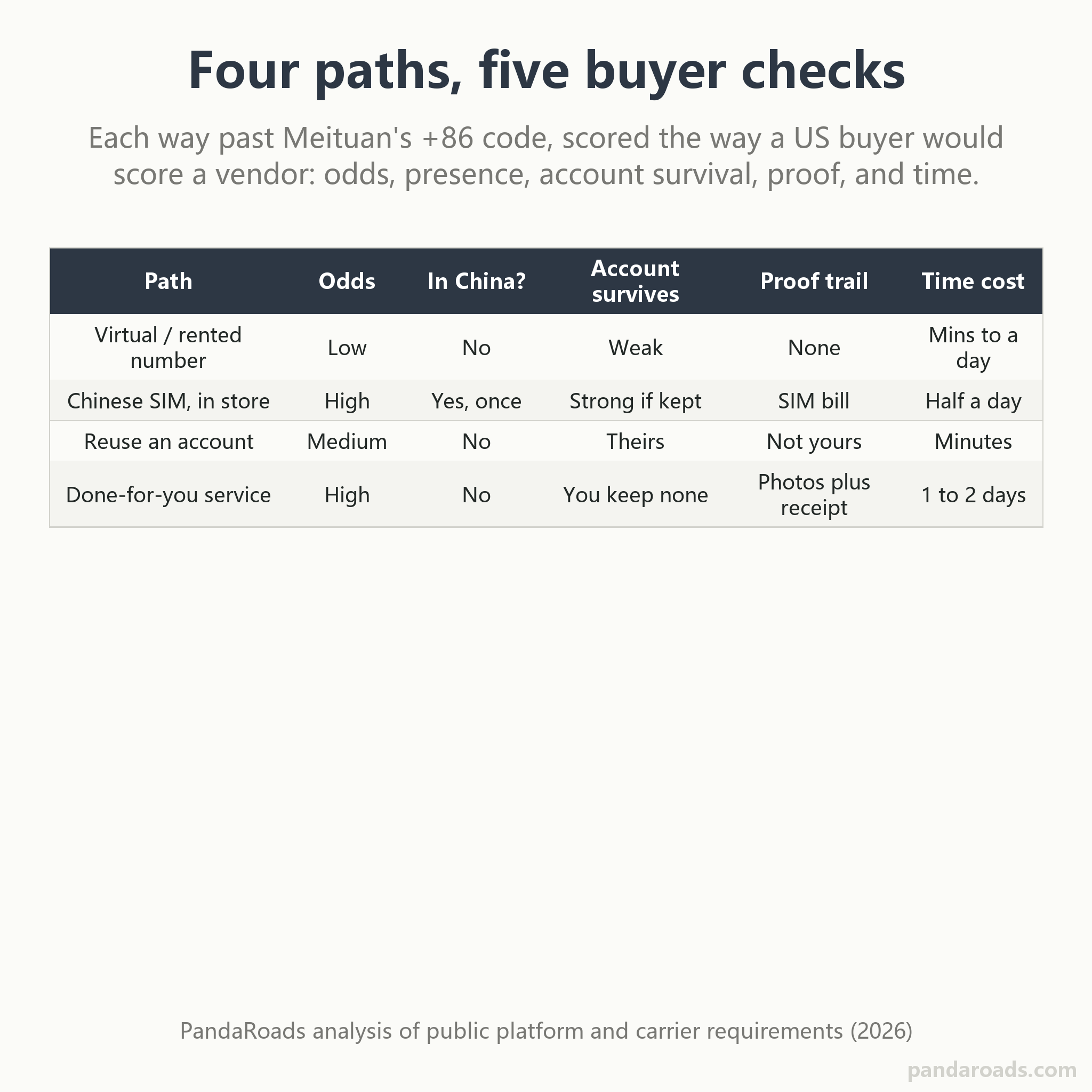
Read as a vendor scorecard, two of the four paths clear the obstacle reliably: the passport-registered Chinese SIM and the done-for-you service, which returns finished work in 1 to 2 business days. The rented number frequently does not, and a borrowed account works only while its owner is willing and available.
The decision falls out of the two load-bearing columns. Physically going to China soon and want the account yourself: path two. Anywhere else in the world wanting an outcome: path four, and treat paths one and three as time you will not get back.
If you already have a +86 number but live abroad
There is a second, less-discussed version of this problem, and for many people it is the one that actually bites. You studied or worked in China, you kept your +86 number and your Meituan or WeChat accounts, and now you are overseas. The number is the account key, and codes are no longer arriving.
The failure is not usually Meituan-specific. It is that the number underneath everything has gone quiet. Mainland prepaid numbers are cut off and then recycled once they sit out of balance, and the operational accounts written by people who handle this for a living give a concrete window: one China-based expat operations guide states plainly that if a prepaid SIM is out of balance for three months the number will be recycled, and that once that happens your only move is to call the carrier hotline and ask whether it can be recovered. Treat that three-month figure as one operator's report rather than a published national countdown, because the carriers differ and no single rule is published that you can schedule around. That is the honest limitation of this guide: neither the carrier recycling rules nor the app's rejection logic are published anywhere you can appeal to, so every verdict here reads mechanics and reported experience rather than a posted policy. The direction of the risk is not in doubt: a quiet number eventually becomes somebody else's number.
The consequence is the part people miss, and it runs counter to how anyone treats an old phone plan back home: a reassigned number is a security hole, not just an inconvenience. If your Meituan, WeChat or bank login still keys to that number, the new holder can receive the codes your accounts send, which makes a recycled line a login path rather than a nuisance. That is why keeping the line reachable, or deliberately migrating the account off the old number, is not optional housekeeping.
A thread from r/chinalife puts the stuck-user version exactly:
"How can I contact China Mobile from abroad to setup international roaming? I need to send and get a verification code via SMS for wechat." (reddit r/chinalife, 2024)
Read that as a buyer reading their own risk register, not as a plea for help. The person is trying to keep a code channel open so an account they already depend on does not slip away. Your practical options, in order:
- Keep the number genuinely active before you leave: periodic top-up, and international roaming or a forwarding arrangement that lets an SMS reach you abroad.
- Move the account's key number to something you control long-term while you still can, using the app's account-security flow. The recovery sequence for the WeChat case, including what to do once a number is already gone, is written out in recovering WeChat when your Chinese number stops working, and the order of operations is the same on this side.
- If what you actually need is Meituan access rather than that particular phone plan, the wallet route is the one that does not hang on a mainland SIM: the guides point foreign users to the Meituan mini-program inside WeChat or Alipay precisely because a Chinese SIM makes standalone signup smoother but is not required for every mini-program flow.
- Once the number is gone and reassigned, do not rebuild sensitive accounts on a fresh rented number; that just recreates the same fragility with less recourse.
If the account you are trying to save was only ever a means to get tasks done from abroad, this is the point to weigh whether maintaining a Chinese phone plan from another country is worth the effort, or whether commissioning the task outright is the cheaper answer.
What Meituan does not do, no matter which path you pick
Meituan's real boundary is an address, not an account. Its own reporting puts coverage at roughly 2,800 cities and counties with some 16,000 round-the-clock pharmacies, every one of them keyed to a Chinese address, and the app has no full English interface. Keeta, the standalone brand Meituan built for markets outside mainland China, runs separate apps and separate accounts.
Getting past the number gate is worth doing only if Meituan is the right tool for your actual goal, so here is the honest boundary.
Meituan is a mainland-China super-app for local services. Its coverage is a phone number and a physical location inside China. It is not a global delivery network, and it is not a way to buy things for someone halfway around the world on its own. Three limits follow from that.
Coverage. Meituan's services (food delivery, instant retail of groceries and medicine, the 跑腿 errand arm, local deal vouchers, hotel and travel booking) are keyed to being available in a given Chinese city at a given address. The footprint is enormous inside China, roughly 2,800 cities and counties by the platform's own reporting, with a late-night pharmacy program spanning some 16,000 round-the-clock pharmacies. It is still address-level: a tier-one city is dense and a smaller place can be thin, so if your target address sits outside a well-covered urban area the app may have little or no service there regardless of which path got you a working account.
Language. The interface is Chinese-first. Guides describe using the app's built-in translate feature to work in English, and it is imperfect. There is no fully native English Meituan. If reading Chinese menus, addresses and button labels is a hard blocker for you, that does not go away once you have a number.
The Keeta distinction. Do not confuse mainland Meituan with Keeta. Keeta is the brand Meituan has built for markets outside mainland China, and its own international site calls it a standalone brand of Meituan focused on instant delivery of food and goods. That means its own app and its own accounts. Having or not having a mainland Meituan +86 account says nothing about whether Keeta serves your city, and a Keeta account is not a Meituan account. If your real need is food delivery inside mainland China, Keeta is not the answer, and vice versa.
A fourth expectation to kill now: no workaround here makes Meituan behave like a Western e-commerce site that ships abroad or settles in dollars to a foreign buyer. That is not what it is built for. If your goal is "get something bought, collected, checked or delivered inside China while I stay overseas, and pay in US dollars," then the app is the wrong class of tool entirely, and a managed done-for-you service exists precisely because it operates the app and the rails on your behalf. The general method for that, start to finish, is in our guide to how overseas buyers get a China task done, and if the specific want is the platform overview itself, see our Meituan guide for foreigners.
Frequently asked questions
Can I use Meituan with a foreign phone number? For the standalone app, generally no: registration keys the account to a mainland +86 number for the OTP, and a foreign number will not finish that step.
Accessing Meituan inside the WeChat or Alipay mini-programs can sometimes inherit the wallet's verified identity and skip a separate code screen, but that behavior is inconsistent, so treat "foreign number works" as a may, not a promise.
Do I need a Chinese phone number for Meituan? To own a standalone Meituan account, effectively yes, because the number is the login key and the code target. If you never want a Chinese number, the alternative is to not hold an account at all and commission the task through a service that places the order for you.
How can I use Meituan in China as a foreigner? Buy a Chinese SIM in person with your passport at an airport desk or a large carrier branch, use that +86 number for the OTP, and open Meituan (standalone or inside WeChat or Alipay). Keep the number active, because codes and account recovery depend on it.
Why is my Meituan verification code not coming through? Most often the +86 number underneath the account has lapsed, run down to zero balance, or been recycled after inactivity, so it can no longer receive SMS. International roaming that does not carry inbound SMS, or a number now reassigned to someone else, produces the same symptom.
Can I receive a Chinese SMS verification code from abroad? Only if the number is still active and set up for international roaming or forwarding before it goes quiet. Once a prepaid number is deactivated and reassigned, you cannot reliably receive its codes again, and there may be no way to get the number back.
Do I need a Chinese SIM card to register Meituan? You need a number that can receive the Chinese SMS code, which in practice means a physical Chinese SIM you registered with a passport, or access to someone's already-registered number. A data-only travel eSIM does not qualify: it gives you internet, not a mainland number, and it cannot receive the code. National rules require real-name registration for the SIM itself.
Is there an English version of the Meituan app? No native one. The interface is Chinese-first, and foreigners typically rely on the app's built-in translate feature, which is imperfect. Reading menus and addresses in Chinese is not fully removed by any of the four paths.
What is Keeta and is it the same as Meituan? Keeta is the international brand Meituan operates outside mainland China, with its own app and a separate account system. A mainland Meituan account is not a Keeta account, and neither substitutes for the other in the other's market.
Can I order food delivery in China from another country? Not through Meituan itself: it serves a physical location inside mainland China and does not ship abroad or settle as a global store. If you are overseas and want food or an errand handled at a Chinese address, the practical route is a done-for-you service that operates the app on the ground for you.
What happens to my Chinese phone number when I leave China? If it is prepaid and goes inactive or runs out of balance, it is cut off and then recycled and reassigned by the carrier.
The operational accounts foreigners leave behind describe a window of around three months out of balance before a number is recycled, though no single published national rule fixes the clock. Any account still keyed to that number becomes reachable through that number by whoever gets it next, which is both an access and a security risk.
The bottom line
Meituan will not bend its +86 verification to fit a foreign number, and that is not a bug you can trick past; it is a national real-name rule stacked under an app that keys accounts to a Chinese SMS code. The four paths are just four different ways to pay for that reality with your time, your presence, or your accountability.
Reduce it to the two columns that decide everything. If you will be physically in China soon and want an account that is genuinely yours, spend the half day and get your own passport-registered SIM (path two), and keep the number alive so it does not get recycled out from under you. If you are anywhere else in the world and you just need a specific thing bought, collected, checked or delivered at a Chinese address, do not build an account you will never control (paths one and three); commission the task through a done-for-you service (path four) that hands you a dollar quote, delivery photos and a receipt, which is exactly the paper trail a rented number or a borrowed login never can.
That is the whole decision, and it is a buying decision, not an app-configuration puzzle. If the outcome is what you want rather than the experience of being a Meituan user, price the task instead of troubleshooting the registration: see the china tasks page for standard task types and dollar pricing, or send a task request for a quote if you already know what has to be finished.
References
- Shenzhen Municipal People's Government. (2024, December 10). How to get a SIM card. Shenzhen Government Online. https://www.sz.gov.cn/en_szgov/news/infocus/SZCitywalk/Videos/Essentialguide/content/post_11857177.html
- Liu, J. (2026, September 21). China SIM card for foreigners (2026): How to buy, setup, avoid mistakes. Hidden China Travel. https://hiddenchinatravel.com/china-sim-card-for-foreigners
- Kretch, R. (2026, August 4). How to use the Meituan app in English: Foreigner's guide (2026). The Fabryk. https://thefabryk.com/blog/how-to-use-meituan
- Liu, J. (2026, August 27). Meituan without a Chinese number: How to use Meituan for foreigners in China (2026). Hidden China Travel. https://hiddenchinatravel.com/how-to-use-meituan
- China Travel Guide. (2026, August 10). How to order Meituan takeout in China without a Chinese phone number (via Alipay). BSWen China Travel Guide. https://chinatour.bswen.com/blog/2026-08-10-order-meituan-takeout-via-alipay/
- Keeta. (n.d.). Keeta: Food delivery [Company website]. Retrieved October 2, 2026, from https://www.keeta-global.com/
- Chengdu Expat. (n.d.). You may lose your Chinese mobile number if it is out of balance. Chengdu Expat. Retrieved October 2, 2026, from https://chengdu-expat.com/you-may-lose-your-chinese-mobile-number-if-it-is-out-of-balance/
- PandaRoads. (2026). Meituan guide for foreigners in China [Platform guide]. PandaRoads. https://pandaroads.com/meituan-china-foreigner-guide.html
- PandaRoads. (2026). China errands from overseas: done-for-you local tasks [Service hub]. PandaRoads. https://pandaroads.com/errands-in-china-from-overseas.html
- PandaRoads. (2026). China sourcing and local task service [Task catalog]. PandaRoads. https://pandaroads.com/china-tasks.html
Last reviewed and updated: October 2026. Author: our editorial team. For tailored guidance, contact our team.