How to Use Meituan in China: A Foreigner's Field Guide
Meituan is a Chinese-only on-demand super-app. The three setup gates a foreigner hits, verified App Store and Google Play download ids, a translated order walkthrough, the real fee stack, and when the 跑腿 errand arm beats hiring a person.
Last updated: July 2026 · By the PandaRoads team in China
TL;DR
To use Meituan in China you need a mainland-capable phone number for the SMS code, a funded Alipay or WeChat Pay wallet (the app does not take your foreign card directly, and even linked cards hit per-wallet ceilings, about ¥3,000 a transaction on Alipay and ¥6,000 on WeChat Pay), and you order by memorizing a few Chinese labels: 外卖 to open food delivery, 选规格 to pick options, 提交订单 to submit. Most orders cost a ¥2 to ¥6 delivery fee on top of a ¥15 to ¥30 per-store minimum, and the 跑腿 errand feature moves parcels and buys medicine across town in about 40 minutes.
Abstract
Meituan is a Chinese-only on-demand super-app; a foreigner can run it by clearing three setup gates, learning six Chinese tap-targets, understanding the real fee stack, and knowing when the 跑腿 errand arm beats hiring a person.
Key Takeaways
- Meituan is Chinese-only; there is no full English interface
- Three gates: mainland SMS number, funded wallet, foreign-card cap
- Download the real app: iOS id 423084029, Android com.sankuai.meituan
- Order via 外卖, 选规格, 提交订单; note it with 备注
- Fee stack: ¥2 to ¥6 delivery plus a ¥15 to ¥30 minimum order
- 跑腿 errand sends parcels and buys medicine in about 40 minutes
Table of Contents
- Abstract
- Key Takeaways
- What Meituan Is, and What It Is Not
- The Three Setup Gates a Foreigner Hits
- Getting the App: Verified Download Routes
- A Translated Ordering Walkthrough
- What a Real Order Costs: The Fee Stack
- By the Numbers
- What You Can and Cannot Do Without Reading Chinese
- Meituan Errand (跑腿): When It Beats a Human Runner
- Frequently Asked Questions
- Conclusion
- References
What Meituan Is, and What It Is Not
A Chinese-only super-app, not a wallet. Meituan is a single on-demand app for food, groceries, medicine, vouchers and errands, founded in March 2010 and serving roughly 2,800 cities and counties, with 16,000 round-the-clock pharmacies. It has no full English interface, and payment runs through Alipay, WeChat Pay, or e-CNY rather than a card you hand it.
Meituan (美团), operated by the Sankuai (三快) group, is a Chinese on-demand super-app, a single phone application that orders hot food, groceries and medicine, sells discounted in-store vouchers, books a taxi, and sends a rider across town to carry a parcel for you. It calls itself a technology retail company, founded in March 2010 and listed on the Hong Kong exchange on 20 September 2018, with the stated mission to help everyone eat better and live better (source: meituan.com). The scale behind that mission is real: by its own reporting the platform reaches roughly 2,800 cities and counties, and its late-night pharmacy program has lit up 16,000 round-the-clock pharmacies so medicine can be ordered at 2am (source: meituan.com), (source: roamchinatravel.com).
What it is not matters just as much to a foreigner. It is not an English-language service. There is no full English interface; the app assumes you read Chinese and every button, dish name and fine print is in Chinese characters (source: roamchinatravel.com). It is also not a wallet. The app does not hold your money or take your card directly; payment runs through Alipay, WeChat Pay, or the Digital RMB (e-CNY) wallet, China's official digital-currency app, which you set up somewhere else entirely (source: english.shanghai.gov.cn). If your wallets and VPN are not sorted yet, that install order belongs to our China apps download and setup guide, and this article stays focused on the app itself.
Here is the map of what the app actually does, and how far a non-Chinese-reader gets with each part.
| Capability | In-App Label | Works Without Chinese? | Notes |
|---|---|---|---|
| Food delivery | 外卖 | Mostly | Photo menus let you order by appearance |
| Groceries and convenience | 超市/便利 | Mostly | Same flow as food, from stores and pharmacies |
| Medicine | 医药 | Partly | Pick by photo; read the label with a translator |
| In-store vouchers | 团购 | No | Deal fine print and time limits are Chinese-only |
| Errand and parcel | 跑腿 | No | Booked through a WeChat mini-program |
| Payment | via wallet | Yes | Alipay, WeChat Pay, or e-CNY, set up elsewhere |
Two ideas make the whole app legible once you accept them. First, the app is a marketplace of local shops plus a rider network, so it can only surface what is near your set location, and the location must be a real Chinese address. Second, the app is built for a Chinese user who already has a funded wallet and can read the screen, and every friction a foreigner feels comes from being one or both of those things only partially. The rest of this guide works through the setup gates, a translated ordering walkthrough, the real cost of an order, and the one feature, 跑腿, where it quietly competes with hiring a person to run an errand for you.
The Three Setup Gates a Foreigner Hits
Three gates stand between a foreigner and an order. A Meituan account is created from a phone number and a six-digit SMS code, with no password or email signup; payment needs a funded, verified Alipay or WeChat Pay wallet; and a linked foreign card is capped per wallet, roughly ¥3,000 per transaction on Alipay and ¥6,000 (¥50,000 a month) on WeChat Pay.
Before a single dumpling gets ordered, three gates decide whether the app works for you at all: a phone number that can receive the login code, a funded payment wallet, and an understanding of the ceiling that foreign cards hit inside those wallets. Clear them in order and the app is usable; skip one and you stall at checkout with no obvious reason.
A phone number that receives the code
Meituan accounts are created from a phone number, nothing else. You tap 登录/注册 (log in or register), type a number, press the button for an SMS code, and enter the six digits that arrive (source: english.shanghai.gov.cn). There is no password and no email signup. The practical question is whether your number receives that text. The Shanghai government's own guide walks through SMS registration without requiring a mainland number, and some travelers do get the code on a foreign SIM (source: english.shanghai.gov.cn). But delivery to overseas numbers is inconsistent, and most foreigner guides tell you the reliable path is a local SIM from China Mobile or China Unicom, obtainable in person for around ¥20 (source: roamchinatravel.com). If you are setting up before arrival, register on your normal number first and treat a mainland SIM as the fallback, not the plan.
A funded Alipay or WeChat Pay wallet
The app does not process the card in your hand. At checkout it offers Alipay, WeChat Pay, or the Digital RMB (e-CNY) wallet, and you pay through whichever of those you have connected (source: english.shanghai.gov.cn). That means the wallet is the real gate: it must exist, be identity-verified, and have money or a linked card behind it before the app can pull anything. How to install and verify those wallets, and in what order to set them up alongside a VPN, is covered in our China apps guide; this article assumes the wallet is done and only flags where it bites back inside the app.
The foreign-card spend cap
Even with a wallet, a foreign card has a ceiling. Alipay caps a linked international card at roughly ¥3,000 per single transaction, and WeChat Pay at about ¥6,000 per transaction with a ¥50,000 monthly cumulative limit (source: china-briefing.com). For food delivery those numbers are almost never a problem, a big order is well under a thousand yuan. They matter when you push the app to do bigger jobs, a bulk grocery haul or an expensive 帮买 (help-buy) errand, where a single payment can brush the per-transaction cap. Know the ceiling before you rely on it for anything large, and keep a second funding method for the day a payment declines without explanation.
Put the three together and the setup checklist is short: a number that reliably receives the code, one funded and verified wallet, an honest read of the card cap, and a saved Chinese address for where you are staying. Everything past that is navigation, which is the easier half.
Getting the App: Verified Download Routes
Install by store id, not by search. The genuine Meituan super-app is Apple App Store id 423084029 (Sankuai Technology, version 12.66.201, store languages English and Chinese) and Google Play package com.sankuai.meituan; the delivery-only 美团外卖 sits at id 737310995. Because the app is Chinese-only, trust only apps.apple.com and play.google.com listings, never a third-party APK.
Plenty of lookalikes carry the name, so install the real app from a verified store identity rather than a random APK link. Every id and package below was checked against the live listing in September 2026 using Apple's iTunes Lookup service and the Google Play catalog (source: apps.apple.com), (source: play.google.com).
- iPhone, App Store: 美团, App Store id
423084029, publisher Sankuai Technology Co., Ltd., category Lifestyle, free, store languages English and Chinese, current version 12.66.201 (source: apps.apple.com). The same id resolves on the China storefront and on the US storefront, so many accounts can grab it without changing region (source: apps.apple.com). - Android, Google Play: package
com.sankuai.meituan, listed as 美团-美好生活小帮手 (roughly "Meituan, your little helper for a good life"), published by a Sankuai (三快) company, the same group behind the App Store listing (source: play.google.com). If Google Play will not load for you in the mainland, pre-install everything before you cross the border.
The main super-app versus the delivery-only app
Two products from the same company confuse people. The super-app above (id 423084029) is the one that bundles food, groceries, medicine, vouchers and errands. The company also ships a standalone takeout client, 美团外卖, at App Store id 737310995 (category Food & Drink, store languages EN/FR/ZH/ES) (source: apps.apple.com). If all you ever want is restaurant delivery, the delivery-only app is lighter and its listing exposes more language support. A third related name is 大众点评 (Dianping, App Store id 351091731), its reviews-and-deals sibling; you will not need it to order, but it is the same company (source: apps.apple.com).
A caution worth stating plainly. Because the app is Chinese-only, travelers sometimes find an "English Meituan" download on a third-party site. Treat any store page that is not apps.apple.com or play.google.com as suspect, and never install a sideloaded build whose developer string is not Sankuai (三快). The verified identities above are the whole point: memorize the id, confirm the seller, and the app you get is the real one. Once installed, the next section is the part no screenshot gallery makes obvious: actually finishing an order when you cannot read the buttons.
A Translated Ordering Walkthrough
Six Chinese labels carry a whole order. A foreigner can finish a Meituan food order by recognizing six tap-targets: 外卖 opens delivery, 选规格 picks options, 配送费 is the delivery fee, 起送价 is the minimum order, 提交订单 submits it, and 备注 holds delivery notes. Photo menus plus a funded wallet cover the rest, and a rider typically arrives in about 45 minutes.
Here is one food order, screen by screen, with the Chinese you will actually tap translated. You do not need to read Chinese; you need to recognize about six shapes on the screen and know what each one commits you to.
Six Chinese tap-targets to memorize
- Open the 外卖 (waimai, "takeaway") tab. It is the big first icon on the home screen and it lists every restaurant delivering to your current location (source: english.shanghai.gov.cn).
- Pick a restaurant. Stay near the top of the list, favor places with high star ratings, and check that the delivery time reads under about 45 minutes.
- Add a dish, then tap 选规格 (xuǎn guīgé, "select options") to choose spice level or portion size before it goes in the cart.
- Watch the cart line for two numbers: 配送费 (pèsòng fèi, the delivery fee) and 起送价 (qǐsòng jià, the minimum order). The cart will not let you check out below the minimum.
- Tap 提交订单 (tíjiāo dìngdān, "submit order") to place it. The app then asks whether you need cutlery; choose 不需要餐具 ("no cutlery needed") to decline and skip a small packaging add-on (source: english.shanghai.gov.cn).
- Pay with Alipay, WeChat Pay, or e-CNY, then watch the live map track your rider to the door (source: english.shanghai.gov.cn).
Those six cover a routine order. When something needs a human touch, the 备注 (bèizhǔ, "notes") field on the checkout screen is where you type instructions the restaurant and rider both see, and this is where not reading Chinese starts to cost you.
Notes, phone calls, and the front desk
Two phrases carry most of the load, and it is fine to paste them rather than compose them. 送到前台 means "deliver to the front desk," for a hotel whose staff stop riders at the lobby. 请打电话 means "please call," if you would rather be phoned than have the food left somewhere (source: roamchinatravel.com). A rider will often call on arrival, and the call and any follow-up messages are in Chinese; if you do not want to answer, a short saved message like "I'm in the lobby" beats fumbling. The cleanest foreigner tactic is to have the front desk type your address and any note in Chinese once, then save that address in the app so every later order reuses it (source: roamchinatravel.com).
You can also lean on translation instead of people. Open the mini-program inside WeChat or Alipay and use its built-in Translate action to render the screen in English, or screenshot a menu page into a translation app. Photo menus are your shortcut: order dishes that show a clear picture and you can go a long way without reading a single description (source: roamchinatravel.com). The order flow is genuinely doable for a non-reader; it is the fine print, the disputes, and the phone call where the language barrier stops being an inconvenience.
What a Real Order Costs: The Fee Stack
A Meituan order stacks a fee on the menu. A typical delivery adds a ¥2 to ¥6 delivery fee (配送费) on top of the food, and you must first clear a per-store minimum order (起送价) that is usually ¥15 to ¥30, or ¥50 to ¥80 at premium kitchens. A rice-and-two-dishes meal runs about ¥21 to ¥36 delivered, and most orders arrive in 25 to 45 minutes.
The price you see on a dish is not the price you pay, and understanding the gap prevents most checkout surprises. The total on the checkout line is the food plus three stacked charges, a delivery fee (配送费), a small per-container packaging fee, and any minimum-order effect (起送价) you had to clear to unlock delivery at all; coupons then offset parts of it. The four lines that decide what you pay: the delivery fee, the minimum order, packaging, and coupons. The rider does not set these numbers; the platform and the merchant do (source: roamchinatravel.com).
- Delivery fee (配送费): typically ¥2 to ¥6 for a nearby restaurant, rising with distance and during bad weather (source: roamchinatravel.com). Both the app and its rivals push delivery-fee coupons on the restaurant page, so this line is often reduced or waived.
- Minimum order (起送价): a per-store floor you must clear before delivery is offered. Most places set ¥15 to ¥30; some premium kitchens ask ¥50 to ¥80 (source: roamchinatravel.com). The standard trick is to add a cheap drink to cross it.
- Packaging: a small fee per container, which the cutlery prompt at checkout can trim if you decline disposables.
- Coupons: restaurant and platform discounts that come off the food or the fee, shown before you submit.
Here is what a typical order costs end to end, using the reported ranges for a single person or a shared meal (source: roamchinatravel.com).
| Meal type | Food price | With delivery | Notes |
|---|---|---|---|
| Rice with two dishes | ¥18 to ¥30 | ¥21 to ¥36 | Everyday fast-food tier |
| A noodle dish | ¥15 to ¥25 | ¥18 to ¥31 | Often clears the minimum alone |
| Hot pot kit for two | ¥60 to ¥120 | ¥65 to ¥127 | Feeds two, better per-person value |
| A burger-combo meal | ¥35 to ¥50 | ¥40 to ¥58 | English-chain names are searchable |
| Coffee and a pastry | ¥25 to ¥45 | ¥28 to ¥52 | Common 跑腿 help-buy errand too |
Two timing facts round out the cost picture. Most orders arrive in 25 to 45 minutes, sliding toward an hour at the 12:00 to 13:00 lunch and 18:00 to 20:00 dinner peaks (source: roamchinatravel.com). And the errand arm is priced on distance and urgency rather than a menu, advertised at an average 40-minute delivery for a city-wide parcel run (source: peisong.meituan.com). The takeaway for budgeting is simple: expect a few yuan of fee on top of the menu price, know that a cheap add-on can satisfy a minimum, and remember that the platform, not the rider, decides the number.
By the Numbers
- 2,800 cities and counties the platform serves (source: roamchinatravel.com)
- 40 minutes, the advertised average for an intra-city 跑腿 errand (source: peisong.meituan.com)
- 16,000 24-hour pharmacies wired into late-night medicine ordering (source: meituan.com)
What You Can and Cannot Do Without Reading Chinese
You can order and pay, but not read your way out. Browsing a photo menu, adding to the cart, paying through a funded wallet, and tracking the rider need zero Chinese, so a non-reader can run the routine loop. What stays blocked is text: dish descriptions, 团购 voucher fine print, and a rider's phone call, which is where a stalled order at 11pm becomes a real problem.
The honest answer to "can I use the app without Chinese?" is: you can order, and you can pay, and you will get stuck on the parts that require reading. Naming exactly where the wall is saves you from a stalled order at 11pm.
The solo-doable half is larger than people expect. Browsing a photo menu and tapping the dishes that look right needs no reading. Adding to the cart, checking out through a wallet you already funded, and tracking the rider on the map are all icon-and-number tasks. Clearing a minimum order is just arithmetic on screen. In other words, the routine loop, browse by picture, add, pay, wait, works for someone who reads zero Chinese (source: roamchinatravel.com).
The blocked half is anything expressed as text. Reading a dish description to learn what is actually in it, or whether it contains something you avoid, is Chinese-only. So is the fine print on a 团购 voucher: what is included, whether it is weekday-lunch only, whether you must reserve a table. When something goes wrong, the after-sales path (售后) and any dispute are handled in Chinese chat, and a rider's incoming call is answered in Chinese or not at all (source: roamchinatravel.com).
The workarounds close most of the gap. The WeChat or Alipay mini-program has a Translate action that re-renders the current screen in English. Screenshotting a menu into a translation app conveys roughly what you are ordering (source: roamchinatravel.com). The front desk can type your address and a delivery note in Chinese characters once, and you save both. None of these make Meituan an English app; they just move you from "blocked" to "slower."
The table below shows where a non-reader lands on each common task, and the single move that unlocks the ones that do not.
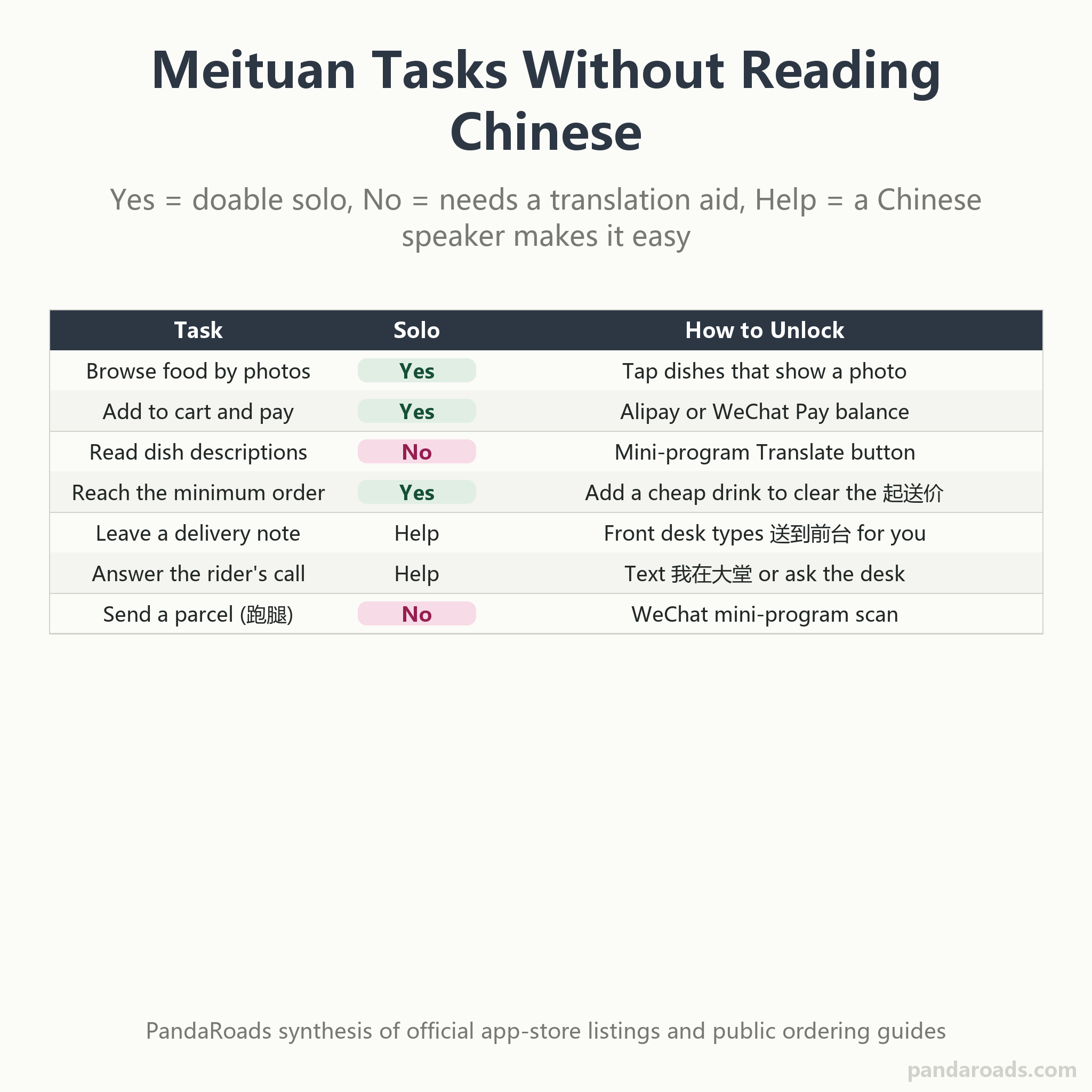
The pattern is worth internalizing before you rely on the app for anything with stakes: The app is safe and easy for low-risk, visual, in-the-city orders, and it is the tasks carrying consequences, a medicine label, a paid voucher's restrictions, a parcel handed to a stranger, where you want either a translator open or a person who reads Chinese on your side.
Meituan Errand (跑腿): When It Beats a Human Runner
跑腿 is a courier with a purchase option, not an agent. Meituan's intra-city errand arm has two modes: 帮送 carries food, documents, flowers, cakes, apparel or electronics across town at an average 40-minute delivery, and 帮买 sends a rider to buy nearby snacks, coffee, medicine or daily goods. It moves and buys things; it does not read, verify, or write to you in English.
Tucked inside the app is an intra-city errand service called 跑腿 (pǎotuī, literally "run about"), and it is the feature that blurs the line between an app and a hired helper. The platform's own delivery site describes two modes. 帮送 ("help-send") picks up and carries an item across town for you: food, documents, flowers, cakes, apparel, even digital devices, city-wide, with the advertised speed of an average 40-minute delivery (source: peisong.meituan.com). 帮买 ("help-buy") sends a rider to buy something nearby and bring it to you: snacks, coffee, milk tea, medicine, daily goods (source: peisong.meituan.com). You book a run through a WeChat mini-program by scanning a code, and a rider handles the physical leg.
The jobs 跑腿 nails are the concrete, low-judgment, same-city ones. You left a charger at a friend's place and need it before a flight. A contract has to physically reach an office across the city in an hour. It is midnight, you are out of medicine, and a 24-hour pharmacy is reachable. A home-cooked meal needs to get to a relative on the other side of town. In each case 跑腿 is faster and far cheaper than hiring a person to do the run, because you are paying a rider for a trip, not a professional for their time and judgment.
The jobs it cannot do are exactly where a human task-runner earns their fee. 跑腿 moves and buys things; it does not read, decide, verify, or correspond. It will not call a supplier to check whether a company is real, inspect a package for quality before it ships, chase a government window in Chinese on your behalf, or email you a structured English report of what it found. It is a courier with a purchase option, not an agent. When a task needs that judgment, or any English output you can act on from abroad, an app dispatch is the wrong tool (source: peisong.meituan.com).
So the decision is a clean fork. If the task is "physically move or buy object X within one city, now," open the 跑腿 feature; it is fast and priced like a delivery. If the task is "handle a situation in China that needs reading, calling, verifying, or an English result," route around the app and use a person, which is what our China life-errands service and hire-someone-in-China guide are built for. Two boundaries keep this from bleeding into other guides: sending parcels is not the same as a furniture or cargo van move, which is a different model covered in our Lalamove China delivery guide, and forwarding boxes overseas from Chinese sellers is its own job, walked through in our package-forwarding guide. 跑腿 is the small, same-city, same-hour slice, and within that slice it is close to unbeatable.
Frequently Asked Questions
Paying, ordering and finding an English screen, in short. The three questions foreigners ask Meituan have fixed answers: you register with a phone number and a six-digit SMS code; you pay through a funded Alipay or WeChat Pay wallet, with foreign cards capped near ¥3,000 per transaction on Alipay and ¥6,000 on WeChat Pay; and there is no English interface, only photo menus and the mini-program's Translate button.
Can I use Meituan with a foreign phone number? Sometimes. Accounts are created from a phone number plus a six-digit SMS code, and the registration flow accepts a number without a password (source: english.shanghai.gov.cn). Foreign numbers can receive the code, but delivery is unreliable, so most guides recommend a cheap local SIM to guarantee signup (source: roamchinatravel.com). Register early, before you depend on the app.
Is there an English version of the Meituan app? No. It has no full English interface, and every label, dish name and policy is in Chinese (source: roamchinatravel.com). The practical substitutes are the WeChat or Alipay mini-program's built-in Translate action, screenshot translators, ordering from photo menus, and having the front desk type your address once.
How do I pay on Meituan as a foreigner? You pay through a wallet, not a card. It accepts Alipay, WeChat Pay, or the Digital RMB (e-CNY) at checkout, so the wallet must already be funded and verified (source: english.shanghai.gov.cn). Linked foreign cards sit under a per-wallet cap, about ¥3,000 a transaction on Alipay and ¥6,000 (¥50,000 a month) on WeChat Pay, which rarely binds a food order but can on a big help-buy errand (source: china-briefing.com).
What does delivery cost on Meituan? Expect a delivery fee of about ¥2 to ¥6 on top of the menu price, plus a small packaging fee, at stores whose minimum order (起送价) you have cleared, usually ¥15 to ¥30 (source: roamchinatravel.com). Coupons on the restaurant page often cut the fee, and the platform, not the rider, sets these amounts.
What can Meituan errand (跑腿) deliver? Both directions. 帮送 carries a specific item across town, such as documents, food, flowers, cakes, clothing or electronics, at an advertised average of 40 minutes, and 帮买 sends a rider to buy nearby snacks, coffee, milk tea, medicine or daily goods for you (source: peisong.meituan.com). It moves and buys things; it does not decide, verify or correspond.
Does Meituan work in every Chinese city? Broadly yes in the places travelers go. It serves roughly 2,800 cities and counties, and its core services are strongest in big cities like Beijing, Shanghai, Guangzhou and Shenzhen (source: roamchinatravel.com). Coverage and rider supply thin out in small towns, so confirm that restaurants actually deliver to your address before you count on it.
Conclusion
The app is worth the friction because it does something no English-language app in China does at the same price: it brings a hot meal, a box of medicine, or a parcel across town to your door in under an hour, for a few yuan on top of the menu. You do not need to read Chinese to get there. You need a number that receives the login code, one funded and verified wallet, the real app from a store id you can check (iOS 423084029, Android com.sankuai.meituan), and about six Chinese shapes to recognize on the screen. Clear those and the routine loop, browse by photo, add to cart, pay through your wallet, watch the rider on the map, runs for you the same way it runs for anyone born here (source: roamchinatravel.com).
Where the app stops being easy is where reading, judgment, or consequences enter: a dish description you cannot parse, the fine print on a paid voucher, a medicine label, a dispute with a merchant, a phone call from a rider standing outside your door. Those are the moments to keep a translator open or a person who reads Chinese on your side. For the small, same-city, same-hour jobs, 跑腿 is close to unbeatable, an average 40-minute run for a city-wide parcel (source: peisong.meituan.com). For anything that has to be read, checked, phoned in, or reported back in English, an app dispatch is the wrong tool, and a human task-runner is the right one.
References
- Meituan. (2026). 关于美团 [About Meituan]: 一家科技零售公司. https://www.meituan.com/
- Sankuai Technology Co., Ltd. (2026). 美团-问美团,都安排 (Version 12.66.201) [Mobile application]. Apple App Store. https://apps.apple.com/cn/app/id423084029
- Sankuai Technology Co., Ltd. (2026). 美团外卖-外卖订餐,送啥都快 (Version 8.82.0) [Mobile application]. Apple App Store. https://apps.apple.com/cn/app/id737310995
- Hanhai Information Technology (Shanghai) Co.Ltd (2026). 大众点评 - 吃喝玩乐指南 (Version 11.72.2) [Mobile application]. Apple App Store. https://apps.apple.com/cn/app/id351091731
- Sankuai. (2026). 美团-美好生活小帮手 [Meituan] (Application) [Mobile application]. Google Play. https://play.google.com/store/apps/details?id=com.sankuai.meituan
- Meituan Delivery. (2026). 同城跑腿急送 (帮送、帮买) [Intra-city errand express]. https://peisong.meituan.com/paotui
- RoamChinaTravel. (2026). Food delivery in China guide 2026: Meituan, Eleme & how foreigners can order. https://roamchinatravel.com/posts/toolkit/china-food-delivery-apps-guide/
- China Briefing (HKTDC). (2023). WeChat enables foreigners to pay with overseas cards in China. https://www.china-briefing.com/news/wechat-enables-foreigners-to-pay-with-overseas-cards-in-china/
- International Services Shanghai. (2024). Payment methods for foreigners. Shanghai Municipal Government. https://english.shanghai.gov.cn/en-PaymentMethods/20240313/6f4e58272f1a4cea9aec59c518915bdf.html
- China Daily. (2018, September 21). Meituan IPO whets investors' appetite. http://global.chinadaily.com.cn/a/201809/21/WS5ba44d2ba310c4cc775e7780.html
Last reviewed and updated: September 2026. Author: our editorial team. For tailored guidance, contact our team.