Hire a Product Inspector in China Before You Pay: 6 Steps
Hire a product inspector in China before payment: lock the balance, screen the provider with documents, then read the report as a hold or release decision.
Last updated: September 2026 · By the PandaRoads team in China
TL;DR
Hiring a product inspector in China before you pay is not a vendor purchase, it is a verification protocol. The gate comes first: on the standard 30 percent deposit and 70 percent balance structure, the check is worth nothing until the balance physically has not left yet. Trust is then documentary rather than a feeling, an ISO/IEC 17020 scope you can read, the original business license, who actually attends, samples pulled from different cartons instead of the ones the factory staged, and a live video link from the floor.
Abstract
A step-by-step procedure for a small US importer or e-commerce seller who has to hire someone on the ground in mainland China to physically verify finished goods before the balance payment is released: how to lock the payment gate so an inspection has something to withhold, how to screen an inspector for independence using documents you can actually check, how to write the defect spec and the sampling level into the purchase order, how to time the booking so the sample comes from real export cartons, how to run an evidence protocol on the day, and how to read the resulting report as a release or hold decision on the wire.
Key Takeaways
- A pre-shipment check is worthless if the balance already left
- Independence is documentary, an ISO/IEC 17020 scope you can read
- An agent's own quality department is not an independent inspector
- A valid PSI needs 100 percent produced and 80 percent packed
- Samples from different cartons, or the factory picks your evidence
- An AQL plan prices risk, it never guarantees a clean container
Table of Contents
- Abstract
- Key Takeaways
- What you are actually buying is a gate, not a verdict
- Step 1: Lock the payment gate before you shop for an inspector
- Step 2: Screen for independence with documents, not branding
- Step 3: Write the defect spec into the purchase order before production
- Step 4: Time the booking so the sample is real
- Step 5: Run the evidence protocol on the day
- Step 6: Read the report as a release or hold decision
- What We Can Honestly Do on the Ground, and What We Cannot
- Frequently asked questions
- The bottom line
- References
What you are actually buying is a gate, not a verdict
A balance invoice is coming. The goods are finished inside a factory you have never entered, and the only person who can tell you whether they are right is a stranger you will never meet. That is not a procurement problem dressed up as a quality problem. It is a verification problem, and what you are actually buying is a gate on money that has not moved yet.
The order you placed twelve weeks ago is nearly done. You paid something around 30 percent of it as a deposit, and the supplier's invoice now wants the rest before the goods leave China. Between those two events sits the only bargaining chip you own. Once the balance is in their account, an inspection is a document you read at a desk. Before the balance is in their account, an inspection is a decision.
What people actually ask online is not a pricing question. A buyer on r/ecommerce, watching their order volume grow, put it plainly: "I'm buying from alibaba and as my volume increases I'd like to hire a QA inspector, how do you find a trustworthy one?" (source: reddit r/ecommerce, 2024-12). Another seller is still standing at the first door rather than the second, "Currently, I am debating whether or not to have my products inspected before leaving China. (Leaning towards hiring someone to inspect it)" (source: reddit r/FulfillmentByAmazon, 2018-02). Neither is asking what a man-day costs. One is asking how to trust a person four thousand miles away, and the other has not yet noticed that the answer depends on whether money is still on their side of the wire.
Here is the thesis in one line. You cannot verify an inspector by meeting them, so you verify them by the things they can produce on demand and the things you can watch happen from your own desk. The two deliverables you are buying are a payment gate and an evidence protocol, and every step below builds one of those two.
A pre-payment inspection is a gate on money rather than a verdict on a supplier. The structure most orders run on is a 30 percent deposit against a 70 percent balance, and that balance is the only card a buyer holds from eleven thousand miles away. Once the money moves, an inspection becomes a document you read at a desk instead of a decision you make.
How this file was assembled matters for how much weight to give it. Every figure came from a page we fetched and read during writing rather than from a summary of one: we compared the payment structure, the platform's own published inspection prices, the sampling standard, the packing threshold, the independence checks and our own rate sheet at the source. Three things came out of that reading, and we found the first of them inside one vendor's own pages: two published posts from the same firm describe travel add-ons differently, one modeling an average US$60 on top of an advertised US$240 day and the other documenting a wider surcharge for remote locations, so this guide quotes the market as a band and never as a promise (source: tradeaiders.com). The primary standard documents themselves sat behind bot walls on this network, so the sampling standard is carried here through a published restatement of it rather than through the ISO page. And we tried for a published industry-wide defect rate or rejection rate, found nothing we could open on this network, and left the number out, which is why the loss figure in Step 6 is arithmetic on an example order instead of a statistic.
Note: This guide is about one thing: a single check on finished goods before you release a balance payment. It is not about hiring a standing quality function. A post in a Shenzhen expat group looking for someone who can "lead quality control for my garment business," a role that will "involve setting up and managing" a whole function, is a different and larger commitment, and none of the steps below will get you there (source: Facebook Expat Rent Shenzhen, 2024-11). Nor is this a check on the factory itself, the visit that answers whether the place deserves your deposit at all.
By the Numbers
- $149-$320 The published 2026 band for a third-party pre-shipment inspection man-day in China, with most independent operators sitting between $199 and $280 (source: tradeaiders.com)
- $188 The original rate on Alibaba's own published inspection price sheet for a CCIC pre-shipment inspection, against $118 for Bureau Veritas and $48 for its Production Monitoring service (source: activity.alibaba.com)
- 80% The share of your order that has to be packed into export cartons before a pre-shipment inspection is valid at all (source: ecqa.com)
- 200 units The sample a General Inspection Level II plan pulls from a 3,500-unit lot, which then accepts on 10 or fewer major defects (source: gqc.io)
- 48 hours The deployment window one named international inspection firm states for getting an inspector onto a factory floor (source: qima.com)
- $239 What a PandaRoads on-site verification day costs, billed from departure with travel time counted (source: pandaroads.com)
Six figures, and the one quoted most often and understood least is the first. Small importers debate the day rate as though it were the decision. It is the smallest number in the decision. A check that runs after the balance has wired is worth exactly nothing at any rate, and a check that runs before it can hold the whole invoice, which is why the first step below fixes the payment structure and only then goes shopping for an inspector. The other five numbers each live in a specific step, and none of them is a marketing figure. They are a published band, a platform price, a packing threshold, a sample size and our own price sheet.
Step 1: Lock the payment gate before you shop for an inspector
Before you email a single inspection company, fix where the money is. The standard structure on a China goods order is a deposit around 30 percent and the remaining balance before shipment, and the practitioner guidance is explicit that a third-party inspection should happen before that final balance is released. An inspection that runs after the wire is a report about goods you have already paid for in full.
The 30 and 70 structure
Advanta's guidance for buyers states the rule in terms a supplier will recognize: engage a third-party inspection company to inspect your goods before you make the final 70 percent balance payment, and this is "universally recommended," while paying more than 30 percent up front is not advised (source: advantasourcing.com). The same source describes the variant you will actually be offered, 30 percent deposit with the 70 percent balance settled against the bill of lading, and notes that a mature relationship can move to terms where more is paid after the goods arrive.
Why the timing works is worth saying out loud, because it is the part a first-time buyer misses. Production being finished removes your only remaining argument. You cannot reject a shipment you already paid for, you cannot hold a container you have no money left in, and you cannot threaten to move the next order to a factory you have never quoted to when the next order is two years away. The balance is not a bargaining chip in a relationship. It is a gate, and gates only work before they open.
What the platform will sell you
Alibaba does sell inspection directly, and it publishes the prices on its own inspection service price sheet: CCIC Inspection at US$188, Bureau Veritas at US$118, and its own Production Monitoring service at US$48, all booked through inspection.alibaba.com, the same sheet that lists a promotional half-price column beside each original rate (source: activity.alibaba.com). That answers the question a lot of buyers type, and it also answers it with walls. Production Monitoring is offered only in Dongguan, Foshan, Guangzhou, Huizhou and Shenzhen, and the mainland inspection network excludes Chongqing, Gansu, Guizhou, Hainan, Hebei, Henan, Heilongjiang, Jilin, Inner Mongolia, Qinghai, Xinjiang and Tibet (source: activity.alibaba.com). A $48 monitoring service in a city your factory is not in is not a discount, it is a different product.
Where your money is when the check runs
| Payment structure | Already paid | Still withheld | What the check can stop |
|---|---|---|---|
| 30 percent deposit, 70 percent balance before shipment | The deposit | The balance | Release of the balance on a failed check (source: advantasourcing.com) |
| Inspection booked through the marketplace | Whatever the invoice says | Usually the balance, if the order sits under platform protection | A documented quality finding inside the platform's own claim window (source: activity.alibaba.com) |
| Full prepayment, or a deposit above 30 percent | Everything | Nothing | Only the relationship, and only if you want it back (source: advantasourcing.com) |
Three things to confirm before you contact an inspector, in this order. The invoice splits 30 and 70 rather than asking for more up front. The balance is contractually tied to a satisfactory pre-shipment inspection, in writing, in the language the purchase order is already written in. And the factory's planned shipping date leaves you a real gap to work inside, because a check booked for the day the container is collected is not a gate.
Note: This guide deliberately does not teach a five percent retention convention, sometimes repeated in importer forums as a balance you hold back for ninety days. We could not verify that practice against a published source during writing, so it is not in the steps. The only structure used here is the 30 and 70 one a fetched practitioner source states plainly.
Step 2: Screen for independence with documents, not branding
Trust here is not a feeling you get from a well-designed website. It is a set of things you can demand, read and file from your own desk. Screen a provider on the documents they can produce and the answers they will put in writing, because those are the only parts of the relationship a buyer in Ohio can actually verify.
Demand the accreditation certificate itself, a real sample report carrying measured numbers rather than a pass stamp, and a written answer on whether the inspector takes referral fees from factories. Fewer than 8 firms in China carry more than 100 full-time inspectors by one industry count (source: v-trust.com), which is why who physically attends, payroll staff or a subcontractor booked for the day, is not a detail question.
The accreditation filter comes first. An inspection body should hold accreditation to ISO/IEC 17020, the standard for inspection bodies specifically, and the check is on the certificate itself rather than on a logo in a footer: confirm who issued it, confirm that it is current, and confirm that the scope of accreditation covers the kind of inspection and the product family you are buying (source: maplesourcing.com). A firm can hold a valid certificate scoped to textiles and be entirely unqualified for your electronics order, and the scope line is where you find that out before the container is the test.
The register-level checks are blunter and they work. Look at the original business license rather than a scan of a copy, and read the business scope, because in China inspection registrations are frequently held by entities whose stated scope is trading, consulting or buying agent rather than inspection. Registered capital above RMB 2.3 million, roughly US$350,000, was the threshold AQSIQ used to recognize a third-party inspection institution, and the certificate that actually matters for an inspection body is CNAS accreditation to ISO/IEC 17020 or the Chinese government's AQSIQ accreditation, because an ISO 9001 certificate is general to any company and says nothing specific about inspection capability (source: v-trust.com). The same source puts the market in scale: firms carrying more than 100 full-time inspectors number fewer than eight.
Now the part nobody selling you a service wants on the table. A quality department inside your sourcing agent is not an independent inspector, because the agent's economics run through the same supplier relationship you are asking them to fail (source: maplesourcing.com). That does not make an agent dishonest. It means an agent's own check is a different product from a third party's check, and you should know which one you are buying.
Seven things to demand before you book, and what a weak answer sounds like
| What you ask for | What it proves | The weak answer |
|---|---|---|
| The accreditation certificate itself | That it is real, current and scoped to your product family (source: maplesourcing.com) | A logo on a website and no document |
| Who physically attends the site | Whether it is the firm's own payroll staff or a subcontractor booked for the day (source: maplesourcing.com) | "We have people everywhere" |
| A real sample report from a similar order | That they record measured results and photographs rather than a verdict (source: maplesourcing.com) | A PDF with a pass stamp and no numbers |
| Whether the price includes travel, waiting and re-inspection | That the quote is the cost (source: maplesourcing.com) | "That depends" on a supposedly fixed fee |
| Lead time and report turnaround | When an inspector can be on site and when you will read it (source: maplesourcing.com) | No stated turnaround at all |
| Whether the inspector takes commissions or referral fees from factories | That their income does not depend on your supplier staying happy (source: maplesourcing.com) | Offense at the question |
| Whether you can join the inspection by video | That the visit is open to being watched while it happens (source: maplesourcing.com) | Some providers allow it, others bill for it separately |
A firm that answers all seven in writing is not automatically honest. It is something better and smaller than honest. It is checkable, and checkable is the whole of what a buyer who cannot get on a plane can act on. V-Trust's own advice to prospective buyers is the same move from the other side, visit the office, look at the originals and ask how the quote is built, including whether the sample size per man-day and any per-piece inspection are stated (source: v-trust.com).
Step 3: Write the defect spec into the purchase order before production
An inspector who arrives with no written spec is improvising in front of your supplier, and the supplier is standing there watching. The contract move that wins the argument later is the one you make before production starts: define the defect classes and the sampling level in the purchase order itself, so the floor decision is a reading of your document rather than a judgment call made by a tired person at 9 a.m.
Defect classes settle the outcome before anyone reaches the factory floor. A critical defect is accepted at 0, which means 1 unsafe unit fails the whole lot, while major and minor defects are read against their own accept counts for your lot size. Put the classes and the sampling level in the purchase order before production starts, because the call on the floor is then a reading of your document.
The standard behind the numbers is worth naming precisely. AQL, the acceptance quality limit, is defined as the quality level that is the worst tolerable, not a share of defective product you have agreed to receive, and the tables working inspectors apply are the ISO 2859-1, ANSI/ASQ Z1.4 and MIL-STD-105E family, the consumer-goods standard developed under the American National Standards Institute (source: gqc.io). The consumer-goods default the market quotes is 0 critical, 2.5 major and 4.0 minor, run at General Inspection Level II unless the buyer deliberately chooses the tightened Level III, a reduced level, or one of the special levels S-1 through S-4 (source: gqc.io). Contrary to the plain-English reading of the acronym, the 2.5 major figure is not permission to ship 2.5 percent defective goods. It is the line at which the sample you pulled rejects the whole lot.
Translate the three buckets into buyer language before you put them in a document. A critical defect makes the goods unsafe or illegal to sell, and at zero tolerance a single unit fails the lot. A major defect stops the product doing what your customer paid for and generates a return. A minor defect is cosmetic, the loose thread most people would open, shrug at and keep anyway.
The arithmetic is mechanical, and it is the same in every quote you receive this month. One lot of 3,500 units at General Inspection Level II produces code letter L, which means a sample of 200 units, and at 0 critical, 2.5 major and 4.0 minor that lot accepts on 10 or fewer major defects and 14 or fewer minor defects (source: gqc.io). You should see your lot size, your level, your code letter and your sample size printed in the proposal, because a provider who cannot state them is not running a plan.
Then do the thing that costs nothing. Write your defect definitions into the purchase order before production starts. The same loose thread is a minor defect on a hem and a major defect on a load-bearing seam, and those two calls sit one and a half tolerance points apart in the spec, 4.0 against 2.5 (source: gqc.io). Photographs of a color you did not approve are worthless in a dispute. A line in the order that says which pantone code, which seam, which tolerance is major is worth a negotiation.
Note: Two honest limits here. A plan built on a sample can pass a lot that is genuinely bad, and the standard's own restatement says it plainly, an AQL inspection will not guarantee a defect-free order (source: gqc.io). And the full rate table plus a longer walkthrough of reading these plans lives in our published China product inspection cost guide, which this step deliberately does not duplicate.
Step 4: Time the booking so the sample is real
A check that runs too early does not fail loudly. It produces a confident report about a lot that does not exist yet, and the buyer reads it as a pass. Timing is a trust mechanism, because it decides whether the inspector is sampling your export cartons or a staging area.
The two trigger numbers are published and they are not negotiable. A pre-shipment inspection is valid when production is complete and the goods are already packed, ECQA states PSI runs at 100 percent production complete and at least 80 percent packed, and the report that comes out of that visit is the evidence on which the shipment is released or held (source: ecqa.com). A visit booked against a factory's verbal "almost done" is a visit to a room of half-finished units and one neat pallet of samples someone assembled for the occasion.
Which leads to the rule the factory hopes you do not know. Samples have to be drawn from different cartons and from different positions in the stack, because pulling from one location risks evaluating only the products the factory specifically prepared for the inspector (source: ecqa.com). This is not a rumor about dishonest factories. It is the stated reason a competent inspection protocol selects across cartons rather than within one, and it is why a report that shows twelve photographs of twelve units from the top of the same pallet tells you almost nothing.
What to verify before you confirm the date
| Condition to confirm | Why it decides the visit | How to confirm it from abroad |
|---|---|---|
| Production finished on 100 percent of the order | Otherwise the report describes a lot that does not exist yet (source: ecqa.com) | Ask for the packing list and the total carton count, not a verbal assurance |
| At least 80 percent packed into export cartons | The inspector has to sample the cartons that will actually ship (source: ecqa.com) | Ask which cartons are closed, and where they are stacked |
| The factory will allow random carton selection | Staged cartons flatter the sample and the verdict (source: ecqa.com) | Put the different-carton requirement in the booking email, before the visit |
| The order leaves late enough for a re-inspection | A failed check you cannot re-run is only a bill (source: maplesourcing.com) | Confirm the sailing date and the re-inspection lead time in the same email |
Speed is the feature the market now sells, and it cuts both ways for your timing. QIMA states that inspectors are on site within 48 hours, that reports are published the same day as the inspection, and that a booking can be changed or canceled up to the day before (source: qima.com). That is genuinely useful when a factory tells you packing finished last week. It is actively harmful when you use it to book early because your freight is already confirmed, because a fast visit to an unfinished lot still costs a full day rate. The honest question to ask a provider is not can you come quickly, it is can you come after the cartons are closed.
Note: The most expensive timing mistake is booking to the sailing date instead of to the packing date. An early visit samples unfinished goods and a re-inspection is billed again unless travel, waiting time and re-checks were inside the original quote, which is exactly why the all-in price question in Step 2 belongs in the same email as the date (source: maplesourcing.com).
Step 5: Run the evidence protocol on the day
This is the step that answers the question the forums keep asking, and it answers it with things you can demand rather than with advice to be careful. Trust is manufactured on the day by evidence that is expensive to fake and cheap for you to require. Six moves, and you can paste them into a booking email almost as written.
1. Get on a live video call from the floor while a carton is open. Some inspection providers will let a buyer join the inspection by video and others bill for it separately, which is why it belongs in the pre-booking question set rather than in a hopeful follow-up email (source: maplesourcing.com). A live call defeats the pre-arranged photograph. Nobody can stage a carton they have not opened yet while you are watching it get opened.
2. Require the carton number and its position in the stack in the frame, before the tape is cut. A picture of a product on a table proves someone owned a product. A picture of carton 1,842 with its label legible, taken before it was opened, ties the finding to a location in the stack you are actually shipping (source: ecqa.com).
3. Demand measured results rather than verdicts. A report line that says the dimensions passed is worth nothing to you. The same line reading spec 12 cm, measured 11.4 cm on 3 of 200 units, is worth a negotiation, and it is the difference between a report that shows measured results and photographs and one that shows a verdict with a smiley (source: maplesourcing.com).
4. Have the inspector seal and courier two counter samples. One stays with the factory, one ships to you, both marked with the carton they came from. A dispute about what was in the carton then has a physical answer instead of two sets of photographs.
5. Insist on the same-day report while the visit is still on the calendar. Firms compete on this and QIMA publishes same-day reporting as a product feature (source: qima.com). A report written two days later, after the inspector has left and the factory has had forty-eight hours, is a memory rather than a record.
6. Log the failure counts against your accept numbers, not against your feelings. You wrote the level and the AQL into the purchase order in Step 3, so the sample plan tells you the number. Record majors and minors separately and keep the count, because the next order and the price you negotiate on it both hang on that line.
Note: Be honest about the ceiling of all of this. These moves make a report checkable and they make lying expensive for the person writing it. They do not substitute for accredited testing where the risk is safety. A critical defect is a legal exposure rather than a cosmetic one, and a photograph of a seam cannot tell you whether a material contains a restricted substance.
Step 6: Read the report as a release or hold decision
The report is not a grade. It is an input to one question, whether the balance leaves your bank or does not, and a check that runs before payment only means anything if you have decided in advance what answer makes you hold.
The framing the market itself uses is the useful one, and it fits in a single line.
"A pre-shipment inspection confirms the finished batch before the balance moves." Maple Sourcing, 2026 (source: maplesourcing.com)
Everything below is that sentence written out as a decision.
Reading the report as a payment decision
| What the numbers say | What you do with the balance | What you say to the factory |
|---|---|---|
| Any critical defect at all | Hold. The lot fails at zero tolerance regardless of how good the rest of the sample is (source: gqc.io) | State the critical finding and the spec line it violates, and stop there |
| Majors at or below the accept number for your level and lot size | Release, and record the minor count for the next order (source: gqc.io) | Confirm release in writing and keep the report attached to the order file |
| Majors above the accept number | The lot is rejected on the standard, so hold, ask for sorting and a re-check at the supplier's cost (source: gqc.io) | Ask for a sort plan and a re-check date, and confirm whether re-inspection was inside the original quote (source: maplesourcing.com) |
| A report with no measured results and no carton positions | Treat it as no report and do not release on it | Ask for the measurement lines and the carton numbering, or book a different provider |
Now put the fee against what it is protecting, which is the arithmetic nobody does in advance. Published 2026 rates for a China pre-shipment inspection run US$149 to US$320 per man-day, and most independent operators sit between US$199 and US$280. That advertised band is the number most often conflated with the all-in cost of the day, and the two are not the same: all-inclusive quotes land 20 to 30 percent higher than the headline number, and the gap is travel and report fees billed on top, since the same comparison models an advertised US$240 day with average US$60 travel add-ons as an effective US$300 (source: tradeaiders.com). There is no minimum order quantity gate in that market, and a 500-unit order normally takes one inspector-day (source: tradeaiders.com). Our analysis of that band against the US$239 day we publish is that we sit inside it rather than beneath it, and the difference between the two products is the deliverable, not the price.
Against that sits your invoice. On an example US$15,000 order, if 8 percent of the goods turn out unsellable, that is US$1,200 of product (15,000 x 0.08) before freight, before the refund you cannot force, and before the season you missed. A day at the US$199 to US$280 independent rate is between a sixth and a quarter of that US$1,200 figure, and even the widest published band runs only from about an eighth to just over a quarter. That is arithmetic on a made-up order value, and yours is a different figure, so run it on your own invoice before you decide the check is expensive.
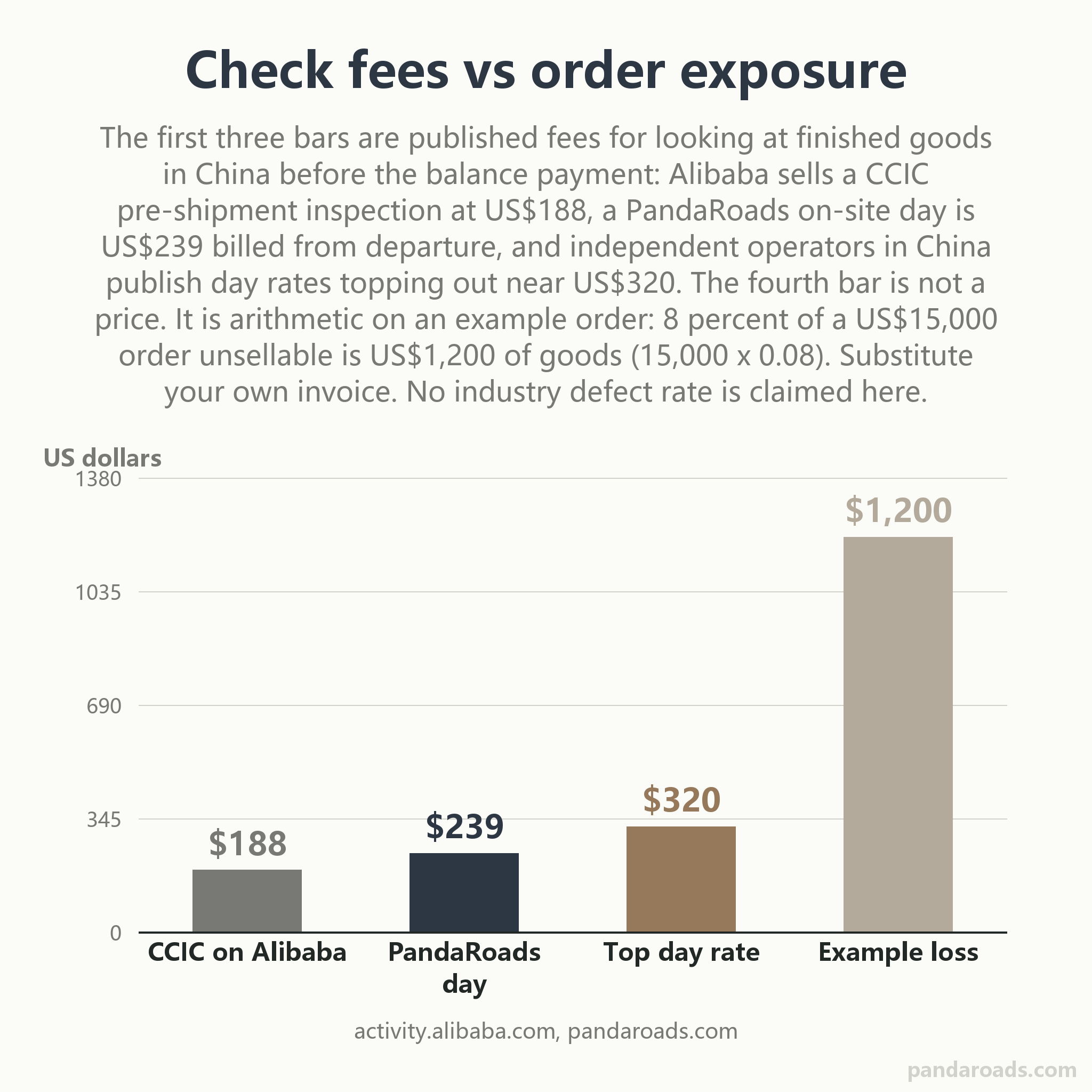
Note: The loss column in that chart is not a cited statistic. It is 8 percent applied to an example US$15,000 order, and this article deliberately asserts no industry defect rate, rejection rate or failure rate, because no fetchable source for one could be found while writing. Substitute your own order value and your own worst-case unsellable share, which is the number you can actually estimate from your product.
A check is only a gate if you can still say no, and that is why the payment structure came first in Step 1. If the balance has already been wired, this table becomes a bill you are choosing whether to chase.
What We Can Honestly Do on the Ground, and What We Cannot
Run the six steps above and the shape of the job becomes obvious. Every one of them wants a body in a Chinese industrial park on a weekday, standing in front of cartons that are already closed, and you are not that body. This is the part of pre-payment verification a buyer in Arizona genuinely cannot do remotely, and it is the honest reason a fixed-fee service on the ground exists at all.
A ground check in China is priced by the day and not by the outcome. We bill an on-site verification day at US$239 counted from departure, and formal AQL sampling, lab testing and certification go to licensed third-party firms such as QIMA, SGS or Bureau Veritas rather than to us. That limitation is published on our own site instead of negotiated per client.
Our published rates are flat. An on-site day is US$239 per day, billed from departure with travel time counted, and it buys a physical inspection at the factory or the warehouse, quantity and quality checks against your approved sample, timestamped photographs and a written report the same day (source: pandaroads.com). A Remote task is US$129 per request, covering the checklist you build with us, supplier coordination, documentation checks and deliverables inside two business days (source: pandaroads.com). A Local Errand is US$239 and includes one trip within 30 kilometers, with anything outside that radius quoted before work starts (source: pandaroads.com). Nothing is charged until you approve an itemized quote, and travel is priced in the same quote rather than added afterward (source: pandaroads.com).
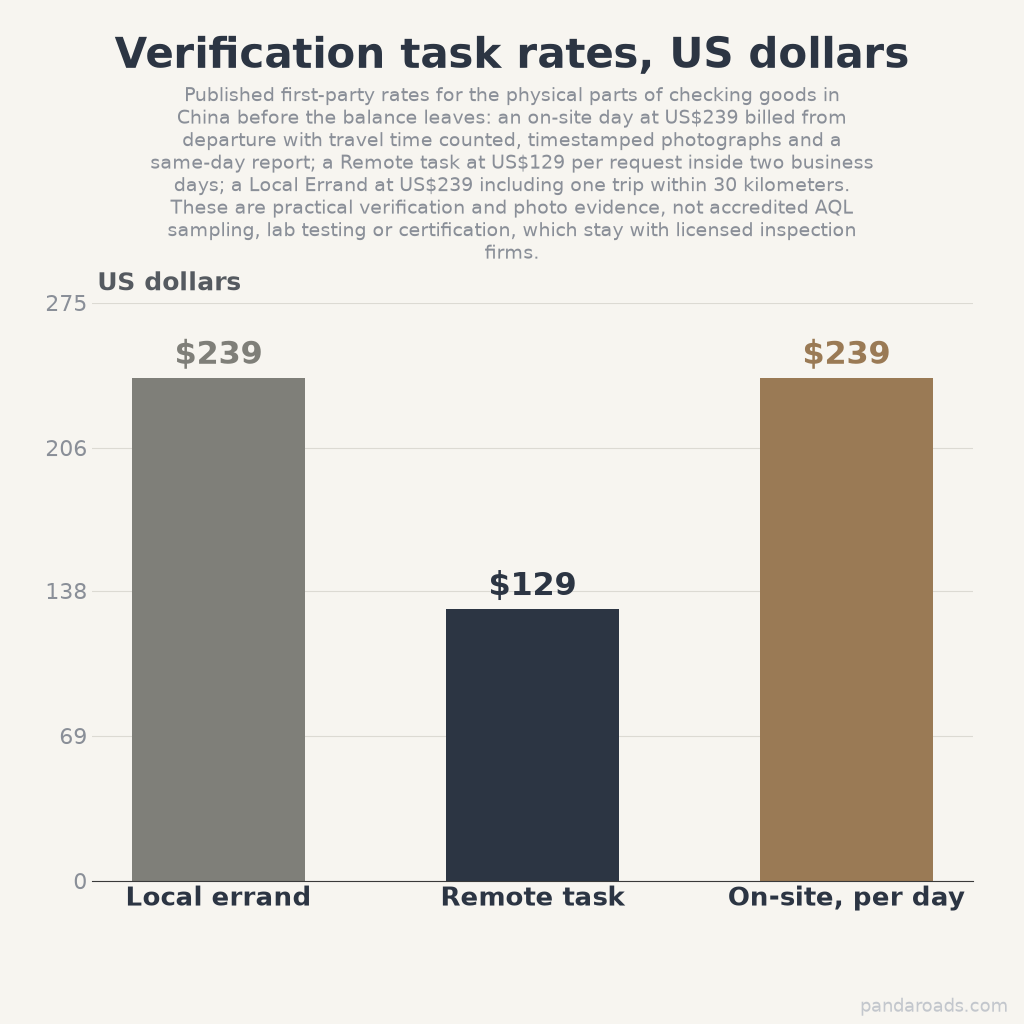
What that day buys is an evidence pack, and what it does not buy is the sentence you should read twice before paying anyone. In our own published words, our on-site checks are practical verification with photo evidence, and for formal AQL sampling, lab testing or certification we connect you with licensed third-party inspectors such as QIMA, SGS or Bureau Veritas, and we report exactly what we verified and what we could not (source: pandaroads.com). We are not SGS. If your product is safety-critical, if a retail buyer is going to demand an accredited report, or if the risk sits in a material or a substance rather than in a seam, the Step 2 screen and the day rate in Step 6 are what you should be budgeting, not a photo pack from a stranger we recognize as honest.
Two more boundaries we hold ourselves to, because they are the ones that make a third-party check worth buying. We do not move your money. PandaRoads never holds client funds for onward transfer and never invoices you for a supplier's order, so your payment for the goods goes to the factory and your payment for the check goes to us, and both receipts stay clean (source: pandaroads.com). And we do not promise outcomes. No one here will tell you a supplier is safe, because a check reports what was found on the day it was found (source: pandaroads.com). Where a report cannot confirm something, it says so, and a report that hides its gaps is the one to distrust.
Note: The two steps that gate the same order are separate jobs. Our own guidance on first orders is to run factory verification before you pay the deposit and a product inspection before you pay the balance, because they catch different failures, and skipping either leaves that class of loss uncovered (source: pandaroads.com). The full rate table and the longer AQL walkthrough live in our inspection cost guide, and the boundaries above are drawn publicly on our honest limits page. If you are instead on the other side of a trade show and need someone to walk a booth, Canton Fair proxy work and the general errands in China from overseas catalog cover that, and buying a single sample for yourself is a different service again, buy and ship an item. The wider import procedure this check protects sits in how to import from China.
Frequently asked questions
How much does it cost to hire a product inspector in China? Published 2026 rates for a China pre-shipment inspection run US$149 to US$320 per man-day, and most independent operators sit between US$199 and US$280 (source: tradeaiders.com). All-inclusive quotes land 20 to 30 percent higher, because travel and report fees are commonly billed on top of the headline day rate (source: tradeaiders.com). Our own on-site verification day is US$239, billed from departure (source: pandaroads.com).
Can I hire a quality inspector in China from the US? Yes, and the whole screen is designed to be done from your desk. You can demand the accreditation certificate and check its issuer, currency and scope, ask who physically attends, require a real sample report, and ask whether you can join the inspection by video before you book (source: maplesourcing.com). Nothing in the process requires you to be in the country.
How do I find a trustworthy inspection company in China? Trust is documentary. Ask for ISO/IEC 17020 accreditation and verify the issuing body, that it is current and that the scope covers your product, then check the original business license and read its stated business scope, because many registrations say trading, consulting or buying agent rather than inspection (source: maplesourcing.com) (source: v-trust.com). Ask whether the inspector takes factory referral fees, and whether you can watch by video.
Should I inspect goods before paying the balance? Yes, and the order matters more than the vendor. On the standard 30 percent deposit and 70 percent balance structure, engaging a third party to inspect before you release the final 70 percent is described as universally recommended, and putting more than 30 percent up front is not advised (source: advantasourcing.com). After the balance is paid, an inspection is a document rather than a decision.
What is a pre-shipment inspection in China? A check on finished, packed goods at the factory or warehouse before shipment, and the point of it is the payment gate. PSI runs when production is 100 percent complete and at least 80 percent packed, and the report is the evidence on which the shipment is released or held (source: ecqa.com). Maple Sourcing states the purpose plainly, it confirms the finished batch before the balance moves (source: maplesourcing.com).
What AQL should I use for a China inspection? The consumer-goods default is 0 critical, 2.5 major and 4.0 minor on the ANSI/ASQ Z1.4 and ISO 2859-1 sampling tables, run at General Inspection Level II (source: gqc.io). AQL means the worst tolerable quality level, not a share of defects you agreed to receive. A 3,500-unit lot at Level II gives a sample of 200, accepting on 10 or fewer majors (source: gqc.io).
Does Alibaba inspect products before they ship? It sells inspections but does not inspect automatically. Alibaba publishes CCIC Inspection at US$188, Bureau Veritas at US$118 and its own Production Monitoring at US$48 on its inspection price sheet, booked through inspection.alibaba.com (source: activity.alibaba.com). Production Monitoring covers only Dongguan, Foshan, Guangzhou, Huizhou and Shenzhen, and the mainland network excludes twelve named regions including Hainan, Qinghai and Xinjiang (source: activity.alibaba.com).
What should a China inspection report include? Measured results against your spec rather than verdicts, the carton numbers and stack positions the samples came from, quantity and packaging checks, defect counts by class against the accept numbers your plan produced, and timestamped photographs (source: maplesourcing.com) (source: ecqa.com). It should also state what could not be verified, which is the line that makes the rest of it believable (source: pandaroads.com).
When should I book a pre-shipment inspection? After the order is fully produced and at least 80 percent packed into export cartons, and early enough that a failed lot can still be sorted and re-checked before the sailing date (source: ecqa.com). Speed is available, one firm states inspectors on site within 48 hours with reports the same day (source: qima.com), but a fast visit to an unfinished lot still costs a full day rate.
Is a third-party inspection worth it for a small order? Often yes, because the market does not gate small buyers. There is no minimum order quantity at most firms and a 500-unit order normally takes one inspector-day (source: tradeaiders.com). Compare that single day rate against your own invoice and the unsellable share you genuinely fear. The one case where it is not worth it is after the balance has already been paid (source: advantasourcing.com).
The bottom line
Two facts decide almost everything here, and neither of them is about the inspector. First, an inspection is only a gate if the balance has not moved. On the standard 30 percent deposit and 70 percent balance structure, the money you have not yet sent is the only pressure that survives contact with a supplier, which is why the payment terms and a written pre-balance inspection condition come before any vendor conversation (source: advantasourcing.com). Once the 70 percent is gone, the same report, from the same inspector, on the same cartons, is a document rather than a decision. Second, trust is documentary, not a feeling. An accreditation certificate whose issuer, currency and product scope you have actually read, the original business license with its stated business scope rather than the marketing site, the name of who physically attends, samples pulled across different cartons and stacks, measured results instead of verdicts, and a live video link into the factory on the day (source: maplesourcing.com) (source: v-trust.com). That list answers the question every buyer in this thread asks in some form: how do you find a trustworthy one. You do not find it in a profile photo. You find it in paper you can check.
So the order is: lock the terms, screen the provider, write the defect spec into the purchase order, time the visit for a finished and mostly packed lot, run the evidence protocol, then read the numbers and decide. If the six steps are the plan and the body in the industrial park is the missing piece, send us the city, the factory or warehouse address and the specific thing you need confirmed, and you will get an itemized quote against our published on-site rate of US$239 per day, billed from departure, before anything is charged (source: pandaroads.com). One scope line, repeated deliberately: an on-site day is practical verification with photo evidence, and accredited AQL sampling, lab testing and certification stay with licensed inspection firms.
References
- Alibaba.com. (2019, May 16). Production monitoring & inspection services (service price sheet and promotion terms). Alibaba.com Help Center. https://activity.alibaba.com/helpcenter/2a6ce385.html
- QIMA. (2026). Pre-shipment inspection (PSI): Service benefits and turnaround. QIMA Limited. https://www.qima.com/consumer-products/pre-shipment-inspection
- ECQA. (2024, September 20). Comprehensive guide to pre-shipment inspection. ECQA Quality Control Services. https://ecqa.com/comprehensive-guide-to-pre-shipment-inspection/
- GQC International. (2026). ANSI sampling tables: ANSI/ASQ Z1.4 and AQL chart. GQC Quality Inspection. https://www.gqc.io/quality-resources/ansi-sampling-tables
- Li, A. (2026, September 2). Third-party inspection services in China: How to choose. Maple Sourcing. https://www.maplesourcing.com/inspection-companies-in-china-how-to-choose.html
- Zhang, T. (2012, December 28). How to choose a good inspection company in China? V-Trust Blog. https://www.v-trust.com/en/blog/how-to-choose-a-good-inspection-company-in-china
- Chipchura, M. (2023, February 7). 30% deposit 70% before shipment or against B/L: What does it mean? Advanta Sourcing. https://www.advantasourcing.com/blog/30-deposit-70-before-shipment
- TradeAiders. (2026, April 20). QIMA alternatives for small importers: 7 third-party inspection options compared. TradeAiders. https://www.tradeaiders.com/qima-alternatives-for-small-importers-7-third-party-inspection-options-compared.html
- PandaRoads. (2026, August). China product inspection: Pre-shipment from $129. PandaRoads. https://pandaroads.com/china-product-inspection.html
- PandaRoads. (2026, August 23). What a China agent won't do: Honest boundaries. PandaRoads. https://pandaroads.com/what-we-dont-do.html
Last reviewed and updated: September 2026. Author: our editorial team. For tailored guidance, contact our team.