Last updated: October 2026 · By the PandaRoads team in China
TL;DR
You can ride DiDi in mainland China on your home phone number and your own Visa or Mastercard. Install the mainland app (bundle com.xiaojukeji.didi, version 8.0.14 released 2026-09-18, English interface), register before you fly, bind one international card and run the ordered decline ladder if the issuer says no, then book in English, check the plate and the last four digits, and walk to the signed ride-hailing zone instead of the curb. Fares are planning ranges only, 6 to 13 CNY base and 15 to 25 CNY for a 5 km city Express ride, and Article 25 of the national measures makes an off-app money demand a prohibited act, not bad luck.
Abstract
This 2026 how-to guide treats DiDi in mainland China as three separable jobs instead of one download: account plumbing you can finish on home Wi-Fi (an SMS-capable number, one bindable international card, the English interface inside the mainland app), booking discipline inside the app (legal pickup pins, category choice, translated quick messages), and spatial execution at the curb, where Chinese airports and rail hubs route ride-hailing into signed ride-hailing zones rather than curbside hails, with the national ride-hailing measures as the escalation path when a deal goes wrong.
Key Takeaways
- Finish account setup at home on your own number and card, before you fly.
- A data-only eSIM cannot receive the SMS code; register on a texting number.
- If the card declines, run the ordered ladder instead of reinstalling the app.
- Airports and stations send ride-hailing to signed zones, never the curb.
- Fares are city-labeled ranges: 6 to 13 CNY base, 15 to 25 CNY per 5 km Express.
- Article 25 bans mid-trip abandonment, detours, off-rule charging and retaliation.
Table of Contents
- Abstract
- Key Takeaways
- Before You Board: Three Separate Jobs, and What Each One Needs
- Install and Choose an Entry Point That Actually Serves Mainland China
- Register on Your Home Number, and Fix the Code That Never Arrives
- Bind One International Card, Then Work the Decline Ladder in Order
- Request the Ride You Actually Need: Categories, Upfront Fare, Bags and Stops
- Place a Pin the Driver Can Reach, Then Walk the Signed Ride-Hailing Zone
- Talk to the Driver Without a Shared Language: Translation, Plate and Last Four Digits
- What the Trip Costs, and What Happens to Your Money After It
- The Rule That Protects You at the Curb: Articles 16, 19, 20 and 25
- Failure Chains, From Refused Boarding to the Money Demand
- Frequently Asked Questions
- Conclusion
- References
Before You Board: Three Separate Jobs, and What Each One Needs
Using DiDi in China takes three separate jobs, and only the first two can finish before departure: account setup on home Wi-Fi, then booking in the app. DiDi's own App Store record lists an English interface, global mobile number login and WhatsApp support within one business day, and People's Daily reported the bilingual launch on 8 May 2017.
How to use DiDi in China is three jobs, not one download. Start with account setup on home Wi-Fi: install the mainland app, register with a number that receives texts, then bind a card before you fly. Booking is the second job, and it lives inside the app. The third job is physical, at the curb, where stations funnel ride-hailing into signed zones instead of the road you were standing on.
The setup job you can finish on home Wi-Fi
The English flow is real. DiDi's own App Store record lists an English interface with global mobile number login and WhatsApp support within one business day, and People's Daily reported the bilingual launch on 8 May 2017.
The booking job that happens inside the app
Once you're moving, the work is on the screen: set a legal pickup pin, choose a category, and send translated quick messages. No special plan, only habits covered later.
The curb job no screenshot prepares you for
The last job is physical and strands most first-timers. Chinese airports and rail hubs route ride-hailing into signed 网约车 zones, not curbside hails, so you walk to the marked bay. No screenshot prepares that walk.
Before you start, have these four:
- A number that receives SMS (a data-only eSIM cannot get the code)
- One Visa or Mastercard you are willing to bind
- Live mobile data for the walk to the curb
- Your hotel or first address in Chinese and English
To be plain: this page sells no SIM kit, no transfer, and no card, and every fare here is a labeled planning range. For connectivity, remember that a data-only eSIM cannot receive the setup code, so register on a number that actually texts.
Install and Choose an Entry Point That Actually Serves Mainland China
Book the mainland DiDi app, listed as "DiDi China: Ride Hailing," bundle com.xiaojukeji.didi, version 8.0.14 released 2026-09-18. It opens in English and takes a foreign number. The real choice is which surface you book from, since each locks your wallet and changes prices.
Which store title serves the mainland, DiDi China and not Didi Rider
Pick the store title "DiDi China," then confirm it serves the mainland. Didi Rider is a separate product that wildchina.com notes runs outside mainland China, so an app that will not match a car in a mainland city is the wrong download.
Five booking surfaces, four of which actually book a mainland ride
| Surface | Mainland | English | Foreign | Wallet |
|---|---|---|---|---|
| DiDi China app | Yes | Yes | Yes | Card |
| Alipay mini | Yes | Host | Alipay | Alipay |
| WeChat mini | Yes | Host | ||
| Amap tab | Yes | Chinese | Host | Amap |
| Didi Rider | No | n/a | n/a | n/a |
The standalone app is the flexible one, binding a card directly instead of borrowing a host wallet. The mini programs settle through their host: the Shanghai portal notes the fare pulls from WeChat Pay inside WeChat and from Alipay inside Alipay. hiddenchinatravel.com adds that price and car types differ between surfaces. That is the real trade-off, and it is why we recommend the standalone app when a foreign card is the only option.
The English interface lives inside the mainland app
English lives inside the mainland app. Set it at Me, Settings, General, Language, English, Confirm, the path the Shanghai portal documents; DiDi's own listing confirms global mobile number login. Drop the old claim that you must install an international version because the Chinese app is Chinese-only and forces a WeChat or Alipay login; that claim is a common misconception, and research marks it contradicted by the first-party record, so our rule is simple: confirm the app serves mainland China.
A forum traveler kept hitting declines, then found the account was live on the Australian DiDi, not the mainland service.
Sources: DiDi China listing (itunes.apple.com, id 554499054, v8.0.14, 2026-09-18); english.shanghai.gov.cn; wildchina.com; hiddenchinatravel.com; chinavistas.com (surface behavior). Retrieved 2026-10-09.
Register on Your Home Number, and Fix the Code That Never Arrives
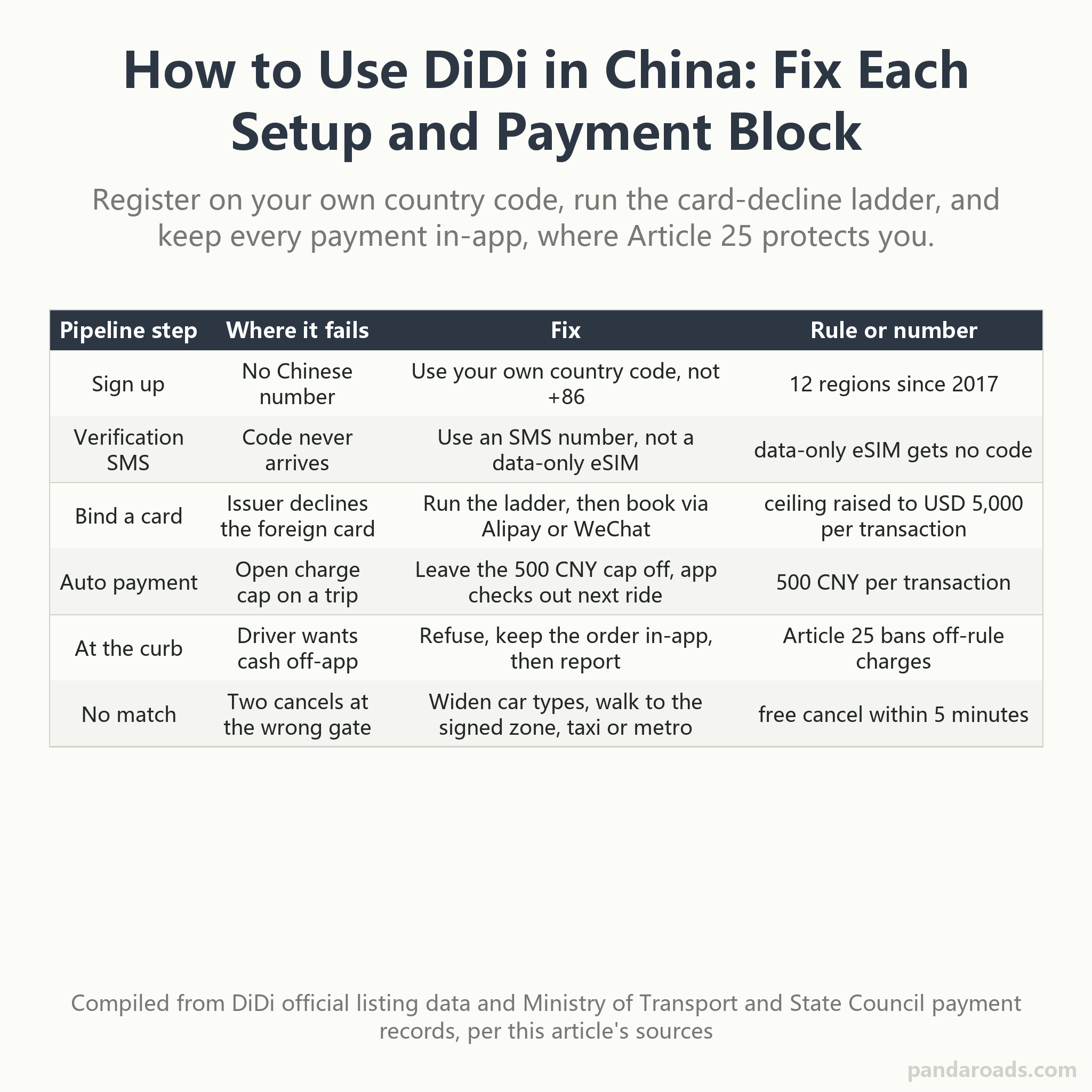
No. DiDi accepts a Chinese or a foreign mobile number, per Beijing's municipal English guide: select Chinese mainland as the region, allow location, then sign in with your phone number. DiDi opened sign-up to numbers from 12 regions on 8 May 2017, so a home number is a supported path, not a workaround.
Select the region first, then your own country code
People's Daily Online named 12 regions in that 2017 announcement: Chinese mainland, Hong Kong, Taiwan, Thailand, South Korea, Japan, United Kingdom, France, Australia, Canada, United States, Brazil. Set the region first, then pick your own country code in the picker, not a +86 field, the mistake tripchina.me flags with +1, +44 and +61 examples. DiDi sends the code to the number you picked, so a wrong prefix sends it nowhere.
No first-party source says registration requires a passport. Some account, payment or risk flows may ask for an identity check, so follow the options the app shows.
The ordered checklist for a verification SMS that does not show up
Work the ladder in order, one change at a time (mychina.guide, tripchina.me).
- Right country code. The picker holds your own code, not +86, entered once.
- SMS filtering. Switch off aggressive spam filtering, which drops short codes.
- Texting line. Confirm the number can receive SMS.
- Wait. Leave time between requests instead of tapping resend.
- Connection. Hold stable data, then retry once.
Why a data-only travel eSIM breaks this step
A data-only travel eSIM profile has no voice-and-SMS number, so the code has nowhere to land. mychina.guide, tripchina.me and chinaneighbor.com report that trap, and it follows from how such profiles work, though no carrier page says so. Register on a number that texts. It is the one point we repeat throughout this setup, because a data plan alone cannot clear a voice-and-SMS step.
Switch on English and save the hotel in both scripts
Shanghai's English portal puts the language switch at Me, Settings, General, Language, English, Confirm. Then save your first address in Chinese characters as well as English; drivers read Chinese.
- Region: the market you declare at sign-up.
- Country code: the prefix DiDi attaches to the number it texts.
- SMS-capable number: a line that receives texts, which a data-only profile is not.
Sources: english.beijing.gov.cn; en.people.cn; english.shanghai.gov.cn; tripchina.me; mychina.guide; chinaneighbor.com.
Bind One International Card, Then Work the Decline Ladder in Order
What DiDi says it accepts, and what the form actually asks
DiDi's mainland app listing advertises payment options including international bank cards. The in-app path is Account, Wallet, Payment Methods. Third-party guides list Visa, Mastercard, JCB, Diners Club, American Express and Discover, so treat that as reported, not guaranteed. The English form, Add an Overseas Bank Card, ends in a 3D Secure or OTP code.
Supported does not mean approved, the five factors that decide
Binding works better in 2026 because of policy. At the 2024-03-01 State Council briefing, republished by the Zhengzhou government, the People's Bank of China said it required Alipay and Tenpay to fix the low success rate foreigners hit binding overseas cards, simplify identity verification, and raise the inbound mobile-payment ceiling from USD 1,000 to USD 5,000 per transaction and USD 10,000 to USD 50,000 a year. The Ministry of Transport added that some platforms pair overseas number registration with card payment, and that Beijing, Shanghai and Chengdu let visitors bind an overseas card through Alipay or UnionPay QuickPass to scan a QR code and ride city buses and rail. Supported still does not mean approved. Five issuer-side factors decide each attempt: your issuer, the card network, overseas-transaction settings, fraud controls, and your current DiDi account setup.
The ordered decline ladder, one step at a time
When a bind fails, run these four steps in order and stop at the first that clears. We built this decline ladder by comparing the fix sequences the guides publish, and it is the same approach we use when a verification code never arrives.
- Issuer side first. Check your issuer's online and overseas settings, and confirm the card is not blocked for international e-commerce.
- Re-enter the card with the correct expiry and billing country.
- Second card. Try a different network or issuer.
- Book DiDi through Alipay or WeChat, each with its own binding path.
The ladder ends at a working wallet, not at abandoning your card.
Password-free auto payment and the 500 CNY per transaction cap
DiDi offers password-free auto payment, reported by chinaguidelines at a 500 CNY per transaction cap. Turning it off suits a large fare, but the Beijing guide notes the app runs checkout before your next order anyway, so an unpaid balance blocks the next booking.
Bind the card at home on your own network, where a fraud flag is easy to clear, not from a curb with 4 percent battery.
Sources: DiDi app listing (itunes.apple.com, id 554499054); zhengzhou.gov.cn, 2024-03-01; english.beijing.gov.cn; chinaguidelines.com; tripchina.me; chinaneighbor.com.
Request the Ride You Actually Need: Categories, Upfront Fare, Bags and Stops
Pick the DiDi category by what the tier actually guarantees, not by its name. chinaneighbor.com reports Standard at about 1.2x Economy, roughly 20% above the base tier (2026); Premier at 1.5x to 2x Express, about 50% to 100% above (2026); and an XL 6-Seater at about 1.3x Express, near 30% above (2026), while mychina.guide warns that a higher tier buys better cars rather than more seats or trunk space.
The picker decides most of the ride. wildchina.com carries the fullest tier list, tripchina.me the Chinese names, chinaneighbor.com relative multipliers rather than prices. Labels shift by surface and city.
The category list with its Chinese names
| Category | Chinese | Relative fare | What the tier guarantees |
|---|---|---|---|
| Express/Economy | 快车 | baseline | no space promise |
| Standard | n/a | about 1.2x Economy | car class only |
| Comfort | n/a | n/a | newer vehicles |
| Priority | n/a | n/a | shorter wait |
| Premier/Premium | 专车 | 1.5x to 2x Express | business tier |
| Luxe | 豪华车 | n/a | top car class |
| 6-Seater/Large Car | n/a | XL, about 1.3x Express | up to six seats |
| Taxi | 出租车 | n/a | cash accepted |
What a higher tier guarantees, and what it does not
mychina.guide and tripchina.me both warn that a higher category does not automatically mean more seats or trunk space, so read Comfort, Premier and Luxe as better cars, not more cargo room. Rules:
- A big suitcase travels better as carry-on, with you in the cabin.
- A bulky load is a 6-Seater or Large Car request: more seats, still no luggage guarantee.
The plus icon for multiple stops and the waiting fee behind it
wildchina.com documents the plus icon beside the address field: tap it to add stops in one order, which it calls often cheaper than separate bookings. hiddenchinatravel.com adds a waiting fee while the car idles, so price that pause or book two rides.
More vehicle types selected means a faster match
Beijing's municipal guide names the one lever you actually hold, and it's selecting more vehicle types: the wider the selection, the higher the probability of a match. Then the money detail, free cancellation runs inside five minutes of driver confirmation, after which the fee rises with the driver's wait. Important to note: no source here publishes a national fare sheet or a coverage map, so the ranges and pins in this guide are planning aids, not guarantees. Check the app at the destination.
Sources: wildchina.com; tripchina.me; chinaneighbor.com; english.beijing.gov.cn; mychina.guide; hiddenchinatravel.com.
Place a Pin the Driver Can Reach, Then Walk the Signed Ride-Hailing Zone
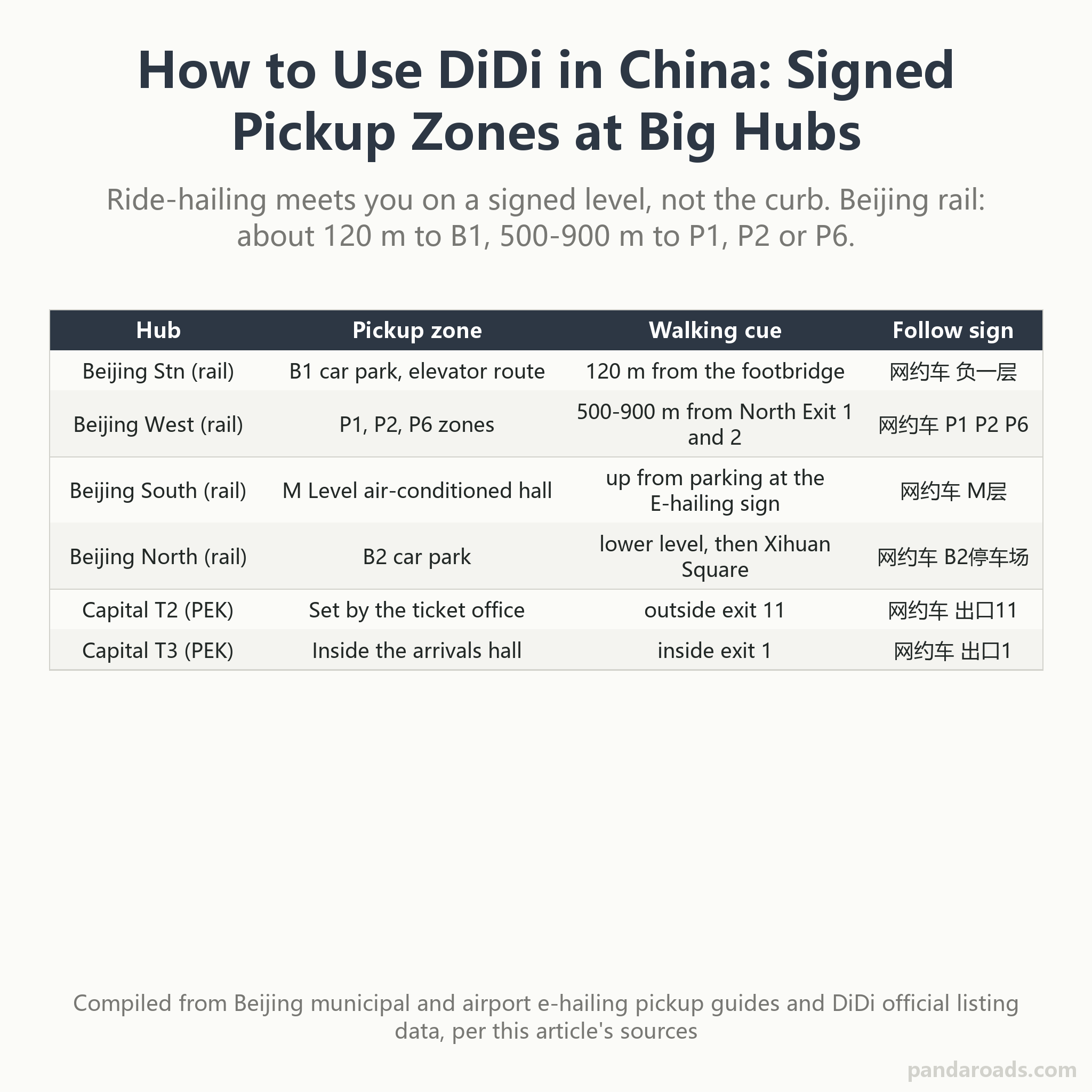
Follow the signed ride-hailing zone, not the road nearest your pin. The Beijing municipal guide published 2025-10-11, sourced from China Railway Beijing Group, lists the Beijing Station pickup on B1 with a footbridge cue of 120 m, and Beijing West at P1/P2/P6 off Exits 1 and 2 after 500-900 m.
DiDi matches a pin, not an intention
DiDi matches a pickup pin, not an intention. Fences and barriers leave the nearest-looking road unusable, so the fix is a legal stopping place, not typing. All seven major Beijing stations publish a signed 网约车 area and a route from a named exit. Never pin a terminal interior. We treat the signed 网约车 zone, not the curb beside your pin, as the real pickup address.
Airports: clear immigration and take bags before you request
- Clear immigration and take bags before you request, the match window is short.
- The terminal is part of the address; north and south squares differ.
- Screenshot the order and plate before walking.
The named terminal and concourse table for seven Beijing stations, Chengdu East and four airports
Beijing rows: the 2025-10-11 municipal guide, via China Railway Beijing Group. Chengdu rows: the general signage rule, not a checked official routing guide.
| Hub | Level | Cue | Sign |
|---|---|---|---|
| Beijing Station | B1 | Footbridge, 120 m, elevator route | 网约车 |
| Beijing West | P1/P2/P6, South Square | Exits 1 and 2, 500-900 m | 网约车 |
| Beijing South | M Level hall | Up from parking, air-conditioned | 网约车 |
| Beijing North | B2, Xihuan Square | Lower level to square | 网约车 |
| Fengtai | South Hub P1/P2 | Split high-speed routes | 网约车 |
| Chaoyang | J/K area | East Square across corridor | 网约车 |
| Qinghe | North lot | Floor-marked route | 网约车 |
| Capital T2 | Ticket office | Outside exit 11 | 网约车 |
| Capital T3 | Arrivals hall | Inside exit 1 | 网约车 |
| Daxing | Ground floor, outside terminal | Ride-hailing stops outside the terminal; for the taxi queue use the English Beijing Taxi Zone and avoid Hebei plates | English |
| Chengdu East | Sign-named level | Enter zone number | 网约车 |
| Shuangliu | By arrivals | Confirm bay on screen | 网约车 |
| Tianfu | Ground transport | Sign, floor, zone number | 网约车 |
Baiyun and Pudong go unnamed, so the rule transfers: follow the ride-hailing sign to the designated floor, then enter that zone number.
When the driver says you are at the wrong gate
If the driver says you're at the wrong gate, don't walk toward the car. Re-read the zone in the app, send the translated message, and set a two-minute backup decision after five to ten minutes. Two cancels in a row means taxi or metro, and each cancel carries the free-cancel window above.
The signed zone, not the road at your pin, is where cars stop.
Sources: english.beijing.gov.cn, chinabeijingprivatetour.com, chinasurvivalkit.com, mychina.guide.
Talk to the Driver Without a Shared Language: Translation, Plate and Last Four Digits
DiDi turned on real-time English to Chinese message translation on 8 May 2017, People's Daily Online reported, and both municipal guides confirm it works, so most drivers who speak only Chinese still understand you. Then confirm the plate and show the driver the last four digits of your registered phone number before entering.
The in-app translator and the quick messages it saves
DiDi switched on real-time English-Chinese message translation on 8 May 2017 (en.people.cn), and both municipal guides confirm it works: Shanghai's portal says driver messages automatically translate to English, and Beijing's guide documents a Message button that sends one-tap quick messages, translated for you, with anything you type saved for next time. Most drivers speak only Chinese, so let the app carry the conversation and keep the destination in Chinese characters. Rider and driver numbers are masked, so contact runs through the app and a missed call is not a dead line.
The four legitimate reasons to message a driver
Keep your messages to the four topics that actually resolve a pickup:
- which bay or zone you are standing in
- what you are wearing so the driver can spot you
- which entrance or gate you are at
- whether a car can legally reach your pin
Learn eight signage words: 出口 (exit), 入口 (entrance), 网约车 (ride-hailing), 上车点 (pickup point), 停车场 (parking lot), 负一层 (basement level one), 到达 (arrivals), and 出发 (departures). We chose these eight because they are the words that actually appear on the floor signs at the hubs in the table above.
Confirm the plate, then the last four digits of your number
At match time the app shows the plate, car type and location (Beijing and Shanghai guides). Confirm the plate before you open a door. Then show the driver the last four digits of your registered phone number as the code. Screenshot those digits before you walk, in case the connection drops at the curb (chinaguidelines).
Walk past anyone waving with no order
If a driver waves you over with no open order on your screen, that is an unlicensed car; walk past (hiddenchinatravel). Decline unsolicited help from strangers offering to find your driver. Your real ride exists only inside the app, plate and last four digits included.
Glossary
- 网约车: the signed ride-hailing area at Chinese airports and rail hubs, the zone you walk to rather than the curb beside your pin.
- fapiao: the invoice the app returns as a PDF in app or by email, taking an individual title or a company registered name plus taxpayer ID.
- Planning range: a city-labeled 2026 rider-reported figure used for budgeting; DiDi publishes no national fare sheet, so a range is not a price list.
- Carrier liability: the responsibility Article 16 places on the platform rather than the driver alone, which a street payment walks around.
- 3D Secure / OTP: the code step that ends the Add an Overseas Bank Card form in the mainland app.
What the Trip Costs, and What Happens to Your Money After It
Planning ranges, city by city, with no national price table
Every money figure this article leans on is defined once here; the sections that follow reuse these ranges rather than adding new prices. Base fare 6 to 13 CNY, a 5 km city Express ride 15 to 25 CNY, per kilometer 1.2 to 2.5 CNY. DiDi publishes no national fare sheet, so these are 2026 rider-reported planning ranges, not a price list.
Article 3 of the national measures makes ride-hailing pricing market-set unless a city adopts guided pricing. Article 19 requires a published metering and pricing method, and Article 20 requires posted pricing plus an invoice. Fare rules are readable at Account, Settings, User Guide.
Tolls, airport platform surcharges and the surge window
Tolls land on the fare automatically. Expect an airport platform surcharge of 5 to 15 CNY, and slower matching at peak arrivals. Surge runs 1.2 to 1.8 times in rain, late night and rush hour, worst at 7:30 to 9:00 and 17:30 to 19:30.
The cash question, answered against the Taxi exception
Private-car categories settle in the app, and the Beijing guide says DiDi is not a cash-friendly system. The licensed Taxi row is reported as cash-accepting, so a flat no-cash answer is wrong. A payment handed over outside the app is one the platform cannot protect.
The temporary card hold, the trip receipt and the electronic fapiao
Some cards show a temporary hold larger than the ride, and it settles down to the real fare days later. That gap, not a double charge, is what sends travelers emailing a bank at 2am.
The paper trail, in order:
- Profile avatar, then Trips, then the ride, then Receipt, with optional email export.
- The fapiao entry takes an individual title or a company registered name plus taxpayer ID, and returns a PDF in app or by email.
Most international expense systems accept the trip receipt plus a card statement.
Sources: mychina.guide; chinaneighbor.com; hiddenchinatravel.com; xxgk.mot.gov.cn, Articles 3, 19 and 20; english.beijing.gov.cn.
By the Numbers
- 6 to 13 CNY base fare, a 2026 rider-reported planning range rather than a price list
- 15 to 25 CNY for a 5 km city Express ride, labeled by city and checked in the app
- 1.2 to 2.5 CNY per kilometer across the reported planning ranges
- 5 to 15 CNY airport platform surcharge, with slower matching at peak arrivals
- 1.2 to 1.8 times surge in rain, late night and rush hour, worst at 7:30 to 9:00 and 17:30 to 19:30
- 500 CNY per transaction cap on password-free auto payment, reported by chinaguidelines
The Rule That Protects You at the Curb: Articles 16, 19, 20 and 25
Is DiDi safe for foreigners? The floor is a national rule, the Interim Measures for Online Booking Taxi Operations and Services, issued 2016-07-27, amended by Ministry of Transport Joint Order 2022 No.42. Article 25 makes a mid-trip money demand a prohibited act, not bad luck. We print the article number beside each on-street action below so you can quote the right one. The four named in the heading are the ones a rider is most likely to quote; the reference table below carries all eight relevant articles, not only those four.
The platform carries carrier liability, not the driver alone
Article 16 puts carrier liability on the platform, which a street payment walks around.
You are entitled to the driver name, photo, number, rating and plate
Article 19 requires that disclosure at the moment of service, plus a published metering and pricing method.
The articles behind each on-street action, with published penalty bands
| Article | Passenger guarantee | On-street action |
|---|---|---|
| 16 | Carrier liability on the platform | Keep payment in-app |
| 19 | Driver, photo, number, rating, plate | Verify the plate |
| 20 | Posted pricing, an invoice | Pull the fapiao |
| 22 | Licensed area, one end inside | Refusals on long legs |
| 23 | Liability insurance for riders | Coverage backs a claim |
| 25 | No abandonment, detour, off-rule charge or retaliation | Refuse, record, report by article |
| 28 | No unlicensed car or driver | Walk past an unordered car |
| 34 | Published fine bands | Quote the band |
Article 34 publishes the bands: 10,000 to 30,000 CNY for an unlicensed platform, 3,000 to 10,000 CNY for a vehicle with no transport certificate, 200 to 2,000 CNY for a driver with no driver certificate. Article 27 keeps your data on mainland servers for at least two years, and Article 26 bars handing it to any third party except lawful state access.
What the app safety buttons actually connect to
Third-party reported, not regulation: a one-tap alarm to 110, trip sharing, in-car recording held 30 days unless deleted, route-deviation monitoring, business-hours bilingual support, plus the Beijing guide's DiDi Safeguard calling the nearest police center. Verify on your own screen.
Sources: xxgk.mot.gov.cn; english.beijing.gov.cn; chinaguidelines.com; wise.com.
Failure Chains, From Refused Boarding to the Money Demand
Five chains strand riders at the curb. We grouped them by the symptom a rider actually hits first. Each block: symptom, cause, fix, escalation. SMS and payment setup belong to Sections 2 and 3; this starts where those end.
The driver asks you to cancel and pay outside the app
Driver says cancel and pay cash or scan a personal QR. Refuse. Keep the order open. Article 25 calls charging outside the rules a prohibited act. Paying on the street voids Article 16 carrier liability, no receipt, no invoice, no protection.
The driver refuses a long intercity job, and when that refusal is lawful
A driver turns down Hangzhou to Pudong. Contrary to how it feels at the curb, Article 22 restricts a licensed vehicle to its permitted area unless one trip end lies inside it, so the refusal is lawful, not rude. Expect it on long legs. Frame a return ending in the driver's zone, or book a cross-border option. Never conclude DiDi skips intercity work.
No car accepts, or the match dies at the wrong gate
Pin sits on a road split by a fence. Request only once bags are in hand, widen vehicle types (Beijing guide), walk to the signed zone from Section 5. Two failed cancels: switch to taxi or metro. Code never arrived at sign-up? That is Section 2, not this one.
A declined card after the ride blocks the next booking
The Beijing guide says the app runs checkout before your next order, so an unpaid balance freezes the loop. Settle the outstanding fare through whichever wallet works, then re-run the Section 3 decline ladder. Do not reinstall.
Extra money demanded mid-trip, the report path
Driver demands more than the fare, detours, or drops you early. Keep the metered screen visible, pay the in-app amount, save the trip record and plate. Escalate:
- In-app help channel, quote Article 25.
- 110 for immediate danger.
- 95128, the MOT taxi line, as phone fallback.
A money demand at the curb is a named violation, not bad luck. What you can push back with is the screenshot you take before reaching for a wallet.
Sources: xxgk.mot.gov.cn Articles 16, 22, 25; english.beijing.gov.cn; zhengzhou.gov.cn; chinasurvivalkit.com; travelchinawith.me.
Frequently Asked Questions
Do I need a China phone number to register with Didi?
No. Beijing's municipal guide says Chinese and foreign numbers both work: select Chinese mainland as the region, allow location, then sign in with your own number.
Can I use DiDi without a Chinese phone number?
Yes. DiDi opened sign-up to numbers from 12 regions on 8 May 2017. Pick your own country code, not +86, and use a number that receives SMS.
How do I download the Didi app?
Install DiDi China: Ride Hailing (com.xiaojukeji.didi, version 8.0.14, released 2026-09-18). Didi Rider is a separate product and serves no mainland rides.
Is DiDi available in English?
English ships inside the mainland app, with bilingual messaging and support within one business day. Shanghai's portal puts the switch at Me, Settings, General, Language, English, Confirm.
How to attach foreign credit card to Chinese Didi?
Account, Wallet, Payment Methods, then Add an Overseas Bank Card, which ends in 3D Secure or OTP. Bind at home, not from a curb.
Can I pay DiDi with Visa or Mastercard?
Its listing advertises international bank cards, and the 2024 State Council briefing raised inbound ceilings to USD 5,000 per transaction. Supported is not approved, so issuer settings decide. A 5 km city Express ride is 15 to 25 CNY, a planning range.
Should I use DiDi inside Alipay instead?
A mini program needs no install but pays through its host wallet. The standalone app binds your card directly, and price and car types differ by surface.
How to take a ride-hailing car at the airport?
Clear immigration and bags first, then follow the 网约车 sign to its floor and enter that zone number. Expect a platform surcharge of 5 to 15 CNY, a planning range.
Is DiDi safe for foreigners?
The national measures put carrier liability on the platform (Article 16), require driver and plate disclosure (Article 19), and ban abandonment, detours, off-rule charging and retaliation (Article 25).
Can you take a didi from hangzhou to shanghai pudong airport?
A refusal can be lawful: Article 22 restricts a licensed vehicle to its permitted area unless one trip end lies inside it. Expect refusals on long legs.
do you leave a tip for a didi driver??
No. Community reports say China is not a ride-hailing tipping culture, and a five-star rating is the gesture riders mean. Fintech-page tip advice is contradicted.
Sources: english.beijing.gov.cn; en.people.cn; english.shanghai.gov.cn; itunes.apple.com; zhengzhou.gov.cn; xxgk.mot.gov.cn.
Conclusion
Getting a DiDi in China is three jobs, and you can finish the first two before you land: install the mainland app (bundle com.xiaojukeji.didi, version 8.0.14), register on your home number, and bind one Visa or Mastercard at home Wi-Fi. The third job is physical, at the signed ride-hailing zone rather than the curb beside your pin. Treat every fare here as a planning range and not a price list, and remember that an off-app money demand is a prohibited act under Article 25 of the national measures, not bad luck.
References
- Didi Chuxing (Beijing) Network Platform Technology Co., Ltd. (2026, September 18). DiDi China: Ride hailing (Version 8.0.14) [Mobile application]. App Store. https://itunes.apple.com/lookup?id=554499054&country=us
- Ministry of Transport, Ministry of Industry and Information Technology, Ministry of Public Security, Ministry of Commerce, State Administration for Market Regulation, & Cyberspace Administration of China. (2022, December 5). Decision on amending the Interim Measures for the Management of Online Booking Taxi Operation and Services (Joint Order 2022 No. 42) [关于修改《网络预约出租汽车经营服务管理暂行办法》的决定]. Ministry of Transport Gazette. https://xxgk.mot.gov.cn/jigou/fgs/202212/t20221205_3719525.html
- Beijing Municipal Government. (2023, April 11). Taxis & ride-hailing. Beijing English Portal. https://english.beijing.gov.cn/livinginbeijing/transportation/202005/t20200513_1895911.html
- Beijing Municipal Government. (2025, October 11). Guide to taxi/e-hailing services at Beijing's seven major railway stations. Beijing English Portal. https://english.beijing.gov.cn/latest/news/202510/t20251011_4221241.html
- Shanghai Municipal Government. (2026, July 21). How to use DiDi Chuxing: Useful apps. Shanghai English Portal. https://english.shanghai.gov.cn/en-UsefulApps/20240206/976515bc601f4803b9ce2f64ae9f0cd3.html
- State Council Information Office. (2024, March 2). Central bank and other departments respond on payment convenience for visitors [央行等多部门最新回应!事关你的支付, republished from China Government Net]. Zhengzhou Municipal Government. https://www.zhengzhou.gov.cn/news0/8242885.jhtml
- People's Daily Online. (2017, May 8). DiDi advances internationalization plan with new bilingual ride-hailing services in China. http://en.people.cn/n3/2017/0508/c90000-9212275.html
- Wang, J. (2026, January 15). How to use DiDi in China without a Chinese number or card [Updated September 14, 2026]. MyChinaGuide. https://mychina.guide/blog/how-to-use-didi-china-without-chinese-number
- China Neighbor. (2026). DiDi for foreigners: How to use China's taxi app (2026) [Last verified October 1, 2026]. https://chinaneighbor.com/guide/transport/didi-for-foreigners-guide-2026/
- Shi, R. (2026, January 11). Didi in China 2026: Ride-hailing guide for foreigners. China Guidelines. https://chinaguidelines.com/en/posts/didi-taxi
Last reviewed and updated: October 2026. Author: our editorial team. For tailored guidance, contact our team.