Reserve a Restaurant in China From Abroad: 6 Real Steps
Reserve a restaurant in China from abroad the way a table actually gets held: the 订座 button, a +86 number that answers, and proof it is confirmed.
Last updated: September 2026 · By the PandaRoads team in China
TL;DR
To reserve a restaurant in China from abroad you are solving a presence problem, not a translation problem. A Chinese table is held by a phone call the restaurant can ring back, and a foreign phone number is the single biggest reason an overseas booking gets cancelled. The reliable move is a booking made on a +86 number that answers, and proof of a confirmed status, not just a submitted form.
Abstract
A grounded, ordered procedure for reserving a mainland Chinese restaurant table from the United States when you are not the one who will dine. A Chinese reservation is a phone call plus a confirmation callback, a +86 number and the Chinese interface lock an overseas arranger out, and the provisional-until-confirmed gap defeats a booking made across a 12 to 15 hour time difference. It also covers the 订座 versus 团购 trap, the 包间 private-room minimum, and where a verified local runner who calls, holds the table on a reachable Chinese number and passes back proof fits honestly.
Key Takeaways
- A China reservation is a phone call and a callback, not an email
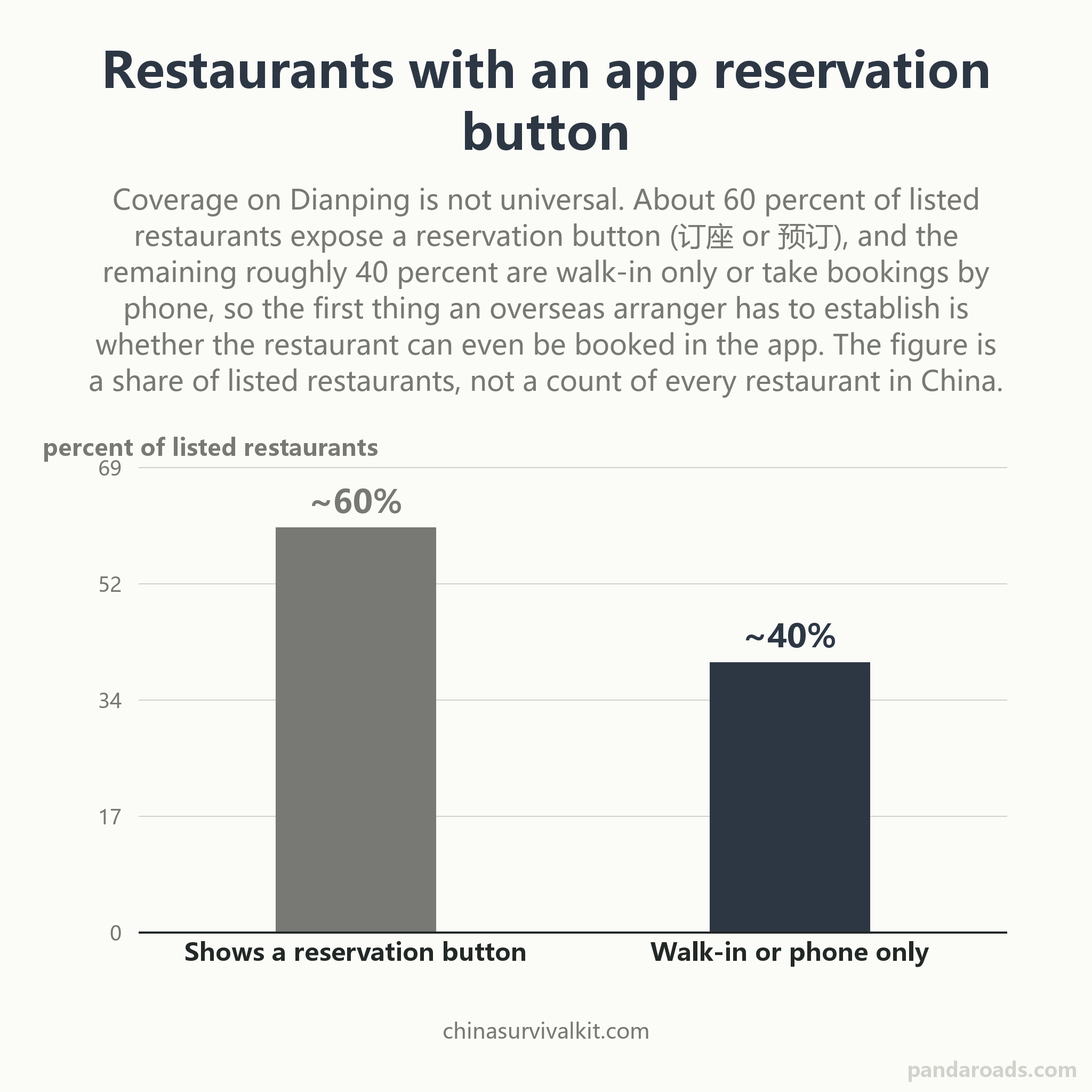
- About 60% of restaurants listed on Dianping expose a reservation button
- A foreign phone number is the top reason a booking gets cancelled
- A booking stays provisional until the restaurant confirms, often 1 to 24 hours
- 订座 holds a table, 团购 buys a prepaid meal voucher instead
- A private room 包间 often carries a minimum spend, 大厅 does not
- The person dining needs a number the restaurant can reach
Table of Contents
- Abstract
- Key Takeaways
- A reservation in China is a phone call, not an email
- Step 1: Confirm the restaurant takes reservations at all
- Step 2: Choose hall or private room before you tap
- Step 3: Put a number the restaurant can actually reach on the booking
- Step 4: Submit, then wait for the confirmation that is not instant
- Step 5: Answer or hand off the confirmation call across the time gap
- Step 6: Get proof the table is real, not a submitted form
- When to hand it to someone on the ground instead
- Frequently asked questions
- The bottom line
- References
A reservation in China is a phone call, not an email
Reserving a restaurant in China from abroad is a presence problem, not a translation problem. A Chinese table is held by a phone call and a confirmation callback, and a gap of 12 to 15 hours between the United States and the mainland means the arranger is rarely awake when the restaurant rings back (source: chinasurvivalkit.com).
It is an ordinary Friday. Your mother's birthday dinner is happening in a restaurant in Shanghai you have never visited, your father is going to sit down at it, and you are in Ohio at a job, twelve to fifteen hours away, with no Chinese phone number and not a word of readable Chinese. You want one thing. You want the table held. So you do what an American does, and you look for a "Reserve" button and a confirmation email. That is the mental model that breaks, and it breaks quietly, because the booking looks like it went through right up until your parents arrive to find the host has no idea they exist.
Here is the fact that is worth learning before you open any app. A restaurant reservation in China is not an email thread. It is a phone call, and a callback, and a queue in an app that speaks Chinese. The path is a direct call to the restaurant or a reservation button inside the Dianping or Meituan apps, and the confirmation usually comes back as a push, an SMS, or a short phone call in Chinese to whichever number is on the booking (source: chinasurvivalkit.com). There is very little English, and almost nothing that works by a form you fill at midnight in another country and forget about. The system is built for a person who is physically there, on a local number, able to answer when the restaurant rings back.
The person asking this question online is not asking how the app works. A traveler on r/travelchina put the real problem in one line:
"How can I go about booking restaurant reservations from abroad? ... I'm travelling to China on November 11-21 and we were hoping to book a few restaurants now if we could." (source: reddit r/travelchina, 2025-04)
That is the whole situation. Someone away from China, trying to arrange a table in advance, for a trip or for other people, discovering that the thing everyone else does with a phone call is not something they can simply do.
The thesis of this guide, stated once so you can test every step against it: reserving a restaurant in China from abroad is a presence problem, not a translation problem. Getting the words right is the easy half. The hard half is being, or having, a person the restaurant can reach back on a number that answers.
How this file was built matters here more than usual. Every mechanic and every figure was matched against the text of the page that carries it, across six fetched sources, and we compared those pages against each other instead of trusting any one of them. We recorded 2 of the six as needing a second verification channel: one returned undecodable bytes and had to be read through a browser render, and one sits behind a bot wall, which is why the errand-economy figure here is labeled as a 2024 measurement with a 2025 projection rather than a current-year number. Two limits deserve saying out loud. We did not test the Dianping booking flow ourselves, because a working account needs a mainland number this writer does not hold, so the app screens here are documented from sources and not from our own screenshots. And one of those six pages contradicts itself on its own headline count; we found that, and the guide carries only the figure the page states in its lead.
Note: This guide is about one narrow thing: a single table or a small gathering booked remotely for other people to attend. It is not about producing a milestone birthday banquet with a planned menu, decor and toasts, and it is not about sending a meal, a cake or flowers to somebody's door. Those are their own jobs. If your dinner has quietly grown into a full 寿宴 celebration, the honest answer is ordering a birthday banquet in China, a heavier and more scheduled piece of work than the single table held here.
By the Numbers
- 15M+ The number of bookable businesses carried on Dianping, which makes it the largest restaurant reservation system in China rather than just a review app; the same page's own closing line puts reservable restaurants at 9 million+, so read 15M+ as listings that can be booked through the platform (source: chinasurvivalkit.com)
- 60% The share of listed restaurants that actually expose a reservation button at all, the rest being walk-in or phone only (source: chinasurvivalkit.com)
- 700M+ The size of the Meituan user base that app-based restaurant bookings in China reach, disclosed alongside the reservation integration (source: tablecheck.com)
- 24 hours The upper end of the provisional window before a submitted booking is confirmed by the restaurant, often one to 24 hours (source: chinasurvivalkit.com)
- 3 to 7 days The working lead time to book a Friday or Saturday dinner in a tier-one city, because popular places fill days ahead (source: chinasurvivalkit.com)
- 52.6B CNY The size of China's errand economy in 2024, the on-the-ground layer that a table hold quietly draws on (source: baike.baidu.com)
Six figures, and the one that actually decides your evening is the second. People argue about how many restaurants exist in China, which is the wrong question. The right question is whether the specific place you want even takes a booking, and about 60 percent of listed restaurants do, while the other 40 percent will only answer a phone or seat a walk-in (source: chinasurvivalkit.com). The 24-hour figure is the second trap: a booking that reads as submitted is not a booking that reads as confirmed, and across a 12 to 15 hour time gap that gap between "sent" and "confirmed" is exactly where an overseas arrangement disappears. The rest of this guide is what you do about those two numbers.
Step 1: Confirm the restaurant takes reservations at all
Before you try to book anything, you have to establish that the place can be booked, and that is not a given. About 60 percent of restaurants listed on Dianping expose a reservation button, and the rest are walk-in only, which means the very first thing an overseas arranger does is find out, within about three taps, whether booking is even possible (source: chinasurvivalkit.com). A guide that tells you to "just book on Dianping" is quietly assuming that button exists. For 4 out of 10 restaurants it does not, and then there is no app move to make at all, only a phone number.
Which button means what
When the button does exist, it does not read "Reserve." It reads Chinese, and the shapes matter more than the words if you cannot translate on the fly. There are three forms of the thing you want, and two that are traps.
Reading the reservation buttons
| Chinese label | What it means | What it is not |
|---|---|---|
| 订座 | Book a table, the target action and the most common | Not a payment, not a deposit |
| 预订 | Reserve, the same intent in a second wording | Not a different kind of booking |
| 在线订座 | Book online, a style on newer listings | Not a stronger guarantee |
| 团购 | Group-buy, a prepaid discounted set-menu voucher | Not a table, this is the trap |
| 代金券 | A cash voucher, money off a future bill | Not a table and not a booking |
The first three are what you are looking for; if you see none of them, the restaurant does not take reservations through the app, and you are back to a phone call or a walk-in (source: chinasurvivalkit.com).
The voucher trap
The mistake that quietly costs people money is tapping 团购 thinking it is the reservation. It is not. 团购 is a group-buy voucher, a prepaid meal deal for a discounted set menu, and if you buy it by accident you have paid real money for food and you still have no seat, because buying a voucher reserves the meal, not the table (source: chinasurvivalkit.com). The fix is a habit rather than a translation skill: look for 订座 first, and only touch 团购 if you deliberately want the discounted set menu on top of a table you separately booked.
One more thing to know at this step, so you do not waste an evening: the app is the path, not the website. The dianping.com site exists but is effectively unusable for bookings, login-gated and with no English, so the working route is the app or its WeChat mini program (source: chinasurvivalkit.com).
Note: Before going further, confirm three things: the restaurant is open on your date, it actually shows a 订座 or 预订 button, and you know whether you want the hall or a private room. If the button is missing, Steps 2 through 5 do not apply to this restaurant, and what applies is the phone call, which is exactly where Step 3 and the delegation section become important.
Step 2: Choose hall or private room before you tap
Book the 大厅, the shared dining hall, for an ordinary dinner, because the 包间, a private room, often carries a minimum spend that starts at 200 yuan and is released only if your table agrees to buy at least that much (source: chinasurvivalkit.com).
The booking form will make you pick where you sit, and if you do not read that choice carefully it becomes the surprise at the door. There are two room options and they cost very differently. 大厅 is the shared dining hall, and booking a table there is free in the sense that there is no spend attached to the room itself. 包间 is a private room, and a private room in China very often carries a minimum spend, frequently starting at 200 yuan or more, meaning the room is only "reserved" if your table agrees to buy at least that much (source: chinasurvivalkit.com).
The failure mode is specific and common. Someone booking blind taps 包间 because it sounds nicer, and the party shows up to a closed-off room and a bill floor they never chose. Unless your family genuinely wants privacy for the birthday, the safe default for an ordinary dinner is 大厅, and you leave 包间 alone (source: chinasurvivalkit.com).
The other fields on the form are worth naming so nothing is a guess. 日期 is the date, 时间 is the time, and 人数 is the number of diners, which the reservation guide's own field row gives as "Number of diners (1-20 usually)", so the headcount is a hard input the form caps rather than a suggestion (source: chinasurvivalkit.com). Set the headcount to the real number of people who will sit down, because a confirmation call exists to verify exactly that.
Then the timing question, which is really a competition question. Popular restaurants fill up days in advance on weekends, and the working rule from the reservation guide is to book three to seven days ahead for a Friday or Saturday dinner in a tier-one city like Shanghai or Beijing (source: chinasurvivalkit.com). A birthday that lands on a Saturday and gets booked the afternoon before is a birthday that gets told there is nothing available.
Note: A private room is not a banquet, and the line matters. If the ask has quietly grown past "a table" into a milestone 寿宴 with a planned multi-course menu, decor, a longevity cake and a run of toasts, that is a bigger, more scheduled job than the one this guide covers, and the right move is the birthday banquet guide rather than forcing a private-room booking to do work it was never meant to do. A small errand from the same family, like buying a cake or flowers and bringing them to the restaurant, is a phone call and a handoff, not a banquet plan, and it is outside this single-table scope except as that one sentence.
Step 3: Put a number the restaurant can actually reach on the booking
A China restaurant booking is provisional, and the host confirms it by calling the number on the booking. The single biggest reason a reservation made from abroad disappears is entering a non-Chinese phone number the restaurant cannot ring back, which is why every guide says to always use a +86 number (source: chinasurvivalkit.com).
This is the section that decides whether anything else here matters. If you remember one mechanic from this whole guide, remember this one, because it is the exact reason overseas restaurant bookings fail even when someone did everything else right.
Why the +86 wall exists
A Chinese reservation is provisional. The restaurant confirms it by phone or by text to the number printed on the booking, and the booking form expects a Chinese mobile number, a number in the +86 country code, because the host will ring that number a day or a few hours before to check your time and your party size (source: chinasurvivalkit.com). There is also a prerequisite one layer up: guest users cannot book at all, you have to be logged in, and a very common way to get a working Dianping account is through a WeChat login. You can register Dianping or AMap with an international phone number, but the same guidance warns that some international numbers do not fully work (source: chinasurvivalkit.com), (source: chinaguidelines.com). So the wall is really two walls standing on top of each other, one at the account and one at the booking.
Why a foreign number breaks it
Now the decisive fact, in the source's own framing. If you enter a non-Chinese phone number, the restaurant cannot call you to confirm and cannot reach you if they need to reschedule, and this is named as the number one reason foreign bookings get cancelled, which is why the guide's advice is flat: always use a +86 number (source: chinasurvivalkit.com). Read that again as a cause-and-effect chain rather than a rule. The restaurant does not know your email. It does not check the app for your arrival. It dials the number on the ticket, and if nobody picks up in a normal Shanghai dinner hour, which is the middle of the American night, the table is released to the next walk-in and the booking dies without ever telling you it died.
The trust-and-reachability anxiety behind this is the one people post about most, and it is not really about restaurants at all, it is about not having a Chinese line to begin with. Someone locked out of even their own WeChat because they cannot catch a text put it plainly: "How can I contact China Mobile from abroad to setup international roaming? I need to send and get a verification code via SMS for wechat." (source: reddit r/chinalife, 2024-09). That is the same wall one floor lower. If a verification text is hard to receive from abroad, a confirmation call is harder.
Note: Do not go hunting for a trick to route around the +86 requirement, because there is no clean trick, and the honest takeaway is structural rather than technical. A China restaurant booking needs a reachable Chinese number attached to it. Step 6 and the delegation section are where you get one that actually answers, whether that number is your parents' own mobile, a friend's phone, or a person on the ground making the call for you.
Step 4: Submit, then wait for the confirmation that is not instant
You have picked the restaurant, the room and the headcount, and now you tap the bottom button. This is the step where the American habit of "submitted means done" causes the damage, so it is worth slowing down here.
The submit button reads 提交预订 (submit reservation) or 立即预订 (book now), and what comes back is one of two things, and they are not the same thing at all. The best case is 预订成功, a booking recorded. The more common case is 等待商家确认, waiting for the restaurant to confirm, which is a provisional state where the table is genuinely not yours yet and you get a push notification somewhere from one to 24 hours later once the restaurant actually accepts (source: chinasurvivalkit.com). Confirmation can reach you three ways: a push in the app, sometimes an SMS to the +86 number, and occasionally a direct phone call from the restaurant in Chinese, usually under thirty seconds just to check your time and party size (source: chinasurvivalkit.com). Contrary to how the first label reads, 预订成功 is the app recording that your request landed, not the restaurant promising you a table, and the same guide documents small venues that use the booking system and then never check it (source: chinasurvivalkit.com). Read 成功 as a receipt, not as a yes.
Here is why the provisional state is dangerous specifically for someone abroad. A booking that needs a callback, to a number nobody answers at 3 a.m. American time, quietly lapses, and the arranger finds out at the worst possible moment, when the parents are standing at a host stand with no table on file.
What each status actually means
| On-screen status | What is true | What to do |
|---|---|---|
| 预订成功 | The booking is recorded by the restaurant | Screenshot it and keep the +86 line active |
| 等待商家确认 | Not confirmed yet, still provisional | Wait for the push and stay reachable on the number |
| An SMS or call from the restaurant | The confirmation is happening right now | Answer in Chinese, or hand the phone to whoever is dining |
| A call that goes unanswered | The booking can lapse silently | This is the exact failure the +86 wall causes |
| No status change in 24 hours | Treat it as unconfirmed | Call the restaurant directly or re-book (source: chinasurvivalkit.com) |
Note: A reservation has real limits the app does not promise away. A booking does not guarantee you are seated the minute you arrive at the booked time, it does not let you edit, and to change the time you cancel and re-book (source: chinasurvivalkit.com). A submitted form is not a table. The word that matters is confirmed, and the next two steps are about getting to confirmed and then proving it.
Step 5: Answer or hand off the confirmation call across the time gap
The confirmation call from a Chinese restaurant usually runs under 30 seconds and only checks your time and party size. The real task across a 12 to 15 hour gap is not learning Chinese but attaching a person on a +86 number who can answer when the restaurant rings (source: chinasurvivalkit.com).
Do the arithmetic of the day before you do anything else, because it is unforgiving. When a Shanghai restaurant calls to confirm a dinner, it calls at a normal Chinese hour, often around the middle of the China day, and that same clock time is the small hours of the night across most of the United States. A twelve to fifteen hour gap between China and the US means an overseas arranger will almost never be awake when the confirmation call lands, and a missed call on a provisional booking is how a table quietly disappears.
You do not actually have to be the one to answer, and pretending otherwise is the mistake. The confirmation call is short and boring, the restaurant mostly just wants to check party size and time, and the reservation guide even gives you the sentence: 你好, 我预订了 X 点 Y 位, 对吗. That is hi, I booked a table for X o'clock with Y people, is that right. If your Chinese is not there you hand the phone to any Chinese speaker because the whole call is under thirty seconds (source: chinasurvivalkit.com). So the real task is not "learn Chinese," it is "make sure a person who can answer that thirty-second call is attached to the booking." A short, practical checklist:
- Put the diners' own reachable Chinese number on the booking rather than yours, since they are the ones awake in that time zone and the ones who will actually sit down.
- Use the 备注 notes field to state the seating need in Chinese, 靠窗 for a window seat, 安静 for a quiet area, or 英文菜单 for an English menu, which also quietly signals to the host that this party may need a little English (source: chinasurvivalkit.com).
- Where you can, choose a booking path that ends in a real person on a +86 line who can answer, which is the thread the next section pulls on.
- Re-confirm yourself on the morning of the dinner by calling the listed restaurant number, because a reservation can exist in the app and still not be on the restaurant's own radar (source: chinasurvivalkit.com).
That last point is the one people skip and regret. The small restaurant that uses Dianping's booking system sometimes forgets to check it, so a reservation shows in the app and nothing shows at the host stand, and a thirty-second call from whoever is in China that morning turns a maybe into a yes.
The honest limit, stated plainly: none of this changes who you are. An American with no Chinese number and no Chinese is fighting the design of a system built for somebody who is physically there and awake enough to pick up in Chinese. The next step is about who that somebody can be.
Step 6: Get proof the table is real, not a submitted form
Treat every booking as unconfirmed until a confirmed status appears, because a reservation can sit at 等待商家确认 and lapse when a restaurant uses the Dianping booking system but forgets to check it. A morning re-confirm by phone, or a screenshot at the host stand, is what turns a form into a real table within about 24 hours (source: chinasurvivalkit.com).
The whole guide has been moving toward one distinction, and it is the distinction between a booking you made and a table that exists. This is the habit that turns one into the other, and it is the reason a person on the ground is worth something here rather than a favor.
The failure this prevents is concrete, and the reservation guide states it in its own words (source: chinasurvivalkit.com):
"Some small restaurants use Dianping's booking system but forget to check it. The reservation exists in the app but not at the restaurant." China Survival Kit, 2026
A booking can sit at 等待商家确认 and never flip to confirmed, and the party arrives to a host stand with nothing on file. A submitted form cannot protect your parents from that. A piece of proof can.
Here is the proof habit, as a checklist anyone can run:
- Take a screenshot of the confirmation page and have the diners show it at the host stand, because "it is in the app" is not something a busy host will go find.
- Keep the confirmation push and any SMS on the +86 number that answered, so there is a record of the restaurant having said yes.
- If the restaurant's phone number is listed, call on the morning of and re-confirm out loud, the single most reliable move in this whole guide.
- Treat any booking you cannot see a confirmed status for as unconfirmed until proven otherwise, and re-book if the status never changes within about 24 hours (source: chinasurvivalkit.com).
Say the trust point the community keeps circling in its own words. What an absent arranger is actually buying is not access to an app, it is an artifact they can check. A confirmed status. A screenshot. A number that answered the callback. Those are checkable, and checkable is the entire category of reassurance available to someone four thousand miles away.
And notice what those four proof habits actually are: a phone call that gets answered, a callback that gets taken, a screenshot that gets captured, and a morning re-confirm that gets made in Chinese at a Chinese hour. That is four small, physical, phone-based tasks. They are nothing a form in Ohio does on your behalf. They are exactly what a person already in that city, on a +86 number, doing them in Chinese while you sleep, does in a few minutes. That is the whole argument of the next section.
When to hand it to someone on the ground instead
Holding a China restaurant table from abroad is a job inside China's own errand economy, which reached roughly 52.6 billion yuan in 2024. A verified runner you brief in English makes the call, re-confirms, and returns a screenshot for a fixed task fee rather than a per-cover charge (source: baike.baidu.com), (source: pandaroads.com).
Take stock of what the six steps actually asked of you. Every one of them wants a person who has a +86 number that answers, reads the Chinese interface, and can put the call in at a normal Shanghai hour. If you are in Ohio at 2 a.m. with a US mobile and no Chinese, you are not that person, and no amount of care makes you one. At some point the honest move is to stop fighting the design of the system and hand the calling to someone who is inside it.
This is not asking for a favor out of the blue. It is buying a service China already runs at scale. Paotui, 跑腿, is a real same-city errand category, and the official service breakdown lists restaurant queueing and buying on behalf right alongside document runs and medicine delivery, part of an errand economy that reached roughly 52.6 billion yuan in 2024 and was projected near 66.4 billion in 2025 (source: baike.baidu.com). So "get someone to call a restaurant and hold a table" sits squarely inside what on-the-ground errand riders in China already do. The catch is exactly the one that keeps an English-only arranger stuck: these errand apps are entirely in Chinese and the request has to go out in Chinese, which is precisely why finding a runner you can brief in English is the actual work (source: www.chinese-forums.com).
What a runner actually does
There is a difference between a random account you found in a group and a runner you can direct from abroad, and the difference is the sequence, not the price tag. A briefable runner takes your request in English, sends you an itemized fixed quote to approve before any call is placed, makes the restaurant call on a reachable Chinese number, answers or forwards the confirmation callback, and passes back the artifact: the confirmed status and a screenshot, the same proof Step 6 told you to demand. Nothing happens until you approve the number. That is the part a stranger in a chat group will not give you, and it is the whole reason to use someone accountable rather than someone available.
Book it yourself or hand it over
| Situation | DIY works if | Hand it to a runner when |
|---|---|---|
| You can hold a Chinese number | You already have a +86 SIM that answers | The gap means you will never catch the callback |
| The restaurant is app-only or phone-only | You can chase a callback yourself | Someone should call and re-confirm in Chinese |
| You want a private room or a set menu sorted | You can read 团购 terms without buying the wrong thing | You want zero surprise minimum spend at the door |
| The dinner is an ordinary single table | None, this is the sweet spot for doing it yourself | It has become a full banquet or a door delivery, which is a different job |
The bottom row is the boundary worth respecting, because the adjacent jobs are genuinely different pieces of work. If the ask is no longer a table but a milestone 寿宴 with a planned menu, decor and a run of toasts, that is the heavier birthday banquet service, not this one. If nobody is going out at all and what your parents need is a hot meal or a cake brought to their door, that is the meal delivery to family in China, where the problem is logistics to an address rather than a seat at a restaurant. Holding a table sits in the middle of that family of errands, alongside meeting your parents at an airport or walking them into a hospital visit, and it is the broader on-the-ground task model this runs on.
The honest boundary
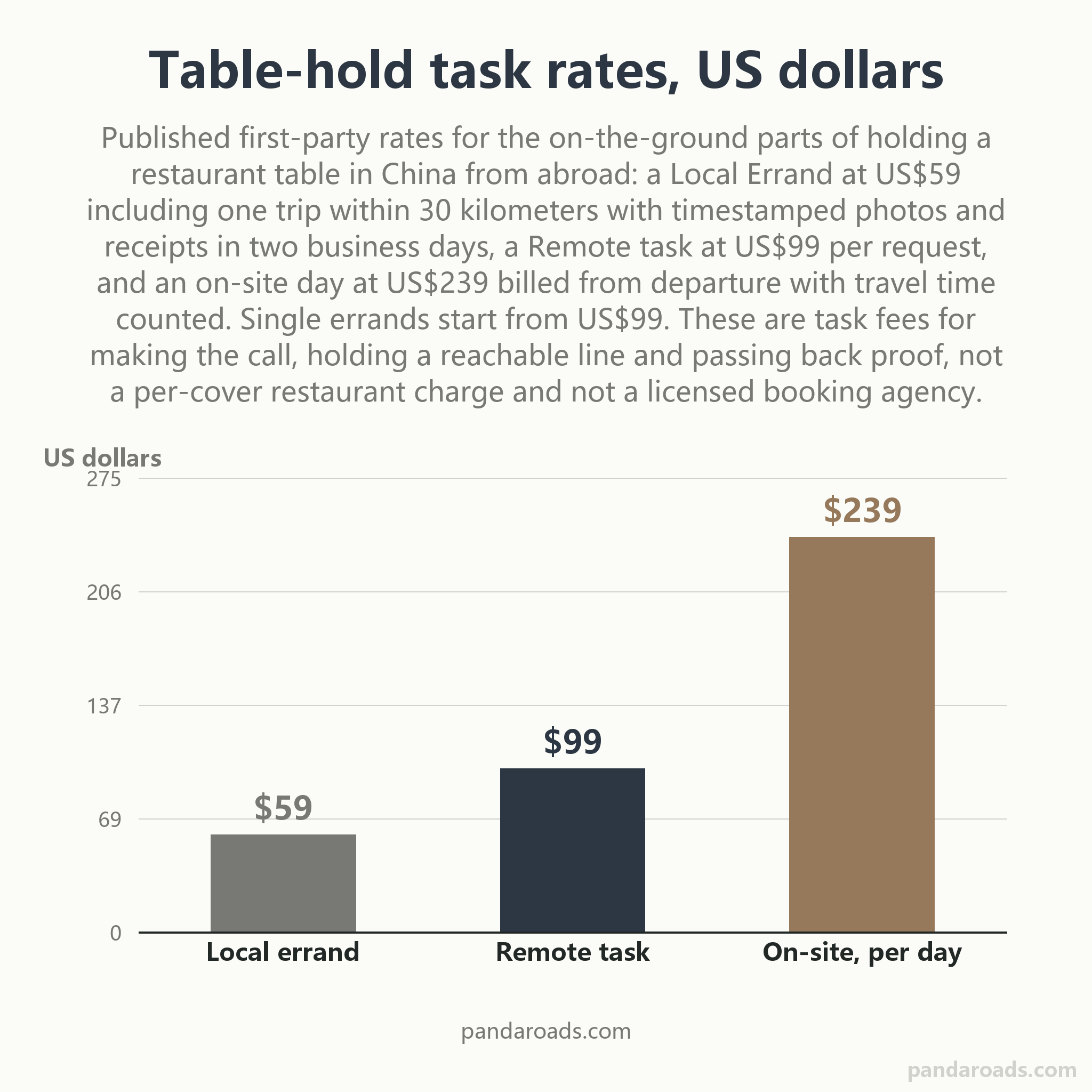
If you hand it over, here is what a fixed task costs, published plainly: a Local Errand runs US$239, covering one trip inside 30 kilometers with timestamped photos and receipts within two business days; a Remote task is US$129 per request; and an on-site day is US$239 billed from departure (source: pandaroads.com). Be clear about what that fee is and is not. It is a task fee for making the call, holding the line, re-confirming and returning proof. It is not a per-cover restaurant charge, and it is not a deposit to the restaurant, and if the venue itself wants a no-show deposit you are paying that separately on the restaurant's own terms. PandaRoads is not a licensed booking agency, not a restaurant, and not the ticketing desk of any platform; it makes the phone call and passes back the confirmation. It cannot invent a table that a genuinely full restaurant is not selling, and any service that promises it can is selling you something that does not exist. No competitor comparison appears here because we tried for an open market rate on a job shaped exactly like this one, a third party placing the call, and came back with none from any of the pages behind this article, so the only rate this section publishes is ours. Our analysis of the US$239 is that it buys a call placed, answered and proved rather than a table, and it should be read against the dinner it protects rather than against somebody else's rate card.
Note: Nothing is charged until you approve an itemized quote, and no fixed errand fee above includes anything the restaurant itself requires, such as a private-room minimum or a no-show deposit that a venue collects on its own terms. Read the fine print on the venue's own terms before assuming a table is free to hold (source: chinasurvivalkit.com).
Frequently asked questions
How can I book a restaurant in China from the USA? A Chinese reservation is a phone call plus a confirmation callback, not an email. Find the restaurant on Dianping, look for a 订座 or 预订 button, and note that only about 60 percent of listings expose one (source: chinasurvivalkit.com). Put a reachable +86 number on the booking, then wait for the confirmed status rather than the submitted form.
Can I reserve a table in China without a Chinese phone number? The app can accept an international number, but it is the weakest path. If you enter a non-Chinese number the restaurant often cannot call back to confirm or reach you to reschedule, and that is the leading reason foreign bookings get cancelled, so the guidance is to always use a +86 number that answers (source: chinasurvivalkit.com).
Do Chinese restaurants take reservations? Some do and many do not. Roughly 60 percent of restaurants listed on Dianping show any reservation button, and the rest are walk-in or phone only (source: chinasurvivalkit.com). Booking in China runs through a phone call or the Chinese app rather than an English web form, so confirm the restaurant takes reservations before you plan around it.
How do you use Dianping to book a table? Search the restaurant in the app, tap the 订座 button, set 日期 the date, 时间 the time and 人数 the party size, choose 大厅 hall or 包间 private room, and submit with 提交预订 (source: chinasurvivalkit.com). The result is often 等待商家确认, a provisional state, so wait for the confirmation push, which can take one to 24 hours.
Can I pay a restaurant deposit in China from overseas? Most ordinary bookings need no deposit, and the errand fee above is a task fee, not money to the restaurant. A few venues do ask a no-show deposit or a private-room minimum, so read the venue's own fine print before assuming a table is free to hold (source: chinasurvivalkit.com). There is no general overseas deposit channel to name.
What is the difference between 订座 and 团购 on Dianping? 订座 books a table, which is the action you want. 团购 is a prepaid group-buy voucher for a discounted set menu, and 代金券 is a cash voucher off the bill, and neither one reserves a seat (source: chinasurvivalkit.com). Tapping 团购 by mistake means you paid for food and still have no table to sit at.
Can I reserve a private room (包间) at a Chinese restaurant remotely? If the listing offers it, you can select 包间 in the app, but a private room often carries a minimum spend, frequently 200 yuan or more, while the 大厅 hall is free to book (source: chinasurvivalkit.com). For an ordinary dinner the safe default is the hall unless you genuinely want the room and can accept the bill floor at the door.
Do I need WeChat to book a restaurant in China? You need a logged-in Dianping account, and guest users cannot book. A common route is a WeChat-linked Dianping login, and you can register on Dianping with an international number, though some international numbers do not fully work (source: chinasurvivalkit.com), (source: chinaguidelines.com). WeChat helps with the account, not with answering the restaurant's confirmation call.
How far in advance should I book a restaurant in a big Chinese city? Popular restaurants in tier-one cities fill days ahead on weekends. The working rule is to book 3 to 7 days in advance for a Friday or Saturday dinner, and to re-confirm on the morning itself, because a reservation can sit in the app and still not be on the restaurant's own radar (source: chinasurvivalkit.com).
Is there an English service that books Chinese restaurants for me? China's own errand economy already does the calling at scale, but those paotui apps are entirely in Chinese and the request has to go out in Chinese, which is the barrier for an English-only arranger (source: www.chinese-forums.com). A service you can brief in English closes that gap for a fixed task fee, starting at US$239 for a single local errand (source: pandaroads.com).
The bottom line
Two facts decide almost everything about whether a booking made from abroad actually survives. First, a Chinese reservation is a phone call plus a confirmation callback, so a booking without a reachable +86 number is likely to lapse in silence, and you will find out at the door rather than in your inbox. Second, a submitted form is not a confirmed table, which is why the screenshot of a confirmed status and a thirty-second morning re-confirm matter far more than tapping 立即预订 and walking away.
The whole sequence fits in one breath: check the restaurant takes reservations at all, choose the hall and not a private room unless you want the minimum spend, put a number that answers on the booking, wait for the confirmed status, and re-confirm the morning of. If you cannot be the person who answers that call, that specific gap is exactly what a verified local runner closes for a fixed task fee (source: pandaroads.com). Send the city, the restaurant and the date and time and you get an itemized quote to approve before anything is charged, set against the published errand rates (source: pandaroads.com). One boundary, said once more plainly: this is a single table held by phone, not a full milestone banquet and not a hot meal delivered to a door.
References
- China Survival Kit. (2026). How to make a reservation on Dianping (English step-by-step 2026). China Survival Kit. https://chinasurvivalkit.com/blog/dianping-reservation-english-guide
- TableCheck. (2024, June 18). TableCheck announces a new system connection with Chinese restaurant booking platform, Meituan. TableCheck Inc. https://www.tablecheck.com/en/blog/meituan-restaurant-booking-integration/
- Baidu Baike. (2026). 跑腿 [Pao Tui: platform-delivered same-city instant errand and on-behalf service]. Baidu. https://baike.baidu.com/item/%E8%B7%91%E8%85%BF/68156818
- Chinese-Forums. (2018, February 21). Pao Tui 跑腿 in China [Forum post]. Chinese-Forums.com. https://www.chinese-forums.com/forums/topic/55973-pao-tui-%E8%B7%91%E8%85%BF-in-china/
- China Guidelines. (2026). Find restaurants in China: Guide for foreigners. China Guidelines. https://chinaguidelines.com/en/posts/finding-good-restaurant
- PandaRoads. (2026). Errands in China from overseas: Hire a local runner. PandaRoads. https://pandaroads.com/errands-in-china-from-overseas.html
Last reviewed and updated: September 2026. Author: our editorial team. For tailored guidance, contact our team.