How to Order a Birthday Banquet for Parents in China From the USA
Staging a 60/70/80 milestone banquet from another timezone: the xu-sui age trap that ruins offshore bookings, banquet etiquette your absence breaks (seating, toast order, red envelopes), decor and longevity traditions with sources, the video-link run-of-show, and what a $239 on-site day actually buys.
Last updated: July 2026 · By the PandaRoads team in China
TL;DR
You can genuinely produce a milestone birthday banquet for a parent in China from the US without flying over, but it is an event build, not a food order. Two decisions carry the most risk before any booking: get the 虚岁 right so you celebrate the correct year (a 七十大寿 falls a year before the Western 70th), and get the elder's consent so a public surprise does not embarrass the person it honors. A private 寿宴 table runs about HK$4,288 to HK$8,888, a foreign card inside Alipay is capped near RMB 3,000 per transaction and WeChat Pay near RMB 6,000, so the deposit has to be held locally. PandaRoads prices the production from its published rates: a $99 remote request to reserve and coordinate the room, a $59 local errand for a buy-and-deliver trip with photos and receipts, and a $239 on-site day for a runner who greets guests, runs the 敬酒 and the WeChat video link, and returns a timestamped photo-and-video report, with nothing charged until you approve an itemized quote.
Abstract
A sourced, offshore-first plan for producing a milestone birthday banquet (做寿 60/70/80 大寿) for a parent or grandparent in China while you live in the United States: why 虚岁 counting means the age on the invitation and the year you book for are not the same, what a private-room 寿宴 actually costs per table and what a foreign card can and cannot clear, the etiquette your absence breaks (who hosts, seating, 敬酒 order, 份子钱 log), the gift and color taboos and the consent-before-surprise question, the video-link arithmetic across a 12 to 15 hour gap, and the photo-and-video evidence you get back, priced from PandaRoads' own published primitives.
Key Takeaways
- Get the 虚岁 right: 七十大寿 falls the year before the Western 70th birthday
- A per-table 寿宴 runs about HK$4,288 to HK$8,888, so the deposit needs a local wallet
- A foreign card is capped near RMB 3,000 on Alipay and RMB 6,000 on WeChat Pay
- Your absence breaks the hosting script: someone must run 敬酒, seating and 份子钱
- Avoid clock, umbrella and white-flower gifts; ask the elder before surprising them
- Book a private room 3 to 7 days ahead around 初十 and weekends
- The deliverable is proof: a $239 on-site day plus a timestamped photo-and-video report
Table of Contents
- Abstract
- Key Takeaways
- What ordering a milestone birthday banquet from the USA really means
- The number-one offshore mistake: booking the wrong year because of 虚岁
- Why 60, 70 and 80 are the ages worth marking
- The etiquette your absence quietly breaks
- Gift and color taboos, and the consent-before-surprise question
- What it costs per table, and the payment ceiling a foreign card hits
- Three ways to stage it: the banquet package tiers compared
- The run of show, and the video link across a 12 to 15 hour gap
- Lead times, deposits and the cancellation reality
- Frequently asked questions
- The bottom line
- References
What ordering a milestone birthday banquet from the USA really means
Your mother turns seventy next spring in a city you have not lived in for years. The family back home is quietly planning a 做寿 banquet, the kind with a private room, a red 寿 character on the wall, and a room full of relatives who will take turns raising a cup to her. You are in Ohio, it is a phone call away, and the two easy moves both feel wrong: wire money and hope someone does it well, or book a flight for a single evening and spend a small fortune on jet lag.
Here is the honest reframe before anything else. Producing this from abroad is not a food order. It is an event build with four parts, and once you can see the parts the whole thing stops feeling impossible. The four are: the right year on the calendar, a held private room with a paid deposit, the etiquette and taboos the family expects you to observe, and a way to actually be present at the table on video while somebody runs the room for you.
The reason it is worth treating as production rather than delivery is that a milestone banquet has a host, and right now the intended host is twelve thousand kilometres away and asleep for most of the dinner. Somebody has to greet the guests, keep the toast order from stalling, hold up a phone so your side of the family is on the screen at the right moment, and send back proof that the evening looked the way it was supposed to. That somebody, not the menu, is the product.
One boundary, stated plainly so you are not misled. If what you actually want tonight is to send your parents a hot dinner, or drop off a single cake, that is a different and already-solved job, and it belongs on the everyday meal and cake delivery page rather than here. The full catalog of on-the-ground tasks lives on the cross-border errand hub and the china-tasks service page. This article stays inside one narrow scene: commissioning and witnessing a proper milestone birthday banquet from the United States.
Ordering a milestone birthday banquet in China from the United States is an event build, not a food order: the right calendar year, a held private room with a paid deposit, the family's etiquette, and a working video link at the table. PandaRoads prices the pieces from $59, $99 and $239 (source: pandaroads.com).
The number-one offshore mistake: booking the wrong year because of 虚岁
The most common and most expensive mistake a child makes from abroad is reserving the banquet for the wrong year, and almost every time it happens the culprit is 虚岁, the traditional Chinese way of counting age. China counts age two ways. The Western count you live by, 周岁, starts at zero and adds a year on each birthday. 虚岁 counts the birth year as age one already and then adds a year at every Lunar New Year, so it sits one to two years ahead of the number on your passport. The milestone 大寿 celebrations are set by 虚岁, not by 周岁, and the rule is explicit that the round-tens "big birthdays" are computed only on 虚岁 (source: ling.cass.cn).
The worked example makes the gap concrete. The academic source gives the rule directly: a 50th-birthday 大寿 is held in the fiftieth year counting from birth, which is the person's forty-ninth 周岁 year (source: ling.cass.cn). Read that again, because it is the trap in miniature: the family's "fiftieth birthday" is a year before the one your calendar would name.
Here is that arithmetic applied to a parent born in 1956, so you can see which year to reserve:
| What the invitation says (虚岁 milestone) | Named milestone | Calendar year to hold it | Parent's Western age that year |
|---|---|---|---|
| 六十大寿 (虚岁 60) | 花甲 | 2015 | 59 |
| 七十大寿 (虚岁 70) | 古稀 | 2025 | 69 |
| 八十大寿 (虚岁 80) | 耄耋 | 2035 | 79 |
The rule behind every row is one line: 虚岁 equals the booking year minus the birth year plus one. So for someone born in 1956, the 七十大寿 lands in 2025, the year they are still 69 in Western terms. Now name the offshore failure precisely. If you order the cake and the room for your mother's seventieth Western birthday in 2026, you are a full year after the family's 七十大寿, and you will feel great about it while the relatives wonder why the milestone was missed. Worse, folk custom holds that a birthday banquet is set on or before the real date and never made up afterward, because a 补办, a belated do-over, is read as inauspicious (source: family.esdlife.com).
The fix is one sentence and costs nothing: before you reserve anything, ask a family member which 虚岁 milestone year the invitation is actually for, and match your booking to that year rather than to the passport age. Every other decision that follows, the deposit, the cake inscription, the video-call date, hangs on getting that number right first.
Why 60, 70 and 80 are the ages worth marking
Not every birthday becomes a 做寿. In Chinese custom the big public celebration is reserved for the round milestones, and knowing why they matter helps you understand what a runner is actually reproducing in a restaurant room. The traditional ages carry names. Sixty is 花甲, the completion of a full 60-year cycle in the old sexagenary calendar. Seventy is 古稀, drawn from the poem line that few live to see the gray seventies. Eighty and ninety are 耄耋, and one hundred is 期颐. There is a second, more playful layer read out of the characters themselves, where each age is hidden in how the Chinese characters for the number can be taken apart: 77 is 喜寿, 88 is 米寿, 99 is 白寿 and 108 is 茶寿 (source: neac.gov.cn).
The milestone is not a suggestion but a rhythm, called 整寿, a major celebration every ten years, and in folk practice 祝寿 traditionally begins at sixty, with the 花甲 sixtieth and the eightieth treated as the most important (source: neac.gov.cn). That is why the reasonable question is never "should I mark every birthday" but "which 整寿 year is this, and does the family intend to hold it."
The ceremony itself has a shape worth knowing, because a good on-site runner follows it rather than improvising. The state cultural reference lays out the rite in five beats: 送帖请客, sending out the invitations; 祭祖上香, honoring the ancestors; 跪拜祝寿, the younger generation kneeling to offer birthday wishes; 共享寿宴, the shared banquet; and 分寿同贺, dividing the longevity cake and well-wishes among all present (source: neac.gov.cn). The room is set as a 寿堂, with 寿桃 and 寿糕 and fruit as offerings, a table veil worked with the 寿 character, and a scroll of the star of longevity, and the elder sits in a high-backed chair to receive the wishes (source: neac.gov.cn).
Food carries the symbolism too. The 长寿面, the longevity noodle, is essential because its length stands for a long life, and younger family members lift noodles into the elder's bowl to "add" years, a gesture called 添寿 (source: neac.gov.cn). The banquet traditionally opens with the longevity foods before the richer dishes and the birthday wine, and the guests raise a cup to the 寿星 in turn (source: neac.gov.cn). Two date rules sit underneath all of it: avoid the traditional sacrificial days, and observe 能早不能迟, hold it early rather than late, with the related 逢九不过 notion that the off-nine years like 59 or 69 are kept low rather than celebrated (source: family.esdlife.com). None of this is decoration for its own sake. It is the score the evening is played from, and it is what you are really buying when you ask someone to run the room.
A Chinese milestone banquet marks the round 整寿 years. Folk custom begins 祝寿 at 60 (花甲), with 70 (古稀) and 80 (耄耋) also major, and the 长寿面 longevity noodle symbolizes a long life, its length the point (source: neac.gov.cn).
The etiquette your absence quietly breaks
When you host a dinner in the US, you arrive, you seat people, you say a few words, you pay, you thank the gift-givers. A Chinese milestone banquet has the same duties, but they are governed by a formal script, and the script has a host at its center who, in your case, is not in the room. Naming exactly what your absence breaks is the most useful thing this article can do, because it is what turns "book a room" into "produce an evening."
Start with the toast order, because it is the beat most likely to go wrong. At a 寿宴 the 敬酒 follows generation and closeness in a fixed sequence: sons and daughters-in-law lead, then married daughters with their husbands, then the grandchildren, then nephews and nieces, then invited guests, each group raising a cup to the 寿星, the guest of honor (source: neac.gov.cn). In a normal family that order is cued by the adult children who are present. When the child nominally hosting is abroad, the sequence has no natural owner. An elder relative can front it, or a runner on the ground can cue each group in turn and keep the room from drifting into an awkward pause where nobody is sure whose turn it is.
Seating has the same invisible rule. A Chinese banquet places the guest of honor and the most senior diners in the seats facing the door, and everyone else sorts by seniority around the table. From a phone in another time zone you cannot see the room layout or gently move a great-uncle to the right chair, so whoever is physically present reads the room and seats the guests.
Then there is the money guests bring. At these banquets guests arrive with gifts and with 份子钱, the customary gift money in a red envelope, and the classic presents are 寿桃, 寿面, 寿糕 and longevity imagery such as 松鹤延年, the crane and pine that stand for long life, and the host registers what comes in so the family can return the favor later (source: neac.gov.cn). Somebody has to stand at the door, receive the envelopes, log them and say the right thanks, which is a real job you cannot do from Ohio. The market rate of that gift money is not secret either: roughly HK$500 for a restaurant lunch, HK$800 for a restaurant dinner or a hotel lunch, and HK$1,000 for a hotel dinner, though many elders now wave off cash in favor of a present, following the honored person's own preference (source: family.esdlife.com).
None of this is exotic or hard to respect. It is simply the host's workload of any dinner, made formal, and the reason a person on the ground matters more than a bigger budget. The one who greets, seats, cues the toasts and logs the envelopes is what turns a reserved room into a banquet your family would recognize.
At a Chinese longevity banquet the 敬酒 toasts follow a fixed generational order, sons and daughters-in-law first, then married daughters and husbands, then grandchildren, then guests, and guests commonly bring 份子钱 gift money around HK$500 to HK$1,000 (source: family.esdlife.com).
Gift and color taboos, and the consent-before-surprise question
Two things protect you here, and neither is about the room. One is not offending the family with an unlucky gift. The other is not embarrassing the very person you are trying to honor.
The gift taboos run on homophones, words that sound like other words, and they are worth taking seriously at an elder's celebration. Do not give a clock or a watch, because the phrase for gifting a clock, 送钟, sounds identical to the phrase for attending on a dying parent and mourning at a funeral, 送终. Skip the umbrella and the hand fan, because the words for them, 伞 and 扇, both sound like the word 散, separation and scattering. And avoid white flowers and white wrapping, since white is the color of death and mourning in Chinese tradition (source: cheng-tsui.com). The safe lane is the one the tradition already blesses: longevity imagery, 寿桃 and 寿面, the 寿 character, the crane-and-pine 松鹤延年 motif, and red and gold wrapping rather than white (source: neac.gov.cn). If you are unsure, a runner buying the 寿糕 and the decor locally is choosing from the celebratory set by default, which is its own kind of safety.
The consent question is the one nobody selling you a package will raise, so it earns more trust than any price list. A 做寿 is not a quiet dinner. In many families it is a loud, multi-generation event with a room of relatives, a 寿堂 set up at the front, and, in traditional form, actual kowtows (source: neac.gov.cn). A grandparent who is shy, or who has told the family for years that they hate fuss, can be genuinely put on the spot by a surprise thrown in their name by a grandchild they see once a year. Some elders have a firm view on the date, the guest list, or whether they want a public milestone at all.
So the right first move is not booking, it is asking. Through a family contact you trust, confirm three things before a deposit is placed: that the elder actually wants the milestone marked publicly, the real 虚岁 year the family is counting (the section above explains why this matters more than the passport), and any date constraints the household cares about. A runner can build the room, the decor and the program around whatever the family agrees to, and can hold the private room and place the deposit you cannot clear on a foreign card, but no service should overrule the person being honored. Producing a banquet the guest of mind did not want is a very expensive way to miss.
Warning: Ask before you book. A 做寿 is a loud, multi-generation event with a room of relatives, and an elder who has said for years that they hate fuss can be genuinely put on the spot by a surprise thrown in their name; confirm the person actually wants the milestone marked publicly before any deposit is placed.
At a 60, 70 or 80 milestone banquet several gifts are taboo because of homophones: a clock (送钟 echoing 送终, funeral mourning), an umbrella or fan (伞 or 扇 echoing 散, separation), and white flowers, since white is the color of mourning (source: cheng-tsui.com).
What it costs per table, and the payment ceiling a foreign card hits
You cannot budget this properly without two numbers, the cost of the table and the limit on the card, and the second one is the blocker nobody mentions until the deposit fails.
Start with the food, and treat it as a market range rather than a quote, because the venue sets it and you pay the restaurant directly. Chinese banquets price by the table, usually a round seating about twelve people, and the 寿宴 set menus are published per table. A Hong Kong round-up of hotel and restaurant 寿宴 packages lists them running roughly HK$4,288 to HK$8,888 per table, with two of the listed packages sitting at exactly HK$4,688 for twelve seats, and venues often throw in a free 蟠桃 cake or extra wine once you book six tables or more (source: family.esdlife.com). A hotel rate card sits higher and is a real anchor for the upper end, with 寿宴 dinner packages around HK$11,888 per twelve-person table plus beverage supplements (source: sitecore-cd.shangri-la.com). Cities on the mainland vary, so the honest use of these numbers is to set expectations for what a proper table costs before you add any coordination.
Now the blocker that decides whether you can even place the deposit. To hold a private banquet room, a Chinese restaurant almost always asks for a deposit, and it expects that money to move through a domestic payment wallet. If you are paying with a foreign-issued card linked inside Alipay or WeChat Pay, that card is capped well below banquet-deposit territory. Alipay allows a maximum of roughly RMB 3,000 per single transaction, while WeChat Pay allows a single-transaction maximum of RMB 6,000 with a monthly cumulative limit of RMB 50,000, and WeChat waives the foreign-card transaction fee below RMB 200 but charges 3 percent above it (source: china-briefing.com). Those are per-transaction ceilings, not monthly allowances you can keep tapping, and a multi-thousand-dollar room deposit cleared in one go is exactly the transaction they are most likely to refuse.
Say the consequence without drama: the payment method that works instantly for a US subscriber is structurally the weakest tool for holding a banquet room in China. That is not a reason the banquet cannot happen. It is the reason the deposit has to be placed by someone paying locally, which is precisely the line between this article and a restaurant's own rate card. The coordination and the on-the-ground payment are what you are commissioning, and they are priced separately from the table.
Note: The per-table ranges above are a market anchor to budget against, not a quote. The venue sets the menu price and you pay the restaurant directly; what is commissioned separately is the coordination and the deposit placed on a local wallet.
A proper Chinese banquet is priced by the 12-seat table, with 寿宴 menus running roughly HK$4,288 to HK$8,888 per table and a hotel card near HK$11,888, while a foreign card in Alipay is capped at about RMB 3,000 per transaction (source: china-briefing.com).
Three ways to stage it: the banquet package tiers compared
Once the year and the etiquette are settled, the actual purchase comes down to how much of the production you hand to someone on the ground. There are three sensible levels, and they map directly onto the service primitives PandaRoads publishes. This matrix is the decision, and no venue page or cake storefront offers it, because they only sell you one layer at a time.
| Tier | What it covers | Typical lead time | Price basis |
|---|---|---|---|
| Room booking only | Holds the private 包间, confirms the per-table menu with the restaurant, places the deposit through a local wallet, agrees the date; the runner is not present on the night | 3 to 7 days ahead around 初十 and weekends | A $99 remote request that includes reservation and coordination help (source: pandaroads.com) |
| Plus decor and cake | Everything in the first tier, plus the 寿 backdrop and balloons set in the room and a locally ordered 寿桃 or 寿糕 longevity cake delivered before service | 5 to 7 days for decor, 2 to 3 for the cake | The $99 remote request plus a $59 local errand that makes one buy-and-deliver trip within 30 km and returns photos and receipts (source: pandaroads.com) |
| Full run of show with video link | A runner present for the whole dinner: greets and seats guests, sets the decor, cues the 敬酒 order, hosts the WeChat video call to you, reads your toast on camera, logs any 份子钱 | 1 to 2 weeks to coordinate guests and the program | A $239 on-site day on top of the room and the items, with receipts for everything (source: pandaroads.com) |
Read the tiers as one ladder. The bottom rung solves the problem you physically cannot: a caller who can read the menu, negotiate the room and hold a deposit on a domestic wallet, which the capped foreign card in the last section cannot reliably do. The middle rung adds the two things that make a room read as a birthday rather than a dinner, the 寿 decor and the cake, delivered and photographed on the way in. The top rung is the one that answers the actual emotional question, which is whether your side of the family can be at the table, because the on-site day buys a person who runs the whole evening and puts the phone up at the toast.
Those are not invented prices. PandaRoads publishes a Local Errand at $59 for one buy-or-collect trip within 30 km inside a two-business-day window, with photos and receipts, a $99 remote request that includes reservation and coordination help, and on-site field work at a $239 day rate with a confirmed timeline (source: pandaroads.com). The standing rule underneath all three is what makes the whole thing safe to commission from an ocean away: nothing starts and nothing is charged until you approve an itemized quote, small material fees are prepaid and settled item by item with receipts, payments run through PayPal, and the service does not sign contracts or move large sums of money (source: pandaroads.com).
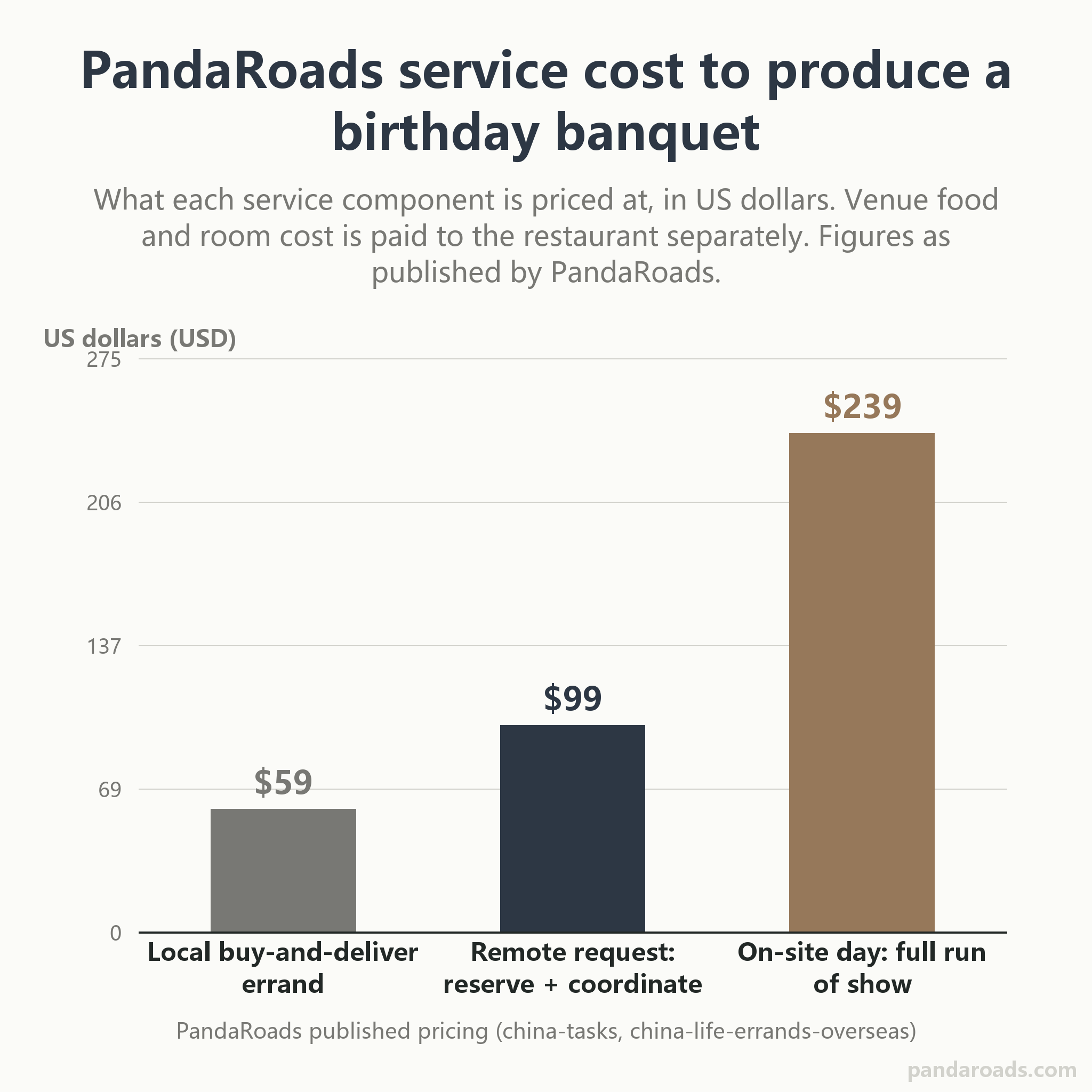
PandaRoads prices a milestone banquet build from its published rates: a $99 remote request to reserve and coordinate the room, a $59 local errand for one buy-and-deliver trip within 30 km with photos and receipts, and a $239 on-site day for the full dinner (source: pandaroads.com).
The run of show, and the video link across a 12 to 15 hour gap
The top tier is easiest to picture as an evening with a timeline, because that is what a runner is actually there to hold. Here is the shape of a full on-site day, and where the video call that lets you attend from the US plugs into it.
Before the door opens, the runner confirms the room and the 寿 setup, checks that the 寿桃 and the 长寿面 are on the table, positions the backdrop and balloons, and does a test WeChat call to a family phone already in the room so the link is proven while there is still time to fix it (source: pandaroads.com). This test matters more than it sounds: a call that fails at the toast, in front of forty relatives, cannot be retried without killing the moment.
As guests arrive, the runner greets by name where the family has flagged who matters, helps seat people with the elders facing the door, and receives and logs any 份子钱 so the host family has the record for returning the favor. During the meal, the runner cues the 敬酒 in the generational order, sons and daughters-in-law first, then married daughters and their husbands, then grandchildren, then nephews and nieces, then guests, raising their cups to the 寿星 (source: neac.gov.cn). At the toast to the guest of honor, the runner brings up the tested WeChat call and holds it so your side of the ocean appears on the screen at the head table, and reads your written toast aloud on camera if you cannot speak at that hour. Each beat is photographed, and at the end the runner hands over a timestamped photo-and-video report and the gift log.
Now the arithmetic you cannot skip, because it is where abroad banquets actually fall apart. Most of China runs 12 to 15 hours ahead of the contiguous United States, so a 6pm banquet in a Chinese city lands somewhere in the small hours of your morning. That is why the call is scheduled and tested in advance rather than dialed on hope, and it is the reason a runner holding the phone in the room beats a FaceTime link you send and half the family cannot answer. If you cannot be awake, the recorded toast read on camera and the timestamped report are what let you be there in substance even when you are asleep in fact.
Be clear about what the on-site day is and is not. It buys a runner present across the whole dinner, a longer and looser engagement than the two-hour drop-in a $59 local errand covers, and it ends with photos and an English report (source: pandaroads.com). It does not include the room and food, which you pay the restaurant, and the runner cannot sign anything or speak in ways the law and the family's own etiquette reserve to a relative. The point of the day is to be the family's capable stand-in for the host who is not there, not to replace the family.
China runs 12 to 15 hours ahead of the contiguous United States, so a 6pm banquet in a Chinese city lands in the early US morning, which is why the WeChat video call to the table is scheduled and tested in advance rather than dialed live (source: pandaroads.com).
Lead times, deposits and the cancellation reality
The logistics that decide whether this works are unglamorous, and it is better to know them a week early than to discover them the night before.
On timing: around the 初十 tenth-day marks and on weekends, a restaurant private room for a milestone dinner is realistically 3 to 7 days out, and longer if the family wants one particular banquet hall. The 寿 decor and the 寿桃 cake each need their own days on top, so a full run of show with a coordinated guest list is planned a week or two ahead, not the night before. This is the ordinary reason a good service quotes a confirmed timeline rather than promising same-day.
On money: to hold the room, the restaurant asks for a deposit, usually pegged to a per-head or per-table figure, and it wants that settled through a domestic wallet. A foreign card linked inside Alipay is capped near RMB 3,000 per transaction and inside WeChat Pay near RMB 6,000, so a real banquet deposit is the kind of charge those ceilings are built to refuse (source: china-briefing.com). In practice the deposit is placed locally and reimbursed at cost against a receipt, which is one of the clearest reasons the person paying has to be in the country.
On cancellation and refunds, the honest answer is that the restaurant governs the food and the room. Deposit and cancellation terms on a private banquet are the venue's own, and they are rarely generous close to the date, because the kitchen has bought the fish. What a coordination service can truthfully offer is to read those terms to you before you commit and to negotiate within them, not to invent a refund the venue will not honor.
The protection that does sit with the service is the approve-first rule, and it is worth restating because it is the risk control for the whole transaction: no work starts and nothing is charged until you approve an itemized quote, small material fees are prepaid and settled item by item with receipts, payments run through PayPal, standing instructions exist only in writing and can be cancelled anytime, and the service does not sign contracts or move large sums (source: pandaroads.com). You are not handing a stranger a credit card and a wish. You are approving a fixed number for a fixed scope before anything happens.
Around the 初十 tenth-day marks and on weekends, a Chinese restaurant private room for a milestone dinner is realistically 3 to 7 days out, with extra days for the 寿 decor and cake, so a full coordinated run of show is planned one to two weeks ahead (source: pandaroads.com).
Frequently asked questions
How do I book a birthday banquet for my parents in China from the USA? Reserve the private room and coordinate the details remotely, then decide how much of the night you want run on the ground. PandaRoads prices a remote request that includes reservation and coordination at $99, and a full on-site day at $239, with nothing charged until you approve an itemized quote (source: pandaroads.com).
How much does a 70th birthday banquet cost in China per table? The venue sets it and you pay the restaurant directly. Chinese banquets price by the 12-seat table, and 寿宴 set menus run roughly HK$4,288 to HK$8,888 per table at hotels and restaurants, with a real hotel rate card reaching about HK$11,888 per table (source: family.esdlife.com) (source: sitecore-cd.shangri-la.com).
Can someone arrange a zuoshou banquet in China while I live abroad? Yes. That is the whole point of the service. A runner holds the room, places the deposit you cannot clear on a capped foreign card, sets the 寿 decor, cues the toast order, runs the video link, and sends back a timestamped photo-and-video report (source: pandaroads.com).
What is the difference between 60 and 70 sui when booking a longevity banquet? Both are 整寿 milestones with names, 花甲 for sixty and 古稀 for seventy, and 祝寿 traditionally begins at sixty (source: neac.gov.cn). Both fall on 虚岁 years, so the calendar year you book for is earlier than the Western birthday, sometimes by a year.
Do I need a Chinese phone number and wallet to reserve a private banquet room? For the call and the deposit, effectively yes, which is the offshore blocker. A foreign card inside Alipay is capped near RMB 3,000 per transaction and inside WeChat Pay near RMB 6,000, so a room deposit is best placed by someone paying on a domestic wallet (source: china-briefing.com).
How do I do a video call toast at a birthday dinner in China? A runner brings a tested WeChat call to the table at the toast to the guest of honor. Because China runs 12 to 15 hours ahead of the US, the call is scheduled and tested in advance, and if you cannot be awake your written toast is read on camera and recorded (source: pandaroads.com).
What gifts are taboo to bring to a Chinese elder's birthday banquet? Avoid a clock or watch (送钟 sounds like 送终, mourning at a funeral), an umbrella or fan (伞 and 扇 sound like 散, separation), and white flowers or white wrapping, since white is the color of mourning (source: cheng-tsui.com). Longevity imagery in red and gold is the safe lane.
How far ahead should I book a private room for a milestone birthday in China? Around the 初十 days and weekends, plan on 3 to 7 days for the room itself, with extra days for the 寿 decor and the cake, and one to two weeks for a full coordinated run of show.
What is a longevity peach cake and where do I order it for a banquet? 寿桃 are steamed buns shaped like peaches, the fruit of immortality, and they open a 寿宴 with the 长寿面 noodles. A runner buys and delivers one locally for photos and a receipt, or a single shop-delivered cake can run about $57.90 for a 6 or 8 inch on its own (source: iweiyi.com) (source: neac.gov.cn).
Can I get photo and video proof that the banquet actually happened? Yes, and it is arguably the real deliverable. A $59 local errand returns photos and receipts, and the $239 on-site day returns a timestamped photo-and-video report of the whole evening, with every material fee settled item by item against a receipt (source: pandaroads.com).
The bottom line
Producing a milestone 做寿 banquet for a parent in China while you live in the United States is genuinely doable, and it comes down to five moves made in the right order. Get the 虚岁 year right so you celebrate the correct birthday, not the passport one. Get the elder's consent so a public surprise honors them instead of embarrassing them. Let someone on the ground place the deposit, because a foreign card capped near RMB 3,000 on Alipay and RMB 6,000 on WeChat Pay will not reliably clear a banquet room. Put a runner in the room to greet guests, run the 敬酒 order and hold up a tested WeChat call so your side of the family is at the table. And take the proof, the timestamped photo-and-video report, as the point of the exercise.
The service side is priced in the open, which is what makes it commissionable from an ocean away: a $99 remote request to reserve and coordinate, a $59 local errand for one buy-and-deliver trip with photos and receipts, and a $239 on-site day for the full dinner, all settled through PayPal with nothing charged until you approve an itemized quote, against a venue table cost of roughly HK$4,288 to HK$8,888 you pay the restaurant (source: pandaroads.com) (source: family.esdlife.com).
If that is the evening you want to build, the next step is a plain message saying which parent, which city, and which 虚岁 milestone year the family is counting, and asking for a fixed itemized quote. One boundary to leave you with: if tonight you only want to send a hot dinner or drop off a single cake, that is a simpler job, and it lives on the everyday meal and cake delivery page rather than in this banquet production.
References
- PandaRoads. (2026). China sourcing & local task service from $99 [Service page]. PandaRoads. https://pandaroads.com/china-tasks.html
- PandaRoads. (2026). China life errands for overseas Chinese [Service page]. PandaRoads. https://pandaroads.com/china-life-errands-overseas.html
- 国家民族事务委员会 (State Ethnic Affairs Commission). (2023, February 27). 当你老了,时光如何被标注?中国人的寿诞礼 [The Chinese longevity-birthday rite]. 道中华 / neac.gov.cn. https://www.neac.gov.cn/seac/c103391/202302/1161239.shtml
- 刘丹青 (Liu Danqing). (2021, November 29). 虚岁、实岁的优劣与选择 [On the merits and choice between nominal and actual age]. 中国社会科学院语言研究所 (Institute of Linguistics, Chinese Academy of Social Sciences). http://ling.cass.cn/ziyuan/ywtd/ywmt/202111/t20211129_5377729.html
- EDKLife Family. (2026). 壽宴場地推介:酒店/酒樓壽宴套餐、價錢一覽(含人情公價、祝壽禮物、60/70/80 大壽祝福語) [Recommended longevity-banquet venues, package prices and gift-money guide]. family.esdlife.com. https://family.esdlife.com/content/%E5%A3%BD%E5%AE%B4%E5%A0%B4%E5%9C%B0-%E9%85%92%E5%BA%97-%E9%85%92%E6%A8%93-%E5%A3%BD%E5%AE%B4%E5%A5%97%E9%A4%90-%E5%83%B9%E9%8C%A2
- Shangri-La. (2024). Chinese birthday dinner package: longevity-banquet evening set menus and rates [Rate card PDF]. sitecore-cd.shangri-la.com. https://sitecore-cd.shangri-la.com/MediaFiles/7/0/6/%7B7065177F-4D47-40E3-8E94-C37ADB69C754%7DKSL_Birthday_Dinner_Package_2024.pdf
- China Briefing. (2023, July 24). WeChat enables foreigners to pay with overseas cards in China. China Briefing. https://www.china-briefing.com/news/wechat-enables-foreigners-to-pay-with-overseas-cards-in-china/
- iWeiyi. (2026). Birthday cake delivery in China: fast, fresh and personalized [Service listing]. iweiyi.com. https://www.iweiyi.com/en/61-birthday-cakes-delivery-china
- Cheng & Tsui. (2018, December 10). 10 dos and don'ts of gift-giving in Chinese culture. Cheng & Tsui. https://www.cheng-tsui.com/blog/10-dos-and-don%E2%80%99ts-of-gift-giving-in-chinese-culture
Last reviewed and updated: September 2026. Author: our editorial team. For tailored guidance, contact our team.