Withdraw Chinese Pension Social Security From Abroad: 7 Steps
A step-by-step procedure for a former worker now living in the United States or elsewhere abroad who wants to settle a Chinese social insurance or pension account: which rule applies to you based on citizenship and age, the eight percent of your own wages that is actually refundable and the employer share that never is, the document set the social insurance bureau demands, how to file when you cannot stand in the Chinese queue yourself, and the keep-and-collect route that trades a lump sum for an annual proof of life.
Last updated: September 2026 · By the PandaRoads team in China
TL;DR
Whether you can cash out a Chinese pension from abroad is not one withdrawal button; it is a citizenship-and-age fork. Under MOHRSS Order No. 13 Article 6, someone who settles abroad before pension age usually just keeps the personal account and collects later; the one-time lump sum opens mainly for a person who has lost Chinese nationality, a foreigner, a Hong Kong, Macao or Taiwan resident, or anyone who reaches retirement age short of fifteen years of contributions. And the only money refundable is the eight percent of your own wages in the personal account, never the employer share that went into the pooled fund.
Abstract
A step-by-step procedure for a former worker now living in the United States or elsewhere abroad who wants to settle a Chinese social insurance or pension account: which rule applies to you based on citizenship and age, the eight percent of your own wages that is actually refundable and the employer share that never is, the document set the social insurance bureau demands, how to file when you cannot stand in the Chinese queue yourself, and the keep-and-collect route that trades a lump sum for an annual proof-of-life.
Key Takeaways
- Settling abroad before pension age usually parks the account, it does not auto-payout
- Only your own eight percent personal account is refundable, never the employer pool
- A lump sum needs a written application to terminate the insurance relationship
- The liquidation notice must be signed by you in person; a proxy signature is invalid
- You can entrust a representative abroad, but only on a notarized power of attorney
- Stay in the system and you must file proof of life at least once a year to keep drawing
- The approval and the calculated amount belong to the social insurance agency, not a runner
Table of Contents
- Abstract
- Key Takeaways
- What this actually is: a citizenship fork, not a withdraw button
- Step 1: Work out which rule applies to you
- Step 2: Know what is refundable, your eight percent, not the pooled fund
- Step 3: If you left before retirement age, the account is usually parked, not paid
- Step 4: The lump-sum-and-terminate claim, and who actually qualifies
- Step 5: Assemble the document set the bureau will accept
- Step 6: File from abroad, the in-person signature and the notarized power of attorney
- Step 7: Or keep and collect, the annual proof of life from abroad
- What it costs to have someone stand in the Chinese queue for you
- Frequently asked questions
- The bottom line
- References
What this actually is: a citizenship fork, not a withdraw button
Two rules settle this before any form is filed. Under MOHRSS Order No. 13 Article 6, someone who settles abroad before pension age normally keeps the personal account, and the one-time lump sum opens mainly on loss of Chinese nationality. Only the eight percent of your own wages in that account is refundable, never the employer's pooled share.
You worked in mainland China years ago, you paid into social insurance every month, and now you live in the United States or somewhere else abroad with a foreign passport. Somebody in the family chat group tells you the money sitting in your Chinese social security account can be taken out, so you start looking for the withdrawal button. The first thing you run into is that there is no single button, and the second is that the social insurance bureau wants you standing in a Chinese office to sign a paper you cannot read.
The threads people actually post in show how much of this is guesswork. On r/chinalife someone asks the exact question this article is built to answer: "How hard is it to get pension/social security out before leaving China? ... Agency charges 10%, is it difficult to do on own or would people who have done it recommend agency? Do you need letter of resignation?" (source: reddit r/chinalife, 2024-06). In a companion r/chinalife thread about helping a parent move back, one poster writes, "If they move back, they also need someone who can help them with their day-to-day stuff. The way things are done in China is so different ...", and another, on elderly care services, adds, "How can I research into private elderly care services? (I'm an ABC who can't read chinese, but I'd appreciate some key chinese words to look up ..." (source: reddit r/chinalife, 2023-11). Read together, those are not asking whether they are entitled. They are asking how the process works, what it costs to get help, and what to do when you cannot read the forms or stand in the room.
Here is the thesis in one line. Settling a Chinese pension or social insurance account from abroad is not one withdrawal, it is a citizenship-and-age fork that decides whether you should cash out, keep the account and collect later, or simply prove once a year that you are still alive. Two facts trip up almost everyone. First, under MOHRSS Order No. 13 Article 6 a person who settles abroad before reaching pension age usually keeps the personal account and collects when the conditions are met; the one-time lump sum is a choice, and it opens mainly for someone who has lost Chinese nationality, for a foreigner, for a Hong Kong, Macao or Taiwan resident, or for anyone who reaches retirement age short of fifteen years of contributions (source: xiapu.gov.cn). Second, the only money that is refundable is the eight percent of your own wages that went into the personal account, never the employer share that went into the pooled fund (source: china-briefing.com).
Note: This article is about the pension and old-age social insurance account only. The medical-insurance personal account settles separately at the medical insurance center, and a deceased relative's bank deposits and inheritance remittance are their own chain with their own notarial and foreign-exchange steps. Neither of those is re-run here. The approval and the final calculated amount belong to the social insurance agency throughout, and the physical errands below are coordination, not legal, notarial or tax advice.
By the Numbers
- 8% of your own wages is credited to the personal pension account, and it is the only slice the bureau can refund to you (source: china-briefing.com)
- 15 years is the minimum cumulative contribution record needed to draw a monthly pension instead of only a lump sum (source: china-briefing.com)
- 60 / 55 are the retirement ages for men and women at which a retained account starts paying, even from abroad (source: china-briefing.com)
- 20 days is Beijing's statutory handling limit for a one-time personal-account payout (source: banshi.beijing.gov.cn)
- 10 days is the committed handling time Beijing publishes for that same claim (source: banshi.beijing.gov.cn)
- 1x a year is the proof-of-life filing an abroad pensioner must make to keep collecting a monthly benefit (source: shanghai.gov.cn)
Six figures, and the one people understand least is the first. Overseas forums repeat that a settled expatriate can pull their "pension" out of China as though the whole contribution were one refundable pot. It is not. Only the eight percent of your own wages that the employer withheld into your individual account, plus the interest on it, is yours to take. The employer share that flowed into the pooled fund stays in the fund and is never part of any lump sum, which is why the money released so often looks smaller than the total you paid in. The other five numbers decide your route more than the balance does, and the steps below tell you where each one bites.
Step 1: Work out which rule applies to you
Before you chase a form or a flight, settle one question: which of the several Chinese rules actually governs your case. The answer does not move on the size of your balance. It moves on four gates, and once you know where you sit you know whether you are looking at a lump sum, a retained account, or a survivorship filing.
The four gates the bureau checks
The first gate is citizenship. Do you still hold Chinese nationality, or have you lost it by naturalizing abroad, or were you never Chinese and simply contributed while employed on a work permit? The second is which scheme you fell under, the employee old-age scheme, the foreigner measures, or the Hong Kong, Macao and Taiwan measures. The third is age, whether you have already reached the pension age of sixty for men and fifty-five for women. The fourth is contribution length, whether you cleared the fifteen cumulative years that a monthly pension needs (source: china-briefing.com).
Which rule applies to you
| Reader profile | Governing rule | What you can actually do |
|---|---|---|
| Kept Chinese nationality, left before pension age | MOHRSS Order No. 13 Article 6 | The personal account is retained; you collect when you meet the conditions, with no lump sum by default (source: xiapu.gov.cn) |
| Lost Chinese nationality | MOHRSS Order No. 13 Article 6 | Apply in writing to terminate the relationship and take the personal-account balance as a one-time lump sum (source: xiapu.gov.cn) |
| Foreign national who worked in China | MOHRSS Order No. 16 Article 5 | Keep the account and accumulate years on any return, or apply in writing to terminate for a lump sum (source: shanghai.gov.cn) |
| Hong Kong, Macao or Taiwan resident | Order No. 41 Article 7 | Keep the account, or apply in your own writing to terminate for the individual-account balance (source: xiapu.gov.cn) |
| Reach retirement age under 15 years | MOHRSS Order No. 13 Article 3 | Apply in writing to terminate and take the personal-account balance as a lump sum (source: xiapu.gov.cn) |
| Retiree already drawing monthly, now abroad | MOHRSS Order No. 16 Article 7 | Keep collecting by filing an annual proof of life, rather than cashing out at all (source: shanghai.gov.cn) |
Read the first row again, because it is the case most people in the diaspora are actually in and it is the one the internet gets wrong. If you were a Chinese national, you settled abroad before pension age, and you never formally renounced or lost your nationality, the ordinary outcome is that your account is parked, not paid. You do not get a lump sum just because you moved, and that is a protection rather than a trap: the record and the balance wait for you, and if you return to work in China the contribution years keep accumulating toward a monthly pension (source: shanghai.gov.cn).
The rest of this guide walks the two live branches. Step 4 is the lump-sum-and-terminate claim and the specific grounds that open it. Step 7 is the keep-and-collect branch, where the real task is not a withdrawal but an annual proof that you are alive. Steps 2, 5 and 6 apply to both branches, because what is refundable and what the counter demands does not change.
Step 2: Know what is refundable, your eight percent, not the pooled fund
Chinese pension premiums come from two pots. The employee paid eight percent of wages into a named individual account, and the employer paid a larger share into a pooled fund. Only the individual account plus its interest is refundable to you. On an RMB 15,000 wage that is about RMB 1,200 a month, so three years builds roughly RMB 43,200 of withdrawable balance.
A payroll blog will tell you that you can claim a full refund of your social insurance contributions when you leave China. That sentence is the single most expensive error in this whole process, and it is worth killing before you build expectations around a number.
Here is the split. Chinese pension premiums are paid by two parties at once. Your employer paid a large percentage of your wages into a pooled fund that pays today's retirees. You, through your employer's withholding, paid eight percent of your own wages into an individual account that carries your name. Only that second pot, the employee's eight percent credited to the individual pension account plus the corresponding interest, is refundable to you. The employer share that went into the pooled fund is not yours to withdraw and never appears in a lump sum (source: china-briefing.com).
Run a worked number so the gap is concrete. Suppose your monthly wage was RMB 15,000. The eight percent that went into your personal account was about RMB 1,200 a month. Three years of that is roughly RMB 43,200 plus interest, and that, not the far larger combined employer-plus-employee total, is the pool any lump sum draws on (source: china-briefing.com). If you paid in for a decade the personal-account pot is larger, but it is still only your eight percent line, not every yuan that left your payslip as a social insurance deduction. Expecting the full deduction is how people end up disappointed by the figure the bureau releases.
Sort the money into the two buckets before you do anything else:
- Refundable to you: the balance of your individual pension account, meaning your own eight percent of wages, plus the interest the agency has credited on it (source: china-briefing.com).
- Not refundable: the employer's pooled contribution, which stays in the fund that pays current pensioners and is never part of any lump sum (source: china-briefing.com).
Note: Treat every number in this step as a way to understand what counts toward your claim, not as a quote. The exact balance and the final calculated figure come from the social insurance agency's own ledger for your record. The agency computes them, and no guide, translator or errand runner can set the amount for you.
The practical consequence is simple and it survives all the way to Step 4: when you eventually terminate and get paid out, the check is drawn against the personal account. If you are weighing whether to cash out at all, weigh that personal-account balance against the monthly pension you would forfeit by closing the record, because those are two different objects and the lump sum is only ever the smaller, personal slice of them.
Step 3: If you left before retirement age, the account is usually parked, not paid
MOHRSS Order No. 13 Article 6 states that the employee old-age personal account cannot be withdrawn early, and that a person settling abroad before meeting pension conditions has the account retained. The balance waits, and returning to work in China lets the contribution years keep accumulating toward the fifteen years a monthly pension requires.
Chat assistants answer this question badly in two opposite directions. One will say yes, the personal account can be cashed out any time you settle abroad. Another will say no, you must wait until retirement age and can never take a lump sum. Both are wrong, and the reason is that the rule is not one statement, it is a fork.
Read the regulation itself. Under MOHRSS Order No. 13 Article 6 the employee old-age insurance personal account may not be withdrawn early, and where an individual settles abroad before reaching the conditions for drawing a basic pension, the personal account is retained, and when those conditions are later met the person enjoys the corresponding pension under national rules (source: xiapu.gov.cn). In plain language: leaving China before pension age normally does not trigger a payout. It freezes your record in place and keeps your eight-percent balance and its interest safe for the day you qualify.
So what is the lump sum, then? It is not a withdrawal, it is a termination, and the bureau makes you confirm that in writing. Under the same article, a person who has lost Chinese nationality may apply, at or after leaving, to end the employee basic old-age insurance relationship, and before that happens the agency must inform them in writing of the right to keep the account and of the consequences of terminating. Only on the person's own written confirmation is the relationship closed and the personal-account balance paid as a one-time lump sum (source: xiapu.gov.cn). The step is deliberate, because the state is warning you that you are about to give up a future monthly pension for a smaller cash figure today.
There is a third option people forget, which is to do nothing at all and come back later. The foreigner measures put the accumulate-years logic plainly: a covered person who leaves before pension age keeps the individual account, and if they return to work in China the contribution years keep adding up (source: shanghai.gov.cn). For someone who might yet reach fifteen years, keeping is usually worth more than cashing, and it costs nothing to wait.
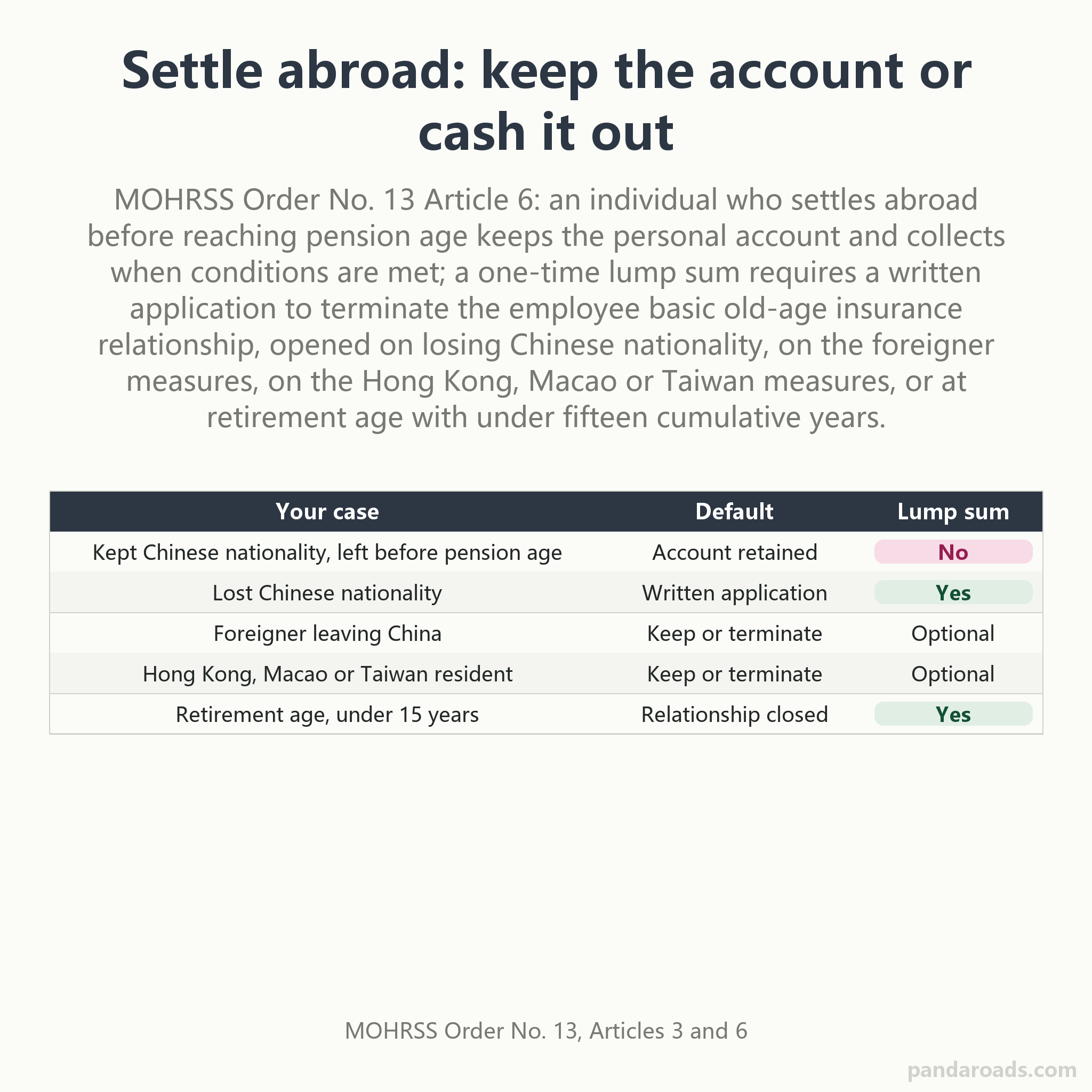
Note: Cashing out forfeits the future monthly pension, and the forfeited value can far exceed the lump sum for anyone young enough to eventually meet the age and years. Weigh the personal-account balance you would take today against the monthly benefit you would be closing the door on, before you sign anything to terminate.
Step 4: The lump-sum-and-terminate claim, and who actually qualifies
The one-time payout is real, but it is conditional, and the conditions are the whole point. It is not a withdrawal you request because you would like the money now. It is a written application to terminate the employee basic old-age insurance relationship, and it opens on defined grounds, not on preference.
The fastest way to see whether you qualify is to read the grounds side by side.
The four grounds for a one-time payout, and what each needs
| Ground | Governing rule | Core requirement |
|---|---|---|
| You have lost Chinese nationality | MOHRSS Order No. 13 Article 6 | Apply at or after leaving, receive the agency's written notice of the right to keep, then confirm in writing to terminate (source: xiapu.gov.cn) |
| You are a foreigner leaving China | MOHRSS Order No. 16 Article 5 | Apply in writing to terminate the social insurance relationship for a lump sum of the individual account (source: shanghai.gov.cn) |
| You are a Hong Kong, Macao or Taiwan resident leaving the Mainland | Order No. 41 Article 7 | Your own written application to terminate for the individual-account balance (source: xiapu.gov.cn) |
| You reach retirement age with under fifteen years | MOHRSS Order No. 13 Article 3 | Written application to terminate; under State Council Document [2005] No. 38 no basic pension is paid and the balance is paid as a lump sum (source: xiapu.gov.cn) |
Every one of those rows has the same skeleton: an act of yours, in writing, that ends the relationship. The article that binds them is consent. Under Order No. 13 Article 6 the agency must first inform you in writing that you could keep the account instead, and spell out what terminating costs you, and only on your own written confirmation is the relationship closed and the balance paid out (source: xiapu.gov.cn). If you have kept Chinese nationality and simply moved abroad, none of these grounds applies by itself, and the default is the retained account from Step 3, not a payout.
The Shenzhen social insurance bureau states the nationality fork in operational terms for the resident scheme, and it is worth quoting because it is the case most diaspora readers are actually in. A participant who has not started drawing benefits and settles abroad while keeping Chinese nationality has the relationship retained and draws the pension when the conditions are met; one who has lost Chinese nationality must deregister, terminate the relationship, and take a one-time payout of the personal-account balance (source: hrss.sz.gov.cn). The same logic runs for someone already drawing: keep the nationality and the monthly payment continues, lose it and benefits stop, the record is closed, and the personal-account balance is paid as a lump sum.
The practical read is that "settled abroad" and "eligible for a lump sum" are not synonyms. Your eligibility turns on the citizenship and contribution facts you established in Step 1, and on nothing else. Once you know which ground, if any, you are on, Step 5 tells you what papers to gather and Step 6 tells you how to file them without flying back.
Step 5: Assemble the document set the bureau will accept
Beijing's published service guide lists what the counter accepts for a payout claimed on loss of Chinese nationality: a foreign passport, proof of the date the foreign nationality was acquired, and a liquidation-application notice signed by the applicant in person. It sets a statutory handling time of 20 working days and a committed handling time of 10.
The reason a pension claim stalls for most overseas people is not entitlement. It is that the paperwork is written in Chinese, issued by offices they no longer have a reason to visit, and ordered in a sequence the counter expects. Get the set right and the claim moves in days rather than months.
The document set, in the order the counter receives it
At the center of the file sits the liquidation-application notice, and around it the papers that prove the ground you are claiming on. Beijing's published service guide for the one-time return of the employee pension personal account sets out what it wants for a claim based on having lost Chinese nationality, and the list is unusually concrete:
- A foreign passport, in your own name, the identity the bureau will match to the record.
- Documents showing when you acquired the foreign nationality, and if those documents are not in Chinese, a translation stamped by a licensed translation company. In place of them you may submit a mainland household-registration cancellation certificate that bears the date the foreign nationality was acquired.
- The liquidation-application notice itself, which must be signed by the applicant in person, with any proxy signature invalid (source: banshi.beijing.gov.cn).
That last clause is the one that surprises people. The bureau treats the signature on the liquidation notice as personal. A representative can carry the papers to the window, but the name on the signature line has to be yours and the hand that signs has to be yours or properly bound to you, which is exactly what Step 6 resolves.
The intake channel depends on who employed you. The official English government FAQ for Shanghai is direct about it: enterprise employees apply through their company to the social insurance sub-center, while individuals, meaning someone no longer employed by a Chinese firm, go to the nearest community affairs service center (source: english.shanghai.gov.cn). If you left China years ago and have no former employer to route through, you are filing as an individual at a community service center, and the address matters because the claim goes to the office that holds your record, not to whichever branch is nearest to your family.
Order the papers the way the counter receives them
Assemble the file in the order above, translation and stamp done before you travel or courier, and expect the clock to start at the office where the record lives. Beijing publishes a statutory handling time of twenty working days for this item and a committed handling time of ten working days (source: banshi.beijing.gov.cn). Ten is the number to plan around; twenty is the outer bound the bureau must not cross. Neither figure is the payment arriving in a foreign bank account, only the agency's processing of the termination and payout decision.
Note: Translation is the work of a licensed translation company and notarization or authentication of any foreign-issued paper is the work of a notary, not of an errand runner. A helper on the ground can arrange the stamp, courier the originals and get the receipt, but the translation and the notarial act are performed by the licensed parties who sign for them.
Step 6: File from abroad, the in-person signature and the notarized power of attorney
When the applicant cannot appear, consular rules require a power of attorney notarized within the previous 30 days, plus the representative's own passport and residence permit and copies of the applicant's. After 3 consecutive years filed by proxy, the 4th year forces the applicant to appear in person, and the bureau still demands the applicant's own signature.
This is the step the absent claimer actually came here to solve. Everything before it is knowledge; this is the physical obstacle. The social insurance bureau wants a person standing at a counter in a Chinese city on a weekday, and you are an ocean away with a job, a family and no easy way to book a flight and a leave window just to sign one form.
You have two ways through, and they differ in one thing, whose hand signs.
File in person or entrust a representative
| Option | What it takes | The catch |
|---|---|---|
| Appear in person | Bring the passport and document set and sign the liquidation-application notice yourself at the counter | Definitive, but needs a body in a Chinese city on a weekday (source: banshi.beijing.gov.cn) |
| Entrust a representative | The representative files the materials, but the liquidation notice still carries your own signature and the entrustment must be a notarized power of attorney | Under consular rules a proxy filing for someone abroad presents their own valid passport and residence permit, copies of the applicant's passport and residence permit, and a power of attorney notarized within the previous thirty days (source: hk.ocmfa.gov.cn) |
Read the in-person rule again, because it survives both rows.
For a claim on the ground of having lost Chinese nationality, the liquidation-application notice must be signed by the applicant in person, and any proxy signature is invalid. (source: banshi.beijing.gov.cn)
That sentence is the reason a casual favor from a relative in the old city fails. Someone who simply walks the file to the window cannot sign for you. What makes a remote claim work is a properly notarized power of attorney that binds the representative to your authority, while the signature that is legally yours stays yours, given through the delegation or on a paper you have signed and had authenticated abroad.
The mechanics of that delegation are documented in the consular guidance of China's Ministry of Foreign Affairs. When an applicant entrusts another person to act, the proxy must present their own valid passport and residence permit, copies of the applicant's passport and residence permit, and a power of attorney notarized within the previous thirty days (source: hk.ocmfa.gov.cn). That same guidance caps how far proxy filing can run: after three consecutive years handled by a representative, the fourth year requires the applicant to appear in person (source: hk.ocmfa.gov.cn). A delegation executed abroad has to be notarized where you are and then authenticated for use in China, the same legalization step that applies to your passport and nationality papers in Step 5.
Two honest limits close this out. Notarizing the power of attorney is the act of a licensed notary office, and the authentication is the act of a consular or competent authority; a runner arranges the appointment, translates, couriers the signed originals and photographs the receipts, but does not perform the notarial act. And even a perfect delegation cannot decide the claim: whether it is approved, and the balance the bureau releases, remain the social insurance agency's call, not the representative's and not any service company's.
Step 7: Or keep and collect, the annual proof of life from abroad
MOHRSS Order No. 16 Article 7 requires a person drawing monthly pension benefits from outside China to file a proof-of-life document at least once a year, issued by a Chinese embassy or consulate or notarized and authenticated locally. A missed filing suspends the payment, and under Article 6 the account balance passes to survivors rather than reverting to the fund.
There is a version of this whole problem where the smart move is not to withdraw anything. If you will reach the pension age and you have the fifteen years, staying in the system and drawing a monthly benefit for the rest of your life is usually worth far more than the one-time lump sum of your eight-percent account. On that path the task is not a payout at all. It is proving, every year, that you are still alive.
The rule is explicit in the foreigner measures. MOHRSS Order No. 16 Article 7 requires a foreigner drawing monthly benefits from outside China to provide, at least once a year, a proof-of-life document issued by a Chinese embassy or consulate, or one that is notarized and authenticated in the country of residence and then authenticated by a Chinese embassy or consulate (source: shanghai.gov.cn). China Briefing states the same duty for the returnee case and adds the numbers behind it: a foreign employee with fifteen or more years of contributions who has reached the legal retirement age in China, sixty for men and fifty-five for women, can receive a monthly pension even while living outside China, provided they file that annual proof of life issued by a Chinese embassy or consulate (source: china-briefing.com).
The filing itself is a small checklist, and the failure mode is a missed deadline rather than a rejected claim:
- Confirm your account is retained and you are drawing, not terminated, because a person who already took the lump sum has closed the record and has nothing to prove.
- Find the embassy or consulate that issues your certificate, or establish how to have a local proof notarized and authenticated, since either route is accepted under Article 7.
- Set a recurring yearly reminder, because a missed filing suspends the monthly payment until the proof is provided, and a long gap can freeze a benefit the recipient still qualifies for.
Two facts round out the keep-and-collect branch. The survivorship rule protects the system against fraud on a payment that keeps going, which is why it applies to someone drawing rather than someone who cashed out and stopped. And the account is not stranded if the worst happens: under Order No. 16 Article 6, on a foreigner's death the individual-account balance may be inherited, so a balance still sitting in a retained account passes to survivors rather than reverting to the fund (source: shanghai.gov.cn). Deciding between Step 4 and Step 7 is therefore a real financial choice, cash out the smaller personal sum now, or keep the monthly benefit and file once a year to protect it.
What it costs to have someone stand in the Chinese queue for you
The on-the-ground work is bounded, so it prices by task, not by a share of your claim. PandaRoads quotes a Local Errand inside 30 km at US$239, a remote request at US$129 and on-site work at US$239 per day billed from departure, with nothing charged until you approve an itemized quote. Approval and the calculated amount stay with the social insurance agency.
Add the seven steps up and the shape of the job becomes obvious. Several of them want a body in a Chinese city on a weekday, at the social insurance sub-center or the community affairs service center that holds your record, and at a notary office for the power of attorney. You are not that body, and the whole reason a fixed-fee local service exists is that one gap between you and the counter.
The community already knows this is the real question. That same r/chinalife poster asking about the pension does not debate whether they are entitled, they debate who should do it and for how much: "Agency charges 10%, is it difficult to do on own or would people who have done it recommend agency?" (source: reddit r/chinalife, 2024-06). That is a process-and-price question, not an entitlement one, and the honest answer is that a percentage of a claim you barely understand is a poor deal when the physical work is bounded and specific.
The published rates are flat, and a fixed fee beats a percentage exactly because you can count the trips. A Local Errand, someone physically doing one thing within 30 kilometers, is US$239. A Remote task, a research or coordination request handled without a field trip, is US$129 per request. On-site field work is US$239 per day billed from departure, and single errands run US$239 (source: pandaroads.com). Nothing is charged until you approve an itemized quote, and travel outside the covered radius is priced and confirmed before anyone moves.
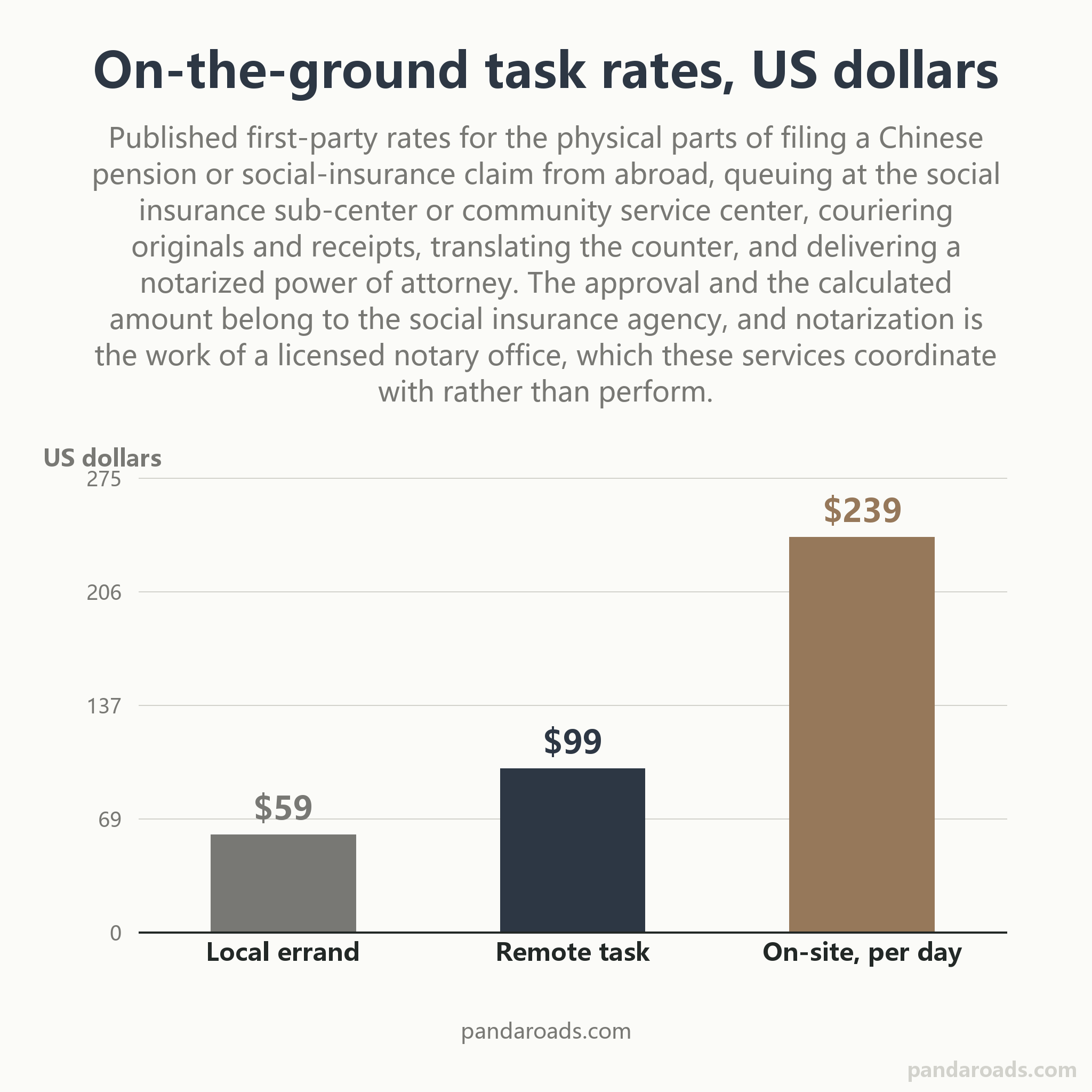
The boundary is the part worth reading twice. PandaRoads is not a licensed intermediary, a law firm or a notary office. It queues, couriers the originals, accompanies, translates the counter conversation and photographs the document chain so nothing goes missing between you, the notary and the bureau. But the decision on whether a claim is approved, and the calculated balance, belong to the social insurance agency, and notarizing a power of attorney is the work of a licensed notary office, which a runner coordinates with and delivers for rather than performs (source: pandaroads.com).
Note: Compare a fixed per-task and per-day fee against the percentage an operator may quote for "handling the whole thing." A flat fee is transparent because you can price the specific physical trips a claim actually needs, and for a pension settlement that number is usually small. What you are buying is presence, so that you never have to fly back just to sign one paper.
Frequently asked questions
Can I withdraw my Chinese social security pension if I have already left China? Sometimes, but not simply because you left. Under MOHRSS Order No. 13 Article 6, someone who settled abroad before pension age usually keeps the personal account and collects later, not a lump sum. A one-time payout opens on a written application to terminate the relationship, mainly for someone who has lost Chinese nationality, a foreigner, or a Hong Kong, Macao or Taiwan resident (source: xiapu.gov.cn).
What happens to my China pension personal account when I settle abroad? It is normally retained, not paid out. The regulation says the employee personal account may not be withdrawn early and, where you settle abroad before meeting the pension conditions, the account is kept and you draw the pension when you later qualify. If you return to work in China, the contribution years keep accumulating toward that pension (source: shanghai.gov.cn).
Do I lose my Chinese pension if I give up Chinese citizenship? Losing nationality changes your route rather than erasing the record. Once you no longer hold Chinese citizenship you may apply in writing to terminate the employee old-age insurance relationship and take the personal-account balance as a one-time lump sum, after the agency warns you in writing of the right to keep the account and the cost of closing it (source: xiapu.gov.cn).
How much of my pension contributions can I actually withdraw? Only your own share. Pension premiums are paid by both sides, but just the employee's eight percent of wages credited to the individual account, plus its interest, is refundable. The employer share that went into the pooled fund is not. The exact figure is calculated by the social insurance agency from your ledger, so treat any estimate as a guide, not a quote (source: china-briefing.com).
What documents does a Chinese social security bureau require to close a pension account? Beijing's guide asks for a foreign passport, proof of when you acquired the foreign nationality with a stamped Chinese translation, or a household-registration cancellation certificate bearing that date, and the liquidation-application notice. The notice must be signed by the applicant in person, and a proxy signature is invalid. Statutory handling is twenty working days, committed ten (source: banshi.beijing.gov.cn).
Can a family member or an agent claim my Chinese pension for me? A representative can file the materials, but not sign as you. Proxy filing runs on a power of attorney notarized within the previous thirty days, with the agent presenting their own passport and residence permit plus copies of yours, while the liquidation notice still carries your own signature. Notarization is the work of a licensed notary office (source: hk.ocmfa.gov.cn).
Do I have to prove I am still alive to keep collecting a Chinese pension abroad? Yes, if you stay in the system and draw monthly. MOHRSS Order No. 16 Article 7 requires a person collecting from outside China to file, at least once a year, a proof-of-life document issued by a Chinese embassy or consulate, or one notarized and authenticated locally and then authenticated by a consulate. A missed filing suspends the payment (source: shanghai.gov.cn).
How long does a lump-sum pension payout take in China? The agency's processing clock is what is published, not the international transfer. Beijing lists a statutory handling time of twenty working days and a committed time of ten working days for a one-time personal-account return, measured from a complete, correctly signed file at the office that holds your record. Getting the money into a foreign account is separate (source: banshi.beijing.gov.cn).
The bottom line
Two facts decide almost all of this. Whether you should cash out, keep the account, or simply prove you are alive turns on citizenship and age, not on the size of the balance: a Chinese national who settled abroad before pension age normally keeps the personal account and collects later, while the one-time lump sum opens on a written application to terminate, mainly for someone who has lost Chinese nationality, a foreigner, a Hong Kong, Macao or Taiwan resident, or anyone who reaches retirement age short of fifteen years. And the only refundable money is your own eight percent personal account plus its interest, never the employer's pooled share, which is why a released lump sum so often looks smaller than you expected.
The sequence, in one breath: work out which rule applies to you, confirm what is actually refundable, choose keep-and-collect or terminate-and-cash, assemble the passport and nationality-proof papers with a stamped translation, sign the liquidation-application notice yourself or entrust a representative on a notarized power of attorney, and file the annual proof of life if you stay in the system. Each step has its own gatekeeper, and the ordering is the information.
If you are abroad and the blocker is physical presence rather than entitlement, the on-the-ground parts can be run for a fixed per-task and per-day fee, and you can send the city, the social insurance office and the specific stuck point to get an itemized quote against the published rates. This is coordination, not legal, notarial or tax advice, and the approval and the final amount belong to the social insurance agency (source: pandaroads.com).
References
- 霞浦县人民政府. (2025, October 24). 出国(境)定居人员可以一次性提取养老保险个人账户吗? [Can a person settling abroad withdraw the employee old-age insurance personal account as a lump sum?]. Xiapu County People's Government. https://www.xiapu.gov.cn/nrrh/202510/t20251024_2406377.htm
- 北京市政务服务. 养老保险个人账户一次性支取(出国定居或丧失中华人民共和国国籍)事项办事指南(海淀区) [Service guide: one-time payout of the employee pension personal account for settling abroad or loss of Chinese nationality, Haidian District]. Beijing Municipal Government Services. https://banshi.beijing.gov.cn/pubtask/task/1/110108000000/2090b7e2-3650-4a08-93b2-0abf6d932d05.html?locationCode=110108000000
- China Briefing. (2024). How foreigners can claim social insurance payments when leaving China. Dezan Shira & Associates. https://www.china-briefing.com/news/how-foreigners-claim-social-insurance-payments-leaving-china/
- 中华人民共和国人力资源和社会保障部. (2011). 在中国境内就业的外国人参加社会保险暂行管理办法(人力资源和社会保障部令第16号)全文(中英对照) [Interim Measures for Social Insurance System Coverage of Foreigners Working within the Territory of China, MOHRSS Decree No. 16, bilingual full text]. Beijing Chaoyang District People's Government. http://www.bjchy.gov.cn/affair/wgrlhgz/8a24fe97665c09e1016661e6c60500bb.html
- Shanghai Municipal People's Government. (2024, June 12). Social insurance for foreign employees in Shanghai [Frequently asked questions, sourced to the Shanghai Municipal Human Resources and Social Security Bureau]. english.shanghai.gov.cn. https://english.shanghai.gov.cn/en-FAQs-Government/20240612/3e9b934bbe5d46619d9da5bcc3aa5dc7.html
- 深圳市人力资源和社会保障局. 出国(境)定居人员养老保险个人账户余额一次性领取 [One-time payout of the pension personal-account balance for persons settling abroad]. Shenzhen Human Resources and Social Security Bureau. https://hrss.sz.gov.cn/szsi/gzfw/ywzsk/ylbs/ylbxdyyw/content/post_12564914.html
- 中华人民共和国外交部驻香港特别行政区特派员公署. (2021, June 8). 办理《在境外居住人员领取养老金资格审核表》须知 [Notice on handling the eligibility-review form for collecting a mainland pension while residing overseas]. Office of the Commissioner of the Ministry of Foreign Affairs in the HKSAR. https://hk.ocmfa.gov.cn/lsxx/yljbg/202106/t20210608_8903365.htm
- PandaRoads. (2026). Errands in China from overseas: how a verified local team works [Service and pricing page]. PandaRoads. https://pandaroads.com/errands-in-china-from-overseas.html
Last reviewed and updated: September 2026. Author: our editorial team. For tailored guidance, contact our team.