Last updated: October 2026 · By the PandaRoads team in China
TL;DR
You get a working China SIM by choosing a data-only travel eSIM (roughly 5-30 USD, no +86 number) or a real +86 SIM, bringing your ORIGINAL passport to a directly-operated carrier business hall (a franchise shop may refuse you), and expecting a live face scan plus a five-test check before leaving. City plans cost about 50-100 CNY and airport bundles 150-300 CNY, but no carrier publishes an English tourist price list, so counter price varies and you must verify on arrival.
Abstract
The 2026 guide treats a China tourist SIM as a legal-identity step plus a connectivity decision: pick a data-only eSIM or a real +86 number, walk into the right kind of store with your original passport, and run five tests before you leave the counter, where city plans cost about 50-100 CNY and airport bundles 150-300 CNY.
Key Takeaways
- Bring your original passport; official counters are reported to refuse photocopies.
- Pick a data-only eSIM or a real +86 number by trip length and apps.
- If a franchise shop refuses you, go to a directly-operated business hall.
- Unicom suits city trips; Mobile or Telecom suit inland, southern and rural routes.
- City plans run about 50-100 CNY, airport bundles 150-300 CNY; verify on arrival.
- A zero-balance prepaid number is reported recycled after roughly 90 days.
Table of Contents
- Abstract
- Key Takeaways
- Step 1: Decide What You Need - Data-Only eSIM or a Real +86 Number
- Why the Counter Asks for Your Passport: Real-Name Registration (MIIT Order No. 25)
- Step 2: Prepare Before You Fly - Unlock, Bands and a Dual-SIM Setup
- Step 3: Choose a Carrier - Unicom vs Mobile vs Telecom (and the Broadnet Note)
- Step 4: Pick Where to Buy - Airport Counter, Business Hall, or Pre-Purchase
- Step 5: At the Store - Your Chinese Phrase Card and the Five Before-You-Leave Tests
- Step 6: Activate and Configure - APN, Restart, and the Firewall Reality
- Which Apps Actually Need a Chinese +86 Number
- Troubleshooting - Refusals, Failed Face Checks, Missing SMS Codes and Suspended Numbers
- Between Trips - Keeping Your Number and Detaching It From Your Apps
- Frequently Asked Questions
- Conclusion
- References
Step 1: Decide What You Need - Data-Only eSIM or a Real +86 Number
Not price. Identity. Maps, translation and messaging need data. Delivery logins and some hotel portals need a mainland +86 number that receives SMS codes, and paid data never buys that.
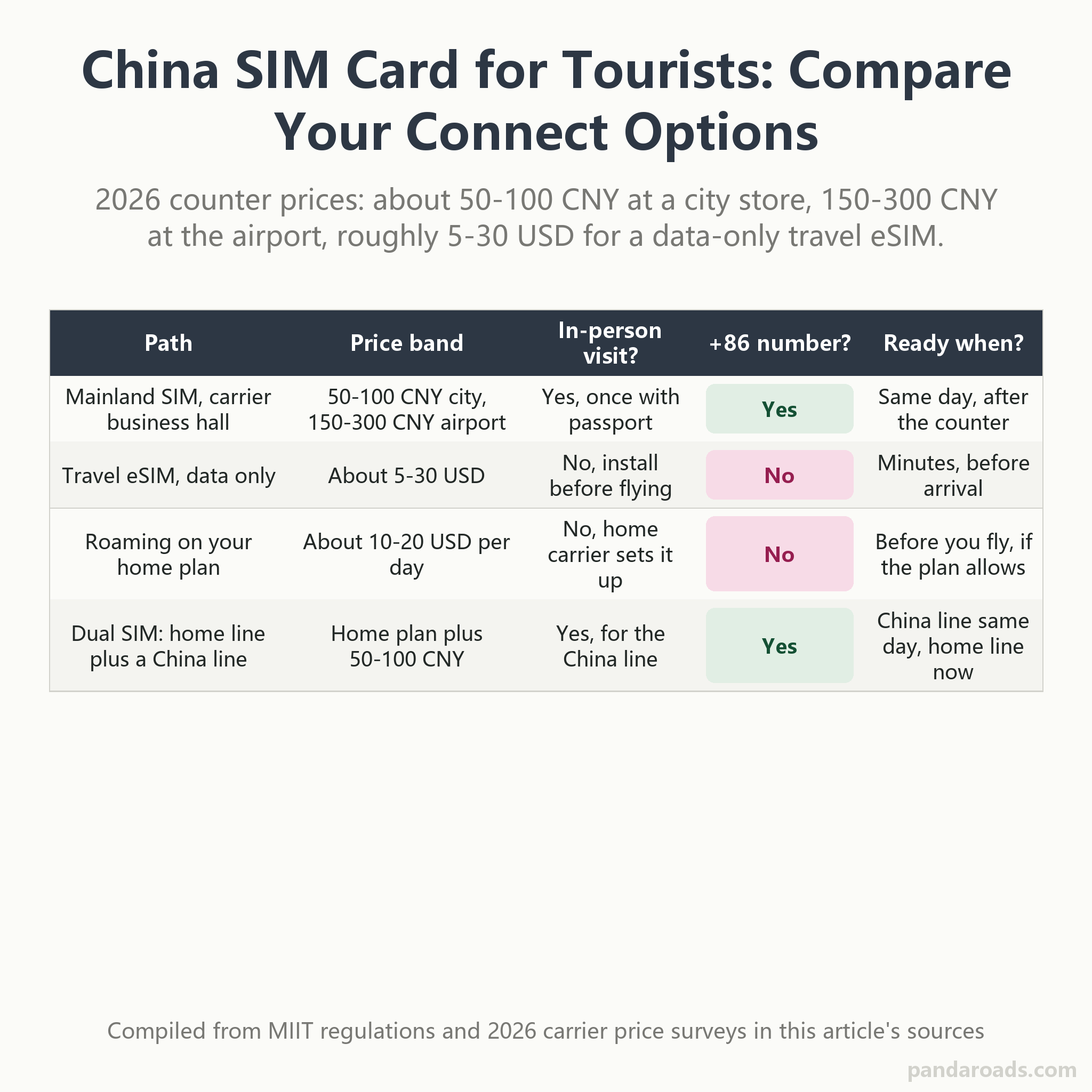
| Decide by | Mainland SIM or mainland eSIM | Data-only travel eSIM | Home SIM on roaming |
|---|---|---|---|
| Real +86 number | Yes | No | No |
| SMS codes | Yes | No | Home number only |
| Google and WhatsApp | Filtered | Reachable, no VPN | Carrier decides |
| Setup | In person, with passport | Install before flying | None |
| Typical 2026 cost | About 50-100 CNY city, 150-300 CNY airport | Roughly 5-30 USD | Daily pass |
| Best fit | Past a week, delivery apps | 1 to 4 weeks | A day or two |
Two questions that settle it: trip length and whether you must create local accounts
Trip length sizes the budget; which accounts you must open picks the product. Alipay, WeChat Pay, DiDi and 12306 are reported by chinaguidelines to accept a foreign number, so a two-week trip often runs on data alone. Meituan, Dianping, Amap and Taobao registration are where travelers report hitting a wall. Both are app behavior that shifts with versions, not rules.
The firewall row is the real split: a mainland SIM sits behind the Great Firewall, while travel eSIM traffic anchored outside the mainland reaches Google and WhatsApp without a VPN (Wang, 2026).
Three checks, in order:
- Does a booking or payment need a code delivered inside China?
- Are you registering new Chinese apps, or using ones that take foreign numbers?
- Can your phone install an eSIM profile before you fly?
Do you need a Chinese phone number as a tourist? Only if an app must verify you by SMS. Payments, ride-hailing and rail booking generally run on a foreign number per chinaguidelines, while food-delivery and local-life apps such as Meituan, Dianping and Amap can stall without a +86 line. A data-only travel eSIM, roughly 5-30 USD, never supplies that number.
The Oct 2025 mainland eSIM launch and why it still rarely helps a tourist
MIIT cleared each of China's three big operators for commercial smartphone eSIM trials on 13 October 2025 (ExpatDen, n.d.), and Xinhua (2025) reported the resulting nationwide eSIM phone service live on 14 October, with activation at physical stores. The Shanghai municipal government's English portal adds the tourist detail: China Unicom (one of China's three major operators) certified 75 models, and for Mobile and Telecom only Apple's iPhone Air was certified at launch. One 2026 eSIM market guide reports providers block new China plan purchases once a device is on the mainland, so the blockers are handset and location, not document type.
Decision rule for a 1-4 week first visit
For a China SIM card for tourists on a 1 to 4 week city itinerary, buy a data-only travel eSIM at roughly 5-30 USD before you fly and keep your home SIM in the second tray. Choose a real +86 line when the trip adds Meituan orders, a Taobao sign-up, or days enough that a mainland plan pays for itself. Both figures are counter prices, so verify on arrival.
Why the Counter Asks for Your Passport: Real-Name Registration (MIIT Order No. 25)
Why do you need your passport to buy a SIM card in China? Because China requires real-name registration for every mobile line under MIIT Order No. 25, the Regulations on the Registration of Authentic Identity Information of Telephone Subscribers. In force since 1 September 2013 and detailed on cac.gov.cn, it accepts a passport as a foreign visitor's identity document.
The legal instrument no top-5 competitor names
The 2016 MIIT notice implementing the Counter-Terrorism Law, republished on cac.gov.cn, is what names MIIT Order No. 25, the rule top-5 guides never cite. It cites the 2014 phone "black card" action plan and the 2015 cleanup campaign, and it sets the road to full enforcement.
What the law actually requires: original ID, reader, network cross-check
The rule dictates method, not paperwork. The 2016 notice makes ID-reading equipment plus a network cross-check mandatory and bans manual keyboard entry of resident ID-card data, and that reader mandate is written for China's resident identity card. For a passport holder the regulation requires staff to examine the document and register what it says, which the guides describe as scanning the photo page. The MOFCOM and NIA expatriate guide (2024 edition, on gat.fj.gov.cn) names a passport or a Foreign Permanent Resident ID Card as accepted at the business halls of China Telecom, China Mobile, China Unicom and China Broadnet, and MIIT Order No. 25 itself lists a foreign citizen passport among the documents an individual may present. Bring the original; official counters are reported to reject photocopies. Expect a face scan, which guides describe but no gov.cn text states as law.
The five-cards-per-ID escalation rule and why a shop turns you away
Here is why a small shop waves you off. The cac.gov.cn notice says that once one ID already sits behind five or more cards at a carrier, a new card must open at the carrier's own directly-operated hall after a hardened review. Franchise and reseller outlets cannot run that review, so that is why we treat a refusal as a routing problem, not a ban on foreigners. Walk to a flagship, operator-owned hall.
By the Numbers
- 1 Sep 2013 real-name rule took effect under MIIT Order No. 25
- 30 Jun 2017 deadline for full nationwide enforcement
- 5 or more cards already on one ID push the next card to a carrier's own hall
- 4 operators accept a passport or permanent-resident card
- 20-60% reported airport premium per gigabyte over downtown desks (2026)
Glossary
- MIIT Order No. 25: the 2013 rule registering every phone line to one verified identity.
- Directly-operated business hall: an operator-owned store, not a franchise, where the next card on an ID that already sits behind five must be opened.
- Network cross-check: the online check of an ID against state and carrier records.
- +86 number: mainland China's country-code line that receives SMS; a real SIM or a mainland-activated eSIM supplies one, a data-only travel eSIM never does.
Step 2: Prepare Before You Fly - Unlock, Bands and a Dual-SIM Setup
Three device checks belong at home.
Confirm your phone is carrier-unlocked
The English FAQ on Shanghai's education portal states it plainly: the phone must be unlocked and compatible with Chinese 3G/4G networks (That's Mandarin, 2024). A handset under an installment plan or a carrier lock will not take a Chinese SIM, and no counter in China can fix that.
Match LTE/5G bands before you leave
Bands pick the carrier. Unicom and Telecom run FDD-LTE, which most foreign handsets include; China Mobile leans on TD-LTE b39, b40 and b41, and one 2026 network guide notes that older or foreign handsets trip on those bands while calling modern phones fine. eSIM belongs in that check. MIIT approved commercial eSIM trials on 13 October 2025 (ExpatDen, n.d.), and Xinhua reported all three operators live with nationwide eSIM phone service on 14 October, with in-store activation (Xinhua, 2025). Unicom listed 75 compatible models at launch and Mobile plus Telecom certified only the iPhone Air, a launch-day snapshot, so re-check the current carrier list (Shanghai Observer, 2025).
Plan to run your home SIM and the China line together
You rarely have to choose.
- Home line stays on for bank and app verification texts, roaming off or capped.
- China line carries the data, a second physical SIM or a mainland eSIM activated in store.
- CDMA legacy is a weak spot. Verizon, Sprint and US Cellular customers report crawling data on Chinese networks; forum signal, not tested fact.
Prepare the handset before you buy a China SIM: it must be carrier-unlocked, it must support Chinese LTE bands, and a mainland eSIM only installs on a model the operator certifies. In October 2025 China Unicom certified 75 devices while China Mobile and China Telecom listed only the iPhone Air (Shanghai Observer, 2025).
Step 3: Choose a Carrier - Unicom vs Mobile vs Telecom (and the Broadnet Note)
For most first-time visitors the English FAQ on Shanghai's education portal calls China Unicom probably the most suitable carrier for foreign tourists, and its FDD-LTE network suits the widest range of foreign phones (That's Mandarin, 2024). A city-store Unicom China SIM card for tourists runs about 69 CNY for 10GB, 500 minutes and 30 days (Hidden China Travel, 2026), though each figure is a counter range you confirm on arrival.
One caution before the numbers. No operator publishes an English tourist price list, so every figure below is a 2026 third-party observation, not a tariff. A simple city prepaid runs about 50 to 100 CNY and an airport bundle 150 to 300 CNY, and a Guangzhou counter rarely matches a Chengdu one, so confirm the price at the desk before you pay (Hidden China Travel, 2026; Wang, 2026).
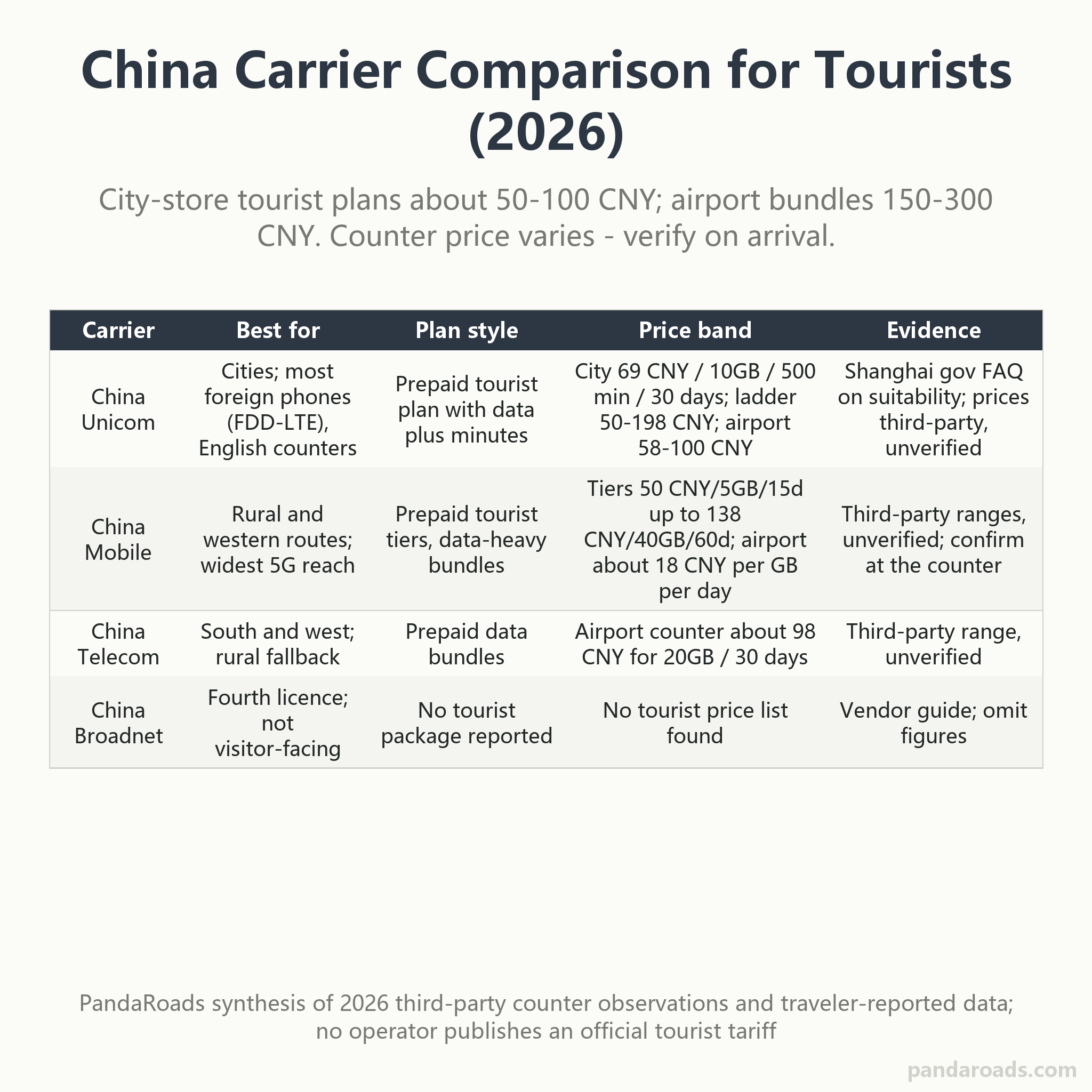
| Carrier | Best for | Plan style | Price band (CNY) |
|---|---|---|---|
| China Unicom | Cities; foreign-phone fit (FDD-LTE), English counters | Prepaid data + calls | 69/10GB/500min/30d (Hidden China Travel, 2026); ladder 50-198 (China Neighbor, n.d.); airport 58-100 (Wang, 2026) |
| China Mobile | Rural and western routes; widest 5G reach | Data-heavy tiers | 50/5GB/15d to 138/40GB/60d; airport ~18/GB/day (China Neighbor, n.d.; Wang, 2026) |
| China Telecom | South and west; rural fallback | Prepaid data | Airport ~98 for 20GB/30d (Wang, 2026) |
| China Broadnet | Fourth license; not visitor-facing | No tourist package documented | No tourist price list found (Ministry of Commerce & National Immigration Administration, 2024) |
City itinerary: Unicom
If your trip stays inside one city, Unicom is the low-friction way to get a China SIM card for tourists, mainly because its FDD-LTE bands match the handsets people fly in with, so you fight compatibility less than on TD-LTE China Mobile devices (That's Mandarin, 2024). Flagship halls staff English counters more often, and a directly-operated branch is likelier to register a foreign passport in one visit (That's Mandarin, 2024). The 69 CNY, 10GB reference plan is the usual downtown shape; the ladder stretches to about 198 CNY when you burn data (China Neighbor, n.d.).
Western and rural itinerary: Mobile or Telecom
Head inland and the ranking flips. China Mobile carries the widest rural and 5G footprint, so travelers bound for Tibet, Xinjiang or western Sichuan often get steadier signal on Mobile or Telecom than on Unicom, a call we make from Chengdu (ExpatDen, n.d.; Shi, 2026). Mobile tourist tiers climb from 50 CNY for 5GB over 15 days to 138 CNY for 40GB, and airport desks have quoted roughly 18 CNY per GB per day (China Neighbor, n.d.; Wang, 2026). China Telecom is reported strongest in the south and west on a CDMA-legacy network, with an airport counter quoted near 98 CNY for 20GB over 30 days (Wang, 2026).
Why China Broadnet is irrelevant to a visitor
China Broadnet holds a fourth mobile license and appears in the MOFCOM and NIA guide as one of the four operators that accept a passport, but it is a small 5G-focused entrant and no tourist SIM or visitor price list is documented, so you won't buy one on this trip (Ministry of Commerce & National Immigration Administration, 2024). One prefix note while on carriers: numbers starting 170 or 171 come from virtual operators, and travelers report that some apps reject them for SMS codes, though that is folklore, not a rule (Hidden China Travel, 2026).
Step 4: Pick Where to Buy - Airport Counter, Business Hall, or Pre-Purchase
Airport counters trade price for hours. A China SIM card for tourists quoted at about 50-100 CNY in a city store is reported at 150-300 CNY on an arrivals deck, and guides put the gap at 20-60% (2026) per gigabyte (ExpatDen, n.d.; Hidden China Travel, 2026; Wang, 2026). Guangzhou Baiyun runs 24-hour Foreigner Service Centers in Terminal 2 and Terminal 3 (Wang, 2026).
| Airport | Desk reported for a foreign passport | Hours signal |
|---|---|---|
| Guangzhou Baiyun (CAN), T2 and T3 | 24h Foreigner Service Center, SIM plus payments setup (Wang, 2026) | Reported 24h; T1 stopped operating in May 2026 (Wang, 2026) |
| Shanghai Pudong (PVG) | One-stop foreigner service center (China Neighbor, n.d.; ExpatDen, n.d.; Wang, 2026) | Reported 24h, verify |
| Beijing Capital (PEK), T3 | Unicom and Mobile counters near baggage claim (China Neighbor, n.d.; ExpatDen, n.d.; Wang, 2026) | Reported business-hours, verify |
| Beijing Daxing, Shenzhen (SZX) T3 | Arrival desks, Shenzhen evenings limited (China Neighbor, n.d.; ExpatDen, n.d.; Wang, 2026) | No 24h evidence |
| Other airports | No foreigner desk documented | Buy downtown next day |
Only the Guangzhou row is documented counter by counter; the Pudong, Beijing and Shenzhen cells are single-source leads, so we treat them as things to confirm.
Airport: convenience at a 20-60% premium
Guangzhou shows the markup on a China SIM card for tourists: Unicom short plans 58-100 CNY, monthly Unicom 200-268 CNY, Mobile near 18 CNY per GB per day, Telecom near 98 CNY for 20GB/30 days (Wang, 2026). expatden puts airport pricing 30-60% (2026) above downtown per gigabyte and hiddenchinatravel 20-30% (2026) overall, observation rather than tariff (ExpatDen, n.d.; Hidden China Travel, 2026; Wang, 2026). Unicom's CUBe Card (early 2025) bundles transit and digital-yuan payment in a 10-day tier for the 240-hour transit window (Wang, 2026). Desks prefer RMB cash, reported hours rotate, and a 2 a.m. landing can find a shuttered counter (Wang, 2026). Counters are reported to cap one passport at about three SIMs, a shop practice with no published tariff behind it (Wang, 2026; China Neighbor, n.d.).
Downtown business hall: cheaper and more passport-experienced
The English FAQ on Shanghai's education portal says it is better to choose a downtown store because those are most likely to support registration with foreign passports (That's Mandarin, 2024), and the Step 3 band of about 50 to 100 CNY applies (ExpatDen, n.d.; Hidden China Travel, 2026; Wang, 2026). You pay it in daylight and a metro ride, and that hall is also the fix when a franchise turns you away.
Pre-purchase online with airport pickup
The documented shape is reserve online, collect at the arrivals desk (Shi, 2026), or a carrier's own overseas storefront, Unicom's international traveler tiers and China Telecom's CTExcel among them (ExpatDen, n.d.). Contrary to how the convenience framing sounds, no source here shows a mainland operator mailing a physical SIM abroad, and pre-purchase never skips the real-name step at a counter with your original passport.
Step 5: At the Store - Your Chinese Phrase Card and the Five Before-You-Leave Tests
Before you walk out of a China SIM counter in 2026, run five checks: the line shows signal, a domestic map app loads on mobile data, one text both sends and receives, staff show a working top-up path, and they state the expiry and keep rule out loud. This five-test protocol is ours: we built it by comparing the walk-out checklists the guides publish, and hiddenchinatravel's list covers four of the five while the expiry question is our addition.
Six phrases that get you to the right counter
First pick the right door. A franchise or reseller shop can turn a passport holder away; a directly-operated business hall is where that registration is reported to work, and Step 1 covers the rule behind that split. The English FAQ on edu.sh.gov.cn adds that a downtown store is the better bet, since those are most likely to support registration with foreign passports. We wrote these six Simplified Chinese lines so you can say them out loud or hand the card over at the counter.
- 我要办旅游手机卡 (wǒ yào bàn lǚyóu shǒujīkǎ) - I would like a tourist SIM card.
- 护照实名登记 (hùzhào shímíng dēngjì) - Register me real-name, with my passport.
- 可以开热点吗 (kěyǐ kāi rèdiǎn ma) - Does it include hotspot or tethering?
Those three settle the sale. The next three are for after the card is in your hand, when something has gone quiet:
- 开国际漫游短信可以吗 (kāi guójì mànàyóu duǎnxìn kě yǐ ma) - Can I enable roaming to receive text codes?
- 怎么查余量 (zěnme chá yúliàng) - How do I check my remaining balance?
- 我收不到短信验证码 (wǒ shōu bú dào duǎnxìn yànzhèngmǎ) - I am not receiving the SMS code.
The registration workflow: queue, plan, activate
Per edu.sh.gov.cn the visit runs in four moves: find a business hall, take a queue number, choose a plan, and let staff activate the line. Hand over the original passport, not a photo. The expat form reported by expatden asks your passport number, visa type and a local address, so keep your hotel name ready. Passport holders are widely reported to face a live face scan; treat it as normal and say the last phrase above if it fails.
The five tests before you walk away
Run these before you leave, so a fault stays a clerk problem, not a stranded-traveler one.
- Activation confirmed. The clerk says the line is live and you see signal, not "no service".
- Data works. Turn off Wi-Fi and open a domestic map app like Amap on mobile data.
- SMS test. Have WeChat or DiDi send a code and confirm it arrives and you can reply.
- Top-up path works. Ask staff to show the recharge route in the carrier app or a WeChat mini-program.
- Expiry rule stated. Ask how long the number stays valid and what happens at zero balance; the Between Trips section covers keeping it.
Photograph the SIM number and the receipt, so support can find your account later.
Step 6: Activate and Configure - APN, Restart, and the Firewall Reality
Getting online is a short sequence, and the honest trade-off is naming what still will not load. Work the steps in order before you blame the SIM.
Swap, restart, then set the APN
Insert the physical SIM or install the eSIM profile you arranged, then finish the identity step at the counter. That step means handing over your original passport for the staff to examine and register, and you should expect a live face capture matched to the passport photo; guides report it, so treat it as the normal workflow rather than a rule the legal text spells out (Hidden China Travel, 2026; Ministry of Industry and Information Technology, 2016). If signal bars show but mobile data stays dead, set the Access Point Name by hand (on an iPhone under Settings, then Mobile Network; on Android in the SIM or Mobile Networks menu). Restart the phone once before deeper troubleshooting (Hidden China Travel, 2026).
A mainland China SIM card for tourists with signal but no data usually needs a manual Access Point Name: 3gnet on China Unicom, cmnet on China Mobile, ctnet on China Telecom, each confirmed by at least two of the guides above (Hidden China Travel, 2026). Set the matching string, then retest a domestic site before you assume the line failed.
What a mainland SIM can and cannot reach
The firewall reality is the biggest source of post-activation regret, and it is network policy, not a defect in your card. A mainland line routes through Chinese carriers, so Google, WhatsApp and Instagram won't load on its mobile data, and the same filtering applies to any Wi-Fi inside the mainland (Shi, 2026; Wang, 2026). A separate VPN is normally what restores them on a mainland SIM.
One narrow caveat, stated the way the sources state it: some hotel portal pages offer SMS login only to Chinese numbers, and that framing comes from guides rather than any carrier or regulator policy. The wider claim that almost every hotel or cafe network needs a +86 code is contradicted by evidence such as Shanghai Pudong's free airport Wi-Fi, reported to take a passport login instead (China Neighbor, n.d.; Shi, 2026).
Which Apps Actually Need a Chinese +86 Number
Few apps need a mainland number to sign up. The China Guidelines 2026 app table marks Alipay, WeChat Pay, DiDi, 12306 and Trip.com as workable on a foreign number, while Meituan, Dianping, Amap and Taobao registration are the rows where travelers report stalling without a +86 line that receives SMS. Read the second group as the source's own "maybe" bucket, not a blocked column.
Work on a foreign number: Alipay, WeChat Pay, DiDi, 12306, Trip.com
- Alipay and WeChat Pay. Foreign number usually OK, traveler-reported for each.
- DiDi. Foreign number usually OK, traveler-reported.
- 12306 rail. Foreign number usually OK, traveler-reported.
- Trip.com. Foreign number usually OK for the app itself.
Can fail without +86: Meituan, Dianping, Amap, Taobao registration
- Meituan and Dianping. A Chinese number can be required at sign-up, traveler-reported for each.
- Amap. A Chinese number can be required at sign-up, traveler-reported.
- Taobao. A Chinese number can be required for new sign-ups and flash sales, traveler-reported.
- Hotel Wi-Fi portals. A few offer SMS login only to Chinese numbers. The "almost universal" claim that circulates is a common misconception and is not supported; Pudong airport's free Wi-Fi is reported to accept a passport login instead, so don't count on either extreme.
The new-WeChat friend-verification obstacle
Signing up for WeChat is a different gate from the phone number itself. Travelers report that a brand-new account sometimes needs confirmation from an existing user before it works normally, which is awkward on day one with no local contacts. Treat it as reported app behavior, not policy, and set up WeChat before arrival if you can.
Version by version, these buckets move. The one fixed rule is arithmetic: a data-only travel eSIM has no +86 number, so it receives no SMS code anywhere in the mainland, no matter which app asks. Keep the app list as a planning shortcut, and let Step 1's decision, data or real line, follow how many of the rows here you actually need.
Troubleshooting - Refusals, Failed Face Checks, Missing SMS Codes and Suspended Numbers
A China SIM card for tourists that fails at registration usually needs a different counter, not a different document. The 2016 MIIT notice on cac.gov.cn sends any new card requested on an ID that already sits behind five or more cards at one carrier to that carrier's own directly-operated business hall, the same answer when a franchise refuses you.
A shop says it cannot process a foreign passport
A clerk says the shop can't handle foreigners. Reseller and franchise counters usually lack the ID reader a passport needs. The fix is a better door: walk into a carrier-owned business hall; the MOFCOM and NIA guide lists a passport as accepted at all four operators.
The face verification will not pass
The capture screen rejects you again. Guides report a live face check against the passport photo page, and glare, headwear or thick frames break it; no fetched official text mandates the scan, so treat it as workflow, not law. Bare the photo page under room light instead, drop hat and glasses, and have staff re-run the capture.
SMS code never arrives (170/171 prefixes)
Data loads, yet a code from WeChat or Meituan never arrives. A data-only eSIM has no +86 line, and an unfinished registration blocks codes too. Then the prefix: travelers report numbers beginning 170 or 171, resold by virtual operators, failing some app gateways, which no carrier confirms. Ask which prefix you are getting, and test two-way SMS before you pay.
Number suspended mid-trip
Bars show, then codes, calls and data stop. expatden reports unregistered cards suspended without notice and zero-balance lines recycled after roughly three months, near 90 days per chinaneighbor, neither one published policy. Work these in order:
- Keep a small balance, recharged in the carrier app or a WeChat mini-program.
- Skip a circular recharge. If the recharge wants a code on the dead line, a loop no carrier documents, top up at a store counter.
- Re-activate in person. A suspended line reportedly needs a passport scan at a directly-operated hall, impossible once you are home.
No signal after activation
Restart once, then work Step 6's APN values. If your China SIM card for tourists still shows no bars, test the card in another handset, the usual suspect being a Step 2 band mismatch.
Between Trips - Keeping Your Number and Detaching It From Your Apps
A China prepaid line left at zero balance is reported recycled after about three months (ExpatDen), and an expired plan is reported to get roughly 90 days of grace before cancellation (China Neighbor); neither window is published policy, and the two sources describe different triggers. Either keep it alive with a top-up while you can still receive SMS codes, or detach the +86 from WeChat and Alipay before it dies.
What happens at zero balance
Guides describe a dormancy ladder: a prepaid number that sits unused and unpaid is suspended, then the number is reassigned. Expatden reports recycling after about three months at zero balance, and chinaneighbor describes a roughly 90-day grace before cancellation. Neither window is a published rule, so treat both as commonly reported, not guaranteed. If you want the line alive for a return trip, the reported top-up paths are the carrier app or its WeChat and Alipay mini-programs, done while you can still receive an SMS code.
Detach your +86 from WeChat and Alipay before you leave
Run the sequence below before departure, not after the number dies (Hidden China Travel, 2026):
- Add a backup email to each account's security settings.
- Change the bound phone to your home number while the +86 still receives codes.
- Confirm both logins work without an SMS to the China line.
Wait until the number lapses and you can be locked out: re-activating a suspended mainland line reportedly needs an in-person passport scan at a directly-operated hall, which you can't do from home.
Prepaid needs no formal cancellation
If you aren't keeping the line, no cancellation step is reported; the balance runs down and the number recycles on its own. Data-only eSIM travelers skip the whole section, since a travel eSIM never bound a mainland number to their accounts.
Frequently Asked Questions
Can foreigners buy a SIM card in China with a passport?
Yes. The MOFCOM and NIA 2024 expatriate guide names a passport accepted at the business halls of all four licensed operators, and MIIT Order No. 25 lists a foreign citizen passport among acceptable documents. The English FAQ on Shanghai's education portal tells visitors to bring the passport, and guides say official counters want the physical document, not a copy.
I am confused, do I need a Chinese number or not?
Only if an app must deliver you an SMS code. Alipay, DiDi and 12306 reportedly accept a foreign number, while Meituan, Dianping and Amap new-account sign-ups can stall without a +86 line. A data-only travel eSIM supplies no number.
For a China trip, should I use a local SIM, an eSIM, or both?
For a 1 to 4 week city trip, a data-only travel eSIM (roughly 5-30 USD) covers maps and messaging. Need a +86 for delivery apps? Add a China SIM card for tourists, about 50-100 CNY at a city store; counter prices vary, verify on arrival.
Which carrier is best for foreigners?
China Unicom is probably the most suitable carrier for foreign tourists per the English FAQ on Shanghai's education portal, and its FDD-LTE bands match more foreign handsets. Inland, southern, western and rural itineraries favor China Mobile or Telecom. Verify any counter price on arrival.
What if face verification fails at the store?
Retry under room light without hat or glasses and ask staff to re-run the capture. If the shop still refuses your passport, go to a directly-operated business hall, the escalation path the 2016 MIIT notice describes for identity review.
Is the counter open late at night?
Guangzhou Baiyun T2 and T3 report 24-hour Foreigner Service Centers; Shanghai Pudong claims a similar desk. Hours rotate, though, and a late-night landing may meet a closed counter. Confirm the specific desk hours before you fly.
Will a Chinese SIM let me use Google and WhatsApp?
No. A mainland SIM routes through Chinese carriers, so Google, WhatsApp and Instagram remain filtered behind the Great Firewall on both mobile data and any Wi-Fi inside the mainland. A data-only travel eSIM anchored outside reaches those apps without a separate VPN.
How many GB of data do I need for 10 days in China?
Reported daily use runs 0.5 to 3 GB, so 10 days lands between roughly 5 and 30 GB, and the same guide's lighter-usage answer for ten days is 5 to 10 GB. Unicom's cited 69 CNY for 10 GB reference fits that lower band. No English tourist price list is published, so verify at the counter.
Can I use my home-country SIM card in China?
Yes, through international roaming at a reported 10-20 USD per day. A cheaper pattern is dual SIM: keep your home line in slot 1 and place a China SIM card for tourists or a data-only travel eSIM in slot 2.
What happens to my SIM when I leave China?
Prepaid needs no formal cancellation. A zero-balance line is reported recycled after roughly 90 days, not published policy. Before departure, detach your +86 from WeChat and Alipay and add a backup email to avoid lockout.
Does eSIM work in China?
MIIT approved the mainland eSIM trials on 13 October 2025 and Xinhua reported the service live nationwide on 14 October, but activation needs a store visit and certified device support was narrow at launch (iPhone Air was the only Mobile and Telecom model, per Shanghai's English government portal). Most visitors find a pre-installed data-only travel eSIM, roughly 5-30 USD, simpler.
Conclusion
Two decisions carry the trip: whether an app really needs a code delivered to a mainland number, and whether you walk into a directly-operated hall with the original passport in hand. Everything else, the APN string, the top-up route, the expiry question, is a counter conversation you can finish in one visit. Run the five tests we built before you leave, and confirm the price at the desk rather than trusting a price quoted online.
References
- Ministry of Industry and Information Technology. (2016, May 25). Notice on implementing the Counter-Terrorism Law and other legal provisions and further improving the registration of telephone users' authentic identity information [工业和信息化部关于贯彻落实《反恐怖主义法》等法律规定进一步做好电话用户真实身份信息登记工作的通知]. Central Cybersecurity Administration Office. https://www.cac.gov.cn/2016-05/25/c_1118926297.htm
- Ministry of Commerce, & National Immigration Administration. (2024, April 1). Guide to working and living in China as a business expatriate (2024 edition) [外国商务人士在华工作生活指引(2024年版)]. Fujian Provincial Public Security Department. http://gat.fj.gov.cn/ztzl/cryjfwwj/crjyw_28279/202404/t20240401_6422459.htm
- That's Mandarin. (2024, March 7). How to get a SIM card in China. Shanghai Municipal Education Commission English FAQs. https://edu.sh.gov.cn/study_en_faqs/20240307/5b66c31c07124ccaa3f50e9746d28c7e.html
- Xinhua. (2025, October 14). China rolls out eSIM phone services nationwide. Xinhuanet. https://english.news.cn/20251015/88a32cb3a13f4a54ab3b627a81ab7af3/c.html
- Shanghai Observer. (2025, October 15). eSIM phone services available in Shanghai. Shanghai Municipal Government English Portal. https://english.shanghai.gov.cn/en-Latest-WhatsNew/20251015/1e9072e1e88742d580d7b6d54d329ee9.html
- Wang, J. (2026, January 14). Buying a SIM card at Guangzhou Baiyun airport: Foreigner guide [last updated September 27, 2026]. MyChinaGuide. https://mychina.guide/blog/buying-sim-card-guangzhou-airport-step-by-step
- China Neighbor. (n.d.). How to get a SIM card in China as a foreigner (2026 guide). Retrieved October 9, 2026, from https://chinaneighbor.com/guide/essentials/sim-card-for-foreigners-in-china/
- Hidden China Travel. (2026). China SIM for foreigners 2026: Buy, setup, mistakes [last updated August 2026]. https://hiddenchinatravel.com/china-sim-card-for-foreigners
- ExpatDen. (n.d.). China SIM card & eSIM guide 2026: Prices and registration (prices verified October 2026). Retrieved October 9, 2026, from https://www.expatden.com/china/sim-card-china/
- Shi, R. (2026, June 14). China SIM card, eSIM or roaming? 2026 guide for foreigners. China Guidelines. https://chinaguidelines.com/en/posts/sim
Last reviewed and updated: October 2026. Author: our editorial team. For tailored guidance, contact our team.